


For many travelers moving around Asia and beyond, 12Go has become a familiar name on the payment screen just before a long overnight bus or a dawn ferry. The platform pulls together buses, trains, ferries, transfers and some flights into a single booking interface, promising to simplify complex overland journeys. But 12Go is not equally useful for everyone. Depending on who you are, how you travel and what your priorities are, it can either be an invaluable planning tool or an unnecessary extra fee layered on top of local prices. This guide looks at who gets the most value from using 12Go, with concrete examples from real routes and situations.
Get the latest updates straight to your inbox!
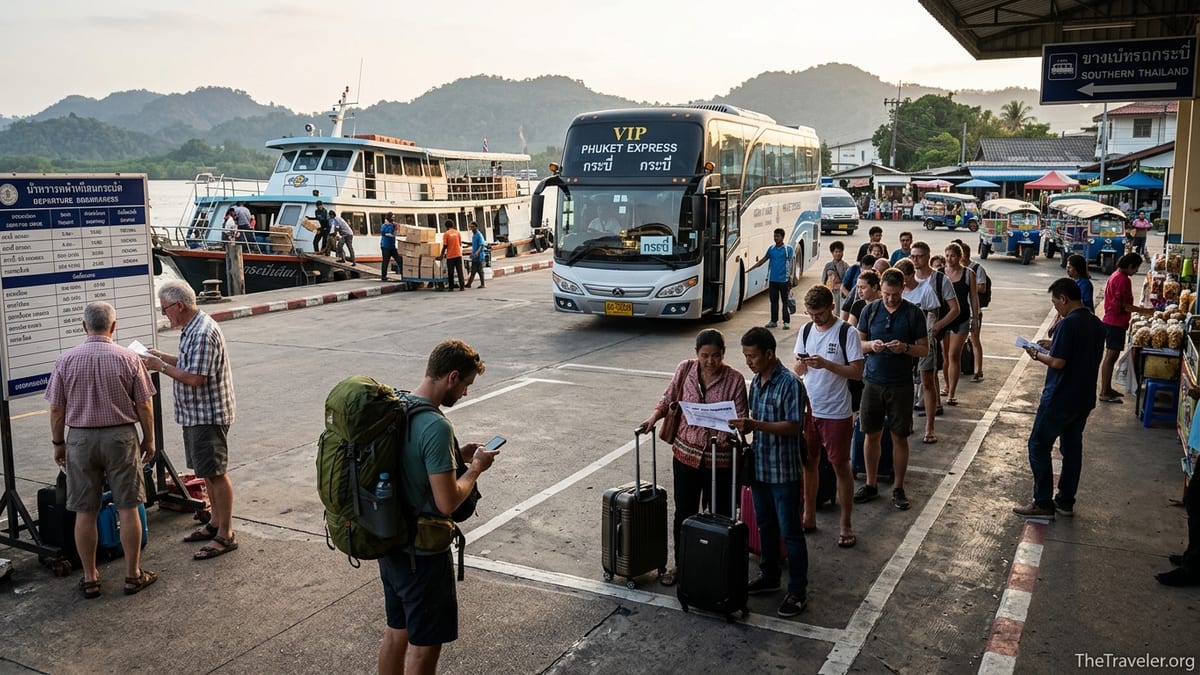
What 12Go Actually Does Well
12Go is a Singapore-registered travel technology company that aggregates transport options from thousands of bus companies, rail operators, ferry lines, minivan operators and some airlines into one searchable platform across Asia and selected other regions. In practical terms, that means you can sit in your apartment in New York or Berlin and book an overnight VIP bus from Bangkok to Chiang Mai, a combined bus and ferry ticket from Kuala Lumpur to the Perhentian Islands, or a minivan from Chiang Mai to Pai using the same interface and payment method. The site shows departure times, approximate durations, vehicle type and user reviews for many operators, which can be difficult to find in English on local company websites.
On a typical Thailand search, common routes such as Bangkok to Chiang Mai or Bangkok to Phuket will show multiple options side by side: government trains, private VIP buses, budget buses, flights, and sometimes combined bus plus ferry packages to islands. For Bangkok to Chiang Mai, for instance, you might see VIP buses starting from roughly 700 to 900 baht and overnight trains from around 800 to 1,000 baht in second-class sleepers, with various departure times spread through the afternoon and evening. The value here is not that 12Go is the cheapest way to make the trip; it is that you can instantly compare modes, times and companies without speaking Thai or hunting down multiple local booking offices.
12Go also shines on multi-leg overland journeys where timings matter. Routes such as Bangkok to Koh Tao or Penang to Langkawi are offered as through-tickets that bundle a bus or train with the ferry plus the transfer between station and pier. While you could buy each leg separately on the ground for less, 12Go’s combined tickets remove some of the guesswork around early-morning transfers or tight connections, particularly for travelers nervous about arriving in a new country and immediately having to negotiate with taxi drivers and ticket booths.
None of this is free. Independent comparisons in Thailand have found typical mark-ups in the range of roughly 10 to 25 percent compared with buying directly at stations or company offices, especially on popular routes like Bangkok to Chiang Mai or bus and ferry packages to the Gulf islands. In exchange for that premium, 12Go provides: an English interface, international card payments, digital vouchers, and a central point of contact if something goes wrong. Whether that is worthwhile depends heavily on your travel style.
First-Time Visitors to Asia and Nervous Planners
The group that often gets the clearest value from 12Go is first-time visitors to Asia who feel anxious about figuring out transport on the ground. Picture a couple flying into Bangkok for a two-week holiday. They want to spend a few days in the capital, then take the overnight train to Chiang Mai, and later connect to an island like Koh Samui before flying home. They are used to booking everything in advance and do not want to gamble on finding tickets at the station after arrival.
In this situation, 12Go allows them to pre-book key segments from home. They might reserve a second-class air-conditioned sleeper from Bangkok to Chiang Mai for around 900 to 1,000 baht per person, securing adjacent berths on their chosen date in peak season. For the next leg, they could choose a combined bus plus ferry ticket from Bangkok to Koh Samui for roughly 1,100 to 1,300 baht, which covers an overnight bus south, the morning ferry, and the transfer between bus terminal and pier. The total cost is higher than piecing it together at South Bus Terminal and a local ferry office, but for new visitors the confidence of having confirmed e-tickets and clear instructions is often worth the extra money.
Consider a solo traveler arriving late at night in Ho Chi Minh City who needs to head to Phnom Penh the next day. Without local knowledge, they might not know which bus companies run the route or where their depots are located. Booking in advance via 12Go means they can choose a reputable operator, know the departure time and station, and arrive with a pre-paid ticket rather than having to negotiate with touts around Pham Ngu Lao at dawn. If they are only in the region for a short time, the mark-up becomes a trade-off for a smoother start to the trip.
First-timers also benefit from the clear presentation of classes and amenities. On Thai trains, for example, 12Go distinguishes between second-class fan sleepers, second-class air-conditioned sleepers and first-class private cabins. Someone unfamiliar with Thai Railways could easily end up with a hard seat on an overnight journey if booking in person without guidance. On 12Go, photos, descriptions and reviews make it much easier to choose a level of comfort that matches expectations, especially for those who might be jet-lagged or traveling with older family members.
Backpackers and Budget Travelers: When the Fee Is Worth It
Backpackers and long-term budget travelers tend to be the most price-sensitive users of 12Go, and opinions in this group are mixed. Many Southeast Asia veterans will tell you they never book through 12Go, preferring to buy tickets at stations or via local agents to avoid the mark-up. At the same time, a significant number of backpackers still use the platform strategically on specific routes where the benefits clearly outweigh the extra cost.
One classic example is the overnight Bangkok to Koh Tao route that combines a bus or train with a dawn ferry from Chumphon. Booking this directly can involve navigating two or three different ticket counters, working around language barriers and making sure you do not miss the early ferry transfer. Through 12Go, a backpacker can reserve the entire journey as a single product, often for around 1,200 to 1,400 baht. That might be 200 baht more than stitching it together independently, but it guarantees the connection and includes instructions in English about where to change vehicles and how long the layover will be.
Another scenario is around major holidays and peak seasons. During Christmas and New Year or local holidays like Songkran in Thailand and Tet in Vietnam, buses and trains on popular routes can sell out days in advance. A backpacker on a tight timeline who needs to be in Chiang Mai for a specific date might reasonably decide to pay a 10 to 20 percent premium through 12Go for the certainty of having a reserved seat. In practice, that could mean paying the equivalent of 800 baht for a bus that might cost around 700 baht at the station, but avoiding the nightmare of turning up at the terminal only to find the next three departures fully booked.
Backpackers also gain value when 12Go helps them avoid tourist traps or inflated commissions. In some hubs, guesthouses and local agencies sell the same bus tickets with heavy mark-ups, sometimes charging close to double the walk-up price. While 12Go is not necessarily cheaper than the official station, it is often more transparent than a random hostel desk. A traveler comparing options might find a minivan from Chiang Mai to Pai listed on 12Go for around 200 baht including pickup, then decide to use that as a reference when bargaining with local vendors. Even if they ultimately buy elsewhere, 12Go’s price transparency becomes a useful benchmark.
Digital Nomads and Remote Workers on Tight Schedules
Digital nomads and remote workers usually have two priorities that shape their transport choices: reliable timing and a comfortable environment to work or recover once they arrive. For this group, 12Go is most valuable when it reduces uncertainty and aligns travel with work commitments, especially on popular routes where services run frequently but vary widely in quality.
Imagine a remote worker based in Chiang Mai who needs to spend a week in Bangkok for meetings. They might have flexibility to travel overnight or during the day, but they still want to arrive rested enough to work. On 12Go they can scan options such as a VIP 24-seat overnight bus with extra legroom, a second-class sleeper train with air conditioning, or an early-evening low-cost flight. Prices could range from roughly 700 to 900 baht for buses, 800 to 1,100 baht for sleeper trains and 1,000 to 1,800 baht for flights depending on the season and carrier. Having all of those on one screen, with user reviews, helps them choose whether to save money with an overnight bus or pay more for a quick flight that leaves after their last call.
Another frequent use case is visa runs and border hops. A nomad staying long term in places like Kuala Lumpur, Bangkok or Bali might occasionally need to exit and re-enter the country. For a Kuala Lumpur based worker doing a weekend hop to Singapore, 12Go can line up bus options from the city to Singapore’s Golden Mile or Queen Street terminals with clear departure points and durations. Instead of trawling separate company sites, they can choose a comfortable executive coach that leaves after work on Friday, arrives before midnight, and returns Sunday evening, all booked with a foreign credit card and consolidated in their email.
Digital nomads are often wary of last-minute cancellations and schedule changes because they may have fixed client calls or online meetings. 12Go’s platform does not eliminate transport disruptions, and there are negative reviews about slow refunds and communication when operators cancel services. At the same time, when things do go wrong, it is often easier for a traveler dealing in a second language to communicate with a central platform’s English-speaking support than to negotiate directly with a small bus company. The value here is not perfect reliability but an additional layer of support and documentation in case a journey affects work commitments.
Families, Older Travelers and People Who Value Comfort
For families with children, older travelers and anyone with mobility concerns, the biggest value from 12Go often comes from avoiding chaotic station experiences and securing specific seat types. A family of four heading from Bangkok to Koh Samui, for example, might choose a combined bus and ferry package through 12Go that keeps them together on the same coach and connects smoothly to the boat, rather than trying to negotiate separate tickets with tired children in tow.
On train routes, the ability to select particular berths can be crucial. In Thailand, the most comfortable overnight option for many travelers is a lower berth in second-class air-conditioned sleepers. Those berths traditionally sell out faster than upper berths. A couple in their 60s who want lower bunks for both legs of a journey from Bangkok to Chiang Mai and back might use 12Go weeks ahead of time to secure exactly those beds on the dates that fit their itinerary. The alternative could be standing in line at the station shortly after landing, potentially discovering that only upper bunks or seats remain.
Travelers with mobility limitations may also appreciate 12Go’s detailed descriptions and photos of vehicles, boarding points and approximate durations. While the platform cannot guarantee full accessibility, it can help people avoid, for instance, cramped third-class carriages or basic wooden ferries without clear safety information. Some ferry routes in Indonesia and the Philippines, for example, involve small pier-side operators without English-language websites. When those operators are listed on 12Go, seeing pictures and reading reviews becomes a way to gauge basic standards before committing.
Families and older travelers often plan their trips further in advance than backpackers. For them, the mark-up is just one part of a broader package of convenience: pre-arranged transfers, guaranteed seats, and fewer stressful unknowns at stations that may not be well signposted in English. While an experienced solo traveler might happily gamble on walking up to the counter in Hanoi or Manila on the day of travel, a family trying to catch a specific ferry to align with a resort check-in time may find real value in locking in tickets early via 12Go.
Complex Multi-Country Itineraries and Niche Routes
Another segment that benefits from 12Go is travelers piecing together long overland or oversea itineraries across multiple countries. When moving overland from Thailand through Malaysia to Singapore, or from Vietnam into Cambodia and onward to Laos, the journey often involves several operators, currencies and booking systems. 12Go acts as a planning backbone, even if you ultimately decide to book some segments locally.
Consider a traveler starting in Bangkok and aiming to reach Penang, Langkawi and eventually Kuala Lumpur over two weeks. On 12Go they can sketch out the entire route using overnight trains or buses from Bangkok to Hat Yai, minivans or trains across the border to Padang Besar, and onward connections into Penang. From there they might book a ferry to Langkawi and later a boat and bus combo back to the mainland with connections to Kuala Lumpur. Prices for individual legs might vary from the equivalent of 300 to 400 baht for short minivan hops up to 1,000 baht or more for longer overnight services and combined tickets. Being able to see roughly how long each segment takes and how much it costs allows them to fine-tune how many nights to spend in each stop.
Niche routes and shoulder-season services are another area where 12Go can be particularly helpful. Some coastal ferries in Thailand and Indonesia, for example, adjust their schedules outside peak months, with fewer departures and occasional weather-related cancellations. Local information for these changes can be patchy online. While 12Go is not always perfectly up to date, it tends to reflect current schedules from partnered operators reasonably well, and user reviews often flag recurring issues like frequent delays. A surfer planning to move between Bali and nearby islands, or a diver heading to less-visited Malaysian or Philippine islands, might rely on 12Go to check whether services are running on their intended dates rather than relying on outdated blog posts.
For overlanders aiming to minimize flights, 12Go can serve as a rough feasibility check. Before committing to an ambitious plan like traveling from Singapore to Hanoi overland in a month, a traveler can plug in individual segments between major hubs: Singapore to Kuala Lumpur, Kuala Lumpur to Penang, cross-border legs into southern Thailand, then multiple jumps through Bangkok and onward into Laos or Vietnam. Even if they only book a handful of these legs through the platform, having realistic journey times and price ranges helps avoid underestimating travel days and overloading the schedule.
Who Probably Does Not Need 12Go
Not every traveler needs or benefits from using 12Go. Seasoned visitors who speak local languages, are comfortable navigating stations and have flexible schedules can often get the same journeys cheaper by booking directly. In cities like Bangkok, Kuala Lumpur or Hanoi, buying a train ticket at the station or a bus ticket at a reputable counter is straightforward once you know where to go. For someone who has lived in Thailand for years, for example, walking into Krung Thep Aphiwat station to reserve a Chiang Mai sleeper at face value will feel more natural than paying an online booking fee.
Travelers on extremely tight budgets who value every possible saving might also avoid 12Go, especially on routes where mark-ups are proportionally large. If a local minivan from Chiang Mai to Pai costs around 200 baht when booked at the station or through a guesthouse, and an equivalent service via 12Go costs significantly more once fees are included, a long-term backpacker might prefer to accept the mild uncertainty and book in person. Over months of travel, the cumulative difference between local prices and aggregated-platform prices can add up to several extra nights’ accommodation.
Another group that may not get much value from 12Go includes those whose trips are highly spontaneous and shaped by last-minute decisions. If you prefer to decide over breakfast whether to move on that afternoon or stay another night, committing to non-refundable or partially refundable online tickets can feel restrictive. In parts of Southeast Asia there is still a culture of turning up at a bus station and simply asking for the next departure to your chosen town. For spontaneous travelers, that freedom can matter more than the convenience of pre-booking via an app.
Finally, it is worth noting that 12Go is not a comprehensive consumer protection shield. There are reports of travelers facing difficulties with refunds when operators cancel services or when schedule changes make tickets unusable. For those who prefer to deal face to face with the actual transport company in such cases, adding a third party to the chain might feel like an unnecessary complication. These travelers may prefer to buy at the station, keep physical tickets and negotiate any problems directly at the counter.
The Takeaway
12Go is a powerful tool for organizing overland and sea travel, but it is not a one-size-fits-all solution. Its greatest strengths lie in aggregating complex routes, offering an English-language interface, accepting international payment cards and allowing advance reservations for popular buses, trains and ferries. For first-time visitors to Asia, families, older travelers, digital nomads with tight schedules and anyone piecing together multi-country journeys, paying a modest premium can be a sensible trade-off for reduced stress and increased certainty.
On the other hand, confident, price-sensitive travelers who are comfortable booking in person and adapting plans on the fly can often save money by going directly to stations or local agents. The key question is not whether 12Go is “good” or “bad,” but whether it fits your specific needs on a given route. Used selectively, the platform can take a lot of friction out of moving between cities, islands and countries. Used indiscriminately, it can quietly inflate your transport budget without adding much real benefit.
Before booking, consider your priorities: How important is having confirmed seats versus saving a few dollars? How comfortable are you navigating local ticket offices? Are you traveling in peak season or to remote islands where schedules are thin? Answering these questions honestly will help you decide when 12Go is a smart ally and when you are better off buying your ticket at the station window.
FAQ
Q1. Is 12Go usually cheaper than buying tickets locally?
In many cases 12Go is slightly more expensive than buying directly at stations or company offices. You are paying a convenience fee for the English interface, card payments and advance booking, so expect a modest mark-up rather than a discount.
Q2. When does it really make sense to use 12Go?
It tends to make the most sense for complex routes like combined bus and ferry journeys, for travel during peak seasons when services sell out, and for travelers who value pre-booking and clear information over getting the absolute lowest price.
Q3. Who benefits most from using 12Go?
First-time visitors to Asia, families with children, older travelers, digital nomads on fixed schedules and people planning multi-country overland trips generally see the most benefit, because the platform reduces uncertainty and simplifies logistics.
Q4. Can experienced backpackers skip 12Go entirely?
Many experienced backpackers do skip it, especially on well-known routes where they know how to buy tickets locally. However, even seasoned travelers sometimes use 12Go for especially busy dates or complicated connections where the convenience outweighs the extra cost.
Q5. Is 12Go reliable for tickets to islands and remote areas?
12Go can be very helpful for island routes and remote areas, especially where information is scattered. That said, schedules in such regions can change due to weather or local conditions, so it is wise to double-check details close to departure and allow some buffer time.
Q6. How do refunds and cancellations work with 12Go?
Refunds and cancellations depend on both 12Go’s policies and those of the individual operator. Some tickets are partially refundable while others are not. Processing can take time, so travelers should read the conditions carefully before booking and avoid assuming full flexibility.
Q7. Is 12Go safe to use for payments?
12Go is widely used by travelers and supports common international payment methods. While no platform is entirely risk-free, it is generally considered a legitimate service, and many people have used it for years without payment issues.
Q8. Does 12Go cover only Asia?
The platform is best known for coverage in Southeast and East Asia, but it has been expanding to include routes in other regions. Availability varies by country, so travelers should check specific destinations rather than assuming blanket coverage.
Q9. Should digital nomads always use 12Go for work trips?
Not always. Digital nomads benefit most when 12Go helps align travel with meetings and deadlines, such as reserving reliable overnight services or cross-border buses. For short, flexible hops where timing is not critical, booking locally may be just as effective.
Q10. How can I decide quickly whether to use 12Go for a route?
A simple approach is to check the route on 12Go to see prices, durations and options, then compare with what you can find locally or from other travelers. If the online premium is small and the route is important to your itinerary, booking through 12Go is often worthwhile; if the difference is large and your schedule is flexible, buying at the station may be the better choice.