


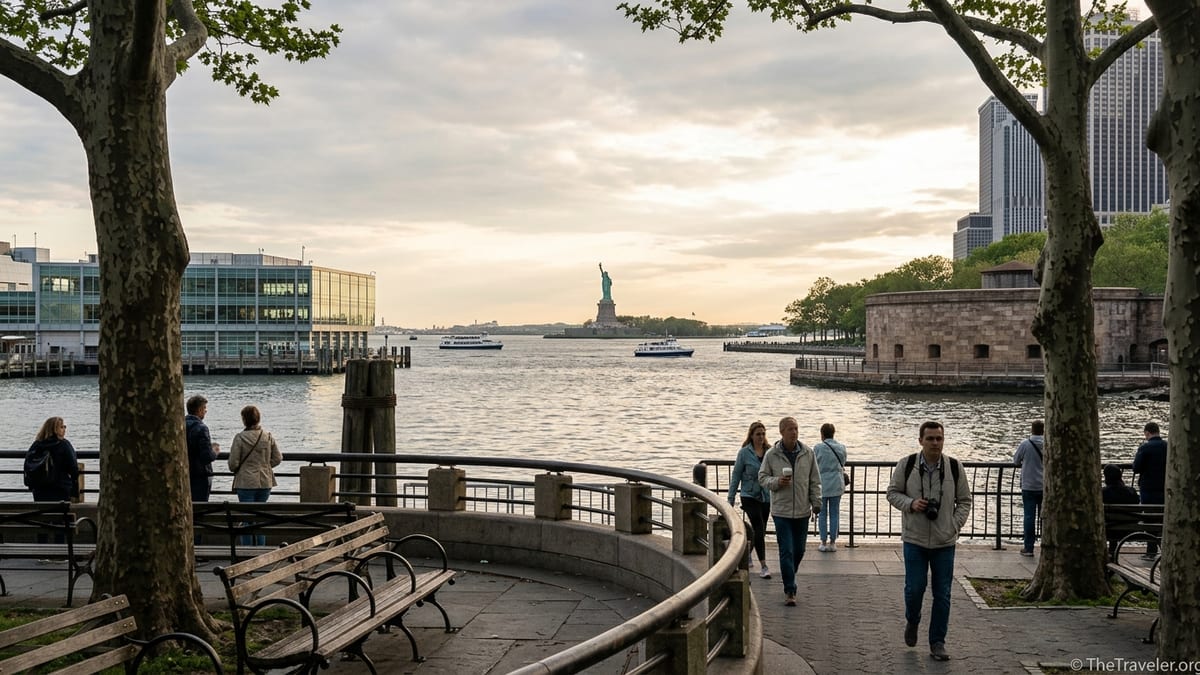
Stand at the harbor’s edge in Battery Park and you can feel two versions of New York pressing in at once. In front of you, the water opens toward the Statue of Liberty, ferries slide across the harbor, and joggers weave around benches under plane trees. Turn your head a few degrees and the towers of the Financial District crowd the sky, while streams of office workers and subway riders pour into Lower Manhattan. This sharp contrast is exactly why Battery Park feels like the city’s deep breath, a rare moment of calm before the chaos of downtown truly begins.
Get the latest updates straight to your inbox!
The Harbor at Your Feet, the Skyline at Your Back
Battery Park’s geography explains a lot of its unusual mood. Spreading across more than 20 acres at the very southern tip of Manhattan, The Battery sits with New York Harbor directly in front and the narrow streets of the Financial District just behind. Turn south, and your line of sight runs over the water to Liberty Island and Ellis Island. Turn north, and glass and steel towers rise almost vertically above Bowling Green and Broadway. The park becomes a literal hinge between open water and dense city.
This setting shapes the way the space feels. On a weekday morning, you might watch Staten Island Ferries gliding in and out of Whitehall Terminal to your left, while Statue City Cruises boats depart from the docks near Castle Clinton to your right. In between, there is surprising quiet: people drinking takeaway coffee along the waterfront promenade, office workers taking a slow lap around the lawns before heading into One Battery Park Plaza, parents pushing strollers toward the SeaGlass Carousel. The harbor absorbs a lot of the city’s noise, so even with thousands of people moving past, the soundscape is more gulls and water than car horns.
Because ferries to the Statue of Liberty and Ellis Island depart from here, visitors often arrive with headsets and printed tickets in hand. Yet before they join security lines at Castle Clinton, many linger along the railings just to watch the harbor traffic. The view alone already feels like an attraction: tugs pushing barges across Upper New York Bay, helicopters beetling back and forth to Governors Island, sailboats tracing slow arcs in the channel. It is New York as working port and scenic backdrop at the same time, a calm counterweight to the skyscraper walls a few blocks away.
Even the way the light hits Battery Park adds to that sense of pause. In the morning, sun slips around the towers and lands on the water first, giving the harbor a pale shimmer while much of the Financial District is still in shadow. At sunset, the reverse happens: the glass downtown towers blaze orange while the lawns and promenade cool into shade, inviting people to sit and watch the sky change before diving back into the subway at South Ferry.
A Historic Fort That Now Manages the Crowds
At the center of Battery Park’s calm is Castle Clinton, a round sandstone fort that has reinvented itself repeatedly over two centuries. Built in the early 1800s as part of New York’s coastal defenses, it has served as a concert hall, an immigrant landing depot, an aquarium, and finally a National Park Service site and launch point for Statue of Liberty ferries. Today, that history is still visible in the thick stone walls and open courtyard, even as digital ticket scanners and security stations serve very modern crowds.
For travelers, Castle Clinton is the nerve center of one of the city’s busiest tourist experiences. This is where you find the official ticket booths for Liberty Island and Ellis Island and where you pass through airport-style security before boarding the ferry. On peak days in spring and summer, queues can snake out of the fort and back across the paved plaza, yet the structure itself encloses much of the bustle, so the rest of the park stays surprisingly unhurried. Families spread maps out on the grass, school groups cluster around teachers near the World War II memorial, and solo visitors lean on railings with coffee, watching lines grow inside the fort without feeling pressed by them.
The contrast becomes especially clear around mid-morning. A traveler who arrives early, say around 8:30 or 9 a.m., might breeze through ticket pick-up and security in under 30 minutes. Step back out at 11 a.m., and the plaza outside Castle Clinton can feel dense and loud: guides raising flags for their groups, vendors calling out for harbor cruises, and staff managing the flow toward the ferry gates. One or two minutes’ walk into the lawns, however, and the mood shifts. You pass under trees, tourists thin out, and the harbor returns as the main soundtrack.
Castle Clinton also anchors visitors in the park before they confront the sensory intensity of Liberty Island itself. Many first-time travelers underestimate how long a Statue of Liberty visit actually takes from Battery Park: factoring in security, ferry crossings, exploring the grounds, and potentially accessing the pedestal, it often becomes a half-day excursion. That is part of why the park feels like a staging ground, a quiet antechamber where people collect themselves before the steady choreography of timed entries, ferries, and museum visits begins.
Everyday Green for Office Workers, Not Just Tourists
Battery Park is far more than a launch pad for boats. For the tens of thousands of people who work in Lower Manhattan, it functions as their everyday backyard, which helps preserve the park’s human scale even as the skyline grows taller. Around lunchtime on a weekday, food trucks often cluster at the edges of the neighborhood, and you see office workers walking in from Broadway or Water Street balancing salads or foil-wrapped sandwiches, heading straight for one of the curved benches that face the harbor.
On warm days, law firm associates in rolled-up sleeves sit on the same lawns as construction crews in reflective vests. Some people power through phone calls on wireless earbuds, pacing the paths, while others simply lie back and stare at the clouds drifting over Governors Island. Battery Park’s plantings, from perennial gardens to tree-lined promenades, help cultivate this relaxed atmosphere. They signal that the space is designed for lingering, not just passing through as quickly as possible.
For travelers staying in nearby hotels, this local rhythm can be a welcome surprise. Step out of a lobby on State Street or Greenwich Street at 7:30 in the morning, and you may encounter joggers looping around the paths, park staff watering flower beds, and a few tourists consulting guidebooks. By 9 a.m., the tempo picks up as commuters exit the South Ferry subway complex or walk over from Wall Street and Broad Street. Yet even at that busier hour, Battery Park maintains a gentler tempo than the narrow cross streets lined with delis, chain pharmacies, and loading docks. The park is effectively the neighborhood’s living room.
This dual identity also buffers visitors from the stress that can come with navigating downtown. If you miscalculate your timing for a morning Statue of Liberty ferry, for example, it is far less discouraging to spend an extra 40 minutes strolling the promenade than it would be to wait in a subway mezzanine. Travelers can top up their water bottle at a fountain, let kids run around on the grass, or ride the SeaGlass Carousel, then rejoin lines for the next departure without feeling they have wasted the day.
Between Ferry Terminals and Transit Chaos
Just outside the park’s greenery, the picture changes quickly. The Staten Island Ferry’s Whitehall Terminal, located at the southeastern edge of the park, funnels millions of passengers a year on its free 25-minute crossings to St. George on Staten Island. Inside the glass-walled waiting hall, commuters scroll on phones, tourists cluster by the windows for first glimpses of the Statue of Liberty, and public announcements echo over tiled floors. When a boat docks, crowds surge down the ramps; when the doors close, the space empties out in minutes, only to refill for the next departure.
For a visitor, that terminal can feel like pure function: grab a coffee from a kiosk, check the departure clock, and shuffle toward the boarding gates in a mass of people. Yet it is only a short walk from this controlled chaos to the quiet of Battery Park’s interior paths. Step outside the Whitehall exit onto Peter Minuit Plaza and you enter an intense transport knot: bus bays to Staten Island, entrances to the South Ferry and Whitehall Street subway stations, taxi queues, bike lanes, and pedestrians crossing at every possible angle. Add hawkers trying to sell private boat tours or unofficial “Statue tickets” to anyone who looks like they might be visiting, and it can feel overwhelming.
Battery Park acts as a pressure valve for all of this. Many travelers stepping off the Staten Island Ferry choose to walk straight through the park to reach Broadway or the 9/11 Memorial, letting the trees and harbor views reset their senses after the terminal’s fluorescent-lit bustle. Others move in the opposite direction: after a morning in Midtown crowds, they head downtown, pass through the Bowling Green station, and emerge in a space that suddenly opens to water and sky. Within a few minutes’ walk, you go from concrete canyons to parkland, from the crush of subway transfers to the breeze off the harbor.
Recently, city agencies have been investing in ferry infrastructure and flood-proofing projects at terminals on both Manhattan and Staten Island, aiming to keep these lifelines operating reliably in bad weather. For everyday travelers, the more immediate impact is still the experience of the terminals themselves: bright, hard, and busy, in stark contrast to the softer landscaping and slower rhythm that awaits a short stroll away inside Battery Park.
The Emotional Reset Before Tackling Downtown
Part of the reason Battery Park feels like calm before chaos is psychological. Lower Manhattan can be an intense place to navigate, especially for first-time visitors. Streets here do not follow the grid of Midtown; instead, they twist and narrow, with sudden changes of name and direction. Address numbers are inconsistent, and sightlines are often blocked by tall buildings. Landmarks like Wall Street, the New York Stock Exchange, the 9/11 Memorial, and One World Trade Center draw heavy foot traffic, and the sidewalks around them can be packed during business hours.
Starting your day in Battery Park functions like an emotional warm-up. The park gives your eyes a chance to adjust to the scale of the city without being hemmed in by it. You can sit on a bench and trace your finger along a map, or simply look north and pick out the spire of One World Trade, the stepped crown of 70 Pine Street, and the cluster of newer towers around them. Seen from this distance, the city feels legible. Once you walk into those same streets, they shrink into a close-up tangle. The harbor vantage point helps visitors orient themselves before plunging in.
The park also allows time for small practical preparations that matter in a high-intensity urban environment. Travelers can reorganize bags before going through security, apply sunscreen for hours of outdoor walking, or grab a snack from a nearby cafe to avoid hunting for food in crowded corridors later. Parents with young children often use the lawns near the playground and carousel as a final low-stress stop before a busy afternoon in museums or observatories. For older travelers, just having a quiet bench to rest on between subway rides, ferry queues, and memorial visits can make the difference between a satisfying day and an exhausting one.
By the time you leave Battery Park and walk up Broadway toward Bowling Green and Wall Street, your senses have recalibrated. Horns honk more sharply, voices echo more loudly between buildings, and traffic feels closer. The park’s calm does not last long in a city like New York, but it stays with you, a reminder that you can always retreat to the water’s edge for a breather if downtown begins to feel like too much.
Practical Ways Travelers Can Use Battery Park
For travelers, understanding Battery Park as a buffer zone helps you use it more effectively. If you have timed tickets for the Statue of Liberty in the late morning, consider arriving in Lower Manhattan an hour earlier than necessary. Spend 30 minutes walking the length of the waterfront promenade, from the SeaGlass Carousel up toward the ferry docks and back again. You will not only have cushions for subway delays, but you will also start your day with open views instead of cramped platforms.
If you are short on time or traveling on a budget, Battery Park still offers rich experiences without paying a cent. You can sit near the eastern edge of the park and watch Staten Island Ferries glide past the Statue of Liberty in the distance, giving you a sense of the harbor’s scale even if you never set foot on a boat. Benches along the water make natural picnic spots; grabbing a bagel or sandwich from a deli near Whitehall Street and bringing it into the park is a common weekday ritual for locals and a simple, low-cost lunch for visitors.
Another practical tip: treat Battery Park as your orientation point when moving between multiple downtown sights. After visiting the 9/11 Memorial and One World Observatory, for instance, it can be tempting to plunge straight into the subway or walk immediately to your next museum. Instead, consider detouring ten minutes south into the park. Sit under the trees, review what you want to see next, and then decide whether to head toward the Brooklyn Bridge, Chinatown, or back uptown. This brief pause can make each neighborhood feel like a distinct chapter in your day, rather than one long, exhausting blur.
For those staying in other parts of the city, it is easy to build Battery Park into a day that also includes Midtown or Brooklyn. Take the 4 or 5 train to Bowling Green or the R train to Whitehall Street in the early morning, walk through the park while it is still relatively empty, and then continue by subway to Times Square, the High Line, or Brooklyn Heights. Ending the day back at Battery Park, perhaps with a simple waterfront stroll at dusk, can serve as a bookend that quiets the mind before a late-night subway ride back to your hotel.
The Takeaway
Battery Park occupies a rare position in New York’s urban fabric. It is simultaneously a major tourist gateway, a daily refuge for office workers, a historic site, and a green buffer at the edge of one of the world’s most crowded business districts. That combination gives it an unusual calm, even when ferry queues lengthen and cruise ships loom across the harbor.
For travelers, treating Battery Park as more than a place to stand in line changes the feel of a visit to Lower Manhattan. It becomes your breathing space before the narrow streets, packed subways, and emotional weight of downtown’s financial and memorial landmarks fully assert themselves. Whether you are here for a once-in-a-lifetime Statue of Liberty trip or just passing through on your way to another borough, a few unhurried minutes on a bench facing the harbor can reframe the entire day.
In a city defined by motion, The Battery’s greatest gift may be its invitation to stop. Here, at the very tip of Manhattan, the water opens up, the skyline pulls back, and you get a moment to collect yourself before stepping into the beautiful chaos of Lower Manhattan.
FAQ
Q1. Is Battery Park the same as The Battery in New York City?
The area is officially called The Battery, but many New Yorkers and visitors still refer to it as Battery Park. They refer to the same waterfront park at Manhattan’s southern tip.
Q2. How early should I arrive at Battery Park for the Statue of Liberty ferry?
Plan to arrive at least 30 to 60 minutes before your reserved time, especially in spring and summer, to allow for security screening and lines at Castle Clinton.
Q3. Can I enjoy Battery Park even if I am not taking a ferry?
Yes. Many people visit solely for the harbor views, gardens, monuments, carousel, and open lawns. You can easily spend an hour or two without boarding any boat.
Q4. Is Battery Park a good place to escape the crowds of Lower Manhattan?
It is one of the best nearby escapes. A short walk from Wall Street or the 9/11 Memorial brings you to open space, water views, and quieter paths under trees.
Q5. Are there scams I should watch out for around Battery Park?
Be cautious of street sellers offering Statue of Liberty tickets on sidewalks near the park. For official ferries, use the ticket booths inside Castle Clinton or reputable online vendors.
Q6. What is the best time of day to experience Battery Park’s calmer side?
Early mornings and late afternoons tend to be the most relaxed, with fewer tour groups and softer light over the harbor, especially on weekdays.
Q7. Is Battery Park suitable for families with children?
Yes. Kids often enjoy the SeaGlass Carousel, open lawns, and watching ferries and boats. The park offers room to move before or after more structured sightseeing.
Q8. How does Battery Park compare with other New York green spaces like Central Park?
Battery Park is smaller and more intimate, with a strong waterfront focus and direct views of the harbor, while Central Park is vast and more like a full-day destination.
Q9. Can I use Battery Park as a base to explore other parts of Lower Manhattan?
Definitely. The park is within easy walking distance of Wall Street, the 9/11 Memorial, the Financial District, and subway lines that connect to Midtown and Brooklyn.
Q10. Is Battery Park accessible year-round, and what is it like in winter?
The park is open year-round. In winter it feels quieter, with fewer ferries at peak times, crisper harbor views, and a starker beauty along the waterfront paths.