


For many travelers, Battery Park is nothing more than a blur at the bottom of Manhattan: a place to hurry through on the way to the Statue of Liberty, Ellis Island, or the Staten Island Ferry. They follow the crowds, cut straight across the pavement, and leave with the impression that the park is just a holding pen for boat queues. In doing so, they miss one of New York’s most quietly distinctive spaces, where layered history, contemporary design, and everyday city life meet the harbor.
Get the latest updates straight to your inbox!
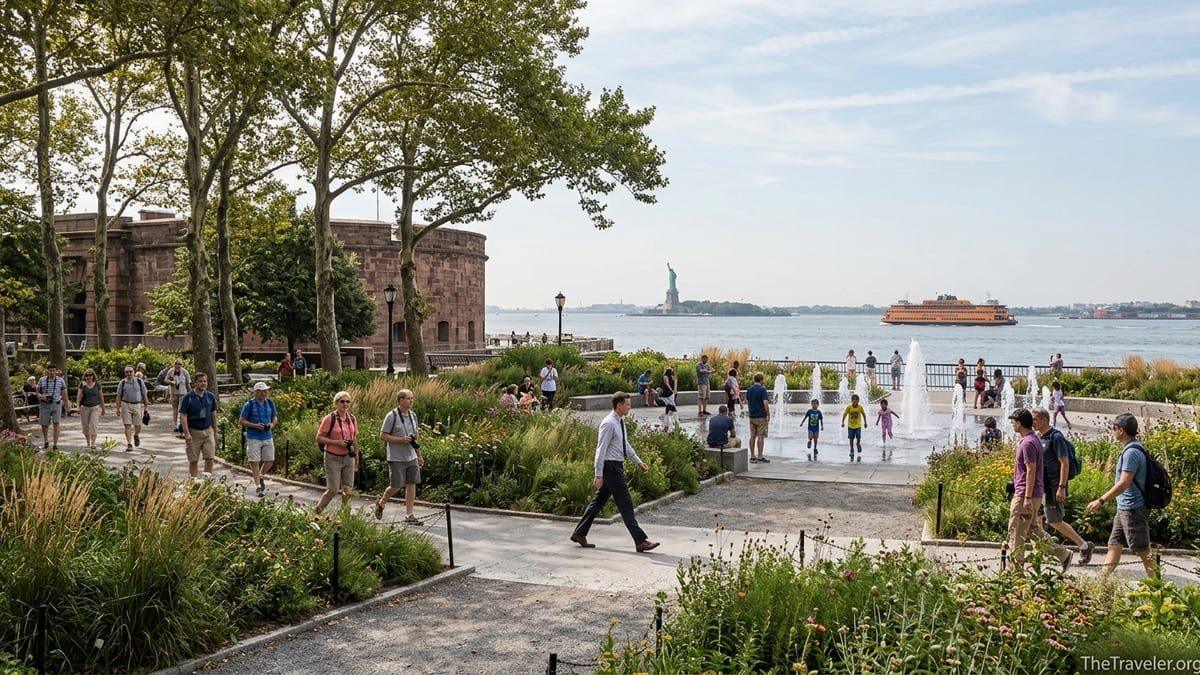
From Defensive Outpost to Downtown Front Yard
Today’s Battery Park, officially called The Battery, feels like an easy green gateway to New York Harbor, but its story runs far deeper than its lawns and food carts suggest. The name comes from the artillery batteries once stationed along this shoreline to defend the growing port city. Over time, the waterfront was filled in and reshaped, but the southern tip of Manhattan remained a place where New York watched the world arrive. Walk slowly instead of racing to the ferry, and you are literally tracing the city’s original edge.
That history is most visible at Castle Clinton, the circular sandstone fort set just back from the water. Built in the early 19th century as part of New York’s coastal defenses, it later became a concert hall, then an immigration station that processed millions of arrivals before Ellis Island took over. Today it serves as the National Park Service’s ticket hub for Statue of Liberty and Ellis Island ferries, which means most visitors only see its interior in a rush. Step outside the ticket line, pause under the thick old walls, and you begin to understand how many roles this small structure has played in the city’s life.
The Battery’s role as a stage for arrivals continues in more subtle ways. Office workers stream in from the skyscrapers around Bowling Green, Staten Island commuters cross the park from the ferry terminal, and school groups spill from buses near State Street. If you ignore the urge to treat the park as a corridor and instead find a bench facing the harbor, the crowds turn into a living illustration of New York’s constant movement. This is one of the few places in Manhattan where you can feel the island’s maritime roots in your bones.
Gardens You Would Never Expect at the Tip of Manhattan
What surprises many first-time visitors who slow down is how intensely green The Battery has become. Once a patchwork of worn lawns and hard surfaces, it now holds more than a hundred thousand square feet of perennial gardens designed with a naturalistic, almost wild look. Instead of rigid flower beds, you find curving drifts of grasses, echinacea, black-eyed Susans, and other perennials that sway in the harbor breeze. From late spring through fall, this section of downtown feels unexpectedly soft and alive, a contrast to the glass towers just beyond the tree line.
A concrete example of how this changes your visit: Imagine you have an 11 a.m. Statue of Liberty ferry reservation and you arrive at 9:45 to be safe. Most people stand in line, scrolling their phones for an hour. Step away from the queue, however, and within two minutes you can be on a gravel path in the gardens, following monarch butterflies and honeybees between flowering stalks. The ferries are still there; you can still see the security lines. But now, while keeping an eye on boarding times, you are walking through a designed landscape that feels more like a European river park than a New York transit hub.
These gardens also change the park’s soundscape. The harbor’s low rumble and the Staten Island Ferry horns are still present, but they are softened by birdsong and wind rustling through ornamental grasses. If you sit at the edge of one of the beds near the Battery Oval lawn, you are likely to share the space with a mix of tourists taking photos of flowers instead of skyscrapers, local residents with dogs, and downtown workers on their lunch breaks. It is a side of Manhattan many short-term visitors never imagine exists below Chambers Street.
SeaGlass Carousel and a Very Downtown Kind of Magic
Near State Street, tucked within the plantings, is one of the city’s most quietly surreal attractions: the SeaGlass Carousel. At first glance you see a glass pavilion with curved panels that hint at shells or waves. Step inside and the park’s noise falls away. Instead of traditional horses on poles, thirty illuminated fish figures rotate and rise around you, accompanied by classical-influenced music and changing colored lights that evoke water. The whole effect nods to the old New York Aquarium that once stood nearby, while feeling entirely contemporary.
Most people encounter SeaGlass from the outside as they hustle toward Castle Clinton. Yet it is one of the easiest places in Lower Manhattan to create a core family memory. A parent who has just shepherded kids through airport security and subway transfers can, for a few minutes, sit in a glowing fish while their child leans forward in awe. Rides are brief, typically just a few minutes, and pricing is modest compared with major Manhattan attractions, which makes it a manageable add-on to a harbor-focused day. Even grown visitors without children often step inside just to see the space and end up taking a spin.
SeaGlass also demonstrates how The Battery has leaned into artful play rather than only utilitarian design. The ride is framed by gardens instead of asphalt, and the pavilion is carefully lit so it glows at dusk without feeling like a theme park. Locals use it as a landmark when giving directions in the neighborhood, not simply as a tourist novelty. If you visit around sunset, you might see commuters pausing to watch the fish shimmer before heading to the subway, a small reminder that this is their everyday park as much as it is your once-in-a-decade trip.
Monuments, Memorials, and Harbor Views Hiding in Plain Sight
Spend more than ten minutes in Battery Park and you realize how much history is folded into its lawns and walkways. Just steps from the ferry queues, the East Coast Memorial rises in a line of tall granite pylons dedicated to American servicemembers lost in the Atlantic during World War II. Beyond them, a large bronze eagle appears to lift from the ground, its wings framing the harbor. Many visitors glance at it while hurrying past, but few walk among the stones and read the names and inscriptions, even though the memorial sits on one of the park’s quietest promontories.
Farther along the waterfront paths, other smaller monuments mark chapters of immigration, exploration, and sacrifice. There is the Korean War Veterans memorial, simple and reflective, and tributes to European explorers and immigrant communities. One practical advantage of taking time to notice them: they often stand in spots chosen for their views. The East Coast Memorial platform, for example, offers a near-frontal angle on the Statue of Liberty, with Ellis Island and the harbor traffic unfolding to either side. Stand here in the late afternoon and you can watch Liberty Island ferries crossing in front of anchored cargo ships and harbor cruise boats heading up the Hudson, all while seagulls track the wind above.
For visitors who are not taking a boat at all, these walkways provide some of the best free views of the harbor and the statue. On a clear day you can pick out details of the torch and the folds of the statue’s robe from the promenade near Pier A, without ever joining a queue. This is particularly appealing if you are traveling on a tight budget or schedule. Families staying in Midtown sometimes ride the subway down, stroll the waterfront for an hour, watch the sun sink behind the New Jersey skyline, and then walk back up through the Financial District for dinner, experiencing the park as a destination in its own right rather than simply an access point.
Bosque Fountain, Playgrounds, and Everyday Life
The Battery is not only for looking and remembering; it is also for cooling off and playing. In the Bosque section of the park, shaded by plane trees and ringed with plantings, a circular fountain throws up dozens of individual jets that children weave through on hot days. Parents park strollers around the edge and share snacks from nearby kiosks, while office workers cut through the space holding iced coffees. During a summer midday, this corner feels more like a neighborhood square than a landmark on global bucket lists.
Just beyond, you will find a substantial playground where local families spend weekend mornings and after-school hours. Tourists who discover it often let their children burn off energy between museum visits or before long ferry rides. Unlike more famous Manhattan playgrounds, this one rarely feels like a sightseeing attraction. Instead, it is where you see Battery Park’s residential side: parents who live in nearby apartment towers chatting on benches, kids in school uniforms racing to claim the highest climbing structures, and caregivers meeting up after making the same walk day after day.
The Bosque area also anchors some of the park’s small food and drink operations. Rather than big-name restaurant chains, you are more likely to find seasonal kiosks serving items like coffee, sandwiches, and simple farm-to-table style salads or flatbreads. Prices tend to be comparable to other Manhattan quick-service options, not bargain-level but not out of line with what you would pay in a Midtown food hall. Grabbing something here and sitting under the trees connects you to the park’s rhythms in a way that standing in a ferry queue cannot.
How Locals Actually Use Battery Park
One of the clearest signs that Battery Park is more than a tourist funnel is how downtown New Yorkers treat it. In the early morning, joggers trace the perimeter paths before heading up the Hudson River Greenway. Office workers from the financial district cut across the lawns to reach the Staten Island Ferry rather than detouring along crowded streets. Residents of Battery Park City, the reclaimed-land neighborhood just to the west, treat the park as an extension of their own waterfront esplanade, walking dogs along the harbor and meeting friends near the gardens before heading to nearby cafes.
During lunch hours on weekdays, benches fill with people in business attire eating takeaway salads or burritos from nearby delis, while tourists consult maps and guidebooks. After work, the energy shifts again: couples meet by the harbor to watch the sunset, and you can sometimes spot small yoga or fitness groups using the lawns when the weather is mild. On summer evenings, the park occasionally hosts events and performances, adding another layer to its role as a civic living room. None of this is obvious if you only experience the park as a corridor between subway and ferry security line.
For travelers, paying attention to these patterns can subtly improve a New York itinerary. If you are staying nearby, for example, you might use Battery Park as your starting point for a morning walk up through the narrow streets of the Financial District to the World Trade Center and beyond, mirroring the commute of downtown residents. Or you could plan your harbor-focused day so that the park becomes your decompression zone after visiting Liberty Island and Ellis Island, returning to sit under the trees and process what you have seen rather than immediately disappearing into the subway.
Planning a Visit: Slow the Pace, Change the Experience
Making the most of Battery Park does not require adding hours to an already packed New York schedule. Instead, it simply means adjusting how you use the time you already plan to spend here. If you have Statue of Liberty tickets, build an extra 30 to 45 minutes on either side of your ferry departure or return. Use that window to wander the perennial gardens, step inside Castle Clinton without the ticket-buying rush, watch a single ride at SeaGlass Carousel, or walk out to the East Coast Memorial platform for a quiet view of the harbor.
Travelers who are not taking any ferries can deliberately anchor their Lower Manhattan day around the park. One realistic pattern might be: arrive downtown mid-morning, stroll the harbor promenade and monuments, grab a simple lunch from a nearby kiosk or deli and eat it in the Bosque or on the lawns, then walk north through the Financial District and visit sites like the New York Stock Exchange area or the National Museum of the American Indian near Bowling Green. In late afternoon, you return to Battery Park to watch the light change over the water before heading back uptown.
Battery Park also works well as a flexible option for days when weather or energy levels are unpredictable. On a humid summer afternoon, for instance, you can pivot from an indoor museum plan and let kids cool off at the Bosque fountain or seaside breezes instead. In colder months, shorter strolls combined with quick coffee stops nearby still let you appreciate the harbor, the monuments, and the garden structure, even when flowers are dormant. The key is to see the park as a place where you can improvise, rather than a hurdle en route to something more important.
The Takeaway
Most visitors step into Battery Park thinking only about boats and departure times. They follow the straightest line possible to the ferry security checkpoints, their minds already on the pedestal of the Statue of Liberty or the exhibits at Ellis Island. By treating the park as a shortcut instead of a destination, they miss a compact, revealing slice of New York: a historic fort that predates skyscrapers, a harbor-front garden that softens the city’s edge, an imaginative carousel glowing among the trees, and a network of paths and plazas where locals actually live their downtown lives.
Shifting your perspective requires almost no extra effort. You do not need tickets beyond what you may already hold, and you do not need to memorize a long list of specific monuments. You simply need to leave a little time unclaimed, step off the most obvious routes, and let curiosity dictate a few detours. In return, Battery Park offers something that even the most famous New York attractions cannot always guarantee: a chance to feel the city’s past, present, and daily rhythms meeting at the water’s edge.
FAQ
Q1. Is Battery Park worth visiting if I am not taking a ferry?
Yes. The harbor views, gardens, monuments, playgrounds, and relaxed atmosphere make Battery Park a rewarding standalone stop, even if you never step on a boat.
Q2. How much time should I plan to spend in Battery Park?
Plan at least 45 to 60 minutes to walk the waterfront, see a few monuments, and enjoy the gardens. Add more time if you ride SeaGlass Carousel or visit Castle Clinton.
Q3. What is the best time of day to visit Battery Park?
Early morning is quiet and popular with joggers, while late afternoon and sunset offer beautiful harbor light. Midday is livelier, especially in summer.
Q4. Can I see the Statue of Liberty well from Battery Park without a ferry?
Yes. From the harbor promenade and near the East Coast Memorial you get clear, direct views of the statue, Ellis Island, and passing harbor traffic.
Q5. Is SeaGlass Carousel suitable for adults, or only for children?
SeaGlass Carousel is designed for all ages. Many adults ride it without children, both for the design experience and for photography.
Q6. Are there places to eat in or near Battery Park?
Yes. You will find seasonal kiosks and small food stands in the park, plus many cafes, delis, and restaurants in the surrounding streets of Lower Manhattan.
Q7. Is Battery Park safe to visit in the evening?
In general, Battery Park and the surrounding area are busy and feel safe during evening hours, especially around the ferry terminals, though normal city awareness is recommended.
Q8. Are there public restrooms inside Battery Park?
Yes. The park has several public restrooms near key areas such as Castle Clinton and along Battery Place, usually open during daytime hours.
Q9. Is Battery Park accessible for visitors with limited mobility?
Most main paths are paved and relatively flat, and key attractions like Castle Clinton, SeaGlass Carousel, and the harbor promenade are reachable with wheelchairs or strollers.
Q10. Can I combine a visit to Battery Park with other Lower Manhattan sights?
Yes. Battery Park pairs naturally with the Statue of Liberty and Ellis Island, the Financial District, the Staten Island Ferry, and the World Trade Center area in a single day.