


Florence’s Boboli Gardens are vast, hilly, and full of surprises. Walk them without a plan and you can spend hours on gravel paths, only to realize you missed the most beautiful viewpoints over the city. With a bit of strategy, though, you can turn this Medici-era garden into your private balcony over Florence, linking one great panorama to the next while still savoring statues, fountains, and shady avenues along the way.
Get the latest updates straight to your inbox!
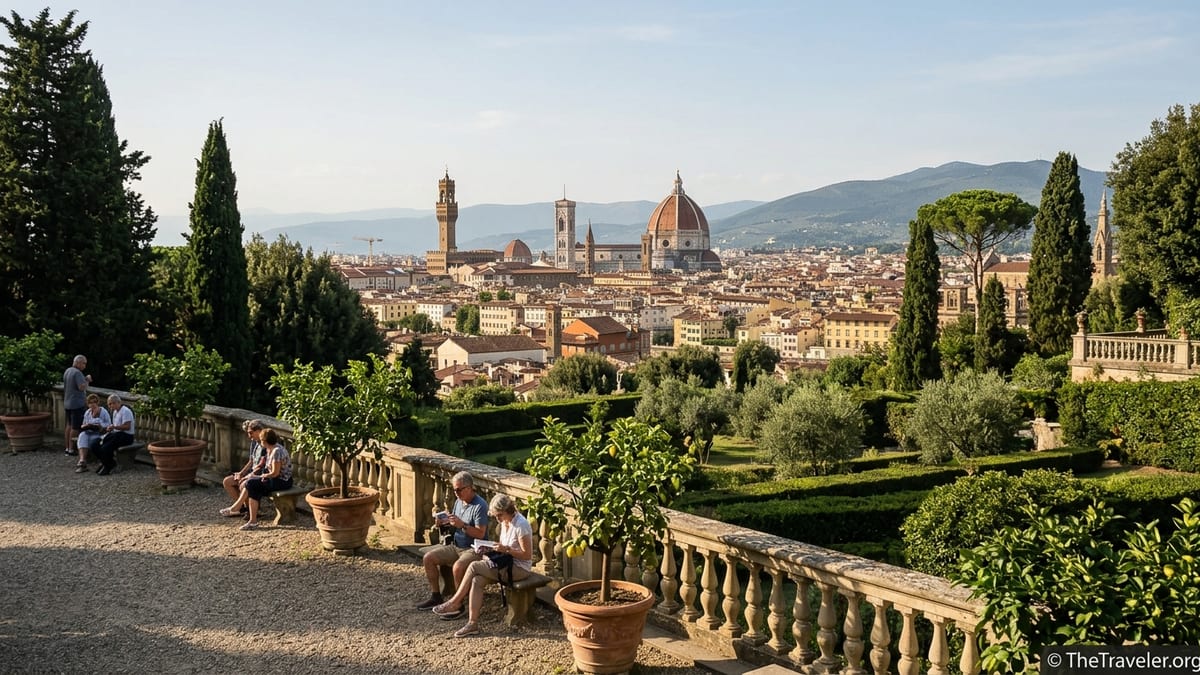
Understanding Boboli’s Layout So You Don’t Miss the Views
Boboli Gardens stretch over roughly 30 hectares behind Palazzo Pitti, rising up a steep hillside and then gently rolling toward the southern city walls. The overall design is geometric and axial, but in practice the garden feels like a maze of staircases, sloping paths, and side terraces. The best viewpoints are not always on the most obvious routes, and many visitors follow the crowds up one main path, then loop back down, never realizing how close they were to a spectacular overlook.
Think of Boboli as two main axes that form an L-shape. From the back of Palazzo Pitti, a straight uphill route runs through the grand amphitheatre and up to the Fountain of Neptune and the Knight’s Garden at the very top. A secondary axis cuts off to the right along the Viottolone, also called the Cypress Avenue, descending toward the Isolotto basin and the Porta Romana exit. Most of the classic city views sit in and around the higher terraces above the amphitheatre and near the hilltop Porcelain Museum, while the lower Viottolone rewards you with long, dramatic perspectives rather than a Florence skyline.
The entrances influence what you see. Many visitors enter from Palazzo Pitti, which naturally pulls you uphill toward Neptune Fountain and the Knight’s Garden first. If you come in from Porta Romana at the far south, you start lower and must climb up to catch the views. Either way, the key to not missing the best viewpoints is to prioritize the highest terraces early, while you still have energy and good light, then wander down into the side paths and shaded avenues later.
Before you arrive, download or photograph the official Boboli map at the entrance so you can identify landmarks such as the Amphitheatre, Fountain of Neptune, Knight’s Garden, Porcelain Museum, Kaffeehaus, Isolotto, and Forte di Belvedere. These are your visual anchors; by walking consciously from one to the next, you will naturally pass most of the great viewpoints that make the gardens special.
Tickets, Opening Hours, and Timing Your Visit for Light
Boboli Gardens operate as part of the Uffizi Galleries museum network, with timed tickets and varying seasonal schedules. As of mid-2026, a standard adult ticket to the gardens on its own typically costs around the low teens in euros, while combined options with Palazzo Pitti or longer multi-day passes cost more but can be good value if you also plan to visit the palatial galleries. Prices and combinations change regularly, so it is safest to check the official Uffizi or Palazzo Pitti channels and book in advance, especially for spring and early summer weekends when time slots can sell out.
Opening hours vary by season, with earlier closing times in winter and extended daylight access in summer. A useful rule of thumb is that last entry is usually one hour before closing. To make the most of the viewpoints, aim for either early morning right after opening or late afternoon a couple of hours before closing. Midday sun in Florence can be harsh from late spring through early autumn, flattening the city’s terracotta tones and making uphill climbs feel punishing.
If you book a morning slot, try to enter Boboli no later than 9:30 am. From the Pitti Palace courtyard, you can be standing at the Fountain of Neptune with your first sweeping view over the city by around 10:00 am, before the heat and the groups build up. For afternoon visits, arriving between 3:30 pm and 4:30 pm works well for softer light on the Duomo and Palazzo Vecchio, along with longer shadows on the lawns and cypress avenues. In high summer, golden-hour light near closing can be magical, but check seasonal hours carefully so you do not find yourself rushed out just as the sky turns warm.
For travelers with limited time in Florence, consider pairing a late-morning visit to the Palatine Gallery inside Palazzo Pitti with an early-afternoon stroll through the gardens. You can see masterpieces indoors while it is hottest outside, then head up into Boboli as the light improves and temperatures begin to drop. Just remember that re-entry rules mean you should plan to visit palace interiors and the gardens in a single coherent sequence rather than expecting to come and go multiple times on the same ticket.
The Classic Route: From Palazzo Pitti to the Knight’s Garden
Most visitors enter from the courtyard behind Palazzo Pitti, where gravel steps fan out toward a monumental amphitheatre backed by an Egyptian obelisk. This is your first orientation point. Standing at the base of the amphitheatre and looking uphill, you can already sense how the garden is designed to draw your gaze upward, layer by layer. Take a moment here to look back: the palace facade frames the lower garden, and on a clear day you may catch glimpses of Florence’s stone towers beyond the courtyard.
Climb the central stairs of the amphitheatre slowly, stopping halfway up to pivot and look back toward the palace. The height difference is enough that the skyline starts to rise above the roofline of Palazzo Pitti, giving you an early preview of the city views to come. Continue to the very top of the amphitheatre, where paths radiate left and right, but focus first on the central route that leads straight to the Fountain of Neptune, nicknamed by locals the “Fountain of the Pitchfork” thanks to Neptune’s trident. From this terrace around the fountain, you get one of the most satisfying framed views: Florence’s dome and towered skyline appear beyond the trees, floating above the green slopes of Boboli.
From Neptune, continue a little higher to the Knight’s Garden, a quiet, elevated enclosure with formal flowerbeds and a sense of remove from the crowds below. This area, near the historic Casino del Cavaliere, often feels less busy than the amphitheatre and makes an excellent pause point. Find a bench and linger: on many days you will have a near-continuous view of the Duomo’s red dome emerging above olive groves, church spires dotting the horizon, and the pale stone campanile of Palazzo Vecchio cutting the skyline.
As a concrete example, imagine a late May morning. After a 15-minute walk from the Pitti Palace entrance, you reach Neptune Fountain around 10:15 am. The sun is behind you, lighting the city’s facades, and the dome glows a soft brick-red instead of appearing as a silhouette. Continuing five minutes more to the Knight’s Garden, the path levels out and cars are inaudible. School groups tend to bunch below at the amphitheatre, so you often share this upper terrace with only a handful of independent travelers, sketching or sipping takeaway coffee from bars near Piazza Pitti.
Hidden and Higher: Porcelain Museum Terrace, Kaffeehaus, and Forte di Belvedere
Just above the Knight’s Garden, one of Boboli’s finest vantage points hides in plain sight. The Porcelain Museum, housed in the Casino del Cavaliere at one of the highest points of the gardens, is surrounded by a rose garden and a broad terrace that looks out over the hills south of Florence and across toward Forte di Belvedere. Even if you only spend a few minutes inside the small museum, stepping onto the terrace rewards you with a far-reaching, countryside-tinged panorama that contrasts beautifully with the urban view from Neptune.
Another of Boboli’s atmospheric viewpoints sits at the historic Kaffeehaus, an 18th-century pavilion with a distinctive green-domed roof on one of the upper slopes. Although services and access in and around the pavilion can change from season to season, the surrounding terrace offers an angled view across the city, often less crowded than the main central axis. It feels like a quiet balcony tucked into the hillside, and on hazy summer afternoons you can see the dome of Santa Maria del Fiore hover above a sea of warm terracotta rooftops.
On the southern edge of the garden, Forte di Belvedere occupies the highest hill of the Boboli complex. When open to visitors, its ramparts and terraces provide some of the most dramatic wide-angle views in Florence, rivaling Piazzale Michelangelo but with a different perspective back toward the city. From here, the Arno River curves through the skyline, the Duomo aligns with Palazzo Vecchio, and you can trace the old city walls as they climb the opposite hills. The fort often hosts contemporary art exhibitions and its opening periods can be seasonal, so it is worth checking current information in Florence or at the Pitti ticket office to see whether you can add this viewpoint to your route.
A practical way to link these upper viewpoints is to start at the Knight’s Garden, continue to the Porcelain Museum terrace for countryside views, then angle across to the Kaffeehaus before looping back down toward the central paths. If Forte di Belvedere is open during your visit and access from the garden is allowed at that time, you can extend your walk out to its walls and then return, adding a full 180-degree panorama of Florence to your day without missing any of the internal garden vistas.
Walking the Viottolone and Isolotto Without Skipping the Skyline
Once you have explored the upper terraces, it is time to change the mood with Boboli’s grand processional avenue, the Viottolone. From near the top of the garden, you turn off at a right angle and step into a majestic cypress-lined descent that feels like a long, theatrical corridor of green. Stone statues punctuate the route, and glimpses of sky appear at the far end, where the path eventually opens onto the Isolotto, an oval basin with an island and central fountain.
The Viottolone is less about city views and more about depth and perspective. The sensation of walking down its sloping gravel, flanked by towering cypresses and framed by classical statues, gives you a powerful sense of Renaissance geometry. Yet, you can still capture fleeting side views of Florence by pausing at breaks in the trees along the upper stretches or exploring small side terraces that branch off near the top. Look for spots where side paths widen and the canopy thins; these often hide benches with partial skyline glimpses.
At the base of the Viottolone, the Isolotto basin spreads out with its Fountain of the Ocean and smaller sculptures, a serene water feature that acts as a visual full stop to the avenue. It is an excellent place to rest before deciding whether to continue toward the Porta Romana exit or retrace part of your route. If you entered at Palazzo Pitti and want to be sure you do not miss any upper views, it is usually better to treat the Viottolone and Isolotto as a lower loop you do after your time on the hilltop terraces rather than as a shortcut out of the gardens.
For example, a late afternoon walk might see you leave the Knight’s Garden around 4:30 pm, descend the Viottolone as the light slants between the tree trunks, then pause at the Isolotto around 5:00 pm to watch the water’s surface mirror the sky. This sequence lets you enjoy the golden light on the Duomo from above earlier, then end with cool shadows and reflections below, without sacrificing any key panoramas in between.
Practical Strategies: Avoiding Crowds, Heat, and Getting Lost
Because Boboli is steep in places and largely unshaded on the central axis, it pays to think about comfort as much as photography. Wear shoes you are happy to walk uphill in for at least 20 to 30 minutes on gravel and stone. In warmer months, a hat and refillable water bottle make a big difference. Several drinking fountains within the gardens allow you to top up; plotting these on your map at the start can help you decide where to pause between viewpoints.
Crowds tend to cluster around the amphitheatre and Neptune Fountain, especially when group tours arrive. If you reach Neptune and find the terrace full of people, consider walking ten minutes further to the Knight’s Garden and Porcelain Museum terrace first, then stopping at Neptune on your way back down. Often, the flow of visitors moves in waves, and a spot that seems packed can be nearly empty if you simply adjust your sequence by half an hour.
To avoid getting lost and missing viewpoints, use landmarks rather than small path names. Tell yourself: palace courtyard, amphitheatre, Neptune, Knight’s Garden, Porcelain Museum terrace, Kaffeehaus, then Viottolone and Isolotto. If you reach the southern walls or find yourself on long, monotonous woodland paths without statues or lawns, you have likely drifted away from the main scenic spine. When in doubt, gently climb back toward the central hill rather than continuing downward, as almost all the best city views are from the upper third of the garden.
Travelers with reduced mobility should be aware that Boboli includes steep slopes and staircases. Some routes are more gradual than others, and certain entrances are considered more accessible. Before your visit, it is wise to consult current accessibility notes provided by Florence’s cultural authorities or ask directly at the ticket office so staff can point out the gentlest paths to the main terraces and highlight any areas that are currently difficult to navigate.
Planning Photos and Memorable Moments at the Best Viewpoints
If your goal is to come away with memorable images of Florence from Boboli, timing and angle matter as much as the exact spot. At the Fountain of Neptune and the Knight’s Garden, stand slightly off-center rather than directly in the middle of the terrace. This avoids a stiff, postcard-like composition and lets you frame the Duomo and Palazzo Vecchio between trees or statues. Keep the gravel or hedges in the foreground to add depth, and wait a moment for moving crowds to clear from your frame.
At the Porcelain Museum terrace and near the Kaffeehaus, look for opportunities to include elements of the garden itself in the shot: rose bushes, terracotta pots, or the curve of a stone balustrade leading the viewer’s eye toward the city. These details anchor your images in a specific place rather than making them look like generic Florence panoramas. Late afternoon is ideal here, when the sun hits the hills obliquely and brings out the texture in the olive groves and cypress trunks.
Beyond photography, these upper terraces are perfect settings for quiet breaks: a simple picnic of bakery schiacciata bought near Santo Spirito before you enter, a sketching session with a lightweight notebook, or a reflective pause during a busy trip through Tuscany. While formal picnicking rules can shift and large spreads on the lawns may be discouraged, a discreet sandwich on a bench by the Knight’s Garden or a quick coffee from a nearby bar enjoyed while gazing at the skyline is very much in the spirit of how locals use green spaces.
Travelers celebrating special occasions, such as birthdays or proposals, often gravitate toward the quieter upper corners of the garden or, when open, the terraces of Forte di Belvedere. If you are planning something similar, it is wise to scout the garden earlier in your stay. Walk the route once in a relaxed way, note the spots that feel both scenic and calm, and return at a similar time of day when you are ready for your moment. This ensures you are not frantically hunting for “the view with the Duomo” while the light is fading or the gardens are nearing closing time.
The Takeaway
Experiencing Boboli Gardens without missing the best viewpoints comes down to three things: starting high, moving with intention, and respecting the rhythm of light and crowds. Begin your walk from Palazzo Pitti by climbing steadily through the amphitheatre to Neptune Fountain, the Knight’s Garden, and the Porcelain Museum terrace, taking your time at each stop to let Florence’s skyline reveal itself in layers. Only after you have savored these hilltop panoramas should you drift into side paths, Kaffeehaus terraces, and the grand descent of the Viottolone toward the Isolotto.
Along the way, treat landmarks as stepping stones rather than racing through them: turn around often to look back at the palace, pause at each change in elevation, and remember that some of the best views appear not from a single famous spot but from the simple act of stopping midway on a staircase or beside a hedge. With a bit of planning and a willingness to slow down, Boboli becomes more than just a historic garden. It turns into a series of intimate balconies over Florence, each one offering its own version of the city’s red dome, stone towers, and ring of hills.
Whether you are a first-time visitor with only an afternoon to spare, a photographer chasing the perfect skyline shot, or a repeat traveler in search of quiet corners, the garden rewards those who climb a little higher and look a little longer. Follow the routes and strategies above, and you will leave not with the regret of paths missed, but with the satisfying sense that you saw Boboli as the Medici intended: as a grand stage set for one of Europe’s most beautiful city views.
FAQ
Q1. What are the very best viewpoints in Boboli Gardens for seeing Florence’s skyline?
The most rewarding skyline views are around the Fountain of Neptune, the Knight’s Garden just above it, and the terrace near the Porcelain Museum at the top of the hill. When open, the ramps and terraces of Forte di Belvedere on the southern edge of the gardens offer especially wide panoramas across the city and the Arno valley.
Q2. How long should I plan to spend in Boboli Gardens if I want to see all the main viewpoints?
To walk from Palazzo Pitti up through the amphitheatre to Neptune Fountain, continue to the Knight’s Garden and Porcelain Museum terrace, then loop via the Kaffeehaus, Viottolone, and Isolotto, most travelers need about two to three hours at an unhurried pace. If you take extended photo stops or visit a temporary exhibition at Forte di Belvedere when it is open, allow closer to half a day.
Q3. Is it better to visit Boboli Gardens in the morning or afternoon for good photos?
Both can work, but late afternoon often provides softer, warmer light on the Duomo and the city’s stone towers. Morning has the advantage of cooler temperatures and slightly fewer people, especially on warm-season weekdays. If photography is your priority, aim for a time when the sun is not directly overhead so the rooftops and hills retain texture and color.
Q4. Can I access all the main viewpoints with a standard garden ticket?
A regular Boboli Gardens ticket normally includes access to the main terraces, the central axis up to Neptune Fountain and the Knight’s Garden, and surrounding areas such as the Viottolone and Isolotto. Smaller museums inside the gardens, like the Porcelain Museum, and nearby sites such as Palazzo Pitti may fall under different ticket combinations, and Forte di Belvedere can have its own access rules. It is wise to confirm the current inclusions when purchasing.
Q5. Are there shaded routes to reach the viewpoints, or is it all in full sun?
The central climb from the palace through the amphitheatre to Neptune is relatively exposed, but several side paths and the Viottolone are lined with tall trees that provide shade. To cope with summer heat, many visitors do the steep, sunny stretch to the main viewpoints first, then use the more shaded avenues and wooded sections for their return or for exploring lower areas of the garden.
Q6. What should I wear or bring to be comfortable while exploring Boboli’s hills?
Closed, comfortable shoes suitable for gravel and uneven paths are important, as are light layers suited to changing temperatures on the hill. In warmer months a hat, sunscreen, and a refillable water bottle are very useful. A compact map or a photo of the garden plan on your phone helps you navigate between landmarks without repeatedly backtracking uphill.
Q7. Is Boboli Gardens suitable for visitors with limited mobility who still want good views?
Boboli includes steep gradients, steps, and some uneven surfaces, which can pose challenges. However, there are relatively gentler sloping paths to certain terraces, and staff at the ticket office can indicate the easiest routes in current conditions. If mobility is a concern, it is best to allow extra time, avoid the hottest hours, and ask specifically which viewpoints are realistically reachable during your visit.
Q8. Can I bring food or have a picnic while enjoying the viewpoints?
Rules about picnicking can vary, and large, blanket-style spreads on lawns may be discouraged to protect the garden. A modest snack or simple takeaway lunch eaten discreetly on a bench is generally accepted, especially in less crowded upper areas near the Knight’s Garden or side terraces. Always dispose of any rubbish properly and avoid leaving food remnants that could attract animals.
Q9. What is the best entrance to use if my priority is the best city views?
If your goal is to reach the main viewpoints efficiently, the Palazzo Pitti entrance is ideal, because it places you directly below the amphitheatre and the central uphill route to Neptune Fountain and the Knight’s Garden. The Porta Romana entrance at the far south is convenient for those already near the city walls, but it requires more uphill walking to reach the same panoramic spots.
Q10. Are there toilets and water fountains near the main viewpoints?
Boboli Gardens provides several facilities, including toilets and drinking fountains, spread across the site. Their exact locations can change with maintenance, so it is helpful to check the current map at the entrance and note the icons near major landmarks such as the central amphitheatre area, certain upper terraces, and popular intersections. Planning short restroom and water breaks as you move between viewpoints will make your visit more comfortable.