


Cap d’Antibes has a global reputation built on glossy images of Hotel du Cap-Eden-Roc, polished beach clubs and mega-yachts moored just offshore. Yet this pine-covered peninsula between Antibes and Juan-les-Pins still hides pockets of real quiet, where the Riviera feels closer to a fishing village than a film set. Venture just a little off the main roads and you can still find rocky coves reached by stone steps, old chapels crowded with sailor votive offerings, and local snack bars that serve an espresso for the same price as in town. This guide maps out those lesser-known corners, so you can experience Cap d’Antibes the way locals do.
Get the latest updates straight to your inbox!
Finding Your Bearings on Cap d’Antibes
Cap d’Antibes is a compact peninsula, only a few kilometres long, but its dead-end lanes, gated villas and private gardens can make it confusing for first-time visitors. Most people see only two sides of it: the main road linking Antibes and Juan-les-Pins, and the famous beach clubs at Plage de la Garoupe. Beyond that, the peninsula is criss-crossed by quiet residential streets, stairways leading down to the sea and short woodland paths that rarely appear in tourist brochures.
Public transport is limited but useful if you plan ahead. Local bus routes, which typically cost only a few euros per ride, connect central Antibes with stops near Plage de la Garoupe and along the main ring road around the cape. Schedules can thin out in the evening and on Sundays, so many visitors opt to walk or hire a bicycle from Antibes or Juan-les-Pins. A rental city bike or e-bike for a half day often costs less than a single taxi ride back, and gives you freedom to dip into side streets whenever something catches your eye.
Driving is possible, but parking on the cape is tight in high season. Small public car parks at Salis, Garoupe and along Boulevard Bacon tend to fill by late morning in July and August. If you are visiting in summer, it is often easier to leave your car in a larger lot near Port Vauban or the Antibes train station and continue on foot or by bike. Off-season, from October to April, you will have far fewer problems both with traffic and parking, and the quiet atmosphere is part of the hidden-gem appeal.
A practical way to structure your exploration is to think in loops rather than point-to-point. For example, walk or cycle from Antibes to Plage de la Garoupe, follow part of the coastal path, then cut back inland past the Garoupe lighthouse and plateau. This kind of circuit lets you link several low-key spots in a single half day, instead of simply heading to a beach, sitting still and going home.
The Secret Side of Plage de la Garoupe
Plage de la Garoupe is not exactly unknown. In high summer, its curve of pale sand is busy with private beach clubs renting loungers at premium prices, often comparable to a good dinner for two in Antibes. Yet most day-trippers never stray far from their sunbed. The real charm of Garoupe begins at the edges, where the sand gives way to rocks and the Sentier de Tirepoil coastal path begins.
At the southeastern corner of Garoupe, a rough stone path slips away from the final beach restaurant and wraps around the rocks. Within a few minutes, the world of waiters and sun loungers falls silent behind you. Low walls keep you safe from the drop, but the feel is suddenly wild. On calm days, you will see locals climbing down iron ladders set into the rock to swim directly from the cliffs. Many bring just a towel and mask, skipping the beach club entirely for a free, crystal-clear swim.
On the western side of the bay, things are quieter again. A short stroll past the parking area takes you to pockets of free public sand wedged between the private concessions. These spaces are small, but if you arrive early or visit in late afternoon, you can still lay out a towel, listen to the cicadas in the pines behind you and swim with the same backdrop of islands and mountains enjoyed by guests in the most exclusive sections of the beach.
If you need a simple, local-feeling lunch instead of a lounge chair and champagne, look just behind the beachfront. Small snack bars and cafés on the road above the beach typically serve coffee, soft drinks and sandwiches at prices similar to central Antibes. Grabbing a takeaway pan bagnat or socca here and walking back down to one of the free coves is a good way to enjoy Garoupe without the premium price tag.
Walking the Tirepoil Coastal Path to Hidden Coves
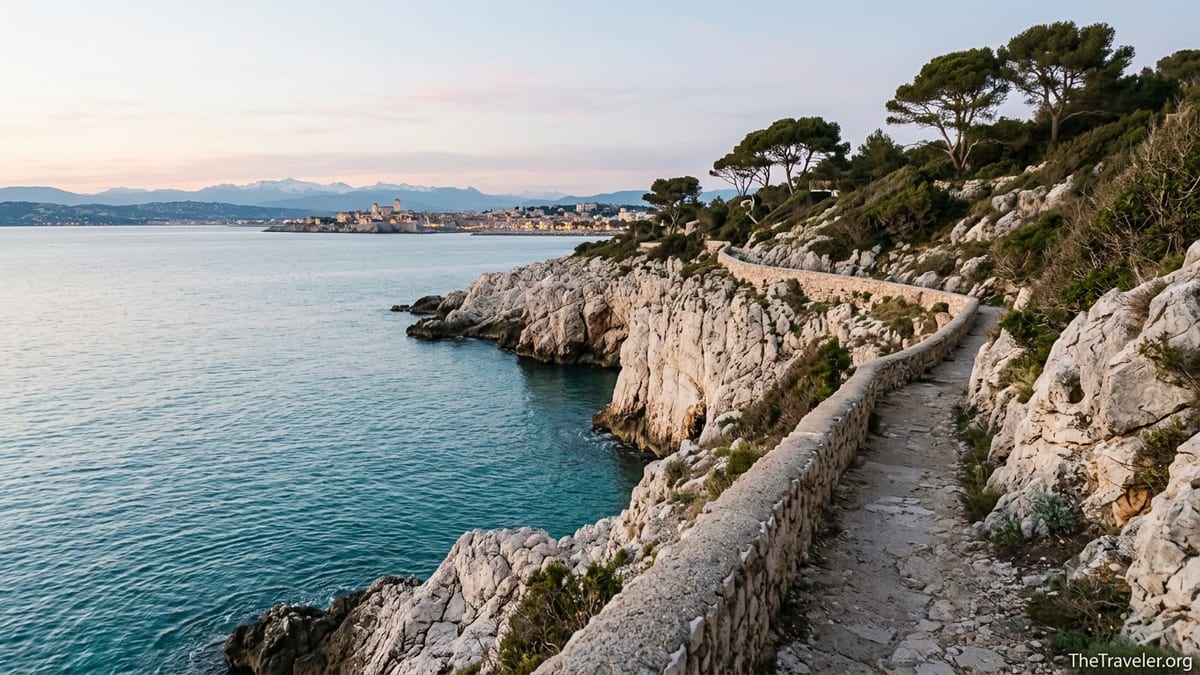
The most spectacular secret of Cap d’Antibes is the Tirepoil coastal path, also called the Sentier du Littoral. Officially it runs for roughly 3 kilometres from Plage de la Garoupe to a point near Villa Eilenroc, at the southern tip of the cape. In practice, many casual visitors walk only a short stretch before turning back. That means large sections of the path, and several wild coves along it, remain surprisingly peaceful even at the height of summer.
The classic starting point is the car park at Plage de la Garoupe, where a low gateway and sign mark the beginning of the path. Underfoot, you will find cut stone, rough concrete and sections of natural rock, with some steps and narrow passages. Good sandals or light hiking shoes make the walk more comfortable. Allow around two hours for a leisurely out-and-back walk, longer if you plan to stop for swims or photographs.
As you follow the path, watch for small, unofficial side tracks that drop down to the sea. Some lead to flat rocks perfect for sunbathing, others to handrails and ladders bolted into the cliffs where locals slip into the water for a quick dip before work. These are not serviced beaches: there are no lifeguards, no facilities and only natural shade from leaning pines. That is precisely their charm. Pack water, reef-safe sunscreen and a small dry bag for your phone and keys, and you can turn any calm day into a private swim stop.
The scenery along Tirepoil feels far removed from the built-up Riviera. On one side, waves crash or lap against white rock, and on the other, thick umbrella pines hide villas behind stone walls. When the sea is calm and the light is clear, you can see across to the Lérins Islands and the red Esterel hills. If you start early, around 8 or 9 in the morning, you will often share the path only with joggers, dog walkers and a few photographers, even during school holidays.
Plage des Ondes and the Western Shoreline
Most visitors who reach the western side of Cap d’Antibes are heading straight for Juan-les-Pins. In doing so, they drive past one of the cape’s loveliest small beaches: Plage des Ondes. This little crescent of sand, facing west across the bay and the Lérins Islands, sits directly below the main coastal road and yet somehow keeps a low profile compared to larger beaches nearby.
Plage des Ondes is public and simple, with a narrow strip of fine sand, shallow water and a small stone jetty with a lone turret-like structure at the end. Families in the know favour it for its gentle gradient and usually calm water, especially in the morning before the afternoon breeze picks up. There are no elaborate facilities, but in summer a seasonal kiosk often appears, selling cold drinks and snacks for a few euros. The nearest bus stop on the road above makes it an easy stop even without a car.
Walk north or south along the roadside pavement and you will find other tiny access points to the sea: staircases dropping between high garden walls, a short lane leading to a concrete platform where locals spread towels, or a small shingle cove invisible from passing cars. These unnamed spots are typical of Cap d’Antibes. They are not signposted, there are no loungers, yet at sunset they fill with nearby residents coming down for a last swim or to watch the sky glow behind the Esterel hills.
If you enjoy photography, aim to reach Plage des Ondes in late afternoon. The west-facing position means golden light on the islands and soft reflections on the water. Even in July, when beaches in Cannes or Nice can feel congested, you may still find space here to sit quietly on the sand and watch small boats bob offshore. Arriving by bicycle from Antibes or Juan-les-Pins makes it easy to stop whenever you spot another promising gap in the wall leading down to the shore.
Plateau de la Garoupe: Lighthouse, Chapel and Pine Forest Calm
High above the beach, the Plateau de la Garoupe offers one of the most atmospheric viewpoints on the French Riviera, yet many beach-focused visitors never make the short climb. From sea level at Garoupe, you can reach the plateau either by a steep but manageable staircase or by following the winding road up through the pines. The reward is a broad terrace shared by the Garoupe lighthouse and a compact religious complex that has watched over sailors for centuries.
The Garoupe lighthouse, one of the strongest on the Mediterranean coast, is a landmark visible for many miles at sea. While the tower itself is not always open to visitors, the surrounding area provides sweeping views over Antibes, Nice and the snow-dusted Alps in the distance on a clear winter day. Benches around the edge invite you to linger with a picnic or simply sit and trace the curves of the coast below, with Cap Ferrat to the east and the red rocks of the Esterel to the west.
Just beside the lighthouse sits the sanctuary of Notre-Dame de la Garoupe, a modest stone chapel with a surprisingly rich interior. Fishermen and sailors have left ex-voto paintings, model boats and plaques here over the years, thanking the Virgin for safe returns. Stepping inside, especially outside the busiest holiday weeks, you may find yourself almost alone in the cool half-light, listening only to the creak of the wooden pews and the faint murmur of wind in the pines outside.
The plateau is circled by sandy paths that thread through low pine forest. These trails are short and easy but offer wonderful spots to read, sketch or let children explore safely away from the road. In the late afternoon, when the heat softens and the sun slants between the trees, the area feels more like a rural hilltop than part of one of Europe’s most famous coastlines. Bringing a simple picnic from Antibes and eating it here can be more rewarding than any restaurant terrace, particularly in spring and autumn.
Batterie du Graillon and the Wild Edge of the Cape
On the eastern side of Cap d’Antibes, tucked between the main road and the sea, lies the Batterie du Graillon, a former coastal battery now integrated into a protected natural area. Many visitors drive past its discreet entrance on their way to the more famous beaches without realising that inside is a pocket world of cliffs, pine forest and maritime history, all free to explore when open.
The site combines low stone ramparts and bunkers with an educational centre focused on the local marine environment. Informative panels and exhibits, some of them interactive, explain the role the headland has played in coastal defence as well as the importance of the surrounding Posidonia seagrass meadows. For travellers with children, it is a welcome change of pace from sand and ice cream, and a chance to give context to the fishing boats and naval vessels seen offshore.
Beyond the small museum area, paths loop through a pinewood that slopes down towards the sea. The terrain is rough in places but not challenging, with viewpoints where you can look back towards Antibes old town or out along the coast towards Nice. There are no formal beaches here, just rocky ledges and small inlets where the sea meets the cliff. It is not a swimming spot in the conventional sense, but on calm days locals sometimes come with a towel to enjoy the solitude and sea air.
Because the Batterie du Graillon is slightly removed from the main tourist flow, it can feel almost eerily quiet outside school visits and occasional special events. If you are spending several days on the peninsula, plan a morning here combined with a picnic at one of the nearby small coves, then continue on foot or by bus to Plage de la Garoupe for an afternoon swim.
Everyday Riviera: Local Stops and Simple Pleasures
The great hidden gem of Cap d’Antibes is not a single beach or viewpoint, but the fact that normal local life still exists behind the postcard images. Step back from the seafront, and you will find small bakeries, corner shops and café-bars that serve residents as much as visitors. Grabbing a coffee for a couple of euros at a simple counter bar on Boulevard du Cap and watching gardeners, dog walkers and delivery vans pass can tell you more about the place than any luxury hotel terrace.
Food on the cape mirrors this duality. Around Garoupe and along parts of the western shore, you will see high-end restaurants attached to beach clubs and hotels, where a plate of grilled fish can cost several times more than in central Antibes. At the same time, small pizzerias and snack stands on the inland roads serve slices, salads and daily specials at modest prices. One practical strategy is to enjoy the natural setting of Cap d’Antibes but eat one or two main meals back in town, where the choice is larger and prices broader.
For self-caterers renting an apartment or staying in a campsite inland, Cap d’Antibes becomes a series of picnic backdrops. Buy fresh produce and bread in Antibes’ covered market or a neighbourhood supermarket, then bring it to the plateau, a quiet rocky platform off the Tirepoil path, or the grassy edge above Plage des Ondes. A compact cooler bag and reusable bottles let you stay out longer without relying on expensive terrace drinks every couple of hours.
Evenings are another moment when the peninsula reveals a softer side. After day visitors have left, residential streets empty and cicadas take over the soundtrack. Sitting on a low wall watching the lights of Antibes old town flicker across the bay, or strolling a short stretch of the coastal path as the sky turns pink, costs nothing and feels worlds away from the crowded promenades of larger Riviera resorts.
The Takeaway
Cap d’Antibes is known worldwide, but much of what makes it special remains surprisingly low key. Away from the famous beach clubs and gated villas, the peninsula still offers public paths, modest chapels, simple snack bars and wild corners of rock and pine where you can sit in silence above the sea. By shifting your focus from “must-see” addresses to slow exploration, you will discover a version of the Riviera that locals quietly cherish.
Plan to walk at least part of the Tirepoil coastal path, even if only for an hour, and make time to climb to the Plateau de la Garoupe. Seek out small public beaches like Plage des Ondes instead of defaulting to the largest options, and do not hesitate to turn down unmarked lanes leading towards the sea. With sensible footwear, water and a flexible schedule, you can weave your own network of hidden spots that no guidebook map fully captures.
Above all, remember that Cap d’Antibes rewards those who linger. An early-morning swim from a rocky ledge, a quiet half hour inside the chapel above the bay, or an impromptu picnic in the pines can become the moments you remember long after the marquee addresses have blurred together. In a region famous for spectacle, the peninsula’s greatest luxury may still be its pockets of simplicity.
FAQ
Q1. Is the Tirepoil coastal path suitable for children and casual walkers?
The Tirepoil coastal path is manageable for reasonably active children and adults, but it does include uneven surfaces, steps and narrow sections. Sturdy footwear is important, and families often choose to walk only part of the trail before turning back. In hot weather, start early and carry enough water, since there are no cafés or shops directly on the path.
Q2. When is the best time of year to explore Cap d’Antibes’ hidden spots?
Late spring and early autumn are ideal, typically from May to early June and again from late September into October. During these months, the sea is often warm enough for swimming, but the paths and small beaches are far less crowded than in July and August. Winter can also be beautiful for hiking and views, though some coastal access may be closed during storms or strong winds.
Q3. Can I visit Cap d’Antibes without a car?
Yes, it is entirely possible. Local buses run from central Antibes to stops near Plage de la Garoupe and along the main road around the cape, and tickets are usually inexpensive. Many visitors also rent bicycles or e-bikes to circle the peninsula, combining coastal viewpoints with short inland detours. Walking from Antibes to the cape takes around 30 to 45 minutes, depending on your pace and starting point.
Q4. Are there truly quiet places on Cap d’Antibes in peak summer?
Even in July and August, you can still find relative calm if you avoid the busiest times and places. Early mornings on the Tirepoil path, small unnamed rocky access points along the western shore and the pine trails around the Garoupe plateau remain quieter than the main beaches. Arriving before 9am or staying out near sunset helps you experience the peninsula with fewer crowds.
Q5. Do I need to pay to access the hidden coves and viewpoints?
Most of the spots described, including the Tirepoil path, small public beaches like Plage des Ondes and the Garoupe plateau, are free to access. You only pay for optional extras such as private beach clubs, restaurant meals or parking in certain car parks. Carry some cash or a card for cafés and kiosks, but you can easily spend a full day on the cape without significant expenses.
Q6. Is swimming safe from the rocky platforms along the coastal path?
Swimming from rocky platforms and ladders is common among locals in calm conditions, but it is unsupervised and requires caution. There are no lifeguards, and waves or swell can make exits difficult. Always assess the sea before entering, avoid going alone, and stay well clear of the water when the forecast mentions strong winds or rough seas. Families with young children may prefer the gentler entry at small sandy beaches instead.
Q7. How can I combine Cap d’Antibes with a day in Antibes or Juan-les-Pins?
A practical plan is to start in Antibes old town, visit the market or Picasso Museum, then walk or take a short bus ride to the cape for an afternoon swim and sunset views. Alternatively, spend the morning on a quiet beach or the coastal path, then head back to Antibes or Juan-les-Pins for dinner and nightlife. The peninsula sits between the two towns, so it is easy to move between them by bus, bike or taxi.
Q8. Are there facilities like toilets and showers at the smaller beaches?
Facilities are limited at the smallest coves and rocky access points. Larger beaches such as Plage de la Garoupe and, to a lesser extent, Plage des Ondes usually have seasonal public toilets and sometimes freshwater showers nearby. When planning to use a more secluded spot, go prepared, and remember that leaving no trace is important. Pack out any rubbish, and avoid using soaps or shampoos in the sea.
Q9. What should I pack for a day exploring Cap d’Antibes’ hidden gems?
A small daypack with water, snacks or a picnic, reef-safe sunscreen, a hat and light cover-up is useful in all seasons. Add sturdy sandals or walking shoes for the coastal paths, a swimsuit and quick-drying towel for spontaneous swims, and perhaps a lightweight windbreaker if you are visiting outside high summer. A compact dry bag can protect your phone and keys when you are close to the water.
Q10. Is Cap d’Antibes a good base for exploring the wider French Riviera?
Cap d’Antibes itself is quiet and residential, better suited to travellers who value calm evenings and daily access to nature. Thanks to frequent trains and buses from nearby Antibes and Juan-les-Pins, it also works as a restful base for day trips to places like Nice, Cannes and the hill villages inland. If you prefer a livelier nightlife, you might choose to stay in town and treat the cape as your favourite nearby escape.