


The Uffizi Gallery is one of those places that travelers dream about for years and then try to “do” in 90 frantic minutes between a Duomo climb and a winery tour. With more than a kilometer of corridors, hundreds of rooms, and many of the most famous paintings in Western art, the Uffizi rewards time, calm, and a bit of strategy. With some planning, you can turn a potentially exhausting box-tick into one of the most memorable, unhurried experiences of your trip to Florence.
Get the latest updates straight to your inbox!
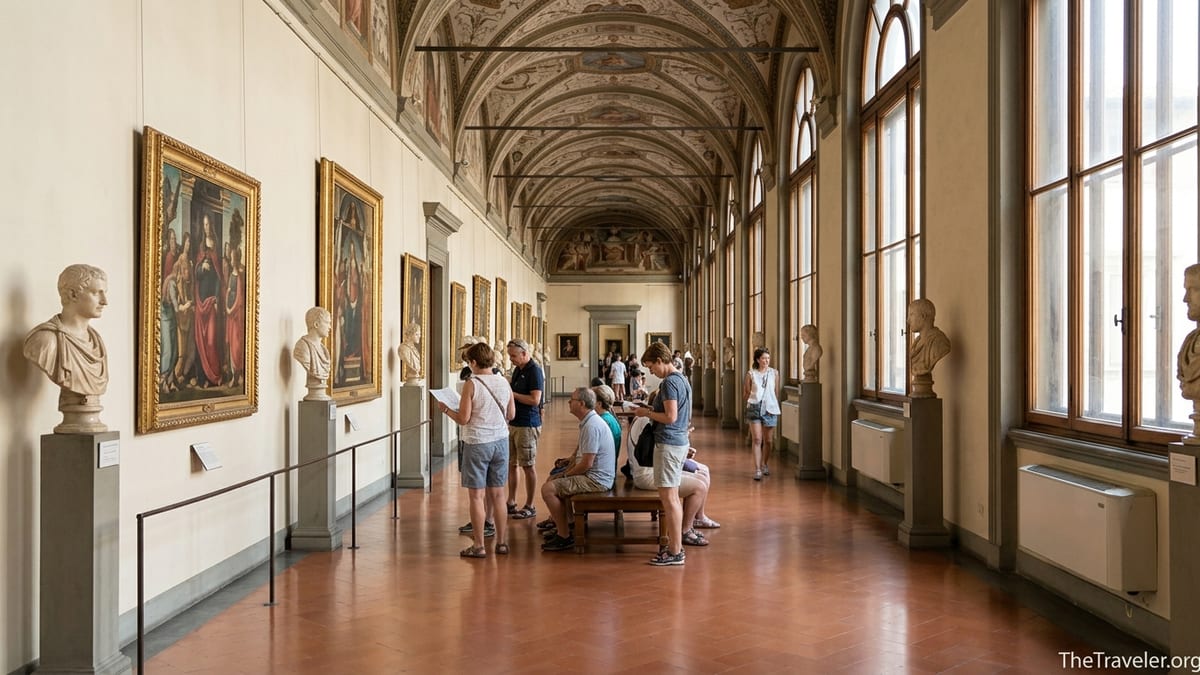
Know What “Not Rushed” Really Looks Like at the Uffizi
One of the biggest mistakes visitors make is underestimating how large and dense the Uffizi is. Guides that work regularly in the museum often recommend at least 3 hours for a comfortable visit, and around 4 hours if you want to pause, sit, and revisit favorite works. That is a very different experience from the one-hour sprint many people try to squeeze in before lunch.
Think of the Uffizi like a small airport: there are security checks, ticket control, and crowd bottlenecks around the botticelli rooms and the Caravaggio gallery. In high season, even with a timed ticket, you may wait 10 to 20 minutes at the entrance. Building this reality into your schedule is the first step to not feeling rushed. If you have only one full day in Florence, dedicating half of it to the Uffizi is not indulgent. It is realistic.
A practical benchmark: if you arrive at 8:15 a.m. opening, plan to leave no earlier than 11:30 a.m. or noon. If you enter around 3:00 p.m., expect to emerge around early evening. Travelers who try to stack a timed Uffizi entry at 3:30 p.m. and a 5:00 p.m. Brunelleschi’s Dome climb often report feeling stressed, constantly checking the clock instead of the paintings.
Ask yourself what kind of memory you want: a blur of crowds and quick snapshots of The Birth of Venus, or a quieter half-morning where you actually notice details like the shimmering seashell edges or the Tuscan hills in the background of Leonardo’s Annunciation. The answer will guide how much time you need to set aside.
Book Smart: Timed Tickets, 5-Day Passes and When to Go
The Uffizi uses timed entry tickets, which function as a basic crowd-control system. On the official booking platform, you choose a 15-minute entry window, pay the ticket price plus a small reservation fee, and are instructed to show up at a specific gate at that time. In busy months like May, June and September, many prime morning slots can sell out days or weeks in advance.
For most independent travelers, a timed entry around 8:15–8:30 a.m. or mid-afternoon around 3:00 p.m. offers the best balance. At opening, groups are just coming in, the botticelli rooms are still relatively calm, and you have fresher energy. In the mid-afternoon, day-trippers start to thin out and you can ride the last two hours into closing. Late arrivals at 5:30 p.m. may feel rushed, because there is usually only about 60–90 minutes before staff begin gently ushering visitors out of the upper floors.
If the Uffizi will be a centerpiece of a longer Florence stay, consider the official Passepartout 5-day ticket issued by the Gallerie degli Uffizi. Priced around 40 euros for adults, it includes timed entry to the Uffizi plus one visit to Palazzo Pitti and one to the Boboli Gardens over five consecutive days. You must visit the Uffizi first, but then you can stroll the hillside gardens or return for palace interiors on another day without more reservations. Travelers who bought this pass in 2025 and 2026 often report that stretching the art across multiple mornings made them feel less pressure to consume everything in one go.
Guided small-group tours can also help pace your visit, especially if you feel intimidated by art history. A typical 2-hour English-language tour starting at 8:15 a.m. might cost in the range of 40–70 euros per person, including your ticket. Once the tour ends, you are free to remain in the museum and explore at your own rhythm. Many visitors use this structure to get oriented, then double back to personal favorites after the guide leaves.
Build a Focused, Human-Sized Route Through the Museum
Not feeling rushed in the Uffizi means accepting that you will not see everything. Even Florentines who work in the city’s cultural sector will admit they discover new corners after years of visits. The trick is to build a focused route that aligns with your interests instead of mechanically walking every corridor.
A classic, relaxed route for first-timers starts on the upper floor in the early Renaissance rooms, moves through the botticelli rooms for The Birth of Venus and Primavera, continues into Leonardo and Michelangelo, then dips into the later galleries with Titian, Raphael and Caravaggio. If you decide in advance that your “must sees” are these big Renaissance highlights plus a few surprises, you can skip whole corridors that interest you less, such as some of the later foreign painting rooms.
One practical example: a couple with a 10-year-old visited on a spring Saturday with a 9:00 a.m. timed entry. They used a paper map from the information desk, circled three priorities (Botticelli, Leonardo, Caravaggio), and agreed that everything else would be “bonus.” They stopped at the windows overlooking the Arno to enjoy the view toward Ponte Vecchio, took a break at the café terrace after about 90 minutes, and finished around noon without feeling depleted. They skipped half the self-portraits corridor and the later Mannerist painters by choice, not by accident.
You can also theme your visit. If you love portraits, spend more time in the Medici portraits and the self-portrait corridor. If mythological scenes fascinate you, move slowly through the rooms with Venus, Medusa, and Bacchus, reading the short labels to follow how pagan stories evolve over centuries. Intentionally ignoring certain areas frees you from the pressure to “cover” the museum and creates a calmer headspace.
Slow Looking: How to Actually Experience a Few Masterpieces
Once you are inside, the temptation is to photograph everything quickly. A more rewarding approach is to choose a handful of works for “slow looking,” spending five full minutes or more at each. In the Uffizi, that might mean planting yourself in front of Botticelli’s The Birth of Venus, Michelangelo’s Tondo Doni, Leonardo’s Annunciation, a Raphael Madonna, and at least one Caravaggio such as Medusa or Bacchus.
Pick one painting, step back several meters to see the whole composition, then move closer to notice details: the folds of Venus’s hair, the tiny flowers in the meadow around Primavera’s dancing figures, or the reflection of Medusa’s face on the polished shield. Ask simple questions in your head: Who is looking at whom? Where is the light coming from? Which details feel oddly modern? This kind of deliberate questioning slows your mind down in the middle of a busy gallery.
Some travelers print or download one or two short essays about specific paintings beforehand, then read them quietly on a bench in front of the work. A Florence visitor in 2024 described reading a one-page commentary on Caravaggio’s Bacchus while sitting in front of it for ten minutes. Instead of trying to understand the entire Baroque section, they left with a vivid memory of that one canvas: the slightly dirty fingernails of the wine god, the almost photographic still life of fruit, and the way Caravaggio used light to make the glass goblet glow.
If you find standing tires you quickly, look for benches along the corridors and in some of the larger rooms. Sitting while you look at a painting allows you to stay with it longer without your body pushing you onward. Even pausing at a window to gaze out over the dome of the Duomo or down to the river acts as a reset button, preventing the “museum fatigue” that often hits after an hour.
Use Breaks, Food and Nearby Walks to Avoid Overload
Another way to keep the Uffizi from feeling rushed is to consciously build breaks into your plan. The museum has a rooftop café with outdoor seating that overlooks the inner courtyard and the Palazzo Vecchio tower. Prices are somewhat higher than a bar on a side street in Oltrarno, but an espresso or a small pastry here buys you fifteen or twenty minutes of rest and a chance to process what you have seen. Many visitors plan this break right after the botticelli and Leonardo rooms, about 90 minutes into the visit.
Timing your visit around meals also affects how hurried you feel. A morning visit that ends around 12:00 or 12:30 p.m. pairs well with a sit-down lunch nearby, perhaps at a simple trattoria a few blocks away in the Santa Croce or Sant’Ambrogio neighborhoods rather than the most touristy places on Piazza della Signoria. Arriving at a restaurant at 1:00 or 1:30 p.m. gives you a chance to sit, cool down in air conditioning or under a fan, and talk through favorite works over a plate of ribollita or tagliatelle with porcini mushrooms.
If you choose an afternoon visit, consider a relaxed gelato or aperitivo afterward instead of racing straight to another timed attraction. For example, with a 3:00 p.m. Uffizi entry, you might leave around 6:30 p.m. and walk five minutes across the river toward the Santo Spirito area for an early aperitivo. Sitting with a spritz or a glass of local Chianti in a quieter square helps you decompress and turns the museum visit into a full, rounded experience instead of an isolated task.
For those holding the Passepartout 5-day ticket, spreading the art over more than one day is powerful. You might plan the Uffizi on day one, then use the pass to wander Boboli Gardens in the late afternoon of day two. The uphill paths, fountains, and views back toward the Duomo give you a physical and mental counterweight to the indoor intensity of the gallery.
Combine the Uffizi with the Right Amount of Florence
It is common to treat the Uffizi as just one checkbox on a very dense Florence day: Duomo climb at 9:00, Uffizi at 11:30, quick sandwich by the river, Accademia at 2:00, and sunset at Piazzale Michelangelo. This sort of itinerary almost guarantees you will feel rushed. A better approach is to pair the Uffizi with lighter activities that do not have fixed entry times.
For instance, a balanced day might look like this: timed Uffizi entry at 8:30 a.m., café break at 10:00 a.m., exit around 11:30 a.m., leisurely walk across Ponte Vecchio into the Oltrarno district, lunch at a neighborhood osteria, then a flexible stroll through artisan workshops near Via Maggio or Borgo San Frediano. None of these later stops require tickets or queues. You can linger or head back to your hotel for a nap without worrying about missing a slot.
Travelers who stayed near Santa Maria Novella station have described another relaxed pattern: Uffizi in the morning, light panini lunch near the river, mid-afternoon rest at the hotel, then an evening passeggiata under the Duomo and a simple dinner in the San Lorenzo area. By giving the museum top billing early in the day and leaving the rest of the schedule open, they avoided the constant low-level anxiety of “will we make it on time” that often creeps in when you stack multiple ticketed attractions.
If you have multiple days, avoid visiting both the Uffizi and the Accademia Gallery on the same day unless you are truly passionate about art. The Accademia’s highlight, Michelangelo’s David, is monumental but concentrated; it fits beautifully on a different morning or late afternoon. Many travelers report that seeing David a day or two after the Uffizi allows them to appreciate both more fully.
Practical On-the-Ground Tips to Keep Things Calm
Small, concrete choices inside the building can make a big difference to how rushed you feel. Arrive 20 to 25 minutes before your timed entry so you can find the correct gate, pass security, and orient yourself without panic. In high season, the line for timed-ticket holders moves reasonably but still involves a short wait; building this into your mental schedule prevents frustration.
Travel light. A compact daypack with a water bottle, light scarf, and maybe a guidebook or folded notes is sufficient. Large backpacks may need to be left at cloakrooms, adding time and an extra logistical step. Wear comfortable shoes, because the museum’s long corridors and marble floors can be surprisingly tiring, especially if you are also walking Florence’s cobbled streets all day.
Inside, resist the urge to walk in lock-step with tour groups. If you see a group crowding around Primavera, for example, step into the neighboring room for five minutes and return when the group has moved on. This simple tactic can turn a chaotic, shoulder-to-shoulder experience into a more contemplative encounter with the same painting.
Finally, give yourself permission to leave before you are completely exhausted. Many visitors feel compelled to “get their money’s worth” and push through until they are cross-eyed and irritable. Instead, pay attention to the moment when your attention starts to fray. If you catch yourself walking past Raphael and not caring, that is a sign to head down toward the exit, stop at the bookshop if you like, and reclaim the rest of your day.
FAQ
Q1. How long should I plan for a relaxed visit to the Uffizi Gallery?
A visit of about 3 to 4 hours works well for most people who want to see the main highlights, take a break at the café, and do some slow looking without feeling rushed. Less than 2 hours usually feels hurried, especially in peak season.
Q2. What is the best time of day to visit the Uffizi to avoid crowds and stress?
The calmest experiences are usually at opening time around 8:15–8:30 a.m. or in the mid-afternoon around 3:00 p.m. Early slots let you start fresh and reach the botticelli rooms before they are packed, while later slots benefit from day-trip groups leaving the city, though you will have fewer hours before closing.
Q3. Is the 5-day combined Uffizi, Pitti Palace and Boboli Gardens ticket worth it?
For travelers staying in Florence at least two or three full days, the official Passepartout 5-day ticket, which includes one entry to each site over five consecutive days, is often good value. It costs around 40 euros and lets you spread your cultural visits across several mornings instead of cramming them into one exhausting day.
Q4. Do I need a guided tour to enjoy the Uffizi without feeling overwhelmed?
No, but a small-group or private tour can help structure your time. A typical 2-hour English-language tour with timed entry introduces the key works and stories, and then you can remain in the museum afterward to revisit your favorites at your own pace. Independent visitors can achieve a similar effect by choosing a handful of must-see works in advance and following a simple route.
Q5. How far in advance should I book Uffizi tickets in busy months?
In popular periods such as late spring and early autumn, book timed tickets at least one to two weeks ahead for prime morning slots, and several days ahead even for afternoon entries. For shoulder seasons, a few days’ notice is often enough, but last-minute same-day tickets can still sell out at popular times.
Q6. Can I leave the Uffizi and come back later the same day?
Standard single-entry tickets do not allow re-entry once you have exited the museum. The idea is to plan one continuous visit, including an internal café break if you need rest. If you want to spread art across days, use the combined 5-day ticket to visit related sites like Palazzo Pitti and Boboli Gardens on other days instead.
Q7. What should I prioritize if I only have 2 hours inside?
With just 2 hours, focus on the upper-floor Renaissance core. Head directly to the botticelli rooms for The Birth of Venus and Primavera, then on to Leonardo, Michelangelo’s Tondo Doni, Raphael and a few Caravaggios. Accept that you will not see everything and skip entire sections that interest you less so you can spend real time with a dozen masterpieces instead of rushing past fifty.
Q8. Is the Uffizi suitable for children without everyone feeling hurried or bored?
Yes, if you plan for a shorter, more focused route. Choose a handful of visually striking works, like mythological scenes with gods and monsters, and let children help find details such as animals, fruits, or strange creatures in each painting. Build in a snack break at the café and keep the total visit to around 90 minutes to 2 hours for younger kids.
Q9. How can I combine the Uffizi with other Florence sights without overloading my day?
Pair the Uffizi with flexible, low-pressure activities instead of multiple timed tickets. For example, visit the Uffizi in the morning, have a relaxed lunch, then stroll across Ponte Vecchio into the Oltrarno district to explore artisan shops or Boboli Gardens. Save other ticketed landmarks such as the Duomo climb or Accademia for a different day.
Q10. What should I wear and bring for a comfortable, unhurried visit?
Wear comfortable walking shoes and light, breathable clothing suited to the season. Bring a small bag with a water bottle, a light scarf or layer for cooler rooms, and any notes or a compact guide to a few key works. Avoid large backpacks that must be checked, as cloakroom stops add time and can interrupt the calm rhythm of your visit.