


Across the major cruise lines, Christmas and New Year sailings have shifted from a pleasant last-minute idea to some of the hardest cabins to secure in travel. Travel advisors now talk about families booking Christmas at sea one or even two years ahead, and cruise lines report record advance ticket sales as holiday departures disappear from inventory long before summer is over. For travelers who grew up seeing December cruises discounted in fall, the speed at which Christmas sailings sell out has become one of the clearest signs of how cruising, and holiday travel more broadly, has changed.
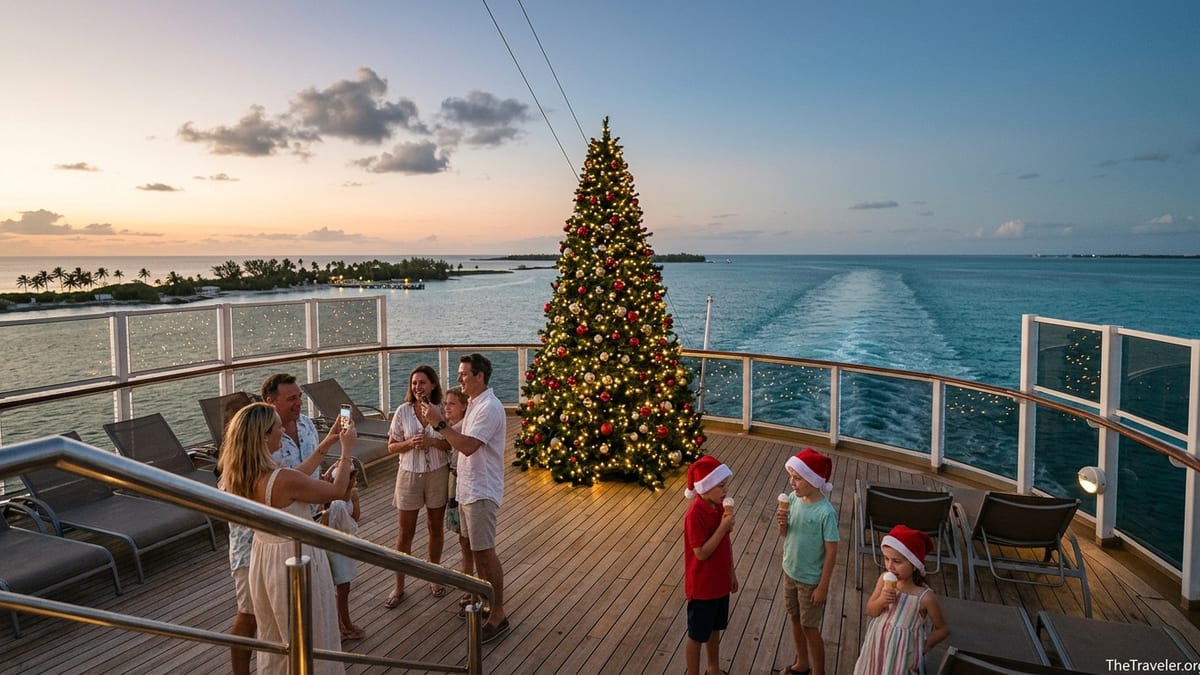
The New Reality: Holiday Cruises as Peak-Season Prizes
In the past, cruising at Christmas was a niche choice. Today it sits alongside spring break and midsummer as a peak period, priced and booked accordingly. Industry booking data from cruise-focused agencies shows that December sailings, particularly those departing between December 20 and January 2, now book out many months earlier than comparable shoulder-season voyages. Advisors report that Caribbean itineraries on mainstream lines such as Royal Caribbean, Carnival Cruise Line, Norwegian Cruise Line, and MSC Cruises frequently show limited cabin availability a full year before departure, especially for family cabins and suites.
Recent financial reports underline the shift. Norwegian Cruise Line Holdings reported a record advance ticket sales balance of around 3.2 billion dollars at the end of 2024, a level executives tied directly to strong demand for peak periods like school holidays and year-end celebrations. Carnival Corporation has separately highlighted new peak booking levels across its brands, with some lines noting record January booking days for future seasons. While these numbers include all dates, agents on the front line consistently describe Christmas week as among the quickest to disappear from the inventory.
Concrete examples are easy to find. By early spring, travelers looking for a seven-night Christmas 2025 Caribbean cruise on newly popular mega-ships such as Royal Caribbean’s Icon of the Seas or Utopia of the Seas often find only scattered inside cabins or high-end suites remaining, with mid-range balcony categories largely sold out. Even smaller-ship lines that once had last-minute space, such as luxury and expedition brands, now report Christmas voyages filling steadily as repeat guests lock in their preferred itineraries a year or more in advance.
The practical message for travelers is straightforward. A Christmas cruise can no longer be treated as a flexible, last-minute alternative to a resort stay. Instead, it demands the same early-planning mindset as securing a ski chalet for New Year’s Week or a beachfront villa during school holidays. Waiting to see if prices drop into the fall often means accepting less desirable cabins, fewer itinerary choices, or no availability at all.
Post-Pandemic Demand and the Rise of “Revenge Holiday Travel”
The sell-out pace of Christmas cruises is tightly linked to the broader surge in post-pandemic travel demand. After years of disrupted plans, many families and multigenerational groups are prioritizing shared experiences over material gifts, turning Christmas into a chance for a big-ticket trip. Airline data has already shown that Christmas season flight bookings are running slightly ahead of recent years, and cruise demand has followed a similar pattern, contributing to record global passenger counts and strong forward bookings.
Cruise lines emerged from the pandemic with a large backlog of guests holding future cruise credits. That pool of travelers, many of whom were determined to rebook for meaningful occasions, helped fill peak dates quickly once sailing programs restarted in full. Advisors routinely describe clients who originally intended a simple Caribbean cruise eventually trading up to a Christmas or New Year departure as a way to “make up” for lost time. For a seven-night Western Caribbean sailing that might have cost a family of four around 3,000 dollars before the pandemic, it is not unusual now to see Christmas week pricing closer to 4,500 dollars or more for a balcony cabin, with those cabins still selling out months ahead.
Another factor is the growing willingness to plan far in advance. Industry surveys from global cruise associations show that travelers are now booking cruises roughly seven months out on average across the calendar, up notably from historic patterns, and that holiday sailings skew even earlier. Travel agents commonly report clients booking Christmas 2026 cruises in late 2024, particularly when a new ship or a special itinerary is involved. On online cruise forums, it is no longer surprising to see travelers counting down 500 or 600 days to a holiday sailing they booked as soon as itineraries opened.
This “revenge holiday travel” mentality has turned Christmas cruises into emotional milestones. Rather than debating whether a late-December sailing is worth a premium, many guests view the higher cost as justified by the rarity of getting the entire family together at sea. That mindset makes travelers less sensitive to price increases and more focused on securing a spot at all, further accelerating how quickly these voyages sell out.
Why Families Are Choosing the Ship Over the Living Room
At the heart of the Christmas-cruise boom is a simple calculation: for many families, spending the holiday at sea feels easier, more predictable, and surprisingly comparable in price to a complex land-based trip. Parents of school-age children often face crowded airports, expensive flights, and pressure to organize elaborate gatherings at home. In contrast, a cruise combines transportation, lodging, meals, activities, and entertainment in one place, with none of the cooking or cleanup.
Consider a typical U.S. family of four looking at December 21 to 28. Flying from the Midwest to Florida and staying at a mid-range beachfront resort can easily reach several hundred dollars per night for lodging and elevated holiday airfares. Add restaurant meals, rental car, resort fees, and a few theme park or excursion days, and total costs can rival or exceed a mainstream seven-night Christmas cruise fare. While a balcony cabin over Christmas may run higher than in September, it bundles much of the trip’s core spending into a single upfront price that families can pay off over time.
Onboard, the appeal is practical as well as emotional. Big-ship lines schedule Christmas parades, sing-alongs, tree-lighting ceremonies, and special dinners, alongside kids’ clubs and teen lounges that stay open with extended hours. Parents gain built-in childcare options and a steady program of supervised activities, which would be costly to replicate at a land resort. Grandparents often appreciate accessible cabins, elevators, and medical facilities, making it easier to bring three generations together.
Real-life booking patterns reflect this dynamic. Travel advisors in cruise-heavy markets regularly see extended families blocking out multiple balcony cabins or suites on the same deck a full 12 to 18 months in advance. On select popular sailings to destinations like the Eastern Caribbean or Mexico’s Riviera Maya, it is common for group coordinators to place deposits on a dozen or more cabins as soon as Christmas week itineraries are released. Once these larger bookings are in the system, the remaining inventory tightens quickly for individuals hoping to book later.
New Ships, Bigger Amenities, and Limited Holiday Space
The hardware of the cruise industry also helps explain why Christmas departures disappear so quickly. In recent years, major brands have introduced high-profile new ships packed with water parks, ice rinks, multi-story entertainment complexes, and exclusive private-island access. Vessels such as Royal Caribbean’s Icon of the Seas, which entered service in 2024 as one of the largest cruise ships in the world, and Utopia of the Seas, a newer Oasis-class ship operating short Caribbean itineraries, have become headline attractions in themselves. Holiday sailings on these vessels often sell out first, as families aim to combine Christmas with a coveted new-ship experience.
Even when overall fleet capacity grows, truly prime holiday space remains limited. Each large ship can sail only one or two Christmas-season itineraries per year. A seven-night voyage that departs on December 21 or 22 effectively captures the core of the holiday week, and lines may schedule just one such cruise per ship. That means a brand with ten Caribbean-based ships might offer only about ten departures that fully cover Christmas Day in any given year, an inherently small pool of sailings relative to global demand.
Private-island days intensify competition further. Many lines now feature their own destinations in the Bahamas or Caribbean, developed with beaches, water parks, and cabanas that are particularly popular for family photo moments on Christmas Eve or Christmas Day. Because there are only so many pier berths and beach cabanas to go around, the voyages that include these ports in late December become especially sought after. Travelers hoping for a cabana at a marquee private island during a Christmas sailing frequently discover they must book as soon as onboard activity reservations open, with prime spots disappearing in minutes.
Luxury and expedition segments face similar constraints. Smaller ships with under 1,000 guests may have waitlists for Christmas in regions like Antarctica, the Galápagos, or the Mekong River, despite prices that can climb into the five figures per person. With only one or two departures positioned around the holiday, these itineraries attract a mix of repeat cruisers and well-traveled families looking to turn Christmas into a once-in-a-lifetime journey, further shrinking availability.
Pricing, Perception of Value, and the Vanishing “Last-Minute Deal”
Historically, travelers could sometimes count on last-minute discounts if they were flexible about destination and cabin type. In the current environment, that strategy rarely works for Christmas sailings. Cruise lines, armed with more sophisticated revenue-management systems and enjoying strong overall demand, have little incentive to cut prices on peak holiday weeks that are pacing far ahead of historical norms. Instead, fares often rise as cabins sell, rewarding those who book early rather than those who wait.
Travel agents and frequent cruisers increasingly recommend locking in Christmas cruises as soon as itineraries open, sometimes two years ahead, especially when sailing on flagship ships from popular ports such as Miami, Port Canaveral, Galveston, or Los Angeles. Many lines offer price-protection policies or fare-adjustment mechanisms for certain rate categories, allowing early bookers to request a lower price or onboard credit if a sale briefly dips below their original fare before final payment. In practice, though, advisors note that genuine downward moves on Christmas week are relatively rare compared with off-peak months like September or early December.
For a concrete example, consider a seven-night Western Caribbean sailing from Florida over Christmas. In the lowest-demand weeks of the year, an interior cabin on a mainstream line might start around 600 to 800 dollars per person before taxes and fees. Over Christmas, that same category can easily be 1,200 to 1,500 dollars per person or more, with balconies priced substantially higher. Despite the premium, cabins still vanish quickly, indicating that travelers perceive the bundled value of a festive, all-in-one holiday resort at sea as worth the extra cost.
The perception of value also extends to onboard spending. Guests tend to allocate a holiday budget that includes specialty dining, shore excursions, and spa treatments as part of the overall experience. Cruise companies recognize that a sold-out ship over Christmas not only fills cabins at strong fares but also produces higher onboard revenue from gift shops, photo packages, and holiday-themed experiences. This reinforces the incentive to keep inventory tight and protects holiday pricing from the discounting that might occur in slower months.
How Booking Behavior Is Changing: From Impulse to Long-Range Planning
The speed at which Christmas cruises sell out reflects a broader cultural shift toward long-range trip planning. Surveys cited in global cruise industry reports show that nearly one-third of cruisers say they prefer to book more than a year in advance for important vacations, and that share rises when children or elderly relatives are involved. The complexity of coordinating multiple households, school schedules, and limited vacation days naturally pushes families to lock in dates earlier.
Online discussions among cruisers illustrate this change well. Travelers now routinely mention having two or three future cruises already on the books, including holiday sailings more than a year away. One common pattern is for guests to book their next Christmas trip while still onboard their current cruise, taking advantage of a small deposit or onboard booking incentives. In some cases, families will book a placeholder Christmas sailing purely to secure a cabin, then adjust the exact itinerary or ship once more details about school calendars or work commitments emerge.
At the same time, many travelers have learned from experience that waiting can mean disappointment. Guests who once relied on late-year sales now find that by the time November rolls around, Christmas week has only a handful of cabins remaining, often in less-desired locations such as low decks near public spaces or very high decks under the pool. Those who need adjoining cabins for children or accessible staterooms for mobility needs discover that these specialized categories are among the first to sell out, sometimes disappearing more than a year ahead of time.
This change in behavior is self-reinforcing. The more travelers hear that Christmas cruises book up quickly, the more they plan ahead, which in turn pushes sell-out dates even earlier. For the cruise lines, the trend offers financial predictability and a strong buffer of advance revenue. For travelers, it creates a new norm: treating a Christmas cruise as a fixed-date event to be reserved far in advance, much like a major concert or sporting event.
Smart Strategies if You Still Want Christmas at Sea
Despite the sell-out headlines, it is still possible to secure a Christmas cruise without booking years in advance, especially for travelers who can be flexible about ships and exact dates. One strategy is to look slightly outside the core holiday week. Sailings that depart in mid-December and return just before Christmas can offer much of the festive onboard atmosphere with lower fares and better availability. Similarly, voyages that sail over New Year’s but miss Christmas Day itself sometimes book at a slightly slower pace.
Another practical tactic is to consider alternative homeports and itineraries. While departures from Florida and Texas to the Caribbean understandably fill quickly, ships sailing from ports such as Baltimore, New Orleans, San Diego, or San Juan may retain inventory longer, especially in less traditional regions like the Eastern Pacific or Southern Caribbean. Choosing an inside stateroom instead of a balcony, or accepting flexible dining times instead of prime seating, can further expand options when availability is tight.
Working with a cruise-focused travel advisor can also make a difference. Advisors often receive early notice when future Christmas itineraries are about to be released, allowing them to place holds the day bookings open. They can monitor fare changes and handle waitlists if a preferred cabin category is sold out. For example, an advisor might know that a line will be deploying a new ship to a particular port for winter 2027, and can alert loyal clients to reserve Christmas week as soon as those sailings appear in the system.
Finally, for truly last-minute planners, there are occasional surprises. Not every ship sails at 100 percent capacity, and occasional cancellations or group releases can free up cabins even in December. Guests who live within driving distance of a major port and can travel on short notice sometimes snag a Christmas sailing just a few weeks out, but they typically do so by being open to any ship, cabin type, or itinerary that becomes available. For most travelers, though, the surest path to a memorable Christmas at sea remains early and deliberate planning.
The Takeaway
Christmas cruises are selling out faster every year because they sit at the intersection of several powerful trends: a post-pandemic appetite for shared experiences, strong global demand for cruising, the emotional pull of stress-free family holidays, and a finite supply of peak-season sailings on the newest and most amenity-rich ships. For cruise lines, the result is record advance bookings and full ships over the festive period. For travelers, it means that spontaneity is giving way to strategy when it comes to celebrating Christmas at sea.
Travelers weighing whether to trade the living room for a lido deck need to think in terms of the coming two holiday seasons, not just the next few months. Those who can plan a year or more in advance, remain flexible on itineraries and cabin types, and work with advisors who understand the nuances of holiday pricing will find the best options and value. For everyone else, the lesson is clear: if the idea of unwrapping presents under palm trees while a ship’s horn sounds a Christmas tune appeals, it is wise to reserve that experience early. The era of waiting for last-minute Christmas cruise deals is largely over, replaced by a new reality where the most magical week of the cruising year tends to sell out first.
FAQ
Q1. How far in advance should I book a Christmas cruise?
Most travelers should plan to book Christmas cruises at least 9 to 12 months in advance, and up to 18 to 24 months ahead for new ships, suites, or specialty itineraries.
Q2. Are Christmas cruises always more expensive than other weeks?
Christmas and New Year sailings usually carry a noticeable premium compared with off-peak weeks, but they bundle lodging, meals, and entertainment, which can still compare favorably with complex land trips.
Q3. Do any cruise lines offer last-minute deals on Christmas sailings?
Occasionally, a ship with unexpected cancellations may discount close to departure, but true last-minute bargains for Christmas week are less common than in slower months.
Q4. Which destinations are most popular for Christmas cruises?
The Caribbean and Bahamas are the top choices, followed by Mexico’s Pacific coast, the Canary Islands, and select warm-weather itineraries such as the Persian Gulf and Southeast Asia.
Q5. Is a Christmas cruise suitable for multigenerational families?
Yes. Modern ships are designed to serve children, parents, and grandparents at once, with kids’ clubs, teen areas, adult-only retreats, and accessible cabins for older relatives.
Q6. How do onboard Christmas celebrations compare to holidays at home?
Ships typically offer decorated trees, festive shows, special menus, and religious services, while removing cooking, cleaning, and driving from the equation for guests.
Q7. Will the ship feel crowded over Christmas?
Holiday sailings often operate near full capacity, so public spaces can be busy, but careful planning of dining times, show reservations, and port days can reduce perceived crowding.
Q8. Are there quieter Christmas cruise options away from the mega-ships?
Yes. Smaller premium, luxury, and expedition lines offer more intimate ships, though these Christmas sailings tend to be pricier and can sell out even earlier.
Q9. What if my preferred cabin type is already sold out?
You can join a waitlist, consider a different cabin category or deck, or ask an advisor to watch for cancellations, but it is wise to book something rather than wait without a reservation.
Q10. Is travel insurance more important for a Christmas cruise?
Given higher fares, complex family logistics, and winter weather that can affect flights, many experts consider comprehensive travel insurance especially prudent for Christmas sailings.