


More news on this day
Delta Air Lines stock is sliding in Wednesday trading as investors reassess the carrier’s recent run-up, weigh fresh operational turbulence, and react to a broader pullback in U.S. equities ahead of key inflation data.
Get the latest news straight to your inbox!
Market Selloff Sets a Cautious Backdrop
Delta’s decline is unfolding against a weaker backdrop for U.S. stocks, with major index futures lower as traders brace for a closely watched inflation report and rising geopolitical unease. According to published market coverage, renewed tensions in the Middle East and concern about the persistence of elevated interest rates are chipping away at risk appetite, prompting a retreat from economically sensitive names.
Travel and airline stocks often move in tandem with broader views on consumer spending and corporate travel budgets. When investors grow more cautious about growth, they tend to rotate out of cyclical sectors, including carriers, even if company fundamentals have not dramatically changed overnight. Delta’s share price is feeling that pressure today as part of a wider risk-off move rather than in isolation.
Volatility indicators have ticked higher in recent sessions, underscoring a demand for portfolio protection and hedging that typically weighs on equities perceived as more exposed to downturns. In that climate, a highly cyclical business such as an airline can see its stock swing more sharply than the broader market, amplifying short-term losses.
For Delta, which entered the week after a period of relative outperformance within the airline group, the market’s shift to caution is translating into profit-taking by investors who had benefited from this year’s gains.
Operational Stumbles Revive Service and Reliability Concerns
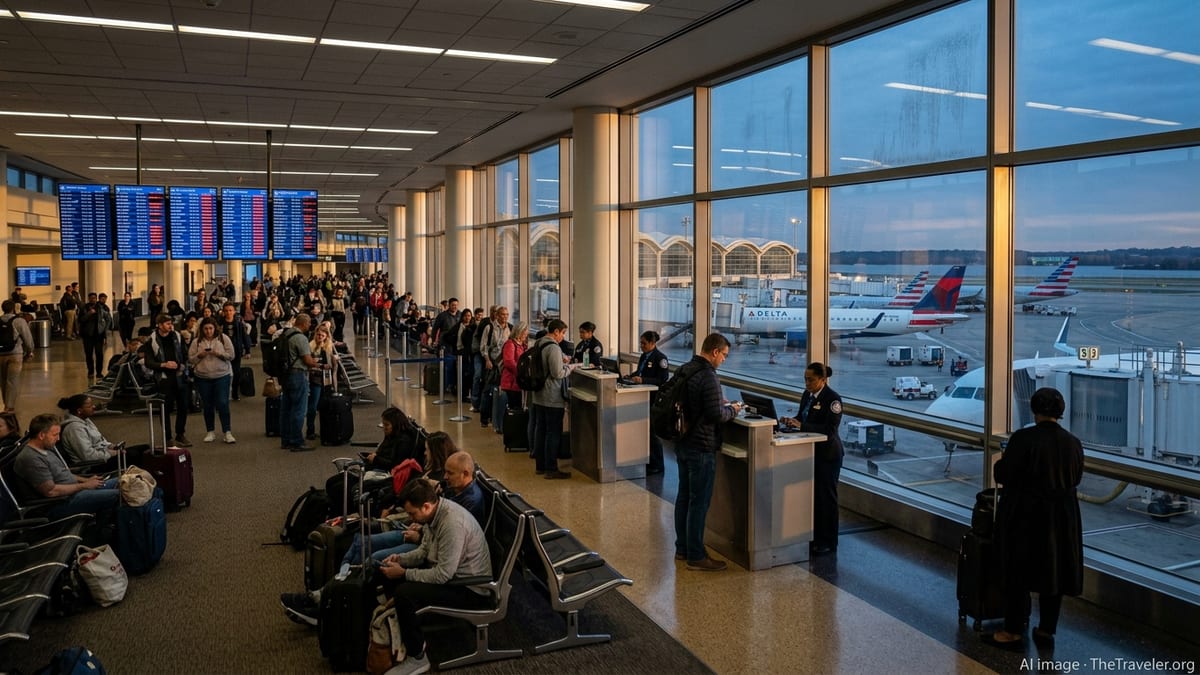
Beyond the macro picture, recent disruption across Delta’s network is adding to investor unease. Industry-focused reporting indicates that the carrier canceled hundreds of flights over a single early May weekend, leaving passengers facing extended delays and limited rebooking options at some of its busiest hubs.
While irregular operations are not unusual in commercial aviation, the scale and concentration of recent cancellations have drawn attention to Delta’s staffing and scheduling resilience at a time when rivals have reported more stable performance. Persistent reports of strained customer-service channels, crowded airport lounges, and shifting schedules are feeding a perception that the airline is struggling to keep pace with demand while maintaining historic reliability standards.
For shareholders, service disruptions can carry both immediate and longer-term implications. In the near term, large waves of cancellations can trigger compensation costs, schedule inefficiencies, and revenue lost to refunds or rebookings on competing carriers. Over time, repeated operational issues can erode the premium brand positioning that allows Delta to charge higher fares and fill more lucrative cabins.
Public discussion among frequent flyers has increasingly framed Delta’s recent performance as a step down from its pre-pandemic reputation, and that narrative risk can weigh on a stock whose valuation is partly built on perceived service quality and customer loyalty.
Strong Fundamentals Face Valuation and Debt Questions
Today’s share-price weakness is particularly notable because it follows a period of solid financial results. Delta’s most recent quarterly update showed revenue growth and healthy margins, supported by resilient demand for both leisure and corporate travel as well as continued strength in its premium cabins and loyalty ecosystem.
Even so, market commentary has highlighted an ongoing debate about whether the stock’s valuation fully reflects the capital intensity and balance-sheet risk that come with running a global network airline. Delta carries a sizable debt load built up during the pandemic, and although management has been paying it down, elevated interest rates make that burden more expensive to service and slower to reduce.
The result is a disconnect that some analysts and investors describe as a tug of war between robust current earnings and lingering skepticism about the durability of those profits over a full cycle. On days when sentiment swings negative across the market, concerns about leverage and exposure to economic shocks can come back to the forefront, pushing airline valuations lower.
For Delta, whose shares had been trading at a multiple that some observers already considered demanding for a cyclical carrier, today’s pullback reflects that reassessment. Investors appear to be recalibrating how much they are willing to pay for expected growth in an environment where financing costs remain elevated and geopolitical risks to travel can flare quickly.
Travel Demand Remains Solid but Sensitivity Is High
Despite the stock’s slide, publicly available industry data still depict a robust backdrop for air travel. Passenger volumes remain strong heading into the summer peak, and forward bookings at major U.S. carriers, including Delta, have generally pointed to sustained demand for both domestic and international routes. Premium cabins and long-haul flights, in particular, have remained areas of relative strength.
However, the market’s reaction today underscores how sensitive airline stocks are to even modest shifts in expectations. Investors are keenly watching for any indications that consumers might begin trimming discretionary trips or that corporations could slow the recovery in business travel if economic data soften. Any sign that strong demand could be nearing a plateau tends to hit airline valuations quickly.
Delta’s guidance has emphasized efforts to adjust capacity, manage fuel costs, and lean on high-margin revenue streams such as its co-branded credit-card partnership. Those initiatives support the longer-term story, but in the short term, traders are fixated on whether margin expansion can continue at the same pace if fares come under pressure or if competitive capacity grows.
In that context, today’s share-price weakness reflects not only immediate news but also a broader repricing of risk around travel-related stocks. For long-term investors, the debate now centers on whether the latest dip represents an opportunity or an early signal that the post-pandemic earnings rebound is entering a more challenging phase.
What the Slide Means for Travelers and Investors
For travelers, Delta’s stock slide will not have an instant, visible impact on day-to-day operations, ticket prices, or route networks. Airlines typically adjust schedules, capacity, and product offerings gradually in response to shifting demand and cost conditions rather than in reaction to a single trading session.
Where the market move could matter over time is in how management prioritizes capital spending and strategic projects. A sustained period of share-price pressure can push companies to more tightly sequence aircraft deliveries, airport investments, and cabin upgrades, as they balance shareholder expectations with the need to maintain reliability and service quality.
For investors, today’s decline is a reminder that airline stocks remain among the most volatile in the travel sector, even when financial performance appears strong. The combination of operational complexity, economic sensitivity, and substantial fixed costs means sentiment can swing quickly with each macro data point or headline about disruptions.
As Delta’s shares trade lower today, the central question for the market is whether the selloff simply reflects broader jitters and short-term operational noise, or whether it marks the beginning of a more sustained reassessment of how much risk premium should be attached to one of the world’s largest network carriers.