


On the east coast of the Isle of Wight, Yaverland Beach looks, at first glance, like a simple sweep of sand backed by crumbling cliffs. Yet families have been returning here, year after year, for generations. Between the shallow waters, the dinosaur-rich shoreline and the old-fashioned holiday atmosphere that still clings to nearby Sandown, this corner of the island offers something that many British beaches have quietly lost: a place where parents can truly relax while children run wild, explore and learn. Spend a few days here in July or August and you quickly understand why Yaverland becomes a summer ritual that families are reluctant to give up.
A Classic Sandy Beach That Works For All Ages
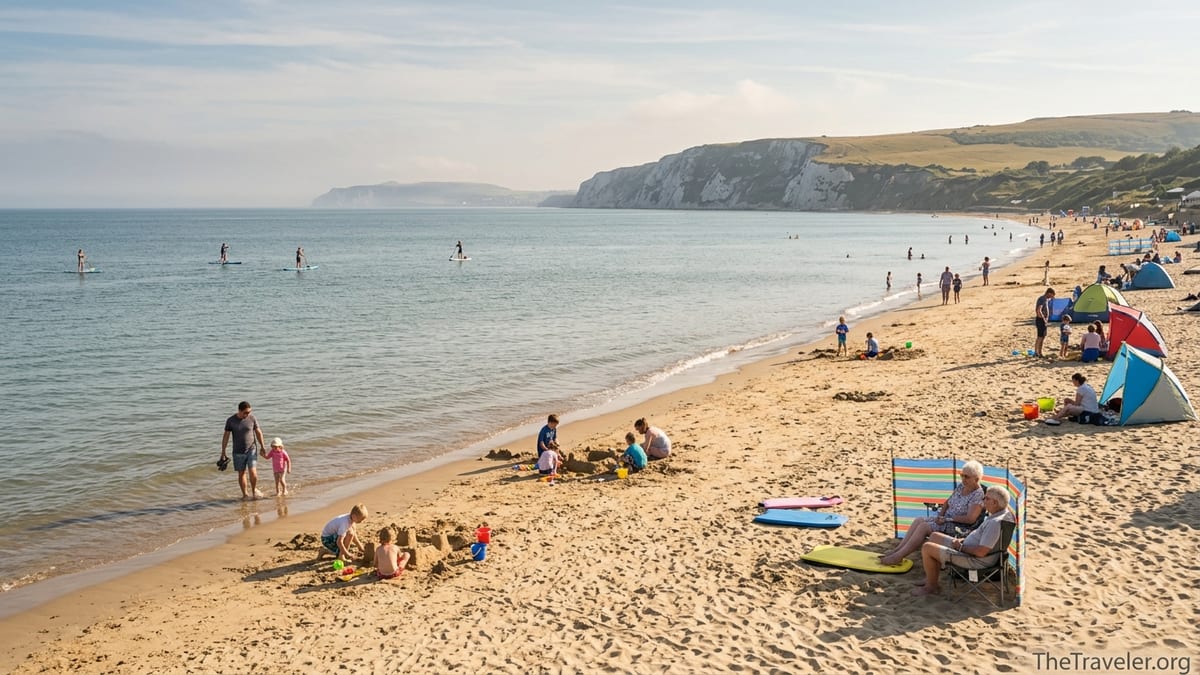
Yaverland Beach sits at the northern end of Sandown Bay, a long, gently curving stretch of coast with views across the English Channel. The sand here is soft and fine closer to the sea, with a firmer, slightly pebbly strip at the back that is ideal for setting down windbreaks and picnic blankets. At low tide the beach widens dramatically, creating a broad playground where toddlers can potter at the water’s edge while older children kick footballs or race along the shoreline. The gently shelving seabed means paddling is possible even for very young children, and in calm conditions the waves are usually no more than a soft lap against the sand.
For parents, one of Yaverland’s biggest attractions is how manageable it feels. There is direct access from the main seafront car park by a short slope, so you do not have to navigate hundreds of steps with pushchairs or coolboxes. Families often arrive with collapsible wagons loaded with bodyboards, buckets, a pop-up sun tent and a full day’s provisions. It is common to see three generations together: grandparents settled in camping chairs near the sea wall, parents supervising paddling, and teenagers drifting between the water and the ice cream hatch near the slipway.
Yaverland is also relatively uncluttered. Unlike some resort beaches that are lined with amusement arcades and large commercial attractions, the backdrop here is mostly open sky, cliffs and the low, pale walls of the Isle of Wight Zoo and Dinosaur Isle further along the seafront. This pared-back setting appeals to families who want space and sand rather than flashing lights. Children still find plenty to do without formal entertainment: building elaborate sand fortresses with moats that the tide eventually claims, staging cricket matches with plastic bats, or simply lying on towels watching ferries and sailing boats cross the horizon.
Even on busy August weekends the atmosphere is more laid-back than loud. Large family groups spread out along the upper beach, but because the sandy area is so wide at low tide, it rarely feels cramped. Many parents comment that this sense of room to breathe, combined with the clear sightlines across the bay, makes it easier to relax than on tighter, cliff-enclosed coves. You can let children roam to collect shells or investigate small streams left by the tide without losing sight of them among deckchairs and crowds.
Safe Swimming, Easy Logistics and Practical Comforts
For families with young children, safety and convenience often matter more than scenery. Yaverland scores well on both. In summer, sections of Sandown Bay are patrolled by lifeguards, and although coverage can vary from season to season, many parents choose Yaverland because of the bay’s generally calm conditions and gradually shelving beach. On light-wind days, the sea often feels more like a large lagoon than an open channel, ideal for first experiences with inflatable rings or short swims parallel to the shore.
The main Yaverland car park, positioned just behind the beach, is another reason regular visitors keep coming back. On a typical summer day you can park only a few minutes’ walk from the sand, which makes multiple trips back to the car with deckchairs or extra clothes far less of a chore. Daily parking charges are in line with many south coast resorts, so families who stay for a week often factor this into their budget, treating it as the trade-off for not having to stay in a seafront hotel. In practice, being able to leave wet wetsuits dripping on the tailgate at lunchtime, or to fetch forgotten sun hats without uprooting everyone, quickly becomes part of the Yaverland routine.
Facilities have gradually improved without overwhelming the beach’s low-key character. The public toilets behind the sea wall include a block powered by on-site renewable energy, an unusual detail but one that local families often mention approvingly. Nearby kiosks serve hot drinks, sandwiches, chips and ice creams, and in high season you will usually find a steady queue of children counting out pocket money for whippy cones or fruit lollies. Parents appreciate that they can keep days reasonably affordable: many bring their own picnic, topping it up with a tray of chips to share or a round of cold drinks in the afternoon.
The beach is also accessible enough to suit families with different mobility needs. The sloped access from the car park, while not perfect, is manageable for most pushchairs and many wheelchairs with assistance. Once on the sand, families often set up close to the concrete promenade so that older relatives can move between firm ground and the beach without tackling long flights of steps. Combined with the modest scale of the facilities and the absence of heavy through-traffic along the seafront, Yaverland offers a level of practical comfort that encourages extended families to gather here year after year.
Dinosaur Footprints, Fossil Hunts and Real-Life Learning
Part of Yaverland’s enduring charm is that it is not just a place to paddle and sunbathe. The cliffs behind the beach form part of the fossil-rich Wealden and Vectis formations, and Yaverland is recognised as one of the island’s classic “dinosaur beaches.” Families regularly book guided fossil walks, many of which start from near the Yaverland car park, timing their outings to low tide when more of the foreshore is exposed. Local experts help children spot fragments of fossilised wood, ripple-marked slabs and, with a bit of luck, the three-toed impressions of dinosaur footprints preserved in the rock.
Parents often talk about the moment a child realises that the strange, shallow depressions they are standing in were pressed into soft mud by a dinosaur more than 120 million years ago. Around Yaverland, some finds have been linked to animals such as Mantellisaurus, an early iguanodontian, as well as to rarer species like the small, dome-headed Yaverlandia, which takes its name from this stretch of coast. While individual visitors are unlikely to stumble across scientifically important bones, smaller discoveries are common enough that many families build fossil hunting into their daily beach rhythm, spending an hour or two on the lower shore in the morning before returning to the sand for swimming and games.
Across the road from Yaverland’s southern end, Dinosaur Isle, the island’s dedicated dinosaur museum, turns these cliff-top stories into something tangible. Housed in a building shaped like a giant pterosaur, it offers full-size reconstructions of island dinosaurs, fossil displays and simple interactive exhibits. On a blustery day when the sea feels too rough for young children, many families spend the morning on the beach looking for fossils, then cross to the museum in the afternoon to compare their finds with labelled specimens. For parents, it is a rare opportunity to turn an easy beach holiday into a hands-on science lesson without any of the formality of the classroom.
The combination of accessible fossils, on-site experts and a dedicated museum has helped cement Yaverland in the imaginations of dinosaur-mad children. Some families deliberately time their visits to coincide with special fossil events or walks advertised locally, while others simply drop into Dinosaur Isle for advice on whether the odd-looking stones in their buckets are worth keeping. Even when the answer is “it is just an interesting rock,” the process of asking questions, comparing textures and learning how fossils form becomes part of the holiday narrative that children carry home and talk about for months afterwards.
Wildlife Encounters and Quiet Coastal Nature
Beyond the dinosaurs, Yaverland offers a surprisingly gentle introduction to coastal wildlife. The cliffs and grassland behind the beach provide habitat for nesting birds and butterflies, and keen-eyed families may spot kestrels hovering over the slope or swifts sweeping above the bay on summer evenings. The rockier sections of shore closer to the cliff base sometimes reveal small rockpools where children can look for tiny crabs, sea anemones and beadlet-like creatures clinging to submerged stones. These are simple pleasures, but they encourage children to slow down, observe and ask questions about the environment they are playing in.
At the northern edge of Yaverland, the low-key Yaverland Sailing and Boat Club adds another layer of activity to the seascape. Small dinghies and sailing boats regularly tack back and forth across the bay, and on breezier days colourful sails pepper the horizon. Families sitting on the sand often use them as impromptu lesson material, tracing the boats’ zigzag courses with their children and talking about wind direction and tides. For older children and teenagers, introductory sailing or paddle sport sessions available elsewhere along Sandown Bay can turn a static week on the beach into a chance to learn a new skill.
Wildlife encounters continue just beyond the beach at the Isle of Wight Zoo, located in the former Sandown Fort overlooking Yaverland’s southern end. Known for its rescued big cats and lemurs, the zoo offers a compact, half-day outing that many families fit into a changeable-weather afternoon. Children who have spent the morning spotting gulls and combing the strandline can suddenly find themselves face to face with tigers or meerkats, an experience that adds a touch of adventure without requiring a long drive or expensive full-day ticket to a mainland attraction.
Because everything is concentrated within a short distance, these different strands of nature and wildlife start to blend into a single, memorable experience. One day might involve a dawn dog walk on the quiet sand, a mid-morning fossil hunt, a lazy picnic, an afternoon swimming session and an early evening stroll along the cliffs listening to birdsong. Over several summers, this rhythm becomes so familiar that many families feel they are reconnecting with an old friend each time the ferry noses into the harbour at Ryde or Fishbourne and the car is pointed towards Yaverland once again.
Nostalgia, Traditions and Multi-Generational Memories
Ask regular visitors why they keep coming back to Yaverland and their answers quickly move beyond the practical. Many adults first visited the beach as children themselves, staying in simple chalets or caravans at the holiday parks in and around Sandown. They remember carrying bodyboards down to the sand, queuing for ice creams at the seafront kiosks and falling asleep in the back seat of the car as the last light faded over the cliffs. Now, in their thirties or forties, they return with their own children and find that relatively little has changed. The cliffs are more eroded and the sea wall is under continued review for coastal defences, but the essential character of the place remains recognisable.
These layers of personal history matter. Grandparents point out where they once learned to swim, or where an old beach hut used to stand before winter storms took it. Parents retell stories of sudden summer downpours when entire families huddled under towels until the clouds passed, only to be rewarded with a double rainbow over the bay. Children, in turn, start building their own catalogues of memories: the year they first found a piece of fossilised wood, the time they stayed up late to watch the Perseid meteors from the darkened beach in August, or the morning they and their cousins were the first to make footprints in the freshly washed sand.
Yaverland is well suited to these multi-generational gatherings because it offers different things to different age groups without anyone having to travel far. Young children dig and paddle within arm’s reach of parents, teenagers drift towards the water sports closer to Sandown or simply stroll the promenade with headphones in, while older relatives settle into a comfortable spot with books, crosswords or binoculars. People can peel off into smaller groups for an hour or two, then reconvene around a shared picnic blanket or portable barbecue as the shadows lengthen.
For many families, the return to Yaverland each summer becomes a way of marking time. Children’s growth is measured not against a doorframe but against how far they are allowed to wade out, or whether they can now manage the short cliff-top walk without being carried. The beach provides a stable backdrop against which life’s inevitable changes play out, from first steps on the sand to teenage summers and, eventually, new generations toddling where their parents once did. In an era when many holidays are one-off experiences in far-flung places, this sense of continuity is both rare and quietly powerful.
Affordability, Simplicity and Easy Day Trips
Another reason families keep choosing Yaverland is that it can be a relatively affordable way to enjoy a traditional seaside break. Accommodation in and around Sandown includes classic seafront guesthouses, small hotels, self-catering flats and family-focused holiday parks set back from the beach. Prices vary widely across school holiday dates, but many families find that a week in a simple caravan or lodge, combined with free days on the sand, compares favourably with more elaborate resort packages elsewhere. Fuel, ferry fares and parking charges still add up, yet the core experience of the beach itself remains free.
Once you are in Yaverland, it is easy to structure days around low-cost or no-cost activities. Fossil hunting, sandcastle building, wave jumping and long walks along Sandown Bay require little more than sturdy shoes and a bucket. Picnicking is a major part of the culture here. On peak summer days the upper beach is dotted with family groups unpacking coolboxes stocked from local supermarkets: homemade sandwiches, chopped fruit, big bottles of squash and the occasional treat of locally baked cakes or pastries picked up in town. A modest budget can comfortably stretch to the occasional meal out at one of Sandown’s cafés or fish-and-chip shops, rather than needing to cover multiple restaurant bills every day.
At the same time, Yaverland makes a practical base for exploring more of the Isle of Wight without lengthy drives. Within an easy radius you can reach the Victorian pier and seafront of Sandown itself, the traditional resort town of Shanklin with its thatched Old Village, and the quieter countryside heading inland towards Brading and beyond. Families often spend most mornings on the beach, then dedicate one or two afternoons to short excursions: perhaps a ride on the Island Line trains up to Ryde, a visit to a farm attraction, or a drive across the island to a contrasting beach on the west coast.
This flexibility allows each holiday to feel a little different while still anchored in the familiar surroundings of Yaverland. One year might feature more focus on water sports, another on nature reserves or heritage attractions. As children grow older and interests shift, parents can tweak the balance between pure beach time and exploring the wider island, without giving up the reassuring constant of Yaverland’s sand and sea at the heart of the trip.
Planning a Family-Friendly Day at Yaverland
For first-time visitors, a little planning can help unlock the relaxed rhythm that keeps families returning to Yaverland. Tide times are particularly important if you are interested in fossil hunting or simply want maximum sand to play on. Many families aim to arrive at or shortly after low tide, when the widest expanse of beach is exposed and the lower foreshore is accessible. On a typical summer’s day this might mean pulling into the car park by mid-morning, staking out a base near the middle of the beach and then spending an hour or so walking along the waterline before the tide begins creeping back in.
Clothing and kit are generally straightforward but make a practical difference. Even in high summer the English Channel can feel brisk, so lightweight wetsuits or shorty suits for children extend the amount of time they can comfortably spend in the water. Sturdy sandals or wet shoes help protect feet from occasional pebbly patches and small stones on the lower shore, while a compact windbreak can transform a breezy day into a pleasantly sheltered one. Many experienced Yaverland families bring a simple pop-up shelter that doubles as sun shade and changing tent, along with a large cotton sheet or old duvet cover to catch sand under towels.
Food-wise, think in terms of flexibility. While there are cafés and kiosks nearby, having a basic picnic packed means you are not tied to fixed mealtimes or queuing for every snack. Popular choices include wraps or rolls that survive being slightly squashed in a rucksack, reusable containers filled with chopped vegetables and fruit, and flasks of tea or coffee for adults. Treats can then be bought as and when the mood strikes, whether that is mid-afternoon chips shared straight from the paper on the promenade or a final ice cream as everyone traipses back to the car at the end of the day.
Finally, build in small rituals that help transform a one-off visit into the beginning of a tradition. Some families always take a group photo in the same rough spot on the beach at the start or end of each holiday, using the outline of Culver Down and its chalk cliffs as a backdrop. Others keep a simple “Yaverland diary” in which children record what they found on fossil hunts, how far the sea came up the beach that day, or what wildlife they spotted. Over several summers, these small habits create a thread that connects each trip, turning Yaverland from a name on a map into a place that feels personally theirs.
The Takeaway
Yaverland Beach does not shout for attention. There are no towering rollercoasters or vast indoor waterparks lining its promenade, and that quietness is precisely what draws so many families back. Instead, this corner of the Isle of Wight offers wide, forgiving sand, welcoming shallows, accessible fossils, nearby wildlife encounters and a gentle, old-fashioned sense of holiday time that has not yet been smoothed away by large-scale development. It is a place where a day can slip easily from paddling to picnicking to fossil hunting without anyone checking their watch.
For parents and grandparents juggling work, school schedules and the relentless distractions of everyday life, Yaverland represents something simpler: a chance to exhale, sink toes into the sand and watch children range freely between sea and cliffs. Whether you come for a single sunny day or return, year after year, to the same stretch of shore, the beach has a way of weaving itself into family stories. That is why, as each new summer approaches, so many people find themselves once again scanning ferry timetables and tide tables, quietly planning their next chapter on Yaverland’s familiar sands.
FAQ
Q1. Where exactly is Yaverland Beach on the Isle of Wight?
Yaverland Beach sits at the northern end of Sandown Bay on the east coast of the Isle of Wight, just beyond the main resort town of Sandown and below the chalk headland of Culver Down.
Q2. Is Yaverland Beach suitable for very young children?
Yes, Yaverland is popular with families who have toddlers and younger children because the beach shelves gently, the sand is soft, and there is plenty of space for paddling and play away from traffic and busy roads.
Q3. Can you really find dinosaur fossils at Yaverland?
Visitors regularly find small fossils such as pieces of fossilised wood and plant material, and occasionally tracks and other remains are visible on the shore. For safety and conservation reasons, families are encouraged to join organised fossil walks or seek advice from experts at Dinosaur Isle rather than hammering into the cliffs themselves.
Q4. Are there lifeguards on duty at Yaverland Beach?
During peak summer months, lifeguard cover is often provided on parts of Sandown Bay, but the exact locations and dates can vary each season. Families should always check current local information on arrival, follow safety signage and supervise children closely whenever they are in or near the water.
Q5. What facilities are available near the beach?
Close to the main Yaverland car park you will find public toilets, seasonal kiosks selling snacks and drinks, and access to the wider seafront where additional cafés and shops are located. Dinosaur Isle museum and the Isle of Wight Zoo are within a short walk, making it easy to combine a beach visit with an attraction.
Q6. Is there parking at Yaverland Beach, and how busy does it get?
There is a pay-and-display car park directly behind the beach, which can fill up on hot weekends in late July and August. Arriving earlier in the day, especially around low tide, usually makes it easier to find a space and settle in before the beach gets busier.
Q7. Do I need special equipment for fossil hunting with children?
You do not need anything complicated. Sturdy shoes, a small bucket or cloth bag, and curiosity are usually enough for a family fossil stroll along the foreshore. A simple hand lens can add to the fun, and guided walks may provide extra tools and safety guidance.
Q8. What is the best time of year to visit Yaverland with a family?
Late spring through early autumn is generally the most pleasant period for family visits, with July and August offering the warmest sea temperatures and the widest range of seasonal facilities. Outside school holidays the beach is quieter, which can appeal to families with pre-school children.
Q9. Are dogs allowed on Yaverland Beach?
Dog access rules can change, and some parts of Sandown Bay have seasonal restrictions. It is wise to check current local signage when you arrive, but many owners walk their dogs along Yaverland at quieter times of day and outside peak summer dates.
Q10. Can Yaverland be used as a base to explore the rest of the Isle of Wight?
Yes, Yaverland is well placed for family day trips. From here it is a short drive or bus ride to Shanklin, Ryde and several inland attractions, while the island’s west coast beaches and countryside can usually be reached in under an hour, allowing you to enjoy varied excursions while returning to a familiar beach at the end of the day.