


On an island ringed with celebrated sands and Victorian esplanades, Yaverland Beach sits quietly at the far end of Sandown Bay, facing the English Channel beneath rust-red cliffs. It does not have the bustle of Shanklin, the surf reputation of Compton or the postcard skyline of the Needles, yet for many Isle of Wight regulars this understated strip of sand and shingle is where they escape to breathe. Part village beach, part open countryside shoreline and part outdoor geology classroom, Yaverland is one of those rare places that reveal more the longer you linger. For travellers willing to walk a few extra minutes beyond the arcades and beach huts, it feels like discovering a genuine hidden gem.
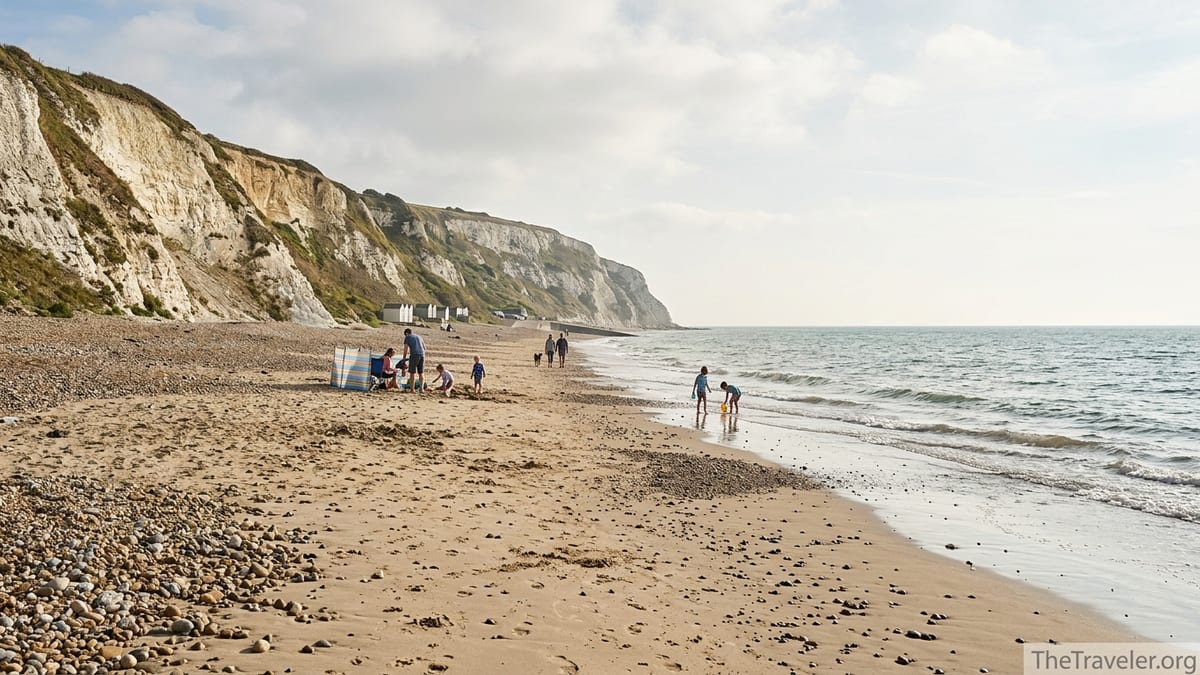
A Quiet Corner at the Edge of Sandown Bay
Yaverland Beach stretches along the northern end of Sandown Bay, tucked beneath Culver Cliff and just beyond the more familiar seafront of Sandown itself. From the main resort, a ten to fifteen minute stroll along the promenade brings you to a broad sweep of pale sand and pebbles that immediately feels calmer. The background soundtrack shifts from arcade music to the rhythmic wash of waves against the shingle. Families who know the area often bypass central Sandown on sunny weekends, driving straight to Yaverland’s modest car park to claim a patch of space with room for sandcastles and beach games without encroaching on their neighbours.
Unlike some of the island’s smaller coves, Yaverland rarely feels hemmed in. The beach runs in a gentle curve between the looming chalk of Culver Cliff at one end and the outskirts of Sandown at the other, so even on busy school-holiday afternoons it is usually possible to walk a short distance and find relative solitude. The sea here is generally shallow and fairly sheltered by the bay’s shape, which helps keep waves manageable for paddling and swimming in typical summer conditions. On clear days, you can see across to the mainland coast, with cross-Channel ferries and cargo ships etched on the horizon.
Part of Yaverland’s charm lies in what it does not have. There is no pier, no row of neon-lit attractions, and no constant thump of music from beach bars. Facilities are present but discreet: a simple café and beach shop, an eco-friendly toilet block and a small slipway serving the local sailing and boat club. This light touch infrastructure keeps the focus on the seascape and cliffs, so the beach feels more like a natural shoreline that happens to be conveniently accessible rather than a heavily packaged resort.
Easy Practicalities Without the Resort Crowds
For a beach that feels so unspoilt, Yaverland is surprisingly easy to reach and use. A dedicated seafront car park sits almost directly behind the sand, with just a short, gently sloping ramp between your vehicle and the shore. Recent descriptions list a little over a hundred spaces, including designated disabled bays, which is enough to keep the beach practical for day trips but not so large that it ever feels like a coach-park destination. Parking fees and regulations can change, so it is sensible to check current tariffs on arrival, but most visitors treat it as a modest add-on to a full day out by the sea.
Next to the car park you will usually find a low-key beach café and kiosk serving exactly the things people want after swimming or fossil hunting: takeaway coffee, ice creams, simple hot food and cold drinks. Seating spills outside onto picnic benches where you can watch paddleboarders setting off or children shrieking as the chilly water reaches their knees. The toilets, praised locally for being more modern and eco-conscious than many older seafront blocks, add to the sense that this is a beach designed to be used for real days out rather than just admired in brochures.
Public transport is workable too. Buses run to Sandown, and from the town it is roughly a twenty-minute walk or a short taxi ride to Yaverland. For visitors staying at nearby holiday parks or self-catering cottages around Sandown and Brading, it is often quicker to walk to Yaverland along the esplanade than to load everything into a car. Many regulars adopt a relaxed routine: a morning swim or dog walk at Yaverland, a stroll into Sandown for lunch or a supermarket shop, then back to the quieter beach in the late afternoon when the day-trippers thin out.
Dog owners in particular prize Yaverland for its relatively open feel. Like many Isle of Wight beaches, there are seasonal restrictions on dogs along certain stretches during the peak summer months, and the precise zones can vary from year to year, so it is important to check the local council signage at the car park. In practice, though, there is usually at least some part of the shoreline where dogs are welcome out of peak hours, and the long, straight run of sand makes it an appealing place for early-morning and evening walks with views back to Culver Cliff.
Sand, Sea and Space to Breathe
Yaverland is technically a sand and shingle beach, and this mix is one reason it remains relatively relaxed even in high season. Above the high-water mark you will often find a bank of rounded pebbles and small stones, good for beachcombing and comfortable for windbreaks. As the tide drops, broader terraces of firm, damp sand appear, ideal for building elaborate castles, flying kites or playing impromptu games of rounders or beach cricket. Parents often note that buggies and beach trolleys can be pushed at low tide, which is a small but welcome detail when you are transporting picnic bags and buckets.
Swimmers tend to favour the middle stretch of Yaverland, where the bay shelves gradually and the seabed is largely sand underfoot rather than rocks. The water here is part of the same expanse that has helped Sandown Bay earn praise for clean, swimmable seas, and in typical summer weather it can be clear enough to watch shoals of small fish darting through the shallows. On calm mornings it is common to see stand-up paddleboarders and kayakers gliding a few dozen metres offshore, taking advantage of the relative shelter provided by the curving bay and the protective bulk of Culver Cliff.
Even on windier days Yaverland can be rewarding. When sea breezes whip up whitecaps further along the island, the bay’s orientation often softens the impact here, making it feel brisk rather than forbidding. Some visitors treat blustery days as the best time for long walks from Yaverland towards Sandown and Shanklin or, in the opposite direction, up over Culver Down on the coastal path. Watching waves crash against the chalk headland from the safety of the beach provides drama without real risk, though as always it is wise to stay clear of the cliffs themselves, where erosion can send occasional blocks tumbling to the shore.
Because of its relatively uncommercialised nature, it is still possible at Yaverland to experience those small seaside moments that are becoming rarer on busier beaches: brewing a cup of tea on a camping stove at the back of the shingle; quietly reading a book with just the rustle of pebbles in the surf; or watching the sky turn apricot and mauve over the Channel on late-summer evenings as the last families pack up and the beach returns to the seabirds.
A Gateway to the Isle of Wight’s Dinosaur Coast
What truly sets Yaverland apart from many other English beaches is what lies in its cliffs and foreshore. The fragile layers exposed here form part of the Wessex Formation, a fossil-rich sequence of Early Cretaceous rocks that has given the Isle of Wight its reputation as one of Europe’s most important dinosaur regions. Geologists and fossil enthusiasts have been combing these strata for nearly two centuries, and new discoveries still emerge after winter storms or exceptionally high tides reveal fresh rock surfaces.
The very name of the dinosaur genus Yaverlandia reflects the global scientific significance of this stretch of coast, referencing a distinctive bone-headed dinosaur first recognised from remains found near the beach. Other prehistoric creatures, from large herbivorous dinosaurs to smaller reptiles and primitive mammals, have left traces in the muds and sands that now solidify into the crumbling cliffs behind the modern shoreline. Occasional dinosaur footprints have been documented on boulders and slabs on the foreshore here, echoing the more famous trackways further along the island at Compton Bay.
For visiting travellers, the most accessible way to connect with this deep-time history is to join an organised fossil walk. Dinosaur Isle, the island’s dinosaur and geology museum housed in a distinctive building on the Sandown seafront, regularly runs guided hunts along Yaverland Beach led by experienced staff. These outings, which typically last a couple of hours and are suitable for families, focus on teaching people how to recognise genuine fossils in the shingle, how to search safely without damaging important scientific sites, and how to understand what the finds reveal about the ancient floodplains and rivers that once covered this area.
On a good day, participants might spot fragments of fossilised bone, pieces of petrified wood, fish scales or impressions of ancient plants among the pebbles. Even when no headline-grabbing discovery appears, the process of searching with an expert guide, learning to “read” the rocks and hearing stories about past finds brings the landscape to life. For many children, a holiday highlight is taking a small, legally collected fossil home as a tangible reminder that their sandcastle playground once hosted huge dinosaurs wandering through swampy forests.
Clifftop Walks and Wider Countryside Adventures
Yaverland is not just a beach; it also serves as a starting point for some of the Isle of Wight’s most rewarding low-level walks. At the northern end of the car park a steep but well-trodden path rises towards Culver Down, joining the island’s coastal path and delivering expansive views back over Sandown Bay. The climb is short enough to be manageable for most reasonably fit visitors yet high enough that, within minutes, the beach below shrinks to a narrow strip between sea and fields, and the white face of the chalk headland dominates the skyline.
Once on the downs, walkers can follow grassy tracks along the cliff-top, often sharing the route with grazing cattle and flocks of seabirds wheeling overhead. The combination of open sky, sweeping sea views and the contrast between chalk cliffs and green pastures makes this one of the most photogenic sections of the island’s coastal circuit. On clear days you can trace the curve of the coast past Shanklin and Ventnor towards the southern tip of the island, while inland the rolling farmland stretches towards Brading and the marshes of the Eastern Yar.
Those preferring gentler terrain can simply wander south from Yaverland along the promenade into Sandown, with the option to continue further towards Lake and Shanklin. This paved seafront route offers an easy, pram-friendly way to combine a quiet morning at Yaverland with a livelier afternoon among the cafés and amusements of town, returning later to the more tranquil end of the bay for sunset. Cyclists sometimes use this stretch too, treating Yaverland as a convenient pause point for snacks or a quick swim during longer rides around the island.
Because of its location on the edge of both coast and countryside, Yaverland also works well as a base for exploring the island’s interior. The nearby villages and lanes lead to farm shops, rural pubs and viewpoints that many day-trippers never see, while the coastal road east towards Bembridge offers additional beaches and marinas. Yet at the end of each excursion, the pull of that familiar strip of sand beneath Culver Cliff is strong; there is something deeply satisfying about finishing a walk or drive with bare feet in cool water at a place that still feels unspoilt.
Family-Friendly Without Feeling Overwhelming
Families often describe Yaverland as a “just right” beach: big enough for children to run free but not so built-up that parents feel they are spending the day saying no to endless commercial temptations. There are no permanent funfair rides or night-time venues on the sand itself, so the noise level tends to be limited to squeals from the shallows and the occasional call of gulls. Parents can usually spread out a blanket, set up a small beach tent and keep a relaxed eye on older children paddling in the gentle surf without worrying about fast-moving cyclists or dense crowds.
The fossil-hunting opportunities add an extra educational layer to a standard bucket-and-spade day. Many families book a guided walk early in their stay, learn the basics of safe collecting and then return to Yaverland on their own to put that knowledge into practice. Children love the idea that an unassuming brown pebble might turn out to be a fragment of 120-million-year-old bone or the cast of a prehistoric plant stem. The nearby Dinosaur Isle museum, with its life-size reconstructions and interactive displays, is close enough that you can combine a couple of hours on the beach with a visit indoors if the weather cools.
Basic amenities such as public toilets, parking close to the sand and a source of drinks and snacks make logistics straightforward for parents managing nap times and sun cream applications. At the same time, the absence of noisy attractions means that the main entertainment remains nature itself. Rockpools sometimes form among the lower foreshore when conditions are right, harbouring small crabs and shrimps that are endlessly fascinating to younger visitors armed with plastic nets and buckets. Occasional visits from touring ice-cream vans or mobile coffee sellers feel like treats rather than fixtures.
Safety, as always on the coast, depends on common sense. The cliffs behind Yaverland are actively eroding, which is precisely why they continue to release fossils, but this also means it is prudent to avoid sitting directly beneath the most crumbly sections or climbing on freshly fallen debris. Tide times are worth checking, as the upper beach can narrow significantly at high water and some stretches of foreshore may become cut off around the base of the headland in certain conditions. Local signage usually provides guidance on both cliff risk and recommended zones for bathing.
Why Yaverland Still Feels Like a Hidden Gem
In an era when many British beaches are heavily branded and promoted on social media, Yaverland retains an appealing understatement. It benefits from its association with the Isle of Wight’s wider “Dinosaur Island” identity yet rarely appears as the main image on posters or campaigns. As a result, it tends to attract people who are willing to look a little further, walk a little longer or read beyond the first page of a guidebook. For these visitors, the reward is a place that feels both authentically local and quietly special.
Part of that hidden-gem quality comes from the way Yaverland weaves together multiple identities. It is simultaneously a family beach with easy parking and facilities, a nationally significant fossil locality visited by scientists and students, a launch point for small sailing craft and paddleboards, and a peaceful vantage point for watching weather systems slide across the Channel. Few other spots on the island combine this breadth of experiences in such a compact area without tipping into overdevelopment.
Another factor is seasonality. In high summer, Yaverland can certainly be lively, with holiday parks nearby feeding a steady stream of beachgoers. Yet outside school holidays it often reverts to something closer to a village shoreline, used mainly by dog walkers, local swimmers and retired couples enjoying a morning coffee in the car while watching the waves. Autumn and winter storm days may feel far removed from bucket-and-spade imagery, but for those who appreciate atmospheric seascapes, the combination of grey-green water, white chalk cliffs and flocks of restless seabirds can be deeply compelling.
Ultimately, what makes Yaverland a hidden gem is not that it is completely undiscovered, but that it still rewards curiosity. Whether you come for fossils, for the walking, for a quiet swim away from busier resorts or simply to sit and watch the changing colours on Culver Cliff, the beach offers enough depth and variety to keep drawing you back. In a compact island where distances are short and options plentiful, the fact that many locals still choose Yaverland for their own off-duty beach time says a great deal.
The Takeaway
Yaverland Beach exemplifies the quieter, more layered side of the Isle of Wight’s coastline. It lacks the headline attractions that crowd brochures, yet offers far more than first impressions suggest: generous space for swimming and play, easy practicalities without resort excess, nationally important fossil beds, access to panoramic cliff-top walks and an atmosphere that changes subtly with the seasons. For travellers who value character over crowds and substance over spectacle, it encapsulates why many people fall deeply in love with the island and return year after year.
If your plans already include a visit to Sandown or a day exploring the island’s dinosaur heritage, building time at Yaverland into your itinerary is straightforward. A morning fossil walk, an afternoon swim, a stroll up onto Culver Down and a quiet hour watching the light fade over the Channel will show you why so many consider this modest, cliff-backed stretch of sand one of the Isle of Wight’s most rewarding hidden gems. It is not trying to be a destination in itself, and that is precisely what makes it feel so special.
FAQ
Q1. Where exactly is Yaverland Beach on the Isle of Wight?
Yaverland Beach sits at the northern end of Sandown Bay on the island’s east coast, just beyond Sandown seafront and directly beneath Culver Cliff.
Q2. Is Yaverland Beach suitable for swimming?
Yes, in typical summer conditions the sea at Yaverland shelves gently and is popular for paddling and swimming, though visitors should always follow local safety advice and signage.
Q3. What facilities are available at Yaverland Beach?
Behind the beach there is a seafront car park, public toilets, a small café or kiosk for snacks and drinks, and access to a local sailing and boat club.
Q4. Can I hunt for fossils on Yaverland Beach?
Fossil hunting is one of Yaverland’s highlights, and visitors are encouraged to join organised walks with local experts or the Dinosaur Isle museum to search responsibly and safely.
Q5. Are dogs allowed on Yaverland Beach?
Dogs are often welcome on parts of Yaverland, but there are usually seasonal restrictions in peak summer, so it is important to check current council signs at the car park.
Q6. How do I get to Yaverland Beach without a car?
You can take a bus or train to Sandown and then walk along the promenade for around twenty minutes, or use a local taxi for the short trip to the Yaverland end of the bay.
Q7. Is Yaverland Beach good for families with young children?
Yaverland is popular with families thanks to its mix of sand and shingle, relatively gentle seas, nearby toilets and parking, and the added interest of safe, supervised fossil hunting.
Q8. Are there places to eat near Yaverland Beach?
There is usually a small café or beach kiosk by the car park for drinks, ice creams and simple food, and a wider choice of restaurants and pubs a short walk away in Sandown.
Q9. What else can I do near Yaverland Beach?
Nearby options include visiting the Dinosaur Isle museum, walking up onto Culver Down for views across the bay, exploring Sandown seafront or continuing along the coastal path towards Bembridge.
Q10. Why is Yaverland considered a hidden gem compared with other Isle of Wight beaches?
Yaverland is less commercialised than many resorts, combining easy access and family-friendly facilities with quiet spaces, fossil-rich cliffs and scenic walks that reward curious visitors.