


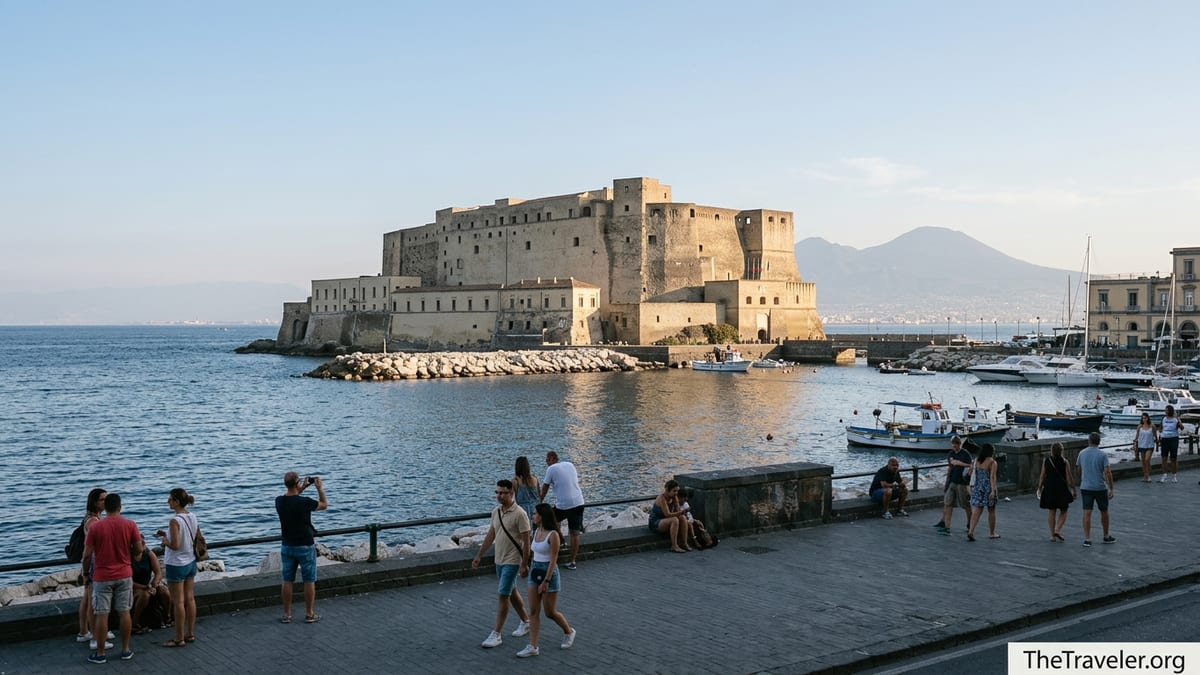
Castel dell’Ovo is one of Naples’ most atmospheric spots, a pale stone fortress rising from the sea with Vesuvius on the horizon and fishing boats bobbing below. It sits at the heart of the city’s waterfront, yet many visitors leave disappointed, frustrated by closures, confusing access, or simple planning errors. With renovation works, changing hours and a setting that blends historic monument with modern nightlife, it is easy to get the logistics wrong. Understanding where visitors most often stumble will help you turn a quick photo stop into one of the most memorable corners of your Naples trip.
Get the latest updates straight to your inbox!
Ignoring Opening Status, Hours and Partial Closures
One of the biggest mistakes right now is assuming Castel dell’Ovo is always fully open. The castle has been undergoing renovation and safety works, with periods where the interior, ramparts or specific terraces are closed, even while the exterior and the little Borgo Marinari harbor remain accessible. Travelers who show up expecting to climb to the cannon terrace for sweeping bay views sometimes find locked gates and scaffolding instead. Reports from 2025 and 2026 describe the site as temporarily closed or partially accessible on certain days, turning what should be a highlight into a frustrating detour.
This confusion is compounded by inconsistent information between guidebooks, blogs and even hotel staff. A visitor using a 2023 print guide might read that the castle is free and open daily from early morning to early evening, only to arrive in 2026 and discover reduced hours, restricted access, or a ticketed exhibition in part of the complex. Others assume that because the causeway and marina restaurants are busy, the castle itself must be open, only to find the heavy wooden doors shut. Before you plan a sunset walk specifically for the castle, verify same-season information from the Naples tourism office or your accommodation and be prepared for parts of the fortress to remain off-limits.
A related mistake is leaving Castel dell’Ovo for your very last afternoon in the city. If you push it to the end of your itinerary and then encounter an unexpected closure due to weather, maintenance or a city event, you have no flexibility to reschedule. Treat the visit as a priority stop early in your stay. That way, if you arrive to find only the exterior accessible, you can still enjoy the setting and perhaps return on another day if circumstances change.
Finally, do not assume the castle keeps the same hours as other major sights such as the Royal Palace or archaeological museums. Naples often staggers opening times, and public holidays can alter schedules at short notice. Build a flexible plan: view Castel dell’Ovo and the waterfront in combination with nearby Piazza del Plebiscito and Via Chiaia so you have alternatives if the inner courtyards are unexpectedly closed.
Underestimating How to Get There and the Walk Involved
Another frequent pitfall is misjudging how to reach Castel dell’Ovo, especially for first-time visitors landing at Naples Airport or arriving by train. The fortress sits on the small peninsula of Megaride at Borgo Marinari, at the seafront end of Via Partenope and the Lungomare Caracciolo promenade. There is no metro station at the doorstep, and taxis can only drop you near the entrance to the pedestrian causeway. Travelers who imagine they will step out of a metro directly at the castle end up walking 10 to 20 minutes more than expected, sometimes in full summer heat.
From Napoli Centrale station, most visitors either ride Metro Line 1 to Municipio or Toledo, or take a bus toward Santa Lucia or Riviera di Chiaia, then continue on foot. It is a scenic but genuine walk, especially if you are pulling luggage on cobblestones or managing mobility issues. The same applies if you arrive with the airport Alibus, which stops by the port area near Molo Beverello. On maps it looks close, but in practice it is another quarter of an hour on foot to the castle along busy streets or the waterfront. Many travelers only realize this when they find themselves weaving between traffic with suitcases or pushing a stroller across uneven paving stones.
Planning to drive right up to Castel dell’Ovo is another common misstep. The surrounding lungomare is often limited to local traffic and has restricted parking, and Borgo Marinari itself is effectively pedestrian. Guests with hotel reservations in the area sometimes discover their taxi or rental car cannot get closer than the main road, leaving them to haul bags over the causeway. Unless your accommodation has clearly confirmed a specific drop-off arrangement, it is usually easier to approach on foot from Piazza del Plebiscito or Via Chiaia, taking in shopfronts and cafés on the way.
Because of these access quirks, travelers on tight connections sometimes try to “squeeze in” Castel dell’Ovo between check-out and the airport, underestimating the round-trip walk plus taxi or bus time. A far better strategy is to visit the castle and waterfront on a day when you are staying locally, without luggage and without watching the clock. Treat the walk itself as part of the experience, not a hurdle to be rushed through at the last minute.
Rushing the Visit and Treating It as Just a Photo Stop
Many people arrive at Castel dell’Ovo, snap a quick shot of the walls against the bay and leave within ten minutes, assuming there is “nothing to see” beyond the view. This is a mistake both historically and experientially. The fortress stands on the ancient site of a Roman villa, later a Norman and Angevin stronghold, and its corridors, courtyards and bastions frame some of the most layered perspectives on Naples you can find. When access to the interior is available, you can easily spend an hour or more wandering the ramparts, looking back at Vesuvius, the port, and the domes of the centro storico.
Even when the interiors are partially closed, the area around the castle rewards slow exploration. Borgo Marinari, tucked just behind the outer walls, is a tiny harbor filled with sailboats and lined with seafood restaurants and low-key bars. Many rushed visitors follow the main path up to the first terrace, then walk straight back over the causeway without ever slipping down into the marina. As a result, they miss quiet corners where local fishermen repair nets, and restaurant terraces where you can have a plate of spaghetti alle vongole or a simple espresso almost at water level.
Because there is no single blockbuster “must-see” room or artwork inside Castel dell’Ovo, its appeal depends on atmosphere: the echo of footsteps under stone arches, salty air on the bastions, and the changing light on the bay. Travelers who treat it like another checklist monument often walk away underwhelmed. Those who build in time to sit on a bench along the promenade, watch joggers and families, and let the sound of waves and traffic fade into the background usually come away with a much stronger sense of Naples’ relationship with the sea.
If the castle’s interior is open, a common mistake is not exploring all levels. Some visitors stop at the first major courtyard, assuming that is the end, and leave without realizing that higher terraces offer progressively more expansive panoramas. Look out for stairways leading further up and be willing to climb a few extra flights when permitted. The reward is a bird’s-eye view that rivals much more expensive rooftop bars and organized tours.
Arriving at the Wrong Time of Day for Weather, Light or Crowds
Timing your visit poorly can dramatically affect how you experience Castel dell’Ovo. Midday in high season, the waterfront bakes in direct sun and the pale stone of the fortress reflects heat, making the ramparts feel like a frying pan. Visitors planning a casual stroll often arrive in early afternoon with no hat or water and quickly retreat to the nearest café, cutting their visit short. Conversely, those who show up late in the evening sometimes find that interior access has already closed, with only the causeway and marina bars still buzzing.
Local advice and traveler reports consistently point to early morning or late afternoon as the most enjoyable times. In the first hours after opening, the sea breeze is cooler, the promenade is filled with joggers and dog walkers rather than crowds, and photography is easier without harsh overhead light. In late afternoon and toward sunset, the castle’s stone walls warm to gold and the silhouette of Vesuvius is particularly striking. Visitors who time their visit for this “golden hour” often pair it with an aperitivo at a Borgo Marinari terrace afterward, watching lights come on along Via Partenope.
Another timing mistake is forgetting that weekends and local holidays dramatically change the atmosphere. On a clear Sunday, half of Naples seems to be out along Lungomare Caracciolo, with families, cyclists, street musicians and vendors packing the promenade. This can be exhilarating but overwhelming if you were hoping for a contemplative historic visit. On such days, interior areas of the castle, when open, may also close a bit earlier or operate with capacity limits. If you prefer quieter conditions, consider visiting on a weekday morning and leaving your Sunday stroll for people-watching rather than serious sightseeing.
Weather is also underestimated. The castle sits fully exposed on a small outcrop. On windy days, especially in autumn and winter, gusts can be strong on the upper terraces, making it uncomfortable to linger. In heavy rain, access to certain exterior sections may be restricted for safety. Checking a same-day forecast before you commit to walking out over the water can save you from battling umbrellas on a slippery stone ramp or finding doors closed due to rough conditions.
Overlooking Safety, Footwear and Accessibility Needs
Because Castel dell’Ovo is often described as “an easy stroll,” travelers with limited mobility, small children or balance issues sometimes underestimate the physical demands. While the causeway is relatively flat, the interior of the fortress, when accessible, involves uneven stone steps, ramps with worn surfaces, and low walls at overlook points. Visitors in flimsy sandals or fashion shoes can find themselves slipping on smooth stone, especially when surfaces are damp from sea spray or recent rain.
A recurring mistake is arriving without appropriate footwear or basic sun protection. Light sneakers or walking shoes with a bit of grip make a noticeable difference on the stairs and bastions. In summer, a hat and sunscreen are essential, since much of the visit is in open sun. Families pushing strollers often discover that after the causeway, many paths within the castle itself are not stroller-friendly, requiring either carrying the stroller up flights of stairs or limiting exploration to lower levels. Planning to use a baby carrier instead for the castle portion can make the visit more comfortable.
Travelers sometimes assume there will be staff or guards everywhere to answer questions or assist. In reality, Castel dell’Ovo frequently has minimal signage and limited personnel visible on the upper levels. If you have mobility concerns, it is worth asking at the entrance which sections are accessible that day and whether there are working lifts or accessible routes open. Do not hesitate to turn back if you feel unsafe on a narrow parapet or in a crowded stairwell; the views from lower terraces and the waterfront can still be excellent.
After dark, the area immediately around Castel dell’Ovo is generally lively with restaurant-goers and couples out for a walk, but like any urban waterfront, you should stay in well-lit zones and avoid wandering alone down unlit side paths beyond the main promenade. Some visitors make the mistake of walking back to their hotel via poorly lit backstreets instead of returning along the busy lungomare. Staying on the main, brightly lit route not only feels more comfortable but extends your enjoyment of the evening atmosphere.
Mismanaging Food, Drink and Spending in Borgo Marinari
The cluster of restaurants and bars in Borgo Marinari is both a highlight and a trap for unwary visitors. After walking out to the castle, many travelers sit down at the first waterfront table they see, without glancing at menus or asking about service charges. While there are excellent, fairly priced places serving fresh seafood and pizza, some establishments lean on the location and views to justify noticeably higher prices. It is not unusual to see main courses in the marina priced higher than similar dishes a few streets inland.
A common mistake is ordering multiple rounds of drinks or elaborate seafood platters without clarifying prices first, then being surprised by the total when the bill arrives. For example, a simple spritz or glass of wine at a terrace bar along Via Partenope might cost only a few euros more than elsewhere in the city, but a “special” mixed seafood plate for two in Borgo Marinari can easily reach a level that feels disproportionate if you were expecting a casual snack. Taking a moment to look over the full printed menu and note whether there are cover charges or coperto per person helps avoid awkward surprises.
Another oversight is skipping the chance to enjoy simple, low-cost pleasures around the castle because you assume everything nearby is expensive. Many locals and budget-conscious travelers pick up a takeaway sfogliatella, gelato or a slice of pizza from bakeries and bars back toward Via Chiaia or Piazza del Plebiscito, then eat it while sitting on the seawall along Lungomare Caracciolo. This approach offers the same bay views for a fraction of the price and lets you decide later if you want to splurge on a sit-down meal in the marina.
Finally, some visitors linger so long over lunch or aperitivo in Borgo Marinari that they end up exploring the castle itself in a hurry, or finding that interior access has already closed. If seeing the fortress is a priority, reverse the order: visit the castle first, then reward yourself with a meal or drink afterward. This way, you can choose a restaurant deliberately rather than collapsing into the nearest chair simply because you are tired and hungry.
Failing to Connect Castel dell’Ovo With the Rest of Naples
Another subtle mistake is treating Castel dell’Ovo as an isolated sight rather than weaving it into a broader understanding of Naples. The fortress marks the transition between the monumental heart of the city, around Piazza del Plebiscito and the Royal Palace, and the elegant seafront neighborhoods of Chiaia and Mergellina. Visitors who taxi directly to the castle, take a few photos and then depart miss the pleasure of strolling these connective streets and squares, where daily life unfolds between historic landmarks.
For example, walking from Toledo metro or Piazza del Plebiscito down Via Chiaia to the waterfront gives you a cross-section of Naples: narrow shopping lanes, grand colonnades, and glimpses into small courtyards. From there, continuing along Via Partenope and Lungomare Caracciolo turns the approach to Castel dell’Ovo into a narrative of the city opening toward the sea. Travelers who plan their day so that the castle is the turning point between “city” and “seafront” often feel they have understood Naples more deeply than those who hop between disparate sights by taxi.
Others fail to notice how near Castel dell’Ovo is to alternative viewpoints and experiences. If the castle’s upper terraces are closed, it is still easy to combine a walk on the waterfront with a visit to Castel Nuovo near the port or a funicular ride up to Castel Sant’Elmo in the Vomero district for a different panoramic view. Treat Castel dell’Ovo not as your only chance for vistas, but as one node in a network of outlooks that together reveal the geography of the bay and the city’s layered history.
Finally, some travelers forget the castle’s mythic and historical context, knowing only the translation of its name as “Egg Castle.” The legend linked to Virgil and the magical egg that supposedly supports the fortress, as well as the site’s origins as a Roman villa and later royal residence, give emotional weight to the stones beneath your feet. Spending a few minutes reading about this background before you visit, or even glancing at a summary from your hotel or a local booklet, can turn a simple seafront walk into a journey through centuries of Neapolitan identity.
The Takeaway
Castel dell’Ovo rewards visitors who plan lightly but thoughtfully. The most common mistakes come from assumptions: that the fortress will be fully open on any given day, that a metro will drop you at the entrance, that the visit is nothing more than a quick photo stop, or that the surrounding waterfront is automatically either too expensive or not worth lingering over. In reality, conditions change with renovations, weather and local rhythms, and the experience depends as much on timing and expectations as on the site itself.
If you check recent opening information, allow time for the walk and for slow exploration, wear sensible shoes, and approach the marina’s restaurants with your eyes open, Castel dell’Ovo can become one of the most memorable places in Naples. Stand on the causeway at sunset, watch the city glow behind you and Vesuvius darken across the bay, and you will understand why this modest fortress, balanced between myth and modern life, still anchors the Neapolitan waterfront today.
FAQ
Q1. Is Castel dell’Ovo currently open to visitors?
The opening status can change due to renovation or safety works. Parts of the interior and terraces are sometimes closed while the exterior and Borgo Marinari remain accessible, so always check up-to-date local information just before your visit.
Q2. Do I need to buy a ticket to visit Castel dell’Ovo?
Access to the basic castle structure has traditionally been free or very low cost, but special exhibitions or events inside may be ticketed. Because conditions change, ask at the entrance or consult the local tourism office for current details rather than relying on older guidebooks.
Q3. How long should I plan for a visit?
If interior access is available, plan about 60 to 90 minutes to explore courtyards and terraces and enjoy the views. Even when only the exterior and Borgo Marinari are open, allow at least 45 minutes so you can stroll the causeway, walk around the harbor and pause for photos without rushing.
Q4. What is the best time of day to go?
Early morning and late afternoon are generally the most pleasant, with softer light and cooler temperatures. Sunset is especially beautiful for views of Vesuvius and the bay, but interior areas may close before full dark, so plan to enter the castle earlier and enjoy the waterfront afterward.
Q5. How do I get to Castel dell’Ovo from Napoli Centrale station?
Typical options include taking Metro Line 1 to Municipio or Toledo and then walking about 10 to 20 minutes down toward Piazza del Plebiscito and the waterfront, or using a bus toward Santa Lucia or Riviera di Chiaia. Taxis can drop you near the start of the pedestrian causeway, but cannot drive up to the castle itself.
Q6. Is the site suitable for people with limited mobility or strollers?
The causeway and immediate waterfront are relatively flat and manageable, but the interior of the fortress involves stairs, uneven stone surfaces and some steep ramps. Many upper levels are not easily accessible with wheelchairs or strollers, so you may need to limit your visit to lower areas or consider using a baby carrier instead of a stroller inside.
Q7. Are there places to eat or drink near the castle?
Yes, Borgo Marinari and Via Partenope are lined with restaurants, pizzerias and bars overlooking the water. Prices are often higher than in backstreets further inland, so it is wise to consult menus and ask about cover charges before ordering. Alternatively, you can bring a snack or takeaway pastry and enjoy it along the promenade.
Q8. Is it safe to visit Castel dell’Ovo in the evening?
The waterfront around Castel dell’Ovo is usually lively and well frequented in the evening, especially in good weather. As in any city, stick to well-lit main routes, avoid very quiet side alleys, and keep an eye on your belongings, particularly in crowded areas around bars and restaurants.
Q9. Can I visit Castel dell’Ovo with luggage on my way to or from the airport?
It is possible but not ideal. Reaching the castle from the airport shuttle or train station involves walking over cobblestones and along the waterfront, which can be tiring with bags. Most travelers find it more comfortable to visit when they are staying nearby and can explore hands-free, rather than squeezing it between check-out and their flight.
Q10. What other sights pair well with Castel dell’Ovo in the same day?
Castel dell’Ovo combines naturally with a walk through Piazza del Plebiscito and the Royal Palace area, shopping streets like Via Chiaia, and the broader Lungomare Caracciolo promenade. If you want more viewpoints, you can also include Castel Nuovo near the port or ride a funicular up to Castel Sant’Elmo for an elevated panorama of Naples.