


More news on this day
A passenger rail collision between Bedford and Luton in southern England has left a train driver dead and dozens of people injured, with reports indicating that nine of those hurt remain in critical condition in nearby hospitals.
Get the latest news straight to your inbox!
Evening collision on busy corridor north of London
Published coverage indicates the collision occurred on Friday 19 June 2026 in the late afternoon on the Midland Main Line, a major intercity route connecting the East Midlands with London St Pancras. Two southbound East Midlands Railway services were involved, one an intercity train from Nottingham and the other a train serving the route from Corby toward the capital. The incident unfolded just outside Bedford, on the stretch of line that runs toward Luton and London.
Reports describe how one London-bound train struck the rear of another that had either slowed significantly or stopped on the same track. Images from the scene show extensive damage to the leading cab of the rear train and crumpled carriages on both services, with debris scattered alongside the tracks and emergency personnel working between the vehicles.
The crash prompted a major emergency response along the line, with multiple ambulance crews, fire services and specialist rail incident teams attending. Nearby roads and rail access points around Bedford were used as staging areas while rescuers worked through the evening to reach passengers in the most damaged sections of the trains.
According to information released since the incident, around 100 people are believed to have sustained injuries of varying severity. Many passengers were treated at the scene for shock, cuts and fractures before being taken away on stretchers or walking wounded to waiting ambulances and support vehicles.
Casualties mount as investigation begins
Subsequent updates from published reports state that at least 28 people remained in hospital on Saturday 20 June, one day after the collision. Of those, nine were described as being in critical condition, suggesting serious trauma consistent with the violent deceleration and interior damage evident in photographs of the crash site.
The driver of the rear train was confirmed to have died in the collision, making this one of the most serious mainline rail incidents in the United Kingdom in recent years. Coverage notes that the force of the impact destroyed the front cab area, where the driver would have been most exposed to the collision energy. Other crew members and passengers seated at the ends of carriages appear to have borne some of the worst of the impact.
Local hospitals, including Bedford Hospital and Luton and Dunstable University Hospital, received the most seriously injured. Public information indicates that others were taken to facilities in the wider region for specialist trauma care. Medical teams worked through the evening and into the weekend to assess internal injuries, head trauma and complex fractures among those caught in the most badly damaged coaches.
Rail and policing bodies have opened a formal investigation into the crash. Early attention is expected to focus on signalling information, the spacing and speed of the two trains, and any mechanical or communication issues that might have affected how the services were managed on the busy approach toward London.
Disruption for passengers between Bedford, Luton and London
The collision brought rail traffic on the Midland Main Line to an immediate halt between Bedford and London St Pancras, cutting a key north–south corridor used by commuters, leisure travellers and airport passengers heading to and from Luton Airport. Services operated by East Midlands Railway and connecting operators were suspended or heavily curtailed while emergency and recovery work was under way.
According to operational updates cited in news coverage, replacement buses were arranged from stations on either side of the affected section, including Bedford and Luton, to move stranded travellers and relieve pressure on local roads. Some long-distance trains were diverted or terminated short of their usual London terminus, while others were cancelled entirely as signalling and infrastructure checks continued.
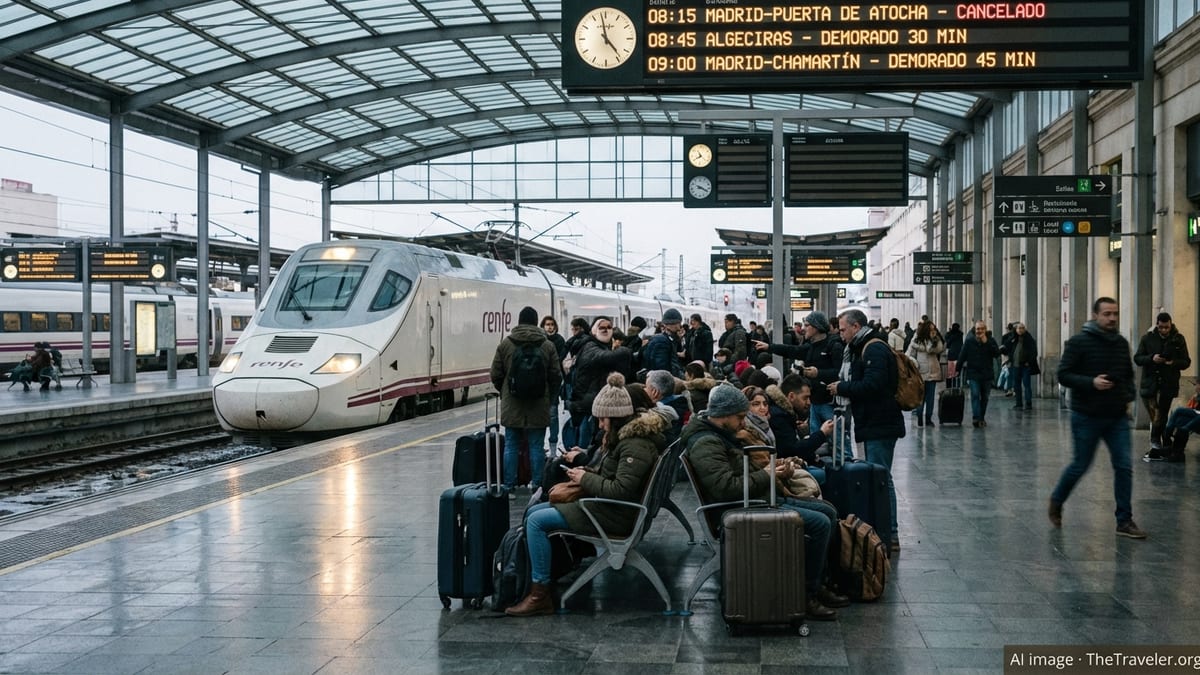
Passengers reported extended journey times, crowded replacement services and last-minute changes to departure boards as the rail network sought to absorb the loss of capacity. Those heading for Luton Airport faced additional uncertainty, with airport-bound services disrupted and travellers urged to allow considerable extra time or seek alternative routes.
Rail industry statements referenced in press reports indicate that significant repair and inspection work will be required before normal timetables can resume. The collision damaged track, cabling and lineside equipment in addition to the rolling stock involved, and the site must be thoroughly examined by investigators before heavy machinery can remove the trains.
Focus on safety systems and rear-end collision risks
Because rear-end collisions are relatively rare on the modern British rail network, the Bedford crash has prompted renewed discussion of how signalling and train protection systems are meant to prevent two services occupying the same section of track. Background material on previous incidents highlights how modern lines typically use layered safeguards intended to slow or stop trains that approach a signal at danger or an occupied block.
Analysts following the incident note that investigators are likely to examine data from on-board recorders, radio communications and signalling logs to reconstruct the sequence of events. Questions may centre on whether the rear train received and responded to appropriate signal aspects, whether any temporary speed restrictions or equipment faults were in place, and how much time and distance were available for braking once the presence of the leading train became critical.
Rail unions and safety advocates quoted in broader coverage have stressed the importance of understanding the human factors involved, such as workload, fatigue and information flow to the drivers and signallers. While no firm conclusions have been issued, the combination of high passenger numbers, line speed and busy traffic patterns on the approach to London makes the Bedford collision a key case study for rail risk management.
Any safety recommendations that emerge could influence future investment in automatic train protection upgrades, cab signalling or additional barriers designed to prevent a repeat on similar mixed-traffic main lines. The incident is already being compared in scope to earlier rear-end collisions that prompted significant reforms to operating rules and signalling technology.
Community impact and questions for future travel
For communities along the Bedford and Luton corridor, the crash has cast a shadow over a route that is central to regional mobility. Many local residents use the line daily for work and study in London, and some of those on board the affected services were regular commuters who know the timetable and stations well.
In the immediate aftermath, local services and volunteer organisations moved to provide support for those stranded or separated from relatives, while rail staff at stations along the route assisted passengers with rebooking and onward travel. Coverage from the area describes a mixture of shock, concern for the injured and appreciation for the rapid work of emergency responders on a difficult section of track.
For travellers planning future journeys on the Midland Main Line, the incident raises understandable questions about safety and reliability, even as statistical evidence continues to show that rail remains one of the safest modes of transport. Industry figures have pointed out in public forums that serious collisions of this kind are infrequent, but acknowledge that the severity of the Bedford crash will require clear explanations and visible steps to rebuild confidence.
As investigators continue their work in the coming weeks, passengers between Bedford, Luton and London are likely to experience ongoing timetable changes and occasional closures while infrastructure repairs and testing take place. For many, the priority remains the recovery of those injured and support for the family of the driver who lost his life in the collision.