


I have nothing against budget airlines or co-branded credit cards. Used strategically, they can shave real money off your trips. But the Frontier Airlines World Mastercard is one product I would never sign up for on autopilot. The card can work for a very specific kind of Frontier loyalist, yet for many casual travelers it introduces annual fees, restrictions, and headaches that outweigh the perks. Before you fill out that application mid-flight for the promise of free bags and “five free trips,” it is worth taking a slower, more skeptical look.
Get the latest updates straight to your inbox!
The Basics of the Frontier Airlines World Mastercard
The Frontier Airlines World Mastercard, issued by Barclays, is a co-branded airline credit card tied directly to Frontier’s Frontier Miles program. As of mid-2026, the headline terms look tempting: a $0 introductory annual fee for the first year, then a $99 annual fee after that, along with a sign-up bonus that is often advertised around 50,000 to 70,000 miles for meeting a relatively low spending requirement. On paper, that sounds like “several free flights,” especially when it is pitched over the cabin speakers while you are cruising at 35,000 feet.
The card’s ongoing earning structure is fairly straightforward. Frontier and Barclays publicly state that cardholders earn 5 miles per dollar on purchases at FlyFrontier.com, 3 miles per dollar at restaurants, and 1 mile per dollar on everything else. In other words, unless you are constantly buying Frontier tickets or eating out frequently, much of your day-to-day spending will only earn 1 mile per dollar, which is not particularly competitive compared with flexible bank cards that earn 1.5 or 2 points per dollar everywhere.
There are some clear airline-related perks. Cardholders can get two free checked bags for the primary cardmember on Frontier flights when certain fare conditions are met, no foreign transaction fees, and various Frontier-specific benefits such as discounts on redemption fees when booking award tickets with the card. These are real benefits, and frequent Frontier flyers can absolutely come out ahead. The key issue is that many travelers are making a snap decision to apply without running the numbers against their own travel patterns.
Editorial reviews from outlets like Forbes Advisor, NerdWallet, and FinanceBuzz all converge on the same basic position: the card can be worthwhile for frequent Frontier customers who know how to maximize Frontier Miles, but it is not a universal “must-have” card. Those nuanced reviews are very different from the enthusiastic, one-size-fits-all pitch you hear onboard a crowded Airbus on the way to Las Vegas or Orlando.
The Annual Fee Math Is Not as Simple as It Sounds
One reason I would not grab this card blindly is the way the annual fee can sneak up on you. The marketing often trumpets “no annual fee for the first year,” which is technically true for current offers, but after that honeymoon period the card costs $99 per year. That means by year two you are effectively paying almost $100 just to keep your Frontier perks and miles-earning structure.
To see how this plays out, consider a Denver-based traveler who flies Frontier twice a year to visit family in Phoenix and twice more to vacation in Florida. On those four round trips, the two free checked bags benefit can easily cover the fee. Frontier’s checked bag prices are dynamic, but it is common to see first checked bags around $40 to $60 each way if you pay close to departure. If this traveler would otherwise check a bag on each trip, even one $50 bag each way on two trips could already match the $99 fee. In that scenario, the card can make decent sense.
Now contrast that with a Chicago traveler who takes a single Frontier round trip to Orlando for a spring break trip and usually travels carry-on only. They might sign up inflight, enjoy the $0 first year, use the welcome miles once, and then forget about the card. When the $99 fee posts in year two, that traveler either has to scramble to justify it with more Frontier flights or cancel the card and potentially hurt their average account age and credit utilization. For someone who flies Frontier only occasionally, the fee is more like a penalty than a perk.
There are also opportunity costs. A casual traveler who charges $6,000 a year on the Frontier card and earns mainly 1 mile per dollar on everyday purchases could earn roughly 6,000 Frontier miles. The same spending on a no-fee 2 percent cash-back card would yield $120 in cash back with no airline restrictions. Depending on redemption values and award availability, that cash may be more flexible and ultimately more valuable than a pile of airline-specific miles.
How Frontier Miles and Redemptions Can Trip You Up
The mileage side of the equation is another reason to pause before applying. Frontier Miles can be useful, but they are not as flexible or straightforward as the points you earn with a bank card that transfers to multiple airlines. Frontier’s network focuses heavily on point-to-point routes out of hubs such as Denver, Orlando, and Las Vegas. If you live near those hubs, you may find decent award options. If you are based in a city with sparse Frontier service, your miles may be much harder to use at reasonable value.
Another complication is that Frontier, like many ultra-low-cost carriers, attaches various fees to its tickets. Even award flights typically come with taxes, carrier charges, and optional fees like seat selection and bags. The card can waive certain award redemption fees when you use it to pay taxes and fees on the ticket, which is a genuine perk. But you may still face charges for carry-on bags or seat assignments that eat into the theoretical value of your “free” flight. It is not uncommon to hear from travelers who burned 20,000 to 25,000 miles for a domestic round trip only to pay another $80 to $120 out of pocket in extras.
Miles expiration is another risk that often gets glossed over in inflight announcements. Frontier has historically required account activity at least once every 12 months to keep miles from expiring, although the details have evolved with program updates. A busy Frontier loyalist may naturally generate enough activity through flights and card spending. A once-a-year vacationer, however, risks watching that 50,000-mile welcome bonus erode if they forget to fly or use the card. Because the Frontier Mastercard is sometimes opened as a “one-time deal” during a trip, there is a real risk that those miles will sit dormant until they quietly vanish.
On top of that, Frontier’s award pricing can fluctuate based on demand and route, and the cheapest “from 10,000 miles” marketing headline does not always match what you will see for popular school holiday dates, spring break, or Thanksgiving. A family of four from Cincinnati hoping to use their welcome bonus for peak-summer flights to Orlando may discover that availability is limited, cash fares are low, or the mileage price is much higher than anticipated. That disconnect between marketing promise and practical reality is exactly why I would not sign up without a concrete plan for those miles.
Frontier’s Fee-Heavy Model and Recent Service Concerns
Before tying yourself to Frontier via a co-branded card, it is important to remember the airline’s broader business model. Frontier is an ultra-low-cost carrier: base fares can be very cheap, but nearly everything else is unbundled. You often pay separately for seat selection, carry-on bags, checked baggage, and even certain types of customer service. This is neither inherently good nor bad; some travelers love the ability to strip an itinerary down to just a personal item. But if you are not the kind of traveler who is willing to forego extras, the real cost of flying Frontier can be higher than the initial headline fare suggests.
Recent airline reviews in 2026 from sites like Upgraded Points and others continue to highlight a mix of low fares and inconsistent customer experience. Travelers praise the ability to score sub-$50 one-way fares from cities like Dallas to Denver during sales, but also report frustration with flight changes, limited phone support, and fees that add up quickly. When you pair that environment with a co-branded credit card, you are effectively committing a slice of your everyday spending power to an airline that may or may not fit your tolerance for trade-offs.
There have also been high-profile concerns around Frontier’s technology and data security. In a recent report by a technology outlet, a security researcher alleged that vulnerabilities in Frontier’s website and API could expose sensitive passenger information, including partial credit card data and personal details, using just booking information from a boarding pass. While the technical specifics matter more to security professionals than to casual travelers, the takeaway is simple: tying a long-term financial product like a credit card to a company whose digital infrastructure has drawn scrutiny should make you pause and ask how comfortable you are with that risk.
This is not to say Frontier is uniquely bad or that no airline has issues. Legacy carriers have had outages, data breaches, and customer service meltdowns of their own. The point is that when you sign up for a co-branded card, you are not just getting access to miles. You are also voting with your wallet for a specific airline and relying on its systems and policies. If you already have misgivings about Frontier’s reliability or the way it handles disruptions and fees, adding a Frontier credit card to your wallet may simply deepen that dependence.
The Psychological Pressure of Inflight Pitches
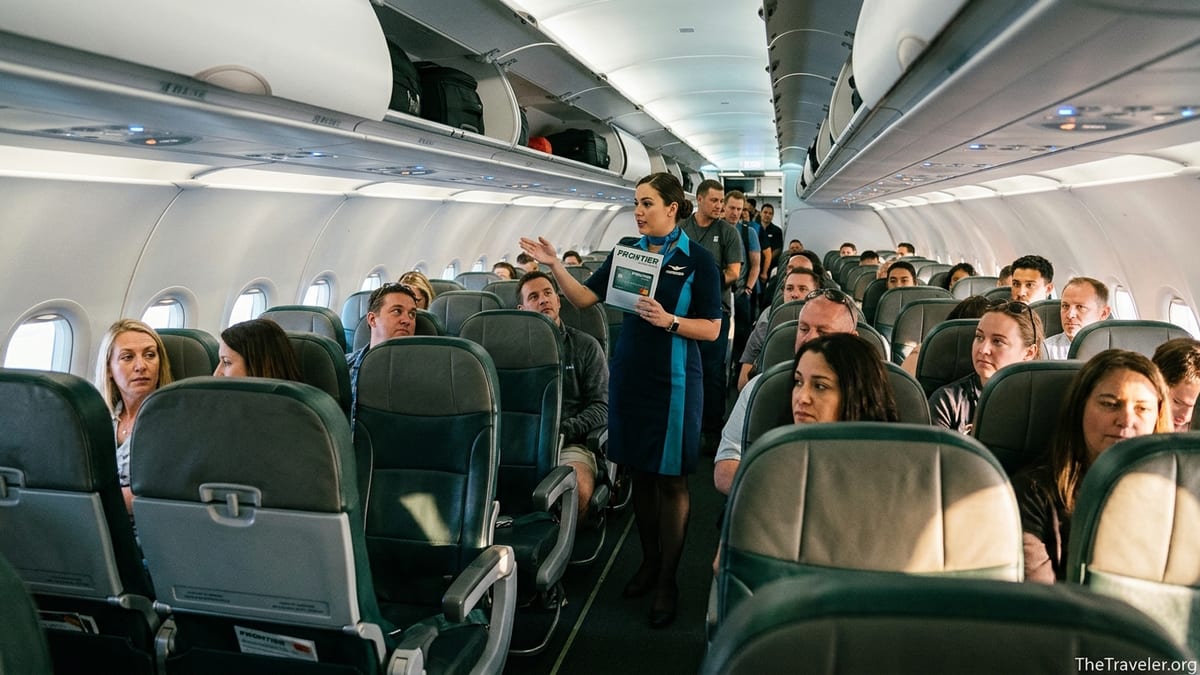
One of the most overlooked reasons I would not get this card blindly is the way it is sold. Frontier flight attendants, like those on many airlines, are trained to promote the card mid-flight. You will often hear a pitch near the end of the flight outlining how you can receive “50,000 bonus miles, worth up to five round-trip flights” and get “two free checked bags for you and your companion” if you apply before landing. On a packed spring break flight to Cancun or Orlando, that can generate a rush of people hastily filling out application forms or scanning QR codes.
The problem is that inflight environments are uniquely bad for financial decision-making. Maybe you are tired after an early departure from Philadelphia, juggling kids, or distracted by work on your laptop. You cannot easily pull up a comparison of the Frontier card versus a general travel rewards card. You certainly do not have the space to run a proper calculation of mile values, break-even points, or your average annual spend on Frontier. The pitch is deliberately simplified to make the card sound like an obvious win, not a nuanced trade-off.
Consider a couple flying from Cleveland to Orlando who hear that 50,000 miles could cover “five one-way flights.” It is easy to mentally translate that to something like two and a half round trips for the two of them each year. But if actual award pricing for their preferred dates comes out at 15,000 or 20,000 miles per one-way flight, suddenly that bonus looks a lot less generous. Without the chance to check on real routes and dates while they are captive in seat 24B, they are making a commitment based on optimistic assumptions.
There is also a time-pressure factor. Some recent Reddit threads from early 2026 describe passengers being told that specific offers, like tiered elite status or waived annual fees, are only available “right now on this flight.” That urgency can push people to apply for a card that does not match their travel patterns. The reality is that banks and airlines frequently recycle similar offers throughout the year. Unless you have already done your homework before stepping on the plane, treating an inflight pitch as your only chance is rarely in your best interest.
Comparing Frontier’s Card to Flexible Travel Rewards
When you strip away the marketing, the Frontier Airlines World Mastercard competes not just against other airline cards, but also against a wide array of flexible travel rewards products that many travelers may find more valuable. For roughly the same $95 to $99 annual fee range, you can find cards from major banks that earn transferable points to multiple airlines and hotels, or flat-rate cash-back cards that keep your options open. While specific product names and terms change frequently, the broad pattern is consistent: flexible currencies tend to be more useful to the average traveler than single-airline miles.
Take a typical U.S.-based traveler who flies a mix of carriers each year: a couple of Frontier sales from Atlanta to Las Vegas, maybe a Delta or United flight for work, and a Southwest hop to visit family. Putting all of that person’s spending on a Frontier-only card locks them into a single ecosystem. In contrast, a flexible points card could allow them to redeem for any of those airlines through a travel portal or via transfer partners. If Frontier adjusts its routes out of their home airport, raises award prices, or suffers a prolonged schedule meltdown, a Frontier-only cardholder has few alternatives for extracting value.
Another angle is elite status and ongoing perks. Frontier occasionally pairs welcome offers with temporary elite status or bonus miles for meeting certain spend thresholds. These can be attractive if you live in a Frontier focus city and can truly use the benefits: earlier boarding, discounted fees, and so on. But again, these are very airline-specific. Competitive alternative products might instead offer general travel statement credits, airport lounge access that works with multiple airlines, or broad trip protection benefits that help whether you are flying Frontier, American, or Aer Lingus.
Finally, there is a question of future flexibility. Co-branded airline cards tend to be at their most lucrative when you are committed to that airline for several years. Yet airline networks shift regularly. Frontier has pulled out of some markets, added others, and reshuffled routes as demand patterns changed. If you lock yourself in with a card because Frontier currently serves your small regional airport cheaply, you may find that a couple of years later those flights disappear, leaving you with a $99 annual fee card and miles that are awkward to use without extra positioning flights.
When the Frontier Airlines World Mastercard Can Make Sense
All of this is not to say that the Frontier Airlines World Mastercard is a bad product across the board. There are specific profiles for whom the card absolutely can make sense. If you live in a Frontier stronghold such as Denver, Orlando, or Las Vegas and regularly fly the airline for leisure trips, the combination of 5x miles on Frontier purchases and two free checked bags can quickly justify the fee. A family of four from Denver that takes three or four Frontier trips a year, always checks bags, and is comfortable with Frontier’s bare-bones service model could easily come out ahead, especially if they plan redemptions carefully.
The card can also be powerful for travelers who are dedicated to optimizing Frontier’s ecosystem. That might include pairing the card with Frontier’s GoWild all-you-can-fly pass to reduce taxes and fees on award bookings, stacking elite status benefits with card perks, and timing sign-up bonuses with major trip plans. For that kind of enthusiast, the restrictions and quirks are not bugs but features to be navigated. It is similar to how some travelers make excellent use of niche hotel cards or region-specific airlines that would not make sense for the general public.
The point is not that no one should ever apply. The point is that only a relatively narrow audience can truly squeeze full value from this card, and those travelers typically know exactly what they are getting into long before a flight attendant passes out the application forms. If you already spend thousands of dollars a year on Frontier tickets, are comfortable with their fee structure, and have specific award flights in mind, then a targeted decision to pick up the card can be smart.
What I am arguing against is the casual, spontaneous sign-up for someone whose typical year involves maybe one or two Frontier flights mixed among several other carriers. For that traveler, the Frontier Airlines World Mastercard is less of a strategic tool and more of a shiny distraction from simpler, more flexible cards that would serve them better.
The Takeaway
The Frontier Airlines World Mastercard is a specialized instrument, not an all-purpose travel card. Taken on its own terms, it can offer real value in the form of free checked bags, accelerated earning on Frontier purchases, and useful perks for regular Frontier flyers. But signing up impulsively during an inflight pitch, without assessing how often you fly Frontier and how comfortable you are with its fee-heavy business model, is a recipe for disappointment.
Before applying, step back and ask a few practical questions. How many times a year do you realistically fly Frontier, and from which airports? Are you the sort of traveler who packs light and avoids seat fees, or do you usually pay for extras that might make the airline less of a bargain? Could a flexible travel rewards or cash-back card deliver more value across the mix of airlines you actually fly? And are you prepared to actively manage your Frontier Miles so they do not expire unused?
If, after honest reflection, you see yourself as a genuine Frontier loyalist with multiple trips planned and a clear strategy for using miles, then applying for the card with eyes open can be a rational move. If not, the safer play is to let the inflight announcement wash over you, keep your wallet in your pocket, and explore more flexible options once you are back on the ground. In a crowded field of travel rewards cards, the Frontier Airlines World Mastercard is best approached with deliberate calculation, not cabin-pressurized impulse.
FAQ
Q1. Is the Frontier Airlines World Mastercard worth it if I only fly Frontier once or twice a year?
For most travelers who fly Frontier just once or twice a year and often use other airlines, the $99 annual fee after the first year is hard to justify. A general travel rewards or cash-back card usually offers better overall value and more flexibility.
Q2. How many free flights can I really get from the Frontier welcome bonus?
The welcome bonus is often marketed as being worth “up to” several one-way trips, but the real number depends on route, dates, and award availability. Many popular routes or peak travel times require more miles than the lowest advertised levels, so you may get fewer trips than the inflight pitch suggests.
Q3. Do my Frontier Miles expire if I do not use the card?
Frontier Miles have historically required at least periodic activity to stay active, and program terms can change. If you rarely fly or spend on the card, your miles may be at risk of expiring over time unless you generate qualifying activity.
Q4. Can the two free checked bags benefit alone justify the annual fee?
Yes, for some travelers. If you regularly check bags on several Frontier trips a year, the savings on baggage fees can exceed the $99 annual fee. If you usually travel with only a personal item or carry-on, the benefit might be much less valuable.
Q5. How does the Frontier card compare to flexible travel rewards cards?
The Frontier card earns miles usable only with Frontier, while many flexible travel rewards cards earn points or cash that can be used with multiple airlines or as statement credits. For most people who are not loyal to a single airline, the flexibility of those alternatives is a major advantage.
Q6. Are there hidden fees when redeeming Frontier Miles from the card?
When you redeem Frontier Miles, you still pay taxes and may face additional fees for bags, seat selection, and other options. The card can reduce or waive certain redemption fees, but it does not remove all extra costs associated with a Frontier ticket.
Q7. Will applying for the Frontier Airlines World Mastercard hurt my credit score?
As with any new credit card, applying will typically result in a hard inquiry on your credit report and may temporarily lower your score by a few points. Over time, responsible use and on-time payments can help your credit, but opening the card just for a one-time bonus is not always worth the impact.
Q8. What if Frontier reduces flights from my home airport after I get the card?
If Frontier cuts or reshapes its routes from your city, it may become harder to use your miles or justify the annual fee. That is one reason to avoid locking yourself into a single-airline card unless you have strong confidence in your ongoing ability to use that airline.
Q9. Is it better to sign up for the card in flight or online later?
Inflight offers can sometimes include limited-time perks, but similar bonuses often reappear throughout the year. Applying later from home allows you to compare terms carefully with other cards instead of deciding under time pressure in a cramped seat.
Q10. Who is the Frontier Airlines World Mastercard best suited for?
The card is best for travelers based in Frontier focus cities who fly the airline several times a year, frequently check bags, and are comfortable with Frontier’s low-cost, fee-heavy model. For everyone else, more flexible travel rewards or cash-back cards are usually a better starting point.