


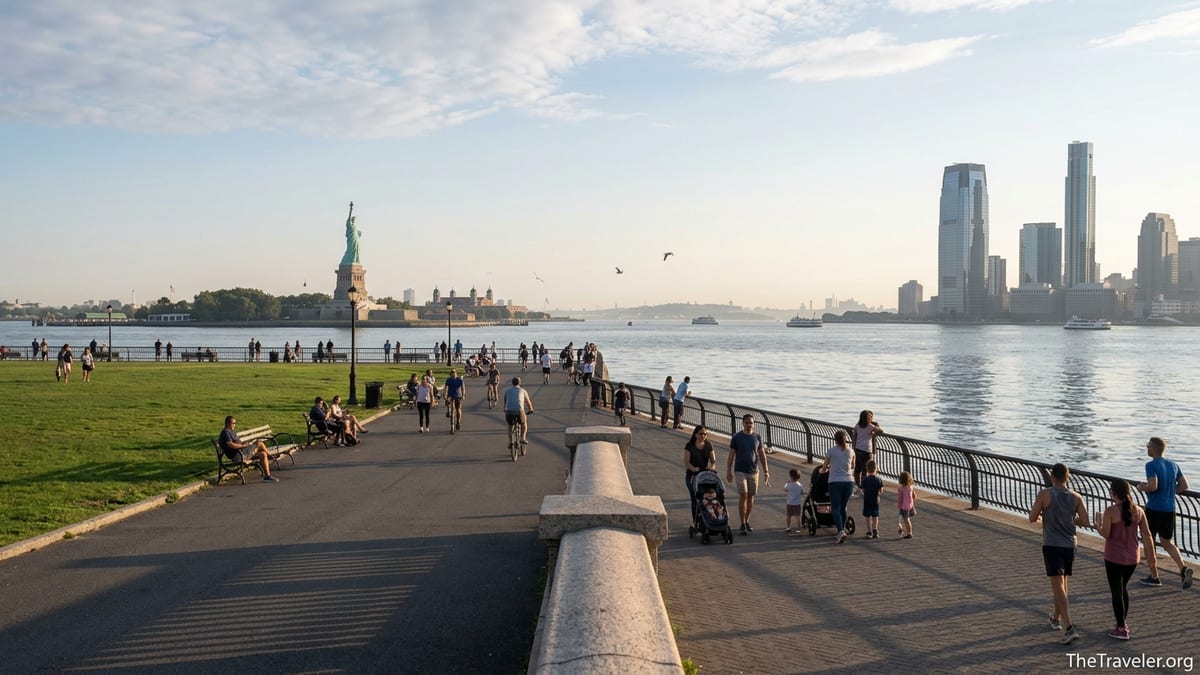
On a clear afternoon at Liberty State Park, you are as likely to see a Jersey City parent teaching a child to ride a bike as you are a visitor from Europe taking photos of the Statue of Liberty. Joggers pass fishermen on the bulkhead, wedding parties pose in front of the Manhattan skyline, and families roll coolers toward a shaded picnic table. What was once an abandoned industrial rail yard on the Jersey City waterfront has quietly become one of the most beloved escapes in the New York region, cherished by locals and increasingly discovered by travelers who want big views without big crowds.
Get the latest updates straight to your inbox!
From Abandoned Rail Yards to Urban Sanctuary
It is hard to imagine today, but the stretch of waterfront that is now Liberty State Park was, for much of the 20th century, a landscape of crumbling piers, derelict warehouses and contaminated rail yards. The Central Railroad of New Jersey Terminal, which now welcomes visitors with its red-brick towers and long arched windows, once processed millions of immigrants arriving from Ellis Island on their way to new lives across the United States. When rail service declined in the mid-1900s, the terminal fell silent, the tracks rusted, and the site became an industrial wasteland at the very moment that the region’s population was growing and open space was vanishing.
Local residents, led by Jersey City shopkeeper Morris Pesin, began pushing in the late 1950s and 1960s for a public park that would give New Jersey its own front-row access to the Statue of Liberty. Pesin famously paddled a rented canoe from Jersey City toward Liberty Island to dramatize how close the state was to one of the world’s great landmarks, yet how cut off it remained by fences and derelict industry. Over nearly two decades, he and other advocates pressed state officials to buy up the abandoned land, clean it and convert it into public green space rather than luxury waterfront development.
When Liberty State Park finally opened in 1976, it was New Jersey’s first true urban state park, a bold statement that this heavily industrial region deserved more than smokestacks and highways. Over time, the land was remediated, lawns were planted, and a two-mile waterfront promenade was built along the Hudson River. The result today is a 1,200-acre patchwork of open fields, tidal marsh, paths and restored historic sites where freight tracks once ran. For locals, the history is personal; for visitors, it adds depth to what might otherwise feel like just a pretty waterfront.
Even now, the park continues to evolve. A state-led revitalization plan is expanding natural areas with new wetlands and forests in the interior, while also planning sports fields and community facilities that reflect the needs of nearby neighborhoods. Regular users see the changes in real time, from freshly graded walking paths to new wayfinding signs near the Central Railroad terminal, reinforcing the sense that this is a living landscape rather than a frozen monument.
Unmatched Views Without Manhattan Crowds
One of the biggest reasons Liberty State Park has become a favorite escape is simple: the views are extraordinary, and you rarely have to fight for them. Standing along the Hudson River promenade, you can trace the Manhattan skyline from the glass towers of the World Trade Center to the older masonry of Battery Park City and the bridges beyond. The Statue of Liberty appears almost centered in your line of sight, far closer than it looks from many Manhattan vantage points, and Ellis Island’s red-roofed buildings sit just across the channel.
For travelers, those views translate into a calmer alternative to the rush of Battery Park. On a Saturday morning in peak season, the security line for ferries in Lower Manhattan can snake across plazas, with guides hawking unofficial tours nearby. At Liberty State Park, visitors who arrive early often find shorter security lines for the same official ferries to Liberty and Ellis Islands, plus the ability to wait on wide lawns rather than in tight queues between buildings. Families with strollers or older travelers appreciate the space to spread out, find a bench in the shade, or let children run on the grass before boarding.
Locals value the views in a different way. For a Jersey City office worker, an after-work jog along the waterfront becomes a moving postcard: container ships sliding past the Verrazzano-Narrows Bridge, sailboats tacking in the harbor, the Statue’s torch catching the last orange light of the day. Couples come for sunset picnics on the lawns near the historic terminal, timing their dinner so that the buildings of Lower Manhattan shift from gold to deep blue as the city lights blink on. On summer evenings, it is not unusual to see a photographer shooting graduation portraits while a nearby family unfolds a blanket for a simple rice-and-beans picnic from a local bodega.
Crucially, Liberty State Park’s openness prevents the sense of crowding that can make some New York viewpoints feel exhausting. The two-mile promenade has room for walkers, joggers, and cyclists to coexist, and the Great Lawn and North Field offer ample space even on busy holiday weekends. Travelers who plan a statue visit from New Jersey often report that the park feels like a breather in the middle of an otherwise packed New York itinerary, a place where they can get the “must have” photos without the constant pressure of the city around them.
An Everyday Backyard for Jersey City Residents
While the skyline and ferries draw outsiders, Liberty State Park is, first and foremost, a neighborhood park on a grand scale. On a Tuesday afternoon in May, you will see local high school teams running drills on the sports fields near the interior, toddlers swarming the playgrounds off Audrey Zapp Drive, and seniors from nearby apartment complexes walking slow loops on the paved paths. For many Jersey City residents, particularly in the dense neighborhoods of Bergen-Lafayette and downtown, this is the closest place to walk under a line of trees without traffic noise overwhelming conversation.
The park’s picnic pavilions have become a staple of local celebrations. Jersey City families regularly reserve them for birthday parties, graduations and baby showers, hauling trays of empanadas, aluminum pans of biryani, or coolers of Caribbean soft drinks from nearby shops. A typical summer Saturday might see a Filipino family grilling marinated pork skewers at one pavilion, a Pakistani family serving chicken karahi at another, and a Dominican playlist drifting in from a third. The park’s grills, tables, electrical outlets and wide adjacent lawns make it easy to host multi-generational gatherings without renting a private hall.
On the quieter stretches of the week, Liberty State Park functions as an outdoor living room. Remote workers bring laptops to shaded benches with a view of the harbor, taking calls against a backdrop of gulls and ferries instead of cafe noise. Fitness groups meet for boot camps or yoga sessions on the grass near the Hudson River, rolling out mats for sunrise classes as the water turns pink. Dog owners favor the less-trafficked interior paths for long, off-peak walks, while cyclists use the park as a safe training loop before or after work.
Local schools and community organizations also rely on the park as an extension of the classroom. Nearby public schools schedule field days on the lawns, while environmental educators lead field trips into the restored marshes to identify shorebirds and discuss the lingering impacts of industrial pollution. For many Jersey City children who live in high-rise buildings or houses without yards, Liberty State Park is where they first fly a kite, feel salt spray, or see a heron lifting off from the reeds.
The Gateway to the Statue of Liberty and Ellis Island
For travelers, perhaps the most practical reason Liberty State Park has become a favorite is its role as a gateway to Liberty and Ellis Islands. Official ferries to the Statue of Liberty National Monument and Ellis Island depart from a terminal within the park as well as from Lower Manhattan. Visitors departing from New Jersey still use the same operator and ticket system, but they often find parking simpler and the boarding process less hectic than at Battery Park.
The logistics are straightforward. Drivers can follow the New Jersey Turnpike extension to Exit 14B and park in designated lots near the waterfront, paying a daily fee that is typically modest compared with Manhattan garages. Travelers staying in New York can take the PATH train to Exchange Place or Newport and transfer to the Hudson-Bergen Light Rail, stepping off at Liberty State Park station and walking or taking a seasonal shuttle toward the ferry area. For families traveling with strollers or grandparents, avoiding crowded Manhattan sidewalks and subway stairs can make the day considerably smoother.
Because every visitor headed to the islands must pass through airport-style security, starting from a calmer environment matters. At Liberty State Park, security screening areas open directly onto lawns and walkways, so those who arrive early for timed ferry tickets can sit in the shade or let children explore the nearby historic rail platforms rather than standing in tight corrals. The Central Railroad terminal building, with its soaring interior and preserved ticket windows, gives travelers a tangible sense of the immigrant journeys that once continued from these very tracks.
For those who do not manage to secure Statue of Liberty crown or pedestal tickets, Liberty State Park still softens the disappointment. Many visitors who discover that special access tickets are sold out for their dates pivot to a relaxed day in the park instead: a basic grounds ticket to Liberty and Ellis Islands combined with a long stroll on the promenade, time in the picnic areas, and maybe a detour to one of the park’s restaurants or the Liberty Science Center nearby. By the time they return in the evening, with the skyline lit and the torch glowing over the harbor, the day feels like far more than a single attraction visit.
Nature, Art and Memory on the Waterfront
Liberty State Park’s appeal is not only visual but emotional. Scattered along its waterfront are sites that invite reflection, from restored marshland alive with birds to powerful memorials that speak to national and local history. Together, they create a layered landscape that resonates with both residents and visitors tracing their own stories through the region.
One of the most striking features is the “Empty Sky” memorial, New Jersey’s official tribute to residents lost in the attacks of September 11, 2001. Two parallel stainless steel walls frame the site line where the Twin Towers once stood, inscribed with the names of the victims and reflecting the changing sky and passing visitors. Locals visit on anniversaries and ordinary days alike, sometimes leaving flowers or photographs at the base. Travelers who come primarily for the Statue of Liberty often stumble upon the memorial on their way back to the parking lots and spend long, quiet minutes there, surprised to find such an intimate space in a large state park.
Beyond the memorials, the park’s natural areas offer a different rhythm. The interior sections, where former rail yards have been allowed to revert to meadow and emergent woodland, are being reshaped into a network of wetlands and nature trails designed to filter stormwater and provide habitat for migratory birds. In spring and fall, local birders station themselves near the marsh edges with binoculars, pointing out egrets, sandpipers and warblers to curious passersby. For city dwellers, seeing a snowy egret stalking fish just across the harbor from the World Trade Center can be unexpectedly moving.
Public art and small-scale installations add further texture. Sculptures near the waterfront and historical plaques along the promenade highlight everything from the story of Black Tom Island, the site of a wartime explosion in 1916, to the engineering behind the Statue’s pedestal. Families on bikes will often stop so that adults can read aloud while children circle on scooters. The result is that a casual loop around the park can easily turn into an impromptu lesson in immigration, industry and resilience without ever stepping into a museum.
For Jersey City residents, these elements make the park more than just open space. It is a place where collective memory is visible, where an afternoon walk can connect the dots between a grandparent who came through Ellis Island, a parent who worked on the Hudson waterfront, and a child who plays soccer in the shadow of the same harbor. Travelers might come for the skyline, but many leave remembering the hush of Empty Sky or the sight of marsh grass bending in the wind.
Easy Access, Everyday Affordability
Part of Liberty State Park’s popularity lies in its accessibility in both practical and financial terms. As a state park, entry is typically free, and visitors pay only for parking in certain lots, reserved facilities such as picnic pavilions, or specific attractions like ferry tickets to the islands or admission to the Liberty Science Center. For local families watching their budgets, this makes it possible to enjoy regular outings without the cumulative costs of private attractions or toll-heavy drives to distant beaches.
Getting to the park is relatively straightforward from across the region. North Jersey residents frequently drive via the New Jersey Turnpike or local roads in Jersey City, timing their arrival to secure shaded parking spots on hot days. Manhattan visitors often combine the PATH train with the Hudson-Bergen Light Rail, using contactless or day passes to cover transit for the whole family. In practice, a couple staying near Penn Station can be walking along the Hudson River in Liberty State Park in under an hour without ever hailing a taxi.
Within the park, amenities are basic but well suited to everyday use. Restrooms are spaced along the main areas, and seasonal concessions offer drinks and simple snacks, particularly near the more heavily trafficked waterfront. Liberty House Restaurant and nearby venues provide upscale dining and event spaces with sweeping skyline views, popular for weddings and corporate events that keep guests rooted in the local landscape rather than shuttling them into Manhattan. At the same time, food trucks and coolers full of homemade dishes are just as common a sight on sunny weekends.
For travelers comparing options, Liberty State Park stands out as a way to experience the harbor and the Statue of Liberty without committing to a full commercial tour schedule. A visitor might spend the morning at the interactive Liberty Science Center, walk ten minutes to a picnic on the Great Lawn, board an afternoon ferry to Ellis Island, and finish with a sunset stroll past Empty Sky, all while spending less than they would on a single themed cruise. That balance of access and affordability helps explain why the park has become a go-to recommendation among New Jersey residents when friends and relatives visit from out of town.
The Takeaway
Liberty State Park’s rise from derelict rail yard to beloved urban refuge is the story of a community that insisted on access to its own waterfront. Locals fought for a park that would remain free and green, and travelers now benefit from that vision every time they step onto the promenade and see the Statue of Liberty framed by open sky instead of private development. The park’s mix of history, nature, memorials and simple recreational space reflects exactly how people use it: as a place to gather, remember, exercise, and catch their breath within sight of one of the world’s most recognized landmarks.
For Jersey City residents, Liberty State Park has become an extension of home, a backyard big enough for soccer leagues, family reunions and solitary sunrise walks. For visitors from across the river or across the ocean, it offers a calmer way to experience the harbor, with easier logistics and more room to linger before or after a trip to Liberty and Ellis Islands. Its appeal is grounded not in novelty but in reliability: a stretch of water and grass that is there on a Tuesday morning as surely as on the Fourth of July.
In a region where public space is scarce and often commercialized, Liberty State Park stands as a reminder that some of the most memorable travel experiences come from places that residents already love. Whether you arrive with a camera and a checklist, or with nothing more than a book and an hour to spare, the park invites you to slow down, look out across the harbor, and feel, if only for a moment, that the city has stepped back and given you room to breathe.
FAQ
Q1. Where exactly is Liberty State Park located?
Liberty State Park is in Jersey City, New Jersey, on the Hudson River waterfront directly facing the Statue of Liberty, Ellis Island and Lower Manhattan.
Q2. Is Liberty State Park free to visit?
Yes. Entry to Liberty State Park is generally free. Visitors may pay for parking in certain lots, reserved picnic areas, ferries and nearby attractions.
Q3. How do I get to Liberty State Park from Manhattan without a car?
You can take the PATH train to Exchange Place or Newport in Jersey City, then transfer to the Hudson-Bergen Light Rail and get off at Liberty State Park station.
Q4. Can I catch the Statue of Liberty ferry from Liberty State Park?
Yes. Official ferries to Liberty and Ellis Islands depart from a terminal within Liberty State Park, offering an alternative to departing from Battery Park in Manhattan.
Q5. Is Liberty State Park a good place for a family picnic?
Very much so. The park has large lawns, picnic tables, grills in designated pavilions, playgrounds and restrooms that make it well suited to family gatherings.
Q6. Are there things to do in Liberty State Park if I am not visiting the Statue of Liberty?
Yes. You can walk or bike the waterfront promenade, visit memorials such as Empty Sky, explore natural areas, picnic, play sports or visit the Liberty Science Center nearby.
Q7. What are the best times of day to enjoy the views from Liberty State Park?
Sunrise and sunset are particularly beautiful, with soft light on the skyline and the Statue of Liberty, but midday offers clear views and is popular for family outings.
Q8. Is Liberty State Park safe to visit in the evening?
Generally, yes. The main waterfront areas are commonly used by locals into the evening, though visitors should follow normal urban safety precautions and check current conditions.
Q9. Can I ride a bike or run in Liberty State Park?
Yes. The park features paved paths and a long waterfront promenade popular with runners and cyclists, as well as open areas for casual riding.
Q10. Do I need to reserve anything in advance to use Liberty State Park?
You do not need a reservation to enter, but you should book ferry tickets and reserve picnic pavilions or event spaces in advance, especially on weekends and holidays.