


Rione Sanità is not the first neighborhood most visitors see in Naples. It sits slightly apart from the postcard seafront and the grand boulevards, wedged in a valley between the historic center and the Capodimonte hill. Yet few areas of the city capture Naples’ contradictions and creative energy as vividly as this former burial ground turned working-class district. To understand what makes Naples different from any other Italian city, you need to walk through the Sanità.
Get the latest updates straight to your inbox!
An Ancient Valley of the Dead Turned Living Neighborhood
Unlike many Neapolitan neighborhoods that developed as residential quarters from the outset, Rione Sanità began as a vast necropolis. Beneath its streets lie Hellenistic hypogea and early Christian catacombs, including the Catacombs of San Gennaro and San Gaudioso, which made the valley a burial and worship site long before today’s apartment blocks appeared. The area was effectively a “city of the dead,” separate from the urban core, which shaped a unique local relationship with memory, superstition, and spirituality that still colors daily life.
When Naples expanded in the 17th and 18th centuries, the valley was urbanized and Sanità became an elegant address for aristocrats. Palaces such as Palazzo Sanfelice and Palazzo dello Spagnolo rose with elaborate Baroque staircases and courtyard façades that you can still admire today simply by wandering via Arena alla Sanità or the Borgo dei Vergini. Unlike the Spanish Quarter, which was built for soldiers, or Chiaia, which grew as an upper-class seafront district, Sanità’s noble origins are literally layered over much older funerary spaces.
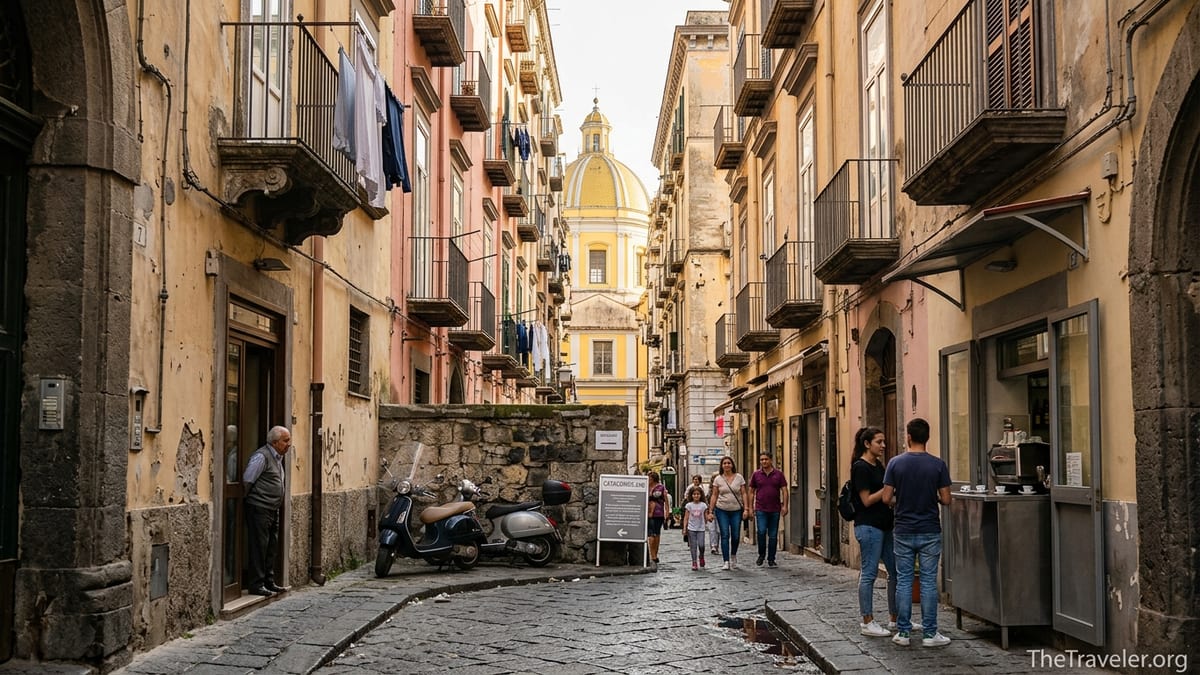
This dual history is physically visible in places like the Basilica di Santa Maria della Sanità, whose bright yellow cupola dominates Piazza Sanità. The church was constructed directly above the catacombs of San Gaudioso, so a single visit takes you from a busy neighborhood piazza down into underground chambers lined with early Christian burials. In few other parts of Naples do you step so quickly from honking scooters and coffee bars into silent rock-cut tombs.
For travelers, this layered past means that a simple morning walk in Rione Sanità feels very different from a stroll along Via Toledo or the waterfront promenade. Here, travel time often includes a descent underground: a guided visit to the catacombs typically runs 60 to 90 minutes, costs roughly the same as a mid-range restaurant meal, and is usually led by local young people from the neighborhood, which adds a community voice to the archaeological narrative.
From Aristocratic Splendor to Urban Hardship
Rione Sanità’s trajectory also sets it apart from other Neapolitan districts. What began as a noble quarter declined sharply in the 19th and 20th centuries, especially after the construction of a major bridge over the valley under the Napoleonic ruler Joachim Murat. The bridge effectively cut the area off from the city’s main flows, diverting through-traffic above rather than through its streets. As wealthier families moved out, Sanità became a dense, working-class neighborhood struggling with underinvestment and high unemployment.
In contrast, hilltop Vomero developed into a comfortable middle and upper-middle-class district full of Art Nouveau villas, department stores, and leafy streets reached by funicular. Waterfront Chiaia consolidated its image as a polished neighborhood of boutiques, cocktail bars, and seafront strolls. The Spanish Quarter, though historically poor, remained tightly linked to central commercial arteries like Via Toledo. Sanità, by comparison, became a semi-hidden pocket of the city, with a reputation locals often summed up as “difficult” or “degraded.”
You can still read this history in the architecture. A walk from Porta San Gennaro into the Borgo dei Vergini takes you past once-grand palazzi whose balconies display laundry lines instead of aristocratic banners, and courtyards where kids kick footballs between flaking stucco and imposing staircases. Unlike newly polished parts of the centro storico, many buildings in Sanità are only partially restored, giving visitors a sense of the neighborhood as a living space rather than a fully curated heritage stage set.
This contrast is particularly striking if you visit Rione Sanità on the same day as a more affluent quarter. In Chiaia, a cappuccino on Piazza dei Martiri or Via Chiaia might cost noticeably more than the espresso you drink standing at a bar on Piazza Sanità. In Vomero, boutiques sell designer brands and concept sneakers, while in Sanità most shops are small family-run businesses offering produce, household goods, and inexpensive clothing to local residents. The neighborhood’s economic reality remains different, even as tourism and cultural projects slowly bring new income.
Grassroots Regeneration Instead of Top-Down Gentrification
What makes Rione Sanità especially distinctive today is the way its recent revival has emerged from below. While other parts of Naples have seen more classic gentrification, with outside investors converting historic buildings into boutique hotels and high-end bars, Sanità’s regeneration has largely been led by local associations, parish networks, and social cooperatives. The Fondazione di Comunità San Gennaro, created in the 2010s, has become a key player, coordinating projects that range from cultural events to social housing and youth employment.
One concrete example is the cooperative La Paranza, a group of young residents who took on the management and guided tours of the Catacombs of San Gennaro and San Gaudioso. Instead of a national or international operator running the sites, local youth lead visitors through the underground galleries, and part of the ticket revenue is reinvested in scholarships, training, and neighborhood projects. Travelers who book catacombs tours in Sanità are not just buying an archaeological experience; they are directly supporting a community-run enterprise.
Another initiative involves converting former religious and monastic spaces linked to the catacombs into guest accommodation and cultural hubs. For example, rooms in cloisters adjacent to the basilicas have been transformed into simple but atmospheric lodgings that help fund preservation and create jobs. This model differs from more commercial hotel development in areas like the seafront, where new properties often have minimal connection to local residents beyond service work.
Visitors also notice the presence of neighborhood festivals, social centers, and small-scale creative studios supported by the community foundation and local parishes. A street-art themed walking tour might pause not only at murals but also inside a workshop where young people learn photography or ceramics. Compared with the Spanish Quarter, where the surge in tourism is rapidly transforming rental markets and storefronts, Sanità’s shifts feel, for now, more anchored in social projects and less focused on attracting a purely upscale clientele.
Street Art, Totò, and Everyday Theatre
Rione Sanità wears its cultural identity vividly on its walls. While the Spanish Quarter has become famous for its giant mural of Diego Maradona, Sanità celebrates another Neapolitan icon: the comic actor Totò, who was born on Via Santa Maria Antesaecula. Around the Borgo dei Vergini and nearby streets, you will find murals honoring Totò and other local figures, often placed alongside older religious shrines and votive images. This layering of pop culture and devotion gives the streets an atmosphere that is distinct from both tourist-friendly Centro Storico and polished Chiaia.
Several tour operators now offer themed walks through Sanità that focus on street art and food. A typical three-hour tour might start at Porta San Gennaro, wind through Via Vergini to see murals of Totò or Neapolitan musicians, and finish with tastings of fried pasta “frittatine,” sfogliatelle pastries, and local coffee at long-standing bars. Prices are often competitive with city-center tours, but the content feels more intimate, with guides pointing out neighborhood gossip, family histories, and personal memories instead of simply reciting historical dates.
The district’s cultural life also unfolds in tiny theatres and improvised stages. Community centers and parish halls host performances that mix traditional Neapolitan song with contemporary storytelling, often reflecting on the neighborhood’s struggles and hopes. Rather than the grand opera of Teatro San Carlo or polished shows near the seafront, entertainment in Sanità tends to be low-cost, participatory, and very local. Visitors who seek it out get a sense of Naples not as a museum city but as a place where culture is constantly made and remade by residents.
Even a casual afternoon in the area can feel theatrical. Children play football in Piazzetta San Severo alla Sanità, older residents observe from doorways, and the constant flow of scooters, vendors, and neighbors greeting each other gives the streets an energy that can be more intense and less mediated than in more touristic parts of town. For travelers used to carefully curated “old towns” elsewhere in Europe, this sense of everyday spectacle is both the charm and the challenge of Rione Sanità.
Spiritual Traditions and the Cult of the Dead
Nowhere in Naples is the bond between the living and the dead more visible than in Rione Sanità. The paleochristian catacombs beneath the neighborhood already give it a strong funerary character, but local traditions have carried that relationship into popular religion. The nearby Cimitero delle Fontanelle, an ossuary filled with thousands of skulls and bones, is tied to the “anime pezzentelle,” or “little wretched souls,” a folk belief involving care for anonymous dead and requests for protection or favors in return.
While this cult has been moderated over time, the idea that the dead remain active members of the community persists. For visitors, this means that tours of the catacombs and the cemetery are not just archaeological visits; they are encounters with practices that still resonate in local families’ stories. Guides from Sanità often explain how grandparents once adopted a particular skull at Fontanelle, cleaned it, lit candles, and spoke to it as an intercessor. This emotional, almost intimate approach to death differs from more sanitized historical narratives you might hear in museums elsewhere in the city.
Other neighborhoods of Naples certainly have strong religious traditions, from processions in the Spanish Quarter to churches in the old center where locals gather in front of ex-votos. But in Sanità, the presence of the catacombs and the ossuary make death unavoidable and ordinary at the same time. A child playing near Piazza Sanità may grow up hearing stories about saints and skulls as part of everyday life. For travelers, this can be unsettling but also deeply illuminating, showing how Naples’ famed attachment to fate, luck, and the afterlife is rooted in specific spaces and rituals.
Practical tours reflect this focus. Combined tickets often allow entry to both San Gennaro and San Gaudioso catacombs, sometimes including shuttle transport from major city landmarks. These visits tend to emphasize silence and respect, and group sizes are controlled to protect the fragile frescoes and corridors. Compared with other Napolitan attractions, the experience feels less like a photo stop and more like entering a shared, if fragile, heritage that locals are actively curating.
Daily Life, Prices, and the Traveler Experience
On a practical level, Rione Sanità also feels different from other Neapolitan neighborhoods because of the way visitors move through it. There are fewer hotels and more modest guesthouses or short-term rentals tucked into residential buildings. You are more likely to stay in a simple apartment with a small balcony overlooking a narrow alley than in a polished hotel with sea views, like those found along the Lungomare or in Chiaia. For travelers comfortable with an immersive, local experience, this can be a major advantage.
Food and drink prices tend to be slightly lower than in the waterfront districts or hilltop Vomero. A takeaway pizza from a well-known neighborhood pizzeria, including Michelin-recognized spots, can cost only a little more than a standard pizza elsewhere in the city, allowing you to try top-level cooking without the premium you might pay in more overtly touristic quarters. Espresso at the bar remains a daily ritual, and it is easy to find a quick, inexpensive lunch of fried street food, such as arancini or “cuoppi” of mixed fry, from small takeaways clustered around Borgo dei Vergini and the main piazzas.
At the same time, visitors need to approach Sanità with realistic expectations. The streets are busy and can feel chaotic, especially at peak hours, with scooters weaving through crowds and market stalls spilling into the road. Refuse collection and building maintenance may not always match the standards of wealthier districts. Some travelers, particularly those expecting the polished historic cores seen in other Italian cities, might initially find the neighborhood rough around the edges.
Safety perceptions also differ from reality. Like many working-class urban areas, Rione Sanità has faced issues with crime and informal economies, and locals still talk about those years frankly. However, increased foot traffic from visitors, the presence of well-organized tours, and community initiatives have generally made the main streets and cultural sites feel more welcoming during the day. As elsewhere in Naples, common-sense precautions apply: avoid flashing valuables, stick to lit streets at night, and use organized transport if you feel unsure. Many travelers now combine an afternoon in Sanità with time in the historic center, using the metro stations at Museo or Piazza Cavour and walking through Porta San Gennaro into the neighborhood.
How Rione Sanità Compares With Other Naples Neighborhoods
To understand what makes Rione Sanità different, it helps to compare it directly with a few of Naples’ best-known districts. The Centro Storico, cut by Spaccanapoli, is officially older and richer in churches and museums, but much of its main axis is heavily oriented toward visitors, with souvenir shops and guided groups dominating the narrow lanes. Sanità, by contrast, has fewer large monuments but a higher ratio of everyday life to tourist infrastructure. It is where you see how Neapolitans actually live rather than how the city stages itself for outsiders.
The Spanish Quarter shares Sanità’s density and working-class roots, with laundry-strewn alleys and a history of poverty and resilience. In recent years, however, the Spanish Quarter has become a near-constant backdrop for social media, especially around major murals and food spots just off Via Toledo. Bars and short-term rentals have multiplied, and rental prices have shifted. Rione Sanità is now on a similar path of growing popularity, yet it still feels a half-step behind in terms of commercialization, with more emphasis on community-led tourism and fewer international chains.
Vomero and Chiaia, meanwhile, function almost as counterpoints. Vomero offers wide views, tree-lined streets, and middle-class calm, with multi-story apartment blocks and shopping streets that could belong to many European cities. Chiaia, with its seafront villas and designer stores, caters to residents and visitors seeking aperitivo culture, nightlife, and coastal scenery. Neither district has the same direct confrontation with ancient burial grounds underfoot, nor the same mix of decayed palazzi and grassroots street art. A day that starts with a funicular ride to Vomero’s Certosa di San Martino and ends with an underground visit in Sanità drives home how dramatically the city changes in just a few metro stops.
For travelers planning an itinerary, this means Rione Sanità works best as a complement to, not a substitute for, other areas. A morning exploring the formal beauty of the royal palaces and seafront promenades can be followed by an afternoon dive into Sanità’s tight streets, informal markets, and underground sites. Those who stay overnight in the neighborhood often report a deeper connection with Naples, from greeting the same barista every morning to chatting with neighbors on stairwells, experiences that can be harder to find in more transient quarters.
The Takeaway
Rione Sanità is different from other Neapolitan neighborhoods because it concentrates, in a small valley, many of the contradictions that define Naples itself. Built atop ancient burial grounds, shaped by aristocratic splendor and later urban hardship, it is now rewriting its story through community-led cultural projects and a renewed sense of pride. Visitors encounter not only spectacular catacombs and Baroque architecture but also crowded markets, street art tributes to Totò, and local kids racing through courtyards that once hosted noble families.
Where the seafront districts offer polished views and the hilltop quarters provide calm, Sanità delivers intensity and intimacy. You are never far from the sound of church bells, scooter horns, and neighbors shouting greetings across balconies. Tours are often guided by residents who speak of “our catacombs” and “our piazza,” and money spent on tickets, food, and small souvenirs is more likely to circulate within the neighborhood.
For travelers willing to navigate its noise and rough edges, Rione Sanità offers one of the most rewarding windows into contemporary Naples. It shows how a district once written off as dangerous or marginal can become a laboratory for social innovation and cultural renewal without losing its soul. Exploring it alongside better-known areas like the Centro Storico, Chiaia, and Vomero reveals not just another stop on a checklist, but a living community that helps explain why Naples feels different from any other city in Italy.
FAQ
Q1. Is Rione Sanità safe for visitors during the day?
Rione Sanità is busy and can feel chaotic, but main streets and cultural sites are generally considered fine for daytime visits. Join guided tours, stay on well-used routes, and follow normal big-city precautions with valuables.
Q2. How do I get to Rione Sanità from the historic center?
Most visitors walk from the Centro Storico to Porta San Gennaro near Piazza Cavour or Museo metro stations, then continue into the Borgo dei Vergini on foot. Taxis and ride-hailing services are also options if you prefer door-to-door transport.
Q3. What are the must-see sights in Rione Sanità?
Key highlights include the Catacombs of San Gennaro and San Gaudioso, the Basilica di Santa Maria della Sanità, the Cimitero delle Fontanelle ossuary, and the Baroque palazzi such as Palazzo Sanfelice and Palazzo dello Spagnolo.
Q4. Do I need to book catacombs tours in advance?
Booking ahead is recommended, especially in peak seasons and weekends, because group sizes are limited to protect the underground spaces. Same-day tickets can be available in quieter periods, but advance reservations give more certainty on times.
Q5. How does staying in Rione Sanità compare with staying in Chiaia or Vomero?
Staying in Sanità is more immersive and residential, with fewer hotels and more modest apartments, plus lower everyday prices. Chiaia and Vomero offer more polished surroundings, wider hotel choices, and easier access to nightlife and panoramic views.
Q6. Is Rione Sanità suitable for families with children?
Families who are comfortable with dense, lively streets often enjoy Rione Sanità, especially older children interested in history and underground sites. Parents should be prepared to keep a close eye on kids around traffic, scooters, and staircases.
Q7. What kind of food can I expect in Rione Sanità?
The neighborhood is known for classic Neapolitan dishes: pizza from traditional and acclaimed pizzerias, fried street food like arancini and crocchè, and pastries such as sfogliatelle. Prices are usually moderate compared with seafront districts.
Q8. Are there many English-speaking guides and services?
At major sites like the catacombs, you will usually find English-speaking guides or audio guides. In small bars and shops, English may be more limited, but staff are generally patient, and simple Italian phrases or translation apps go a long way.
Q9. How much time should I plan for a visit to Rione Sanità?
A half day is enough to see one catacomb complex, stroll the main streets, and have a meal. A full day allows time for both major catacombs, the ossuary, more relaxed wandering, and coffee or aperitivo pauses in neighborhood bars.
Q10. Is Rione Sanità likely to change quickly because of tourism?
Tourism and cultural projects are increasing, and some streets are already livelier than a decade ago. However, regeneration here is strongly tied to local foundations and cooperatives, so changes so far have focused more on community benefits than rapid upscale gentrification.