


Spend a week in Maryland and you may start wondering how one compact Mid-Atlantic state can feel like several different places stitched together. One day you are eating steamed blue crabs on a sleepy Chesapeake wharf, the next you are hiking a misty Appalachian ridge or watching wild horses walk across an Atlantic beach. Add in Baltimore’s dense, brick-and-rowhouse urban core and leafy D.C. suburbs, and Maryland begins to feel less like a single destination and more like an entire road atlas compressed into a few hours of driving.
Get the latest updates straight to your inbox!
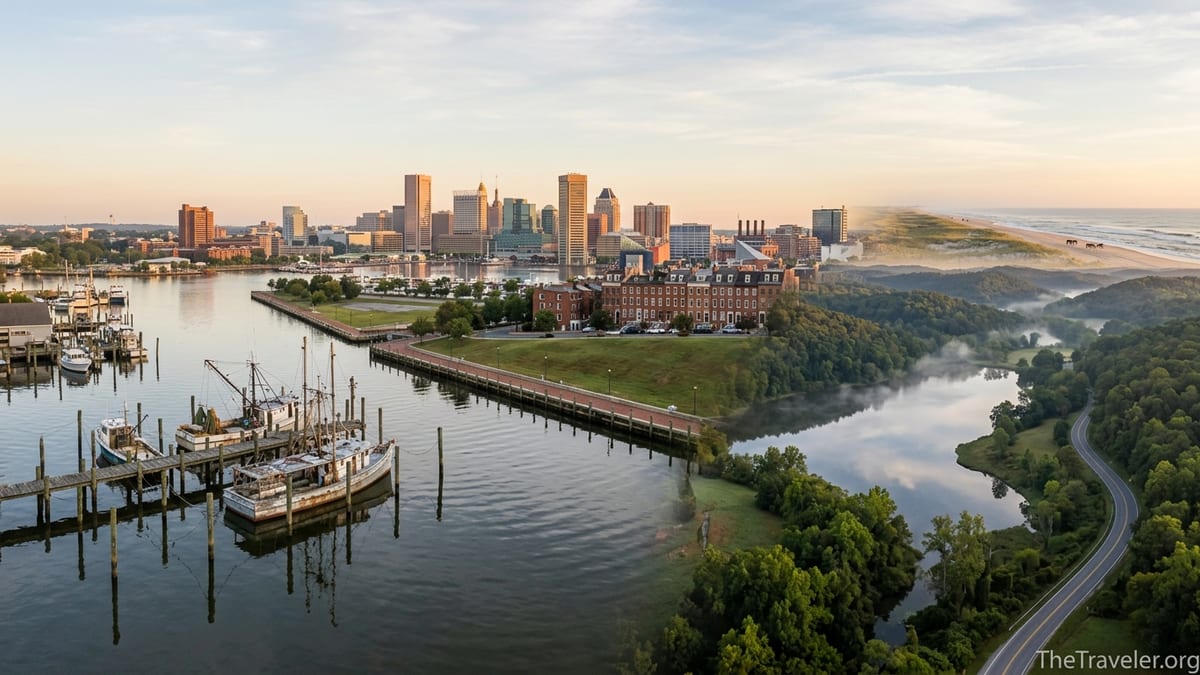
A Pocket-Size State With Outsized Variety
Look at Maryland on a map and it hardly seems big enough to hold multiday adventures. From the Atlantic barrier islands near Ocean City to the West Virginia line beyond Deep Creek Lake, it stretches only about 250 miles. In places near the upper Chesapeake, the state narrows to less than 10 miles across. Yet within that small footprint, travelers move between coastal marshes, working farm country, post-industrial city neighborhoods, and high, forested ridges that get real winter snow.
The contrast is striking when you experience it in a single trip. Land at Baltimore/Washington International Airport and in under an hour you could be walking cobblestone streets in Fell’s Point, rolling past horse farms in Howard County, or parking beside a cornfield on the Eastern Shore. Two more hours on the road puts you in a different world again, swapping tidal creeks for the cool, evergreen slopes above Deep Creek Lake in Garrett County.
Part of the reason Maryland feels so fragmented is that its regions historically looked outward to different economies. The Eastern Shore’s small towns face the Chesapeake and the Atlantic, built around watermen and poultry farms. Central Maryland orients toward Washington and Baltimore’s white-collar jobs. Western Maryland’s identity grew around coal, timber, and later ski slopes and lake tourism. Travelers sense this in the architecture, the roadside signs, even the accent at the next table in a diner.
For visitors, that patchwork is an advantage. You can treat Maryland as a base camp for a coastal getaway, a mountains-and-lakes retreat, or an urban weekend, or you can string all three together into one road trip and feel as if you have crossed several state lines without ever leaving Maryland.
Baltimore: Grit, Harbor Light, and Rowhouse Charm
If any single city captures Maryland’s layered personality, it is Baltimore. Stand on the brick promenade around the Inner Harbor and you are surrounded by glassy offices, big-ticket attractions, and the view of cargo cranes still working the Patapsco River. Walk ten minutes into Federal Hill and Fell’s Point and the mood changes to narrow streets, corner bars, and 19th-century rowhouses packed shoulder to shoulder.
Federal Hill, just south of the harbor, feels almost like a small town perched above downtown. Federal Hill Park’s grassy overlook is where you go to watch the sun set behind the skyline, joggers looping past Civil War-era cannon replicas while families spread picnic blankets. A couple of blocks downhill, Cross Street Market offers a snapshot of modern Baltimore: oyster counters, taco stands, craft beer bars, and people in everything from Orioles jerseys to office lanyards queuing up for lunch.
Head east along the waterfront and the vibe switches again in Fell’s Point. This neighborhood, once a major shipbuilding center, is one of Baltimore’s oldest intact districts, with cobblestoned Thames Street, low brick warehouses converted into pubs, and rows of Federal-style townhouses. A Saturday night might mean live music spilling out of a dozen bars, water taxis pulling up to a small pier, and diners sharing crab cakes at candlelit tables inside former sailors’ boarding houses. It feels more like a historic port city on a European river than the same Baltimore of concrete freeways a mile away.
Even short stays make the contrasts obvious. Travelers might base themselves at a business hotel near the Inner Harbor, walk to a ballgame at Camden Yards, then spend the next day riding the water taxi to Canton’s marinas or exploring Mount Vernon’s cultural institutions. The patchwork of neighborhoods, each with its own social scene and streetscape, makes Baltimore feel like a cluster of small cities hiding inside a single set of city limits.
The Eastern Shore: A Different Country Across the Bay
Cross the Chesapeake Bay Bridge east from Annapolis and it can feel like you slipped into another state altogether. The traffic thins, the horizon opens, and grain silos replace office parks. This is Maryland’s Eastern Shore, a largely rural region of fields, tidal creeks, and quiet towns that owes more to the rhythms of watermen and farmers than to the daily commute around Washington or Baltimore.
Drive through places like Easton, Cambridge, or Chestertown and you see that difference immediately. Instead of glass towers, you find brick courthouse squares, antique shops, and diners where the morning crowd talks about crab prices and corn yields. On summer evenings in St. Michaels, visitors line up at waterfront crab houses, ordering trays of steamed blue crabs covered in seasoning and drinking locally brewed beer while watching workboats head home along the Miles River.
Seafood culture here is not a theme but a working reality. In towns such as Crisfield on the lower bay, watermen head into the marshy shallows before sunrise to haul crab pots, and packing houses process oysters and soft-shell crabs for restaurants across the region. Visitors are drawn to that authenticity, whether they are buying a paper basket of fried clam strips from a roadside stand or paddling a kayak through the shallows of Blackwater National Wildlife Refuge and spotting herons in the reeds.
Physically and psychologically, the Eastern Shore sits apart from the rest of Maryland. Locals often refer to everything across the Bay simply as the Western Shore, spoken with a half-joking sense that the two sides are different worlds. For travelers, that divide means you can base in Annapolis or Baltimore and still carve out a day trip that feels like a long escape into a different state of mind, with flatter horizons, slower clocks, and the smell of brackish water in the air.
Wild Horses and Surf: The Ocean Coast Feels Like Another State Again
Continue driving south along the Eastern Shore and the farm fields eventually give way to condo towers and boardwalk lights. Ocean City, with its high-rise hotels, arcades, and pizza-slice counters, could be any classic East Coast beach resort. Summer weekends here feel like a temporary city of vacationers, from families renting multi-bedroom condos to groups of friends packing into oceanfront motels, all sharing the same miles of soft sand and rolling Atlantic surf.
Yet just a short drive away, Assateague Island offers an entirely different Maryland shoreline. This narrow barrier island, protected as a national seashore and state park, is known for its windswept dunes, salt marshes, and the feral horses that roam the beaches and campgrounds. Visitors may wake up in a tent at Assateague State Park to find a small band of horses walking past their campsite, tails flicking at flies, while pelicans glide just offshore. The atmosphere is far wilder and more elemental than the built-up strip in Ocean City.
Travelers feel that shift inside a single afternoon. You can buy a bucket of boardwalk fries on Ocean City’s busy main drag, drive 20 minutes across the bridge toward Assateague, and within the hour be walking on an undeveloped beach where the only buildings are low dunes and park restrooms. Surf anglers cast into the waves, families dig in the sand, and distant silhouettes of horses appear near the line of scrub pines. Especially in shoulder seasons like late May or early October, the island’s beaches can feel surprisingly empty, the wind carrying only shorebirds’ calls.
The contrast between neon-lit, mini-golf Ocean City and the quiet, sea-grass world of Assateague is so sharp that it almost feels like crossing a state border. To many visitors, experiencing both within the same weekend is what makes coastal Maryland special: you can oscillate between souvenir shops and wild horses, between lifeguard stands and lonely dunes, according to your mood and the weather.
Western Maryland: Lakes, Ski Slopes, and Appalachian Ridges
Point your car in the opposite direction from the coast and three to four hours from Baltimore you arrive in terrain that bears little resemblance to anything east of Frederick. Western Maryland rises into the Allegheny Mountains, a landscape of steep ridges, hardwood forests, and small valley towns that feels closer to West Virginia or western Pennsylvania than to the Chesapeake.
Garrett County, at the state’s western tip, is where many travelers finally accept that Maryland contains multitudes. Here you find Deep Creek Lake, a 3,900-acre reservoir ringed with wooded hills and vacation homes, serving as a year-round playground. In summer it is a world of pontoon boats, jet ski rentals, and kids learning to water-ski behind small runabouts. In autumn, leaf-peepers reserve lakefront cabins to watch maples and oaks flare into red and gold along the shore.
Winter brings yet another shift, as Wisp Resort above McHenry fires up its ski lifts and snowmaking guns. For travelers from Washington or Baltimore, it is possible to leave after breakfast on a Saturday and be clipping into skis in the afternoon, riding chairlifts up a mountain that feels as far removed from the flat Eastern Shore as it gets. Local shops rent skis and snowboards, and many lake houses advertise weekend ski packages, complete with hot tubs and stone fireplaces that come into their own on long January nights.
Not far away, state parks such as Swallow Falls and New Germany offer miles of hiking and cross-country skiing trails, icy waterfalls in February, and cool, mossy ravines in July. Stop in the town of Oakland and the atmosphere is small-town mountain America: historic brick storefronts, diners pouring coffee for hunters at dawn, and a fall foliage festival that draws school marching bands and craft vendors to the courthouse lawn.
Suburban Corridors and Historic Small Cities
Threaded between these extremes of coast and mountains is yet another Maryland: the belt of suburbs and small cities linking Baltimore and Washington. It is here that you find sleek light-rail stations, corporate campuses, and master-planned communities alongside Revolutionary War-era town centers and rolling horse country.
Columbia, for example, feels very different from both Baltimore and the Eastern Shore. Designed in the 1960s as a planned community, it features carefully laid-out neighborhoods known as villages, a large manmade lake, and a town center ringed with national retail chains and concert venues. Visitors coming for a show at an outdoor amphitheater or a business meeting at a corporate headquarters might never guess they are less than an hour from historic waterfront taverns or mountain trailheads.
By contrast, Annapolis blends suburban convenience with centuries of maritime history. As Maryland’s capital and home to the U.S. Naval Academy, it presents tidy colonial streets, a gold-domed State House, and marinas filled with sailboats. On a weekday afternoon, retirees in boat shoes and midshipmen in dress uniforms share the same brick sidewalks as tour groups and office workers heading to lunch. Just beyond downtown, shopping centers and residential cul-de-sacs reveal that you are still very much in the orbit of the Baltimore–Washington metro area.
Smaller cities like Frederick and Hagerstown add further variety. Frederick’s walkable historic district, with its row of restaurants along Carroll Creek Park and murals on brick walls, has become a weekend escape for Washingtonians who want breweries and boutiques without big-city parking headaches. Hagerstown, closer to the Pennsylvania border, feels more blue-collar, a crossroads of interstates and rail lines with easy access to Civil War sites and Appalachian hiking. Each of these hubs acts like a different “mini state,” shaping where residents work and how visitors spend their evenings.
Why It Feels Like Crossing State Lines Without Ever Leaving Maryland
For travelers, the sensation of Maryland being several states in one comes from how quickly those environments follow one another and how total the change can be. You can wake up in a high-rise hotel in downtown Baltimore, grab coffee from a chain cafe under fluorescent lighting, and by lunchtime be cracking crabs at a screened-in riverside shack where the afternoon’s entertainment is watching a workboat tie up at the dock.
On another day, an early departure from Annapolis could have you watching fog burn off the riffles of the Potomac River near Harpers Ferry by mid-morning, then driving switchback roads to a Deep Creek overlook by afternoon. Less than 24 hours later, you could be pulling into a campground behind the dunes at Assateague Island, zipping up your tent as wind rattles the rainfly and horses graze in the distance. The transitions are so abrupt that if not for the same Maryland license plates in every parking lot, you might forget you never left the state.
Culture and cuisine underline that sensation. In Baltimore rowhouse blocks you might hear locals debating the best corner pit beef stand or arguing about baseball prospects. On the Eastern Shore, conversations tilt toward hunting seasons and the health of the bay, while in Columbia or Rockville people trade notes on new software jobs and commuter rail schedules. The state’s signature foods, from crab cakes to Smith Island cake, show up in all these places, but the tone shifts depending on whether you are in a sports bar, a mom-and-pop seafood joint, or a white-tablecloth restaurant courting D.C. diners.
The result is a destination that rewards curiosity and movement. Travelers who stay put in a single Maryland bubble may leave with a narrow impression, but those willing to wander across the Bay Bridge, up into the hills, or down the coast discover how many versions of Maryland coexist within a morning’s drive of each other.
Planning a Trip Through Maryland’s Many Personalities
The easiest way to feel Maryland’s multiple identities is to plan a route that stitches together at least three very different stops. A long weekend could start with two nights in Baltimore, using the city as your base for exploring Federal Hill, Fell’s Point, and a baseball game or museum visit at the Inner Harbor. Spend your evenings walking along the waterfront, sampling crab pretzels and local beer, and listening to street musicians along the promenade.
From there, drive east to the Eastern Shore for a change of pace. Stay at a small inn in St. Michaels or Easton and spend your days bicycling quiet back roads, visiting farm stands, or taking a sightseeing cruise on a skipjack-style boat. Dedicate an afternoon to a no-frills crab house meal, where tables are covered in brown paper and the server drops a mound of steamed crabs in front of you with a bucket for shells and a wooden mallet.
On the final leg, choose either the coast or the mountains. Heading to Ocean City and Assateague offers surf, boardwalk treats, and a shot at seeing wild horses on the beach, especially if you camp or visit at dawn or dusk when the crowds thin. Opting for Western Maryland brings cool mountain air, zip-line courses and ski slopes at Wisp, and quiet evenings on a Deep Creek Lake dock listening to barred owls call across the water.
Because distances are short, it is entirely realistic to do all of this without rushing, especially if you have a week. The key is not to underestimate how different each region feels. Pack beach sandals and hiking boots, a light jacket for mountain evenings and a swimsuit for Atlantic surf, and be prepared for your idea of “what Maryland is” to keep changing as the miles roll by.
The Takeaway
Maryland’s geography, history, and economy pull in so many directions that they create distinct pockets of landscape and culture. Stand in a Deep Creek Lake ski lodge, a Baltimore corner bar, and a crab dock on the Eastern Shore in the same week and you will almost certainly feel as though you have crossed multiple state lines. Yet the whole patchwork fits inside a road trip shorter than a day’s drive.
For travelers, that is Maryland’s quiet superpower. It functions as a sampler of mid-Atlantic life, where you can test-drive urban weekends, coastal escapes, and mountain retreats without ever changing license plates. Plan your route with intention, embrace the contrasts, and you may leave with the sense that Maryland is not just a state on the map but several different states somehow packed into one.
FAQ
Q1. How many days do I need to experience Maryland’s different regions?
For a first trip, four to seven days is usually enough to sample at least three regions, such as Baltimore, the Eastern Shore, and either the mountains or the Atlantic coast.
Q2. Can I visit both Ocean City and Assateague Island in one day?
Yes. The drive between Ocean City and Assateague is short, so you can enjoy boardwalk time and then escape to the quieter beaches and wild scenery of the island in a single day.
Q3. Is it realistic to see both the mountains and the beach on one Maryland trip?
It is. Driving from Deep Creek Lake in Western Maryland to the Atlantic coast is several hours, but many travelers combine a mountain stay with a few days by the ocean.
Q4. When is the best time of year to experience Maryland’s variety?
Late spring and early fall are ideal. Temperatures are comfortable in the city, the mountains, and on the shore, and crowds at beaches and popular parks are usually thinner than mid-summer.
Q5. Do I need a car to explore Maryland’s different “mini states”?
A car offers the most flexibility, especially for reaching the Eastern Shore, Western Maryland, and Assateague. Some urban areas like Baltimore and Annapolis are walkable once you arrive.
Q6. Is Maryland a good destination for families?
Yes. Boardwalk rides in Ocean City, wild horses at Assateague, interactive museums in Baltimore, and lake activities at Deep Creek all appeal to children and teens.
Q7. How different is the Eastern Shore from the rest of Maryland?
The Eastern Shore feels noticeably more rural and water-focused, with working fishing towns, farm fields, and quieter roads compared with the busier central corridor.
Q8. What should I pack if I plan to visit multiple regions?
Bring layers for changing temperatures, comfortable walking shoes, beachwear, and a light jacket or fleece for cooler mountain or waterfront evenings.
Q9. Are Maryland’s wild horses safe to approach?
No. Visitors are required to keep a safe distance from wild horses at Assateague; they are unpredictable animals and should only be observed from afar.
Q10. Can I base in one place and take day trips to different parts of Maryland?
It is possible from central locations like Baltimore or Annapolis, but to fully experience the different atmospheres, many travelers prefer spending at least one night in each major region.