


Maryland may be a small Mid-Atlantic state, but it delivers a surprisingly big range of travel experiences. Within a half day’s drive, you can go from a cobblestoned harbor to a bluegrass festival in the mountains, swap world-class art museums for wild Atlantic dunes, and finish the evening with a crab feast on a waterfront deck. For travelers used to thinking of Maryland as a quick pass-through between Washington and New York, the state’s variety often comes as a welcome surprise.
Get the latest updates straight to your inbox!
From Chesapeake Bay Villages to Atlantic Ocean Beaches
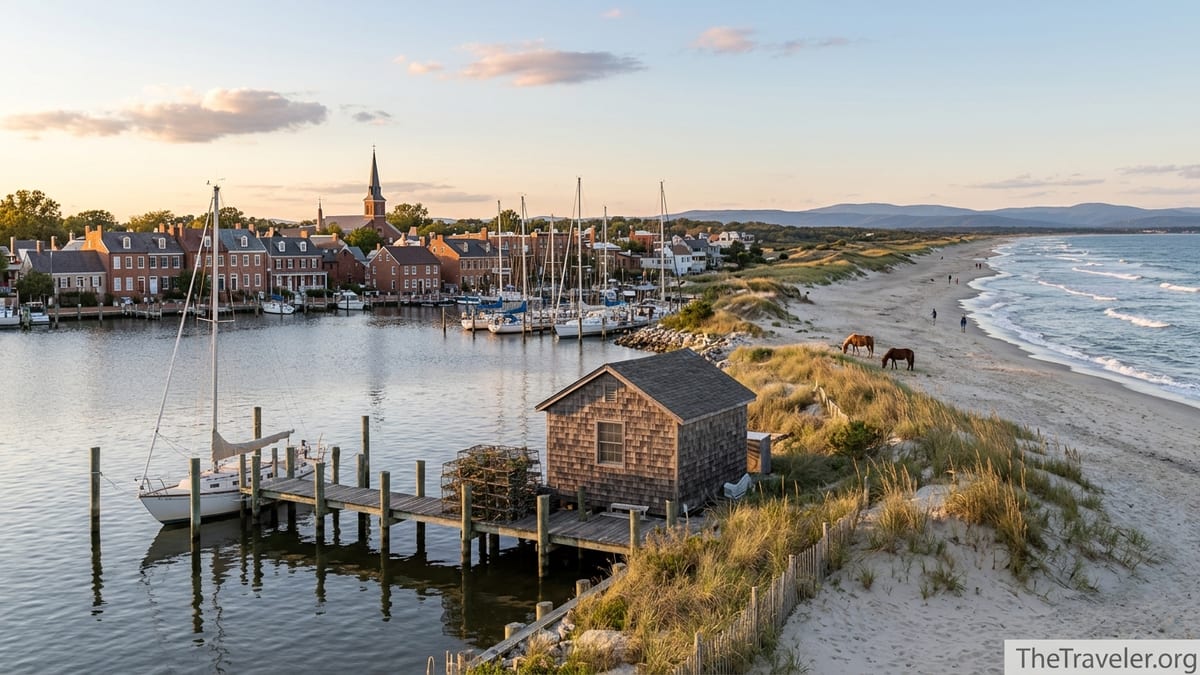
One of Maryland’s biggest surprises is how quickly you can move from quiet Chesapeake Bay villages to classic Atlantic beaches. On the bay side, places like St. Michaels and Oxford feel unhurried, with marinas full of sailboats, 19th century homes, and small inns that often start around the low 200 dollar range per night in summer, depending on the property and exact dates. Walk the waterfront in St. Michaels on a Saturday afternoon and you are as likely to see locals working on deadrise workboats as you are visitors on paddleboards.
Two to three hours east by car from Baltimore or Washington, the landscape shifts to barrier island dunes and broad beaches. Ocean City offers a long, lively boardwalk with arcades, soft-serve stands, and high-rise hotels that can range from budget-friendly motels under 150 dollars in shoulder season to resort-style towers commanding several hundred dollars per night in peak July and August. Just a few miles south of town, Assateague Island National Seashore trades neon lights for primitive campsites and wild ponies that roam the sand, giving travelers two very different beach atmospheres in a single day.
This quick transition between bay and ocean is part of what makes Maryland feel bigger than it is. An early morning spent on a quiet kayak trip through marsh creeks near Crisfield, where watermen still head out to pull crab pots, can easily be followed by afternoon surf fishing on Assateague’s windswept shore. For many visitors, that ability to hop between maritime worlds without crossing a state line is an unexpected highlight.
Even the seafood reflects the shift. In small bay towns, you might crack steamed blue crabs at a paper-covered picnic table, spiced with Old Bay and served with corn and cold beer. On the ocean side, fried flounder sandwiches, soft-shell crab on a bun, and fresh oysters on the half shell are common staples at casual shacks a few blocks from the sand.
Mountains, Ski Slopes, and a Four Season Lake Country
When travelers picture Maryland, few imagine ski runs and mountain lakes. Yet in far western Garrett County, the landscape looks more like neighboring West Virginia or western Pennsylvania. Deep Creek Lake, the state’s largest inland body of water, functions as a four season hub. In summer, the shoreline fills with rented lake houses and small lodges, many with private docks where guests tie up pontoon boats, fishing skiffs, and jet skis. Weeklong vacation rentals around the lake vary widely in price, but it is common to see three bedroom homes that sleep families or small groups starting in the mid four-figure range for peak July weeks, particularly those with direct water access.
At one end of the lake, Wisp Resort operates as Maryland’s only downhill ski area, with chairlifts that serve beginner and intermediate runs in winter and switch to mountain coaster rides, zip lines, and scenic lift rides in warmer months. A family might ski groomed slopes in January, then return in October to ride the same lift up for fall foliage views over Deep Creek’s coves and inlets. This sense of a small but complete mountain resort is something visitors who only know Baltimore or Annapolis do not usually expect.
The surrounding state parks deepen the variety. Swallow Falls State Park, for example, protects hemlock forest and waterfalls that feel a world away from the tidal marshes on the Eastern Shore. In a single long weekend based in McHenry or Oakland, travelers can kayak quiet inlets at sunrise, hike to cascades in the afternoon, and sit beside a wood fire while snow falls outside in the evening. Small towns in the area host events like autumn festivals, local craft fairs, and regional music gatherings that lean more Appalachian than coastal.
Because the western mountains sit roughly a three hour drive from Baltimore, they are realistic even for short trips. It is not unusual for visitors to combine a night in the Inner Harbor with two days at Deep Creek Lake, effectively sampling waterfront city life, a mountain resort, and rural back roads without crossing out of Maryland.
Baltimore’s Urban Energy and Cultural Depth
Maryland’s largest city is often summarized by a few postcard views of the Inner Harbor, but Baltimore offers dense layers of culture and neighborhood life that go well beyond the waterfront attractions. In neighborhoods like Hampden, Fells Point, and Station North, rowhouses with marble stoops sit alongside galleries, small music venues, and restaurants that champion local ingredients. On a Friday night, visitors might bounce from a modern bistro that sources seafood from Chesapeake watermen to a tiny bar where a jazz trio plays to a standing room crowd.
The city’s museums add another dimension. The Baltimore Museum of Art anchors Charles Village with notable modern and contemporary collections and regularly rotating special exhibitions, while the Walters Art Museum in Mount Vernon holds artifacts and paintings that span continents and centuries. Both institutions generally offer free general admission, which makes them accessible pauses between meals, harbor walks, or Orioles games at Camden Yards.
Baltimore’s markets give travelers a direct line into everyday food culture. Lexington Market, which traces its roots back to the 18th century, is widely cited as one of the country’s oldest continuously operating public markets. Inside its renovated hall, visitors line up at stands like Faidley’s Seafood, known for jumbo lump crab cakes that are often held up as a benchmark for the style. A typical visit might involve standing at a high table with a paper plate piled with a broiled crab cake, coleslaw, and crackers, sharing space with office workers on lunch break and out-of-town visitors snapping photos.
The city’s reputation as a bit gritty but deeply creative means it feels quite different from Washington, DC, even though the two downtowns are connected by a train ride of around an hour or less. Travelers who come expecting only a touristy harbor often leave talking instead about murals in Station North, bookshops in Mount Vernon, or a corner bar in Locust Point where fans crowd in to watch a Ravens game.
Small Towns, Colonial Streets, and Maritime History
Outside Baltimore, Maryland’s small towns and historic cores introduce yet another side of the state. Annapolis, the capital, sits on the Chesapeake and leans into its maritime heritage. Brick streets, 18th century homes, and the domed State House create a compact, walkable downtown where you can browse independent shops in restored storefronts, watch midshipmen in uniform walking between classes at the United States Naval Academy, and join a sailing cruise that heads out into the bay at sunset.
Just beyond the main harbor, quiet residential streets lined with clapboard houses and tidy gardens hint at how deeply boating and the Navy are woven into daily life. Weekend regattas send colorful sails across the water, and casual dock bars serve crab dip, rockfish tacos, and local beer to boaters who tie up for the evening. Hotel rates in central Annapolis typically spike during peak sailing events, graduation week, and fall football weekends, which can surprise travelers used to thinking of it as a sleepy state capital.
Along the Eastern Shore, towns such as Chestertown, Easton, and Cambridge mix college campuses, art galleries, and working waterfronts. In places like Cambridge, you might see crab-picking operations along the river, then walk a few blocks to a small contemporary art space or a coffee shop housed in a converted warehouse. Annual events, including waterfowl-themed festivals and heritage days that celebrate Black maritime history, give travelers specific reasons to visit outside the usual summer season.
For history-minded visitors, this patchwork of towns forms part of larger storylines, from colonial trade routes to the Underground Railroad. Scenic byways trace Harriet Tubman’s life across fields, marshes, and churchyards, while small museums interpret shipbuilding, oystering, and African American community life along the bay.
State Parks, Wildlife, and Quiet Escapes
Maryland’s variety shows up not just in cities and resorts, but in the density of public lands where travelers can find quiet. Assateague Island National Seashore is one of the best known examples, with its wild ponies, dunes, and oceanside campgrounds. Campers fall asleep to surf noise under dark skies, yet drive less than 20 minutes back to the bright lights and amusement rides of Ocean City if they want a boardwalk evening.
Elsewhere along the Chesapeake and in the western mountains, state parks preserve forests, rivers, and marshes that feel surprisingly remote given Maryland’s overall population density. In southern Maryland, for example, parklands along the Patuxent River offer boardwalk trails through tidal wetlands. Farther west, Cunningham Falls State Park in the Catoctin Mountains combines wooded hiking trails with a lakefront beach that draws families from Frederick and Washington on hot days.
These places tend to offer straightforward, affordable recreation. Day use fees at many parks are modest, and some areas provide first come, first served campsites where a tent site might cost less than a casual dinner out in a city. Travelers who plan carefully can string together a week of camping and cabin stays that range from rustic Civilian Conservation Corps era structures to modern, heated cabins near trailheads.
Because the terrain shifts from tidal flat to rolling piedmont hills and then to true mountain ridges in a relatively short distance, birders, hikers, and paddlers often find that a single Maryland trip can include multiple ecosystems. A visitor might spend one morning watching herons stalk fish in an Eastern Shore marsh and the next scanning ridgetop skies for hawks at a western overlook.
Food, Festivals, and Local Flavor
Maryland’s variety is perhaps most immediately obvious at the table. Blue crabs are the undisputed icon, but how and where you eat them changes dramatically across the state. In Baltimore and the surrounding suburbs, picking steamed crabs dusted with seasoning is both a social ritual and a summer staple. Long picnic tables at neighborhood crab houses fill with groups ordering crabs by the dozen, pairing them with pitchers of light beer and sides like corn on the cob and hush puppies.
Crab cakes offer a more portable expression of the same ingredient. In Baltimore’s Lexington Market, Faidley’s sells jumbo lump crab cakes that many locals recommend to first time visitors who want a classic example. In waterfront towns like Annapolis or Havre de Grace, white tablecloth restaurants might serve a broiled crab cake alongside seasonal vegetables and a glass of local white wine, offering a more formal take. On the Eastern Shore, roadside shacks fry soft-shell crabs and pile them onto sandwiches with lettuce, tomato, and tartar sauce.
Beyond seafood, Maryland’s cultural mix shows up in everything from pit beef stands on the outskirts of Baltimore to West African and Caribbean restaurants in the suburbs of Prince George’s County and Montgomery County. Farmers markets feature peaches, sweet corn, and heirloom tomatoes in late summer, and wineries and breweries in regions like Frederick and the South Mountain foothills host live music nights that pair local pours with food trucks.
Seasonal events stitch these flavors into the travel calendar. A visitor might plan a trip around a fall oyster festival on the bay, a winter light display in a botanical garden, or a spring cherry blossom celebration in a small town along the Potomac. Many of these events charge modest admission fees or operate on suggested donations, which makes them accessible add-ons to a broader trip rather than high-cost centerpieces.
The Takeaway
Maryland rewards travelers who look past its compact size and familiar headlines. Within a few hours of driving, visitors can move between an urban waterfront with major league sports and museums, a mountain lake dotted with ski slopes and cabin rentals, and barrier island beaches where wild ponies graze the dunes. Small towns, state parks, and working waterfronts fill in the spaces between, each with its own food traditions and local rhythms.
For travelers based in the Mid-Atlantic, this variety makes Maryland an ideal long weekend destination. A couple based in Washington might spend Friday night at a concert in Baltimore, Saturday hiking in the Catoctin Mountains, and Sunday afternoon walking cobblestoned streets in Annapolis without ever crossing a state line. Visitors arriving from farther away often find that the state layers easily into a broader East Coast itinerary as a flexible, surprisingly diverse stop.
In the end, the surprise is less that Maryland has beaches, cities, and mountains, and more how closely those worlds sit together. That proximity allows even short trips to feel full and changeable. For many travelers, one visit to Maryland leads quickly to plans for a second, focused not on repeating a favorite spot but on exploring an entirely different corner of the same state.
FAQ
Q1. When is the best time of year to visit Maryland for variety?
Late spring through early fall generally offers the widest range of options, from beach trips and sailing to mountain hikes, outdoor festivals, and baseball games.
Q2. Can I visit both the mountains and the beach in one Maryland trip?
Yes. Many travelers combine a few days at Deep Creek Lake or in the western mountains with several days on the Eastern Shore or near Assateague and Ocean City.
Q3. Is Maryland a good destination for budget-conscious travelers?
It can be. State park cabins and campgrounds, public museums with free admission, and off-season hotel rates give budget travelers plenty of ways to explore.
Q4. Do I need a car to experience Maryland’s variety?
A car makes it much easier to move between regions such as the mountains, bay towns, and beaches, although Baltimore and Annapolis themselves are walkable once you arrive.
Q5. Are the wild ponies on Assateague Island safe to approach?
Visitors are required to keep a safe distance. The ponies are wild animals, so travelers should never attempt to feed or touch them and should follow park guidelines.
Q6. What foods should first-time visitors try in Maryland?
Many visitors seek out steamed blue crabs, crab cakes, soft-shell crab sandwiches, pit beef, and seasonal produce from farmers markets during summer and early fall.
Q7. Is Baltimore safe for tourists?
Like many cities, Baltimore has safer and less safe areas. Most visitors focus on well-trafficked neighborhoods, stay aware of their surroundings, and follow local advice.
Q8. How many days do I need to get a sense of Maryland’s variety?
A long weekend can cover either city and bay or mountains and small towns, but a week allows time to experience at least two or three distinct regions.
Q9. Are there family friendly activities in Maryland beyond the beach?
Yes. Options include mountain resorts, state park lakes with swimming areas, interactive museums, harbor boat tours, and minor and major league sports events.
Q10. Do I need to book accommodations far in advance?
For peak summer weeks at the beach or lake, and for big event weekends in Annapolis or Baltimore, booking several months ahead is sensible. Off season trips are more flexible.