


Before I went to Nice, I assumed street music on the French Riviera would feel like a soundtrack to a party: loud, showy, and just a bit exhausting. What I found instead was something far more subtle. From the solo guitarists along the Promenade des Anglais to the jazz trios tucked into Old Town courtyards, the musicians in Nice create a gentle kind of energy that seeps into the city’s rhythm. The surprise was not how much music there was, but how peaceful it all felt.
Get the latest updates straight to your inbox!
A City Where Music Lives Outdoors, But Softly
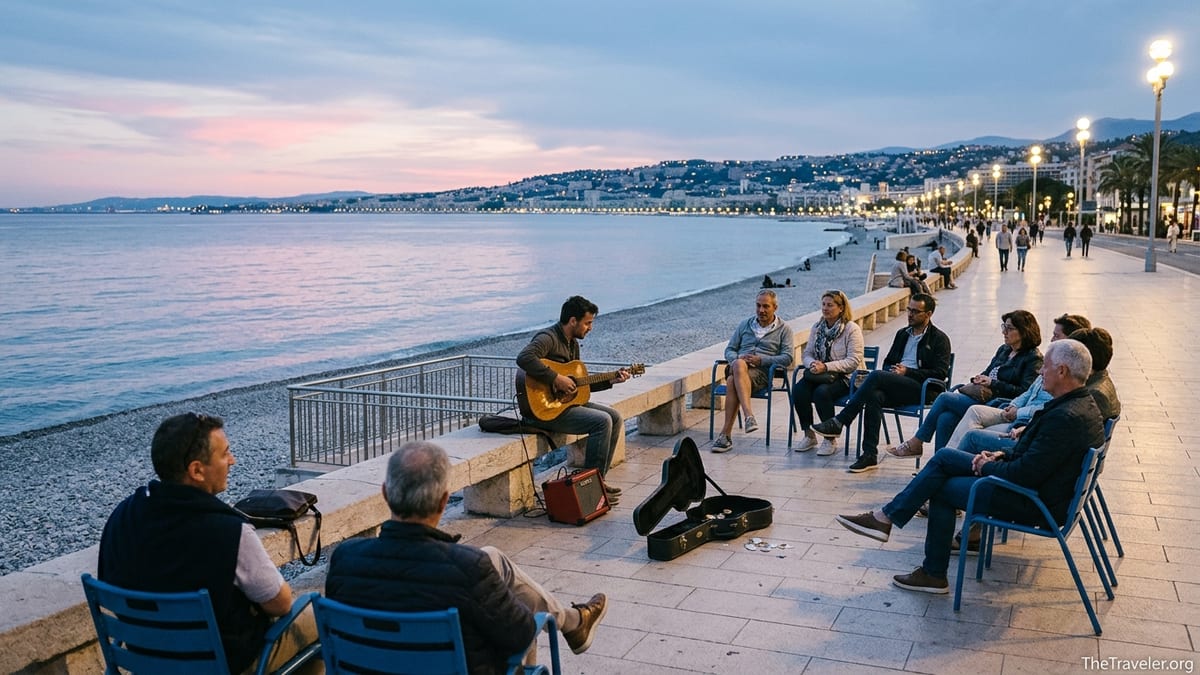
Nice is built for wandering, and the first thing you notice as you walk is how the city itself acts like a giant open-air concert hall. The Promenade des Anglais stretches for several kilometers along the Mediterranean, a wide seafront boulevard separated from the city by a busy road yet somehow still surprisingly tranquil. In the early evening, as joggers pass and families stroll, you are more likely to hear a lone busker playing a nylon-string guitar than a full band. The music sits in the background: a soft cover of a French classic, a Latin rhythm, or a jazz standard carried along by the sea breeze rather than blasted from an amp.
In many big European cities, buskers cluster at high-traffic corners and compete for attention with heavy amplification. In Nice, you feel the opposite. On a spring evening, you might see one musician set up near the famous blue chairs facing the water, with a small battery-powered speaker turned low enough that nearby conversations still dominate. A little further on, someone practices trumpet without any sound system at all, the notes drifting across the pebble beach. The cumulative effect is not cacophony but a kind of slow, shared soundtrack that never quite interrupts your thoughts.
This softness is tangible in the Old Town as well. Cours Saleya, the broad pedestrian street that hosts flower and produce markets in the morning, turns into a restaurant-lined promenade at night. Musicians occasionally work the terraces, but what stands out is how often they perform acoustically or with minimal amplification. You might hear a violinist weaving between café tables or a singer seated on a low stool against a stone wall, their sound blending into the murmur of diners rather than overpowering it. You realize quickly that in Nice, music is expected to accompany life, not dominate it.
Regulated Street Art, Relaxed Street Atmosphere
Part of this peace comes from the way Nice manages its public spaces. The city officially regulates street artists and musicians who perform in key areas such as the Old Town, Place Masséna, and along major pedestrian routes. Performers need authorization and must respect time slots and volume limits, which keeps the soundscape from tipping into chaos. Local rules reflect national French regulations that limit amplified music levels for venues and outdoor performances, aiming to protect both residents and visitors from excessive noise.
In practical terms, this means that when you sit with a coffee near Place Masséna or on the Promenade du Paillon, you rarely face the sonic tug-of-war common in many tourist centers. You will not usually find three acts stacked within a few meters of each other, each trying to be louder than the last. Instead, you encounter a single guitarist or duo occupying a corner of the square, their modest sound system pointed inward rather than blasting across the tram tracks. Even during busy seasons, the city feels curated: energetic, but rarely overwhelming.
Travelers often remark how easy it is to hold a conversation outdoors in Nice, even beside popular busking spots. You might pay a few euros to a saxophonist after recognizing a tune from a jazz standard or an Edith Piaf classic, then walk on and feel the sound fade within a block or two. The peace does not indicate a lack of music; it is the result of boundaries that allow both music and everyday life to share the same streets without constant conflict.
From Jazz Roots to Casual Seaside Sets
Nice has a deep musical history, especially in jazz. The city has produced notable jazz musicians and hosts one of France’s oldest jazz festivals, which often uses central venues such as Place Masséna in summer. Yet what is striking on an ordinary weeknight is not the festival-scale spectacle but how that jazz heritage filters down into intimate, human-scale performances. You see it in the pianist quietly improvising in a corner bar, or the trio rehearsing standards before the crowd builds.
Walk a few minutes inland from the seafront toward the center and you will find venues that have been dedicated to live music for decades. Near Place Masséna, for example, a long-running piano bar keeps a steady program of singers and bands several nights a week, with music starting around late evening and running into the early hours. A modest cover charge that includes a drink is common, and the atmosphere is more living room than nightclub: small stage, close-set tables, and regulars who know the repertoire by heart.
On Rue de France, not far from the seafront hotels, a small rock-oriented bar often hosts cover bands and guitar-heavy sets in a compact space above the street. Here the volume rises, but the room is contained and insulated enough that once you step back onto the sidewalk you are welcomed again by the softer city soundscape: distant traffic, the hum of neighboring restaurants, and perhaps a faint echo of a busker by the beach. Nice allows louder music to exist, but it tends to be tucked indoors so the public spaces retain their calmer tone.
Back by the water, musicians adjust their style to the setting. On a late afternoon walk you might pass a young singer seated cross-legged on the sea wall, acoustic guitar in hand, performing for a small group of friends and the occasional passerby who lingers. There is no tip jar, no merchandising table, only songs blending with the sound of gentle surf and wheeling gulls. The performance feels more like a shared moment than a show you have to watch.
Why the Music Feels So Unhurried
The first time I sat with a glass of rosé at a café off Place Rossetti in the Old Town, I kept waiting for the tempo of the evening to pick up. It never did. A duo set up across the square with a small portable speaker and began playing bossa nova and soft pop covers, but they took long breaks between sets. When a nearby bell tower chimed the hour, the musicians stopped mid-song, smiled at each other, and waited for the last toll to fade before continuing. Their unhurried approach mirrored the city’s broader attitude toward time.
Nice is a place where days naturally pivot around light rather than the clock. Morning brings markets and local shoppers; midday slows as the sun intensifies; late afternoon ushers people back toward the sea. Musicians sync with this rhythm. On the Promenade des Anglais, performances cluster around sunset, when the sky turns pastel and locals fill the blue chairs to watch the horizon. The music adapts to that liminal hour: mellow, steady, reflective. It is rare to encounter aggressive tempos or frantic busking routines here.
Economic reality also plays a role. While Nice is a popular destination, it is not as relentlessly crowded with quick-hit tourists as some European capitals. Many visitors stay several days or longer, mixing sightseeing with slow, repeated walks along the same routes. Musicians tend to build rapport rather than chase instant attention. A violinist in Vieux Nice may recognize returning guests over several evenings, greeting them with a nod before slipping into a familiar melody. The resulting atmosphere favors continuity and comfort rather than spectacle.
Everyday Encounters: Real Moments With Local Musicians
One of the most telling moments came as I crossed the Promenade du Paillon, the long green corridor that links the sea with the theater district. In the late afternoon, children ran through the shallow fountains near Place Masséna while a cellist played beside the water mirrors. The piece was slow and meditative, and though parents watched their children closely, they also turned occasionally toward the music. No one clapped at the end of each piece; instead, passersby slipped a few coins into the open case and kept walking, as if the performance were a natural feature of the park like the plane trees and benches.
Another evening, at Cours Saleya after the market stalls had been cleared, I watched a trio quietly assemble in a corner: an older guitarist, a young singer, and a hand percussionist. They checked their sound levels by playing part of a song, then immediately dialed the speaker down when a waiter gave them a friendly thumbs-up to indicate it was a little loud for the terrace closest to them. Over the next hour they cycled through French chansons and light jazz. People at nearby tables swayed in their chairs between bites of socca and sips of rosé, but no one stood on chairs or shouted for selfies. It felt like a neighborhood party, even though the crowd was a mix of locals and visitors.
Even the more energetic venues retain this sense of proportion. At a live-music bar near Rue Masséna, the band launched into a rock classic and the small dance floor filled quickly. Inside it was lively, almost packed, but when you stepped outside to the street you could still hear the fountain in the distance and the murmur of neighboring cafés. Doors and windows were partly closed, a practical way to contain the sound. Nice lets you seek out noise if you want it, but it rarely forces it on you.
How Travelers Can Enjoy the Music Without Losing the Calm
If you want to experience this peaceful musical side of Nice, it helps to think in terms of time and place. Early evening, especially from about an hour before sunset, is ideal along the Promenade des Anglais. Find a spot on the low wall or in one of the blue chairs near the central stretch by the gardens and listen for acoustic players setting up. Spend a few coins on the performer who becomes the unofficial soundtrack to your sunset, then walk east toward the Old Town as the sky darkens.
In Vieux Nice, start around Cours Saleya and then drift into the narrower lanes around Place Rossetti and Rue de la Préfecture. Here you are likely to encounter a mix of restaurant-terrace performers and solo buskers tucked into corners. Noise levels are usually moderate, so you can choose a restaurant terrace where you like the music style, secure in the knowledge that you will probably still be able to chat across the table. If sound ever feels too much, you rarely need to walk more than a few minutes to find a quieter square where a different musician is playing at a gentler volume.
For travelers who want a more focused listening experience, Nice’s small venues near the center offer structured live shows in intimate settings. Many program jazz, rock, or singer-songwriter nights several times a week, often starting late in the evening and running into the early morning hours. Buying a drink at the bar is usually enough to enjoy the music; reservations are sometimes wise in summer, but walk-ins still find space on slower nights. Crucially, when you exit after midnight, the streets typically feel calmer than the club you just left, reinforcing that sense of the city as a place where music and quiet coexist.
Budget-conscious visitors can enjoy much of this soundscape for little more than the cost of their regular outings. Tossing a few euro coins into a guitar case during an evening stroll, ordering a single drink at a piano bar, or simply pausing on a bench to listen to a busker costs far less than a formal concert ticket. Nice rewards those who listen casually and often, folding music into everyday activities rather than turning it into a high-stakes event.
The Takeaway
What surprised me most about musicians in Nice was not the quality of the performances, though many were excellent, but the way they fit so gently into the city’s daily life. On paper, Nice has all the ingredients for a noisy seaside resort: a long promenade, dense Old Town streets, a thriving nightlife scene, and a constant flow of visitors. Yet the sound of the city rarely feels aggressive. Regulations keep amplified noise in check, local habits favor conversation and strolls over shouting matches, and musicians themselves seem to understand intuitively that they are part of the landscape, not the center of it.
For travelers, this creates a rare balance. You can seek out lively bars and late-night gigs when you are in the mood, then step outside into streets where conversation is still possible and the sea remains the loudest presence. You can dine in squares accompanied by live music that enhances your meal rather than competing with it. You can watch the sun sink behind the Bay of Angels while a single guitar line traces the horizon. In Nice, music does not simply accompany the city; it calms it, turning a busy Mediterranean destination into a place that feels unexpectedly peaceful, one quiet song at a time.
FAQ
Q1. Is Nice a noisy city at night because of street musicians?
Nice can be lively in certain streets, but overall it is less noisy than many major European cities. Street musicians are regulated, especially in central areas, and typically use modest amplification. Most outdoor music stops or quiets significantly by late evening, leaving only pockets of nightlife where you can choose to join the noise rather than be surrounded by it everywhere.
Q2. Where am I most likely to hear peaceful live music in Nice?
You will often find gentle, acoustic-style performances along the Promenade des Anglais around sunset, in Cours Saleya after the market closes, and in small squares of the Old Town such as those around Place Rossetti. These areas host buskers and terrace musicians whose sound usually blends into the overall atmosphere rather than overpowering it.
Q3. Do I need to pay to listen to buskers and street performers?
There is no obligation to pay, but it is customary to drop a few coins into a musician’s case if you stop to listen for more than a moment or take photos or videos. Many travelers budget a small daily amount for street performers. A typical gesture might be one or two euro coins when a performance adds something special to your evening walk.
Q4. Are there particular days or seasons when Nice is especially musical?
Spring through early autumn brings the most outdoor music, as the weather encourages long evenings outside. Summer often includes larger cultural events and festivals in spaces like Place Masséna, while shoulder seasons see more low-key busking and intimate venue performances. Winter is quieter outdoors, though indoor bars and piano lounges maintain regular live music programs.
Q5. How late does live music usually go in Nice?
Street music in central areas tends to wind down by late evening in line with local regulations, helping keep noise manageable for residents. Indoor venues, especially those focused on live music near the city center, can run until the early morning hours. If you want quiet, choosing accommodation on a side street away from bar clusters usually ensures restful nights.
Q6. Can I bring children to places with live music?
Yes, many of Nice’s musical experiences are family-friendly. Early evening walks along the promenade, visits to Cours Saleya, and outdoor dining in Old Town squares often include gentle live music suitable for all ages. Late-night bars and small clubs are more oriented toward adults, but families will find plenty of earlier, calmer options where children can enjoy the atmosphere without it feeling overwhelming.
Q7. What should I do if music near my hotel feels too loud?
If street or venue music is disturbing your rest, first check with your hotel reception; staff are familiar with local patterns and may be able to suggest a quieter room or provide guidance on typical end times. If you are staying in an apartment, simple steps like closing shutters can reduce noise significantly. Persistent, excessive disturbance is relatively uncommon in central Nice, but if it occurs, local police have authority to intervene when regulations on amplified sound are not followed.
Q8. Is it safe to stay out late listening to music in Nice?
Central areas such as the seafront, Old Town, and streets around Place Masséna remain active well into the evening and are generally considered safe, with many people out walking, dining, and enjoying the atmosphere. Usual big-city precautions apply: keep valuables secure, stay aware of your surroundings, and favor well-lit, populated routes when returning to your accommodation after midnight.
Q9. Can I perform music myself in public spaces in Nice?
Yes, but you cannot simply set up anywhere at any time. The city manages street artists and musicians through authorization systems and designated zones, particularly in busy historic and tourist areas. If you plan to perform, it is important to check current local requirements in advance and respect rules on location, hours, and sound levels to avoid fines or being asked to move on.
Q10. How can I find out about upcoming concerts or live music nights?
Local tourism information points, venue noticeboards, and hotel receptions are good starting places for current listings, as many small bars and clubs promote events locally rather than through large international platforms. Once in Nice, simply walking around the streets near Place Masséna, the Old Town, and Rue de France in late afternoon or early evening will also reveal posters and chalkboard signs advertising that night’s performances.