


Like many first time visitors to Tuscany, I arrived convinced I already knew it. In my mind it was all rolling vineyards, remote farmhouses and the occasional day trip into Florence. It was only when I based myself in Siena for several days, rather than treating it as a quick stop, that the region rearranged itself in front of me. Siena changed not only how I saw Tuscany on a map, but how I understood its rhythm, its people and even the way I wanted to travel here in the future.
Get the latest updates straight to your inbox!
From Postcard Tuscany to a Living Medieval City
My previous trips to Tuscany had followed a familiar script: rent a car in Florence, drive into the countryside, check into an agriturismo surrounded by vineyards, and dip into nearby hill towns for lunch and photos. Siena was always a name on road signs, or a two hour guided stop that felt more like a museum visit than a city. Staying in the historic center for four nights changed that. I found a small guesthouse five minutes from Piazza del Campo, with a modest double room for about 120 to 150 euros per night in shoulder season, and suddenly Tuscany stopped being an abstract landscape and became a lived in urban experience.
Instead of waking up to the silence of olive groves, I woke to the sound of church bells and delivery carts clattering over brick at 7 a.m. The bar downstairs did not offer curated tastings but rushed cappuccini for office workers at the counter, about 1.50 to 2 euros each, and a row of cornetti that sold out by 9. That everyday busyness was a reminder that Siena is not just a backdrop for visitors. People here commute, shop for groceries, argue over parking and meet friends for an aperitivo the way they do in any small city, only in this case the setting happens to be a UNESCO listed medieval maze of alleys and palazzi.
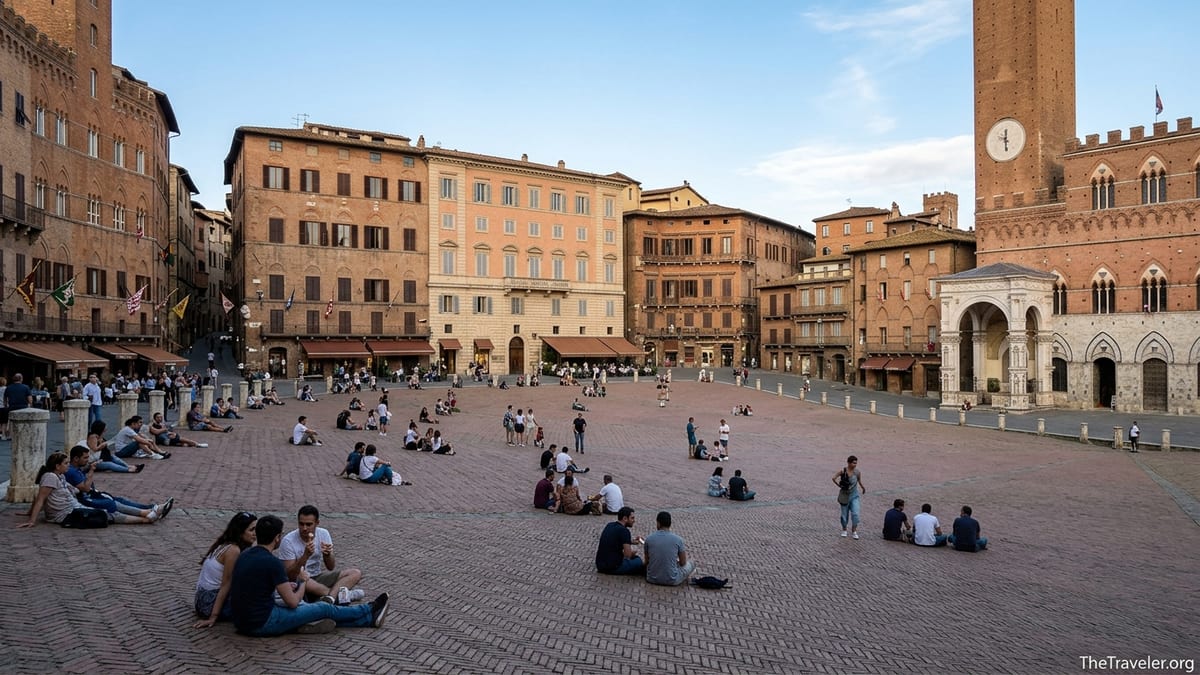
Walking out into Piazza del Campo after breakfast, past municipal offices and school groups threading their way through the streets, the famous shell shaped square stopped feeling like a monument and started feeling like a local living room. Children chased pigeons where, twice each year, the Palio horse race thunders around the packed dirt track. At lunchtime on a weekday, a couple of office workers ate panini on the sloping bricks, chatting in rapid Italian, while a retired couple quietly read newspapers at a café table. Seeing those ordinary moments softened the sense that Tuscany is a curated experience and replaced it with something more human.
Learning That Tuscany Has Many Centers, Not Just Florence
Before Siena, I treated Tuscany as a region orbiting around Florence. Every itinerary, guidebook and package tour seemed to confirm that idea by using Florence as the base and radiating outward to vineyards, Pisa, Lucca and the countryside. Siena forced me to redraw that mental map. Once you are in the city, you realize that for centuries this was a powerful republic of its own and that even today many villages identify more with Siena than Florence.
Practical details drive this home. The bus from Florence to Siena, for example, runs frequently and takes about 1 hour 15 minutes on the faster lines, depositing you just outside the historic center near the monumental San Domenico church. From here, buses fan out to smaller towns like Monteriggioni and Colle di Val d’Elsa, and onward toward the Crete Senesi and Val d’Orcia. Standing at the station watching school kids and commuters pile onto routes that never touch Florence, you start to understand that Siena acts as a hub for southern Tuscany in a way visitors often underestimate.
When I booked a day trip to the Chianti Classico wine region, I expected to drive north from Florence. Instead, I found that the iconic wine road SR222, the Chiantigiana, is practically on Siena’s doorstep, with vineyards beginning less than 10 kilometers from the city walls. A local operator offered a half day tour from Siena, visiting two family run wineries near Castellina in Chianti and Radda in Chianti, for around 90 to 120 euros per person including tastings and a light lunch. The minivan departed from just outside the Porta San Marco, and we were among rows of vines within 20 minutes, without ever seeing the Florence skyline.
That shift in perspective matters when you plan a trip. If your dream of Tuscany includes Pienza, Montalcino, Montepulciano and the soft clay hills of the Crete Senesi, Siena is a more logical base than Florence. Distances are shorter, driving is calmer and public buses, while not perfect, connect several of these towns via Siena in ways that make slow travel more realistic. In my case, what had always been a rushed day tour combining Siena and San Gimignano from Florence became a week of meandering out from Siena to the surrounding countryside and returning in the evening to a city that felt increasingly like home.
Discovering the Contrade and a Different Kind of Community
Nothing challenged my postcard idea of Tuscany more than the contrade, the 17 traditional districts of Siena. On previous visits they had been no more than colorful flags and animal symbols decorating corners of the city. By staying longer and talking to locals, I realized they are living social structures that shape identity, loyalty and daily life. Every Sienese is born into a contrada, baptized into it, and remains connected for life, whether they still live there or not.
I learned this by accident while browsing in a small deli on Via di Città. The owner, noticing my curiosity about the scarves hanging on the wall, asked where I was staying and which contrada that address belonged to. He pointed out that I was in the territory of the Civetta, the Owl, and that during Palio season my street would be crowded with neighbors hosting dinners, decorating fountains and organizing processions. He explained how contrada members offer support for everything from weddings to illness, and how rivalries and alliances around the Palio horse race shape friendships in ways outsiders rarely grasp.
Later that week, I stumbled upon a contrada dinner in a side street near the Basilica di San Domenico. Long tables were set end to end, plastic chairs lined up, and a volunteer kitchen crew ladled pasta from enormous pots for a crowd of families and friends. A resident told me that tickets for these dinners, often around 25 to 35 euros including wine, sell out quickly among contrada members and guests. Watching teenagers carry crates of water, older residents directing seating and volunteers pouring local Chianti from unlabelled bottles, I realized that behind the elegant facades of Siena there is a robust civic fabric that is different from the rural neighborliness I had seen in farm hamlets.
As a visitor, you are unlikely to become part of a contrada in a week. Yet simply knowing they exist changes how you move through the city. Flags and fountains become signs of belonging rather than decoration. When you hear cheering from a bar during a Palio trial race on television, you understand it is not about generic sports fandom but neighborhood pride. Tuscany, in Siena’s version, became not only lines of cypress trees but this dense, vertical community life.
Seeing Iconic Sights Without Losing the Everyday Details
One of my fears about basing in Siena was that it would feel overwhelmed by its own sights. Piazza del Campo, the Torre del Mangia and the striped Duomo draw day trippers by the busload. Yet staying in the center allowed me to experience these landmarks at hours when crowds thin and details emerge. On my first evening, I climbed part of the unfinished medieval façade of the Duomo complex, the so called Facciatone. From that height, Siena revealed herself not as a single postcard view but as a jumble of terracotta roofs, rooftop terraces, laundry lines and vegetable gardens pressed against the city walls.
The next morning, I visited the cathedral itself. The combined ticket that included the Duomo, Piccolomini Library, museum and panoramic viewpoint cost roughly 20 to 25 euros, depending on season and special exhibits. Arriving at opening time meant I could stand under the inlaid marble floor panels, which are fully uncovered only at certain times of year, and actually absorb the intricate scenes instead of shuffling past on a timed tour. A guide explained that local artisans spent centuries completing these floors, a reminder that Tuscan artistry is not only found in Florence’s galleries.
Back in the campo later that day, I spent almost an hour just watching life unfold. A group of students in black academic robes posed for graduation photos, their laurel crowns bright against the brick. A municipal worker methodically swept cigarette ends from the drains around the square. At one café a spritz cost around 7 to 9 euros, but at a quieter bar up a side street a glass of local red wine and a plate of crostini cost less than 6. These kinds of small price differences, and the way locals gravitate to certain spots, are details you miss if you only pass through Siena on a timetable.
For all its fame, Siena still offers corners that feel almost untouched by tourism. One evening I wandered down Via dei Rossi, where independent shops were locking up for the night, and ducked into a neighborhood bar with a single football match on the television. Aperitivo plates of simple bruschetta and olives appeared unasked for alongside my glass of wine. The bill for two drinks and snacks came to under 12 euros. It was a reminder that while Tuscany can be expensive in high season, Siena still has pockets of affordability if you drift away from the main routes between the campo and the Duomo.
Learning to Navigate Practical Realities: ZTLs, Parking and Buses
Romantic visions of Tuscany rarely include parking garages and bus timetables, but Siena forced me to engage with these practicalities. The historic center is almost entirely covered by a ZTL, a limited traffic zone monitored by cameras that automatically issue fines to unauthorized vehicles. Signs are easy to miss and fines can reach well over 100 euros by the time administrative costs are added, often arriving in the post months later. Talking with other travelers at my guesthouse, I heard more than one story of someone following a navigation app straight under a ZTL camera and paying for it later.
To avoid that, I left my rental car in one of the large pay car parks outside the walls, such as the San Francesco or Santa Caterina facilities, where daily rates were roughly 25 to 35 euros depending on the area and season. From these lots, a combination of escalators and pedestrian tunnels carried me up into the historic center. It felt odd to ride moving walkways through the rock beneath medieval streets, but it made arriving in the heart of the city with luggage surprisingly manageable. Once in Siena, I quickly realized I did not need a car inside the walls; distances are short, and the steep lanes are better navigated on foot.
Public buses became my link to the rest of Tuscany. Local routes connect Siena to villages like Monteriggioni, a tiny walled town about 20 minutes away, as well as to larger centers further south. Tickets for regional buses were usually under 5 euros one way for nearby towns, purchasable at tobacco shops or ticket counters near the bus station. Schedules are more generous on school days and slimmer on Sundays, so flexibility helps. On one afternoon trip to Monteriggioni, a small delay meant I arrived later than planned, but it also meant I had the main square almost to myself as day trippers headed back to Florence.
These logistics changed my sense of what a Tuscan trip could be. In the countryside I had always accepted that a car was essential. From Siena, I realized that mixing car days with bus based outings, or even going car free entirely for a stretch, is quite possible if you are willing to plan around timetables and accept a slower pace. It also gently pushed me to interact more with residents, whether asking a tabacchi owner which platform my bus used or chatting to an elderly couple at a stop about the best bakery near their village.
Reframing Tuscany’s Pace, Seasons and Costs
Visiting Siena also challenged my assumptions about the best time and budget for Tuscany. In the past, I had aimed squarely at peak summer, when sunflowers bloom and days stretch late into the evening. Siena in late spring and early autumn, though, showed me a more comfortable and often more affordable side of the region. Daytime temperatures hovered in the low to mid twenties Celsius, evenings were cool enough for a light jacket and the city felt busy without being overwhelmed.
Accommodation costs still rose on weekends and around major events, especially the Palio race dates of July 2 and August 16, when prices can double and minimum stays apply. Outside those windows, however, I found mid range hotels and guesthouses in the center ranging roughly from 100 to 180 euros per night, with simpler rooms or places just outside the walls often cheaper. Eating out followed a similar pattern. A plate of fresh pici al ragù or ribollita at a trattoria off the main streets cost around 12 to 16 euros, with house wine by the carafe still common and good value. Splurge dinners with full tasting menus and pairings could easily reach 70 to 100 euros per person, but they were not mandatory to eat well.
More importantly, Siena revealed a different rhythm of time. Afternoons often slipped into a quiet lull as shops closed and streets emptied, only to come alive again around 6 p.m. when locals headed out for aperitivo. Festivals and religious events punctuated the calendar in ways that felt distinct from Florence. On one visit in September, for example, I arrived just as a contrada held a small victory celebration for a recent Palio success, with flags, drummers and a procession that wound through streets where I had seen nothing but tourists the day before.
Experiencing those variations made me think differently about planning. Instead of treating Tuscany as a single high season destination with uniform prices and crowds, I began to understand the advantages of shoulder season stays in cities like Siena, combining them with a few nights in the countryside. It also made me more sensitive to the impact of major events on local life, and more inclined to either commit fully to experiencing something like the Palio, with all its intensity, or deliberately choose quieter weeks to let everyday Siena take center stage.
The Takeaway
Staying in Siena changed far more than my opinion of a single city. It rewired my mental map of Tuscany from a Florence centric postcard to a region of multiple centers, each with its own history, loyalties and pace. It replaced a vision of scattered farmhouses with the vertical density of contrade life, where medieval streets are not just preserved but actively inhabited. It turned iconic sights like Piazza del Campo and the Duomo from quick photo stops into spaces where I noticed small acts of maintenance, celebration and routine.
On a practical level, Siena taught me to take things like ZTL zones, parking and bus schedules seriously, and in doing so it opened up new ways to travel more slowly and sustainably without resigning myself to an isolated farmhouse stay. Emotionally, it left me with a deeper appreciation for the complexities underneath Tuscany’s beauty: the rivalries that animate Palio season, the quiet pride of shopkeepers in their contrade, the compromises between heritage and everyday life.
If you have always imagined Tuscany as a countryside escape with a single day in Siena, consider flipping that script. Base yourself within the city walls for a few nights, explore the surrounding hills as day trips and give yourself time to see how Siena works when no one is looking. You may find, as I did, that Tuscany becomes larger, more intricate and more compelling once you have walked its brick lanes at dawn and dusk, with the bells of Siena marking the hours.
FAQ
Q1. Is Siena a good base for exploring Tuscany without a car?
Yes, Siena works well as a base if you rely on buses and walking. Regular regional buses connect the city to Florence, Monteriggioni and several southern Tuscan towns, though schedules are more limited on weekends and evenings.
Q2. How many days should I spend in Siena to really experience it?
Two nights is a minimum to see the main sights without rushing, but three to four nights allow time to understand the contrade, enjoy early mornings and evenings in Piazza del Campo and take at least one countryside day trip.
Q3. Do I need to worry about ZTL zones when driving into Siena?
Yes, the historic center is covered by a limited traffic zone enforced by cameras. Park in signed car parks outside the walls and use escalators or buses into the center to avoid expensive fines for unauthorized entry.
Q4. Is Siena very expensive compared to other parts of Tuscany?
Prices are similar to other popular Tuscan towns. Central hotels and cafés near major sights can be pricey, but more affordable guesthouses and neighborhood bars a few streets away offer moderate prices for food and lodging.
Q5. When is the best time of year to visit Siena?
Late spring and early autumn offer pleasant temperatures and manageable crowds. July 2 and August 16, when the Palio horse races are held, are thrilling but very busy, with higher prices and limited availability.
Q6. Can I visit wineries in Chianti easily from Siena?
Yes, many wineries in Chianti Classico are within a short drive. You can join small group tours departing from Siena, hire a driver for the day or, if comfortable driving, plan a self guided route along the scenic Chiantigiana road.
Q7. Is Siena suitable for families with children?
Siena can work well for families, especially if you choose accommodation near the center to minimize walking on steep hills. Children often enjoy the open space of Piazza del Campo, the tower views and seasonal events, though crowds during Palio can be intense.
Q8. Do I need to book tickets in advance for the Duomo and main attractions?
In high season and around major events it is wise to reserve timed tickets for the Duomo complex and the Torre del Mangia to avoid long waits. In shoulder seasons you can often buy tickets on the day, especially if you visit early.
Q9. Is English widely spoken in Siena?
Staff in hotels, main restaurants and attractions usually speak at least basic English. In smaller shops and residential areas you may meet people who prefer Italian, but simple phrases and gestures are normally enough to communicate.
Q10. How does staying in Siena change a typical Tuscany itinerary?
Using Siena as a base often means fewer rushed day trips and more time walking, using local buses and discovering nearby hill towns. Many travelers find it leads to a slower, more immersive experience than staying only in Florence or isolated countryside lodgings.