


Many travelers to Nice think in headlines: Old Town for color, the Promenade des Anglais for sea views, and the Port for nightlife. In that quick mental map, the Musiciens district often disappears between the train station and the palm trees. Skipping it, though, can mean missing one of Nice’s best combinations of elegance, convenience and value, especially if you want a central base that feels more local than touristic.
Get the latest updates straight to your inbox!
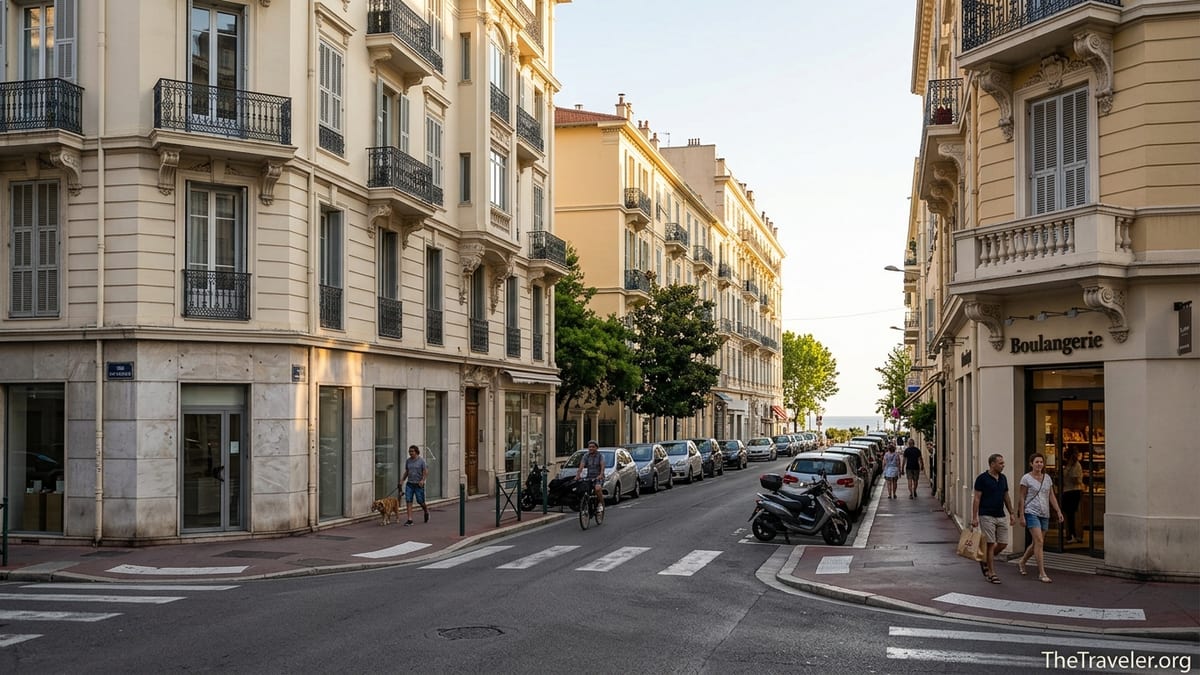
A Quietly Central District Hiding in Plain Sight
Musiciens sits in the flat heart of Nice, between the grand Boulevard Victor Hugo, busy Avenue Jean Médecin and the main Nice-Ville train station. On a map it is labeled Thiers, but locals and agents alike call it Musiciens, after the grid of streets named for composers like Verdi, Berlioz, Rossini, Gounod and Offenbach. In practical terms, it is a five to seven minute walk to the station in one direction and roughly ten minutes to the Promenade des Anglais and the beach in the other, a location that quietly undercuts more famous quarters on convenience.
The district developed after Nice was annexed to France in 1860, when winter tourism boomed and vegetable gardens gave way to Belle Époque and Art Deco apartment palaces. Today, many of those creamy facades with iron balconies still line the streets. The area feels residential rather than postcard-pretty, but if you stand on Rue Verdi or Rue Rossini at golden hour watching the light catch the stonework, you understand why it remains one of the most coveted central addresses for locals.
Importantly for visitors, Musiciens is one of the rare central districts that blends bourgeois architecture with everyday life. Rather than souvenir shops and ice-cream stands, you find small supermarkets, pharmacies, neighborhood bakeries and local services. For travelers who want to feel part of the city for a few days, that everyday fabric can be as valuable as any sea view.
What “Best Value” Really Looks Like Here
Value in Nice is rarely about rock-bottom prices. It is about what you get for the rate you pay. Musiciens typically sits just a notch below the prime beachfront and Carré d’Or in nightly cost, but can offer larger rooms, quieter streets and the same transport access. In recent years, midrange hotels and rental apartments in the area have targeted travelers who want city-center practicality without the mark-up of a Promenade-facing address.
As an example, a standard double in a clean, midrange three-star on or just off Rue Gounod or Boulevard Victor Hugo might cost noticeably less than a similar-rated property directly on the seafront, especially in shoulder seasons such as late April or early October. Yet from that room you can still be on the pebbles of the beach in under ten minutes on foot, and you are arguably better placed for day trips because the train station is closer. For a week-long stay, the difference can easily add up to the price of multiple restaurant meals or a side trip to nearby towns like Menton or Antibes.
Apartment rentals show the contrast even more clearly. In Musiciens, many one-bedroom apartments in older bourgeois buildings come with high ceilings, double windows and sometimes a small balcony. They may not have sea views, but they are often larger than similarly priced studios squeezed into the Old Town or right on the promenade. For couples or remote workers planning a longer stay, that extra space for a desk or dining table can significantly improve day-to-day comfort without breaking the budget.
Architecture, Atmosphere and Who the Area Suits
Musiciens has a distinct architectural personality. A large share of the housing stock consists of Belle Époque or early twentieth-century buildings that were designed for a well-off clientele, then modernized inside over the decades. You will notice ornate cornices, tall windows, carved stonework and wrought-iron balconies. Even newer postwar blocks often try to echo that genteel feel down at street level, with planted courtyards or marble lobbies.
On the ground, the atmosphere is calm and orderly rather than bohemian. Several real estate specialists describe the district as a quiet, residential quarter appreciated for the quality of its buildings and a lifestyle that feels upmarket without being ostentatious. You are more likely to see retirees walking small dogs, office workers commuting to central jobs, and families pushing strollers than groups of partying visitors. For many travelers, especially those sensitive to noise, this alone can justify choosing Musiciens over more raucous seafront blocks.
The profile of people who like staying here is relatively consistent. It suits couples looking for a romantic but practical base, solo travelers who prioritize safety and easy navigation after dark, and longer-stay guests who want to feel like temporary residents. Business travelers appreciate the walking distance to the train station and tram, while digital nomads value the combination of quiet streets, well-built apartments and cafés within a few minutes’ stroll.
Connections, Everyday Practicalities and Getting Around
One of Musiciens’ underappreciated strengths is just how easy it makes the logistics of a Nice trip. Nice-Ville station, the main hub for regional TER trains and long-distance services, sits on the district’s northern edge. From many streets named after composers, you can wheel a suitcase from your accommodation to a direct train for Monaco, Cannes or Ventimiglia in under ten minutes. That proximity removes the need for taxis to and from early-morning departures or late-evening returns.
Tram line 2, which links the airport to the city center, runs a few blocks south of Musiciens along an axis parallel to the sea. Depending on where you stay, you can usually reach a stop like Alsace-Lorraine or Jean Médecin in five to eight minutes on foot. Having a fast, frequent tram to the airport means you can time your departure with confidence and avoid both traffic and high airport transfer fees. Tram line 1, which follows Avenue Jean Médecin down to Place Masséna and the Old Town, provides further options if you prefer not to walk.
Daily needs are straightforward. Several supermarkets, bakeries and small food shops dot the grid of streets between Boulevard Victor Hugo and the station side. Pharmacies, clinics and medical offices are well represented, and there is even a branch of the tourist office and the city’s main post office on the district’s fringes. For a traveler, that concentration of services means last-minute needs, from sunscreen to train tickets, are easy to handle without detours across town.
Comparing Musiciens with Other Nice Neighborhoods
Many first-time visitors automatically choose the Old Town, the Port or Libération without considering Musiciens. Each of those areas has clear strengths, but the comparison shows why the composer streets are worth a look. Vieux Nice, for instance, offers medieval alleys and postcard charm, but some buildings can be noisy, flats are often compact, and weekend crowds make late-night returns a bit of a squeeze. The Port has a dynamic bar and restaurant scene, though noise and occasional late-night revelry are part of the package.
Libération, just to the north, is beloved for its big daily market and a strong local feel. Prices there can be attractive, particularly for apartments north of the tram tracks. Yet from parts of Libération, the walk to the sea is longer, and your routes might involve some uphill stretches. Musiciens occupies a sweet spot between these zones, with mostly flat walking in all directions, slightly more polished architecture than Libération, and less nightlife than the Port.
Set against the Carré d’Or, the comparison becomes one of nuance. The Carré d’Or, directly behind the Promenade des Anglais, commands some of the highest hotel and rental prices in Nice because of its proximity to the beach and designer shopping streets. Musiciens, just to the north and slightly east, shares much of that centrality and architectural pedigree but at a gentler price point. If you do not need a direct sea view, choosing Musiciens can feel like unlocking a quieter, more residential version of the Carré d’Or at better value, particularly during peak summer when beachfront premiums are steep.
Street-Level Experiences: Cafés, Food and Small Pleasures
Musiciens is not a destination dining quarter in the way the Port or Old Town might be, but that is partly its charm. Instead of long lines for hyped bistros, you find a network of neighborhood cafés, brasseries and small restaurants that serve the people who live here year-round. Morning might start in a corner café on Rue Rossini or near Place Mozart with a simple espresso and croissant at the counter, surrounded by locals reading the paper or chatting with the staff.
At lunchtime, many workers from nearby offices filter into unfussy spots offering plat du jour menus at prices that, while not cheap, often undercut the more tourist-oriented seafront. It is a good opportunity to try a salade niçoise, stuffed vegetables or a slice of socca in a setting that feels everyday rather than curated for visitors. In the evenings, wine bars and bistros around Boulevard Victor Hugo fill gently with a mix of residents and visitors; the mood is conversational rather than rowdy, and terraces tend to close at reasonable hours, preserving the quiet atmosphere in side streets.
Food shopping can be a pleasure, too. Small fruit and vegetable shops, independent bakeries and local butchers still hold their ground in Musiciens, though like much of central Nice they coexist with chain supermarkets. A traveler renting an apartment can assemble breakfast or picnic supplies within a few minutes’ walk, then carry them down to the Promenade or to the lawns of the nearby Promenade du Paillon. The simple routine of buying a morning baguette, then watching the neighborhood wake up, can become one of the most memorable parts of a stay.
Who Should Think Twice: Limitations and Trade-Offs
For all its advantages, Musiciens is not ideal for every type of traveler. Those who dream of flinging open their window to uninterrupted sea views will need to either pay Carré d’Or prices or stay directly on the Promenade instead. In Musiciens, street vistas tend to be of elegant facades, tree-lined boulevards and cross-streets; charming, but not the Riviera panorama that graces postcards.
Nightlife-seekers may also find the area subdued. While you can certainly walk to busier bar clusters in the Old Town, the Port or along the seafront, Musiciens itself keeps a relatively early bedtime. For some, that is an advantage; for others, particularly younger groups looking to step from bar to bar without long walks or trams, it might feel too quiet. It is worth being honest with yourself about how much nighttime energy you want directly on your doorstep.
There are also micro-variations within the district. A few blocks closer to the station can feel more transient, with higher traffic and a slightly grittier edge, as is common near major rail hubs across Europe. Travelers particularly sensitive to this may prefer streets closer to Boulevard Victor Hugo or around Place Mozart, which many residents describe as the most refined pockets of the neighborhood. When searching for accommodation, reviewing recent traveler comments about street noise and surroundings is a sensible step.
The Takeaway
If you only look at Nice in broad strokes, it is easy to miss Musiciens as you bounce between the sea, the Old Town and the Port. Yet those who choose a base around Rue Verdi, Rossini or Berlioz often discover that the district quietly solves most of the city’s practical puzzles. You can walk to the train, the tram, the beach and the shopping streets, yet sleep on residential blocks where the loudest nightly sound is usually a distant scooter or a recycling truck at dawn.
For many travelers, that mix of elegance, calm and everyday convenience at slightly softer prices is precisely what “best value” means. You sacrifice a direct sea view and on-your-doorstep nightlife in exchange for larger rooms, Belle Époque facades and the feeling of living in Nice for a few days rather than just passing through. If your travel style leans toward local rhythms, café rituals and easy access to day trips, skipping Musiciens may indeed mean skipping one of Nice’s smartest, most underrated choices.
FAQ
Q1. Where exactly is the Musiciens district in Nice?
It lies between Boulevard Victor Hugo, Avenue Jean Médecin and Nice-Ville train station, a short walk inland from the Promenade des Anglais and the beach.
Q2. Is Musiciens a safe area for visitors?
Musiciens is widely considered a safe, residential neighborhood, with mostly quiet streets and a mix of families, retirees and professionals, especially away from the busiest station-side blocks.
Q3. How long does it take to walk from Musiciens to the beach?
From many streets named after composers, you can usually reach the Promenade des Anglais and the pebbled beach in about 8 to 12 minutes on foot, depending on your exact address.
Q4. Is Musiciens cheaper than staying directly on the Promenade des Anglais?
Prices vary by season and property, but equivalent rooms and apartments in Musiciens often cost less than similar options facing the sea, especially in high summer.
Q5. How easy is it to reach the airport from Musiciens?
Tram line 2, running between the airport and the city, has stops within a short walk of Musiciens, making the journey relatively quick, inexpensive and predictable compared with taxis in traffic.
Q6. Does Musiciens have good restaurant options?
Yes, though the area leans towards everyday neighborhood cafés, bistros and brasseries rather than headline fine dining, with plenty of places for relaxed meals and drinks without big crowds.
Q7. Is Musiciens a good base for day trips along the Riviera?
It is excellent for day trips because Nice-Ville station is so close, giving easy rail access to destinations such as Monaco, Cannes, Villefranche-sur-Mer and Menton.
Q8. What type of accommodation is most common in Musiciens?
The district is dominated by apartment buildings, from Belle Époque palaces to later blocks, so you will find many rental flats alongside a selection of midrange hotels and guesthouses.
Q9. Is the neighborhood noisy at night?
Most interior streets in Musiciens are calmer at night than the seafront or Old Town, although roads closer to the station and major avenues can have more traffic and city noise.
Q10. Who is Musiciens best suited for?
Musiciens works especially well for couples, solo travelers and longer-stay guests who value central convenience, a residential feel and good transport connections over direct sea views.