


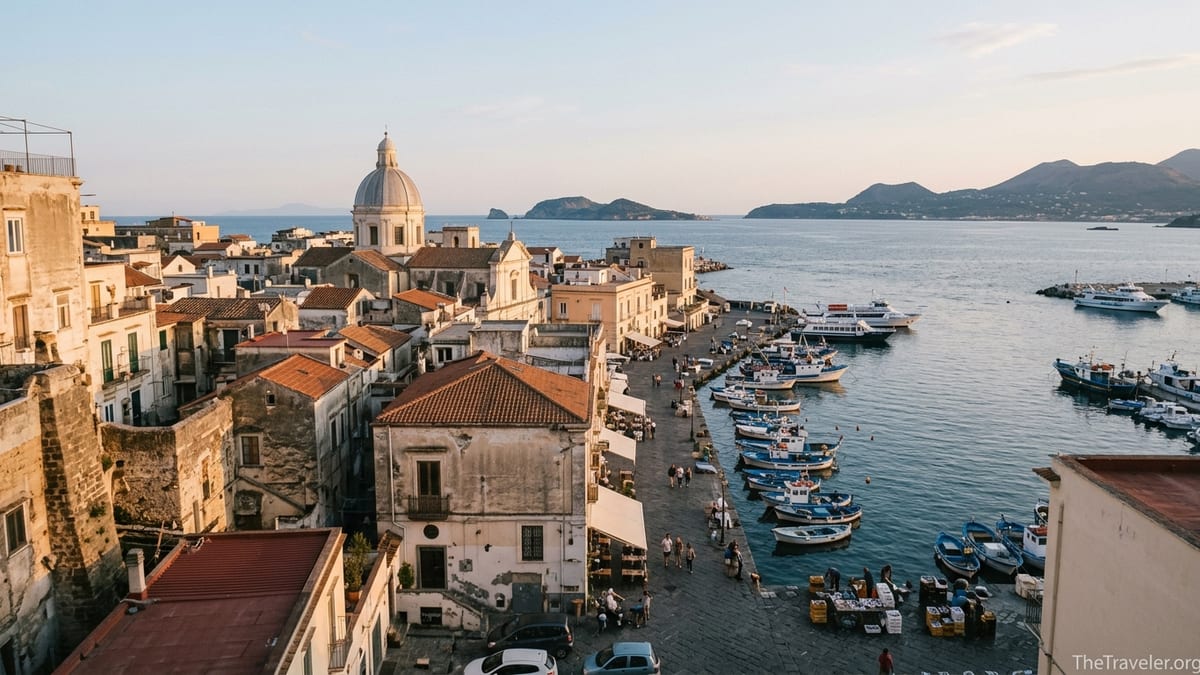
Pozzuoli rarely appears on glossy Amalfi Coast wish lists, yet ask people from Naples where they go for Sunday seafood, a waterfront stroll and a dose of ancient history, and this former Roman port comes up again and again. Just 30 minutes from central Naples by train, Pozzuoli is the kind of lived‑in, slightly scruffy seaside town where boats still unload the day’s catch beneath a skyline of church domes and Roman arches, and where volcanic cliffs frame some of the most atmospheric views in the Bay of Naples.
Get the latest updates straight to your inbox!
A Seaside Town That Still Feels Genuinely Local
For Neapolitans, Pozzuoli is close enough for a spontaneous evening but far enough from the historic center to feel like an escape. Line 2 of the Naples metropolitan railway connects Piazza Garibaldi with Pozzuoli in about 30 minutes, and commuters pile on alongside families heading out for a seafood lunch or a late walk along the waterfront. When you step out at Pozzuoli station and follow the streets downhill, you reach a compact harbor where fishing boats, ferries and kids fishing off the pier share the same working waterfront.
Unlike carefully staged resort towns, Pozzuoli’s lungomare, the seaside promenade, is salty and practical. Fishermen repair nets next to small bars pouring espresso, and older residents sit watching ferries leave for Ischia and Procida. Concrete piers and weathered bollards give way to wide views across the Tyrrhenian Sea, with the silhouettes of the islands on clear days and, to the east, the spread of Naples climbing up the slopes of Vesuvius. It feels more like a neighborhood than a destination, which is exactly what locals love about it.
On summer evenings, especially from June through September, families from nearby districts like Fuorigrotta and Bagnoli drive or take the train in, meeting friends at gelaterie set back from the water or grabbing a seat on the low wall along the harbor. You are as likely to hear talk about the latest Napoli match as you are to overhear recommendations about which trattoria did the best risotto alla pescatora that week. As a visitor, it is easy to blend into this easygoing crowd rather than feel like a spectator in a tourist show.
Accommodation in Pozzuoli remains relatively low key. Instead of large resort hotels, you find small guesthouses in renovated townhouses up the hill, simple B&Bs near the amphitheater, and a few boutique properties overlooking the bay. Prices are often noticeably lower than in central Naples or on Capri, especially outside August, which allows travelers to use Pozzuoli as a base for exploring the Phlegraean Fields while enjoying the town’s relaxed, local pace.
Seafood Straight From the Boats to Your Plate
The most immediate reason Neapolitans give for coming to Pozzuoli is seafood. The town’s small port still receives daily catches from boats working the bay, and much of that fish ends up in the bars and trattorias just a few streets away. Early in the morning, a small open-air market near the harbor typically fills with stalls selling glistening anchovies, squid, prawns and mullet laid over crushed ice, with prices per kilo called out over the sound of engines and gulls.
By lunchtime, that same catch appears on menus as spaghetti alle vongole, fried paranza, grilled pezzogne and whole sea bream cooked with clams and cherry tomatoes. Along the waterfront streets near the port and toward the Rione Terra, restaurants range from no-frills osterie with paper tablecloths to more polished spots with white tablecloths and panoramic terraces. Locals often book Saturday or Sunday lunches weeks in advance at their favorite places, then linger for hours over antipasti of marinated anchovies, octopus salad and plates of sautéed mussels.
One of the pleasures of eating here is the sense of continuity between the port and the plate. In many trattorias you can look out the window and see the same boats that supplied your meal rocking in the harbor. House wines are usually simple Campanian whites served in carafes, well suited to seafood. While exact prices fluctuate, visitors commonly find generous plates of spaghetti alle vongole and a glass of local Falanghina costing less than similar dishes in the historic center of Naples or in more famous coastal towns, which is another reason locals make the trip.
Street food plays its part as well. Kiosks on and around the waterfront sell fried cuoppi filled with calamari rings, small fish and zucchini blossoms, eaten with a squeeze of lemon while walking the promenade. In the cooler months, some bars serve zuppa di cozze, a spicy mussel soup that feels particularly appropriate in a town where the sea is only ever a few steps away. For travelers, joining the line at a busy stall or sliding into a crowded seafood bar is one of the quickest ways to experience Pozzuoli as residents do.
Roman Puteoli Beneath a Modern Neighborhood
Beyond the harbor, Pozzuoli’s everyday streets sit on top of one of the most important ports of the Roman world. Known then as Puteoli, the town emerged as a key maritime gateway for Rome, receiving goods and people from across the Mediterranean long before Ostia and Portus took over that role. Today, that history is still visible in major monuments that locals pass on their way to school or work, sometimes almost casually.
The Flavian Amphitheater, a short walk uphill from the station, is a striking example. Considered the third largest Roman amphitheater in Italy, it is large enough to have once held tens of thousands of spectators. Built during the reigns of Vespasian and Titus in the 1st century, it now sits partly sunken below modern street level, encircled by apartment blocks, shops and passing traffic. Visitors can descend into its remarkably preserved underground passages, where cages and mechanisms for raising animals into the arena are still clearly visible.
Closer to the waterfront, the so-called Temple of Serapis, in reality the remains of a Roman marketplace or macellum, stands in a sunken plaza where columns show clear banding from centuries of rising and falling sea levels. Locals use this site as an informal barometer of bradyseism, the gradual up and down movement of the ground caused by volcanic activity beneath the Campi Flegrei. While scientists monitor the area carefully, for residents the visible traces on these columns are part of daily life and a reminder that the town has survived cycles of sinking and rising over millennia.
Layered on top of these ruins are medieval and early modern buildings, such as the cathedral dedicated to San Procolo martire, built over a Roman temple on the Rione Terra promontory. Walking from the amphitheater down to the port, travelers pass cafes, bakeries and corner shops that occupy buildings resting on ancient foundations. It is this close, almost casual coexistence with antiquity that gives Pozzuoli a particular charm: Roman history is not curated behind glass, but woven into commuter routes and school runs.
Rione Terra: From Abandoned Rock to Revived Quarter
Jutting out into the bay above the port, the Rione Terra is the oldest settled part of Pozzuoli, an acropolis first used by Greek colonists and later developed as the Roman heart of Puteoli. For centuries it was packed with tightly clustered houses, lanes and churches. In the 1970s, however, increased volcanic activity and bradyseism led authorities to evacuate residents from the promontory, leaving an entire neighborhood empty and walled off.
In the decades since, a long restoration program has transformed Rione Terra from a ghostly rock into one of the town’s most fascinating areas. Archaeological excavations below street level have revealed an intact Roman quarter, complete with paved streets, workshops and storerooms. Above, historic palazzi and the cathedral have been stabilized and restored, and guided routes now take visitors through underground Roman spaces before emerging onto terraces with sweeping views of the bay.
For locals, the reopening of Rione Terra in stages has been both a cultural and emotional milestone. Families who once lived in the quarter return for festivals, cultural events and evening passeggiate along its lanes. At sunset, residents often climb to viewpoints near the cathedral to watch the light shift over the water and the island silhouettes. From here, you can see clearly how the town, amphitheater, modern port and volcanic craters all fit together in a tight coastal landscape.
Practical access is usually via organized visits that must be reserved, especially on weekends and in high season, so travelers who want to explore the Roman quarter beneath Rione Terra should plan ahead. Combined with a seafood lunch below in the port and a visit to the amphitheater, Rione Terra makes Pozzuoli feel like an open-air textbook of Mediterranean history, with the added advantage that the town around it is very much alive.
Coastal Views Shaped by Fire and Water
Pozzuoli’s coastline is not all soft beaches and predictable resorts. Instead, the shore here bears the marks of the Campi Flegrei volcanic system that surrounds the town. Low cliffs, black sand coves and fumarole fields like those near the Solfatara crater give the landscape a raw, almost otherworldly edge, even though you are only a short train ride from downtown Naples. For locals, this geology is simply part of everyday scenery, but it also creates some of the most distinctive viewpoints in the region.
From the harbor, the view sweeps across the bay with ferries shuttling to Ischia and Procida and the outline of Nisida and Cape Miseno in the distance. Walking west along the waterfront, you encounter stretches where the land rises into rocky terraces used for small gardens or informal lookout points. On clear winter days, when the air is crisp and the bay sparkles in the low sun, residents often note that the view from Pozzuoli feels wider and calmer than from the busier promenades in central Naples.
Up in Rione Terra, viewpoints over terracotta roofs and church domes frame the port below and the amphitheater further inland. In the other direction, toward the interior, you can see the undulating line of volcanic craters and the steam sometimes visible from geothermal vents. For photographers, early morning and late afternoon bring especially dramatic light, with long shadows emphasizing the texture of cliffs, old walls and fishing boats pulled onto slipways for repair.
Nearby thermal areas, including the famous hot springs and spa complexes scattered through the Phlegraean Fields, add another layer to the relationship between Pozzuoli’s people, the land and the sea. Locals might plan a day that starts with a soak in mineral-rich pools, continues with lunch at a seafood trattoria in town, and ends with an evening walk on the harbor wall, watching the sky change color over the water that sustains both their history and their present.
Experiencing Pozzuoli Like a Local Visitor
Travelers who want to understand why Pozzuoli is so beloved by nearby residents should approach it the way Neapolitans do. A typical local outing might start with a mid-morning arrival by train at Pozzuoli station, followed by espresso and a sfogliatella at a bar on the way down toward the harbor. From there, you can wander the fishing port, watching crews unload crates filled with shellfish and small fish and listening to quick negotiations over prices.
Late morning is a good time to head uphill to the Flavian Amphitheater, when the sun has climbed high enough to illuminate the upper arches but temperatures have not yet peaked. After exploring the arena and its tunnels, locals might walk back toward the sea through everyday streets, stopping to pick up pastries or to chat with friends in piazzas that double as children’s football pitches. Unlike more tourist-focused towns, there is rarely a strict divide between sightseeing and normal life; the two overlap.
Lunch is the centerpiece of the day. Many families reserve a table at a long-favored seafood restaurant near the port or under the Rione Terra. They order antipasti to share, then perhaps a pasta dish and a grilled or baked fish to divide between the table. Often, there is no rush to turn over seats; staff recognize repeat customers, and meals stretch into long conversations. For visitors, it can be worth asking for the pescato del giorno, the catch of the day, which usually reflects what was landed that morning rather than a fixed list.
In the afternoon, people drift either toward the promenade for gelato and a walk or up to Rione Terra for a guided visit and sunset views. Children ride scooters along pedestrian stretches, while older residents lean on railings discussing local politics and football. Trains back to Naples run into the evening, allowing a leisurely finish. For travelers, building an itinerary that mirrors this rhythm, instead of rushing through a checklist of sights, often leads to a richer understanding of why Pozzuoli feels special to those who live nearby.
Practical Tips for Today’s Traveler
Reaching Pozzuoli from Naples is straightforward. Line 2 trains generally run throughout the day from key stations such as Napoli Piazza Garibaldi and Cavour to Pozzuoli Solfatara, with journey times often around half an hour depending on stops. Tickets for this commuter line are usually inexpensive compared with long-distance rail, and many visitors choose a simple day-return ticket. From the station, clear signage and a downhill walk of about 10 to 15 minutes bring you to the harbor and central promenade.
Because Pozzuoli is a living town rather than a resort built around visitors, opening hours occasionally reflect local rhythms rather than strict sightseeing schedules. Many restaurants close one day a week, often Monday or Tuesday, and some smaller shops shut in the early afternoon. In August, when many Italians take vacation, the town can be busier with domestic travelers, and some businesses close for short breaks. Checking current opening times for key sites such as the Flavian Amphitheater and Rione Terra before you travel is advisable, as access can depend on ongoing conservation work and local regulations.
Weather plays a role in how you experience Pozzuoli. Summer can bring high temperatures and bright sun reflecting off water and stone, so a hat, sunscreen and water are sensible. Spring and autumn often offer mild days and clearer views across the bay, while winter can be cooler but atmospheric, with rougher seas and dramatic skies that emphasize the town’s volcanic backdrop. Because the area is geologically active, local authorities maintain monitoring systems for volcanic and seismic activity, and visitors should follow any official guidance if conditions change.
Prices in Pozzuoli for food, coffee and everyday items are generally similar to or slightly lower than in central Naples, which makes spontaneous stops at bars and bakeries easy on the budget. Carrying some cash is still useful for smaller purchases and at traditional markets, though most restaurants and larger cafes accept cards. English is spoken to varying degrees in tourist-facing businesses, but a few words of Italian, such as ordering “un cuoppo di frittura” or asking “qual è il pescato di oggi,” often elicit a warm response and help bridge the distance between traveler and local.
The Takeaway
Locals love Pozzuoli because it feels like a complete coastal world scaled to everyday life. The town offers excellent seafood that travels only a few hundred meters from boat to plate, a dense concentration of Roman and later history woven into ordinary streets, and sea views framed by volcanic cliffs that constantly remind you of the forces that shaped this shoreline. Yet it remains, above all, a place where people live, meet, argue about football and celebrate family milestones.
For travelers willing to look beyond the most famous postcards of Campania, Pozzuoli provides an accessible, authentic alternative. It can be a day trip from Naples centered on lunch and a stroll, a base for exploring the wider Phlegraean Fields, or a quiet overnight stop between island hops. Whatever the format, approaching the town with the relaxed rhythm of local visitors reveals why this compact harbor, its amphitheater and its rocky promontory exert such a lasting pull on those who know it well.
FAQ
Q1. How do I get from central Naples to Pozzuoli without a car?
Take Line 2 of the Naples metropolitan railway from stations such as Piazza Garibaldi or Cavour to Pozzuoli Solfatara, then walk downhill about 10 to 15 minutes to the harbor.
Q2. Is Pozzuoli safe to visit as a solo traveler?
Pozzuoli is a lived-in commuter town where people are out on the streets late, especially in good weather, and most visitors feel comfortable using normal big-city precautions with bags and valuables.
Q3. When is the best time of year to enjoy seafood in Pozzuoli?
Seafood is served year-round, but many locals particularly enjoy long weekend lunches from spring through early autumn, when outdoor tables and sea views make the experience especially pleasant.
Q4. Do I need to book restaurants in advance?
For popular seafood restaurants near the port and under Rione Terra, especially on Friday and Saturday nights or Sunday lunch, reserving a few days ahead is wise to avoid waiting.
Q5. Can I visit the Flavian Amphitheater and Rione Terra in one day?
Yes, many visitors combine a morning tour of the amphitheater with an afternoon visit to Rione Terra and still have time for a relaxed seafood meal and a waterfront walk.
Q6. Are there beaches in Pozzuoli?
The coastline near the town center is more harbor and rocky shore than sandy beach, but nearby areas in the Phlegraean Fields offer lidos and small beaches reachable by local transport or taxi.
Q7. Is Pozzuoli a good base for visiting Ischia and Procida?
Ferries and hydrofoils connect Pozzuoli’s port with the islands, so some travelers choose to stay here, enjoying lower-key evenings and using the town as a jumping-off point for island day trips.
Q8. How much time should I plan for a first visit to Pozzuoli?
A full day allows you to see the amphitheater, walk the harbor, enjoy a long meal and visit Rione Terra; an overnight stay gives more time for relaxed exploration.
Q9. Is volcanic activity a concern for tourists?
The area is carefully monitored by Italian authorities, and everyday life continues normally; visitors should simply follow any official instructions if local conditions change during their stay.
Q10. Do I need to speak Italian to get by in Pozzuoli?
Basic English is understood in many restaurants and tourist sites, but learning a few Italian phrases helps with menu questions, reservations and friendly interactions with residents.