


On an island already synonymous with high-end holidays, Psarou Beach has managed to stand apart. This small, curving bay on Mykonos’ south coast draws superyachts, A-list regulars and travelers who see a beach day as an excuse to indulge. With its clear Aegean water, meticulous beach service, upscale hotels and some of Greece’s most expensive sunbeds, Psarou has become shorthand for luxury in the Cyclades.
Get the latest updates straight to your inbox!
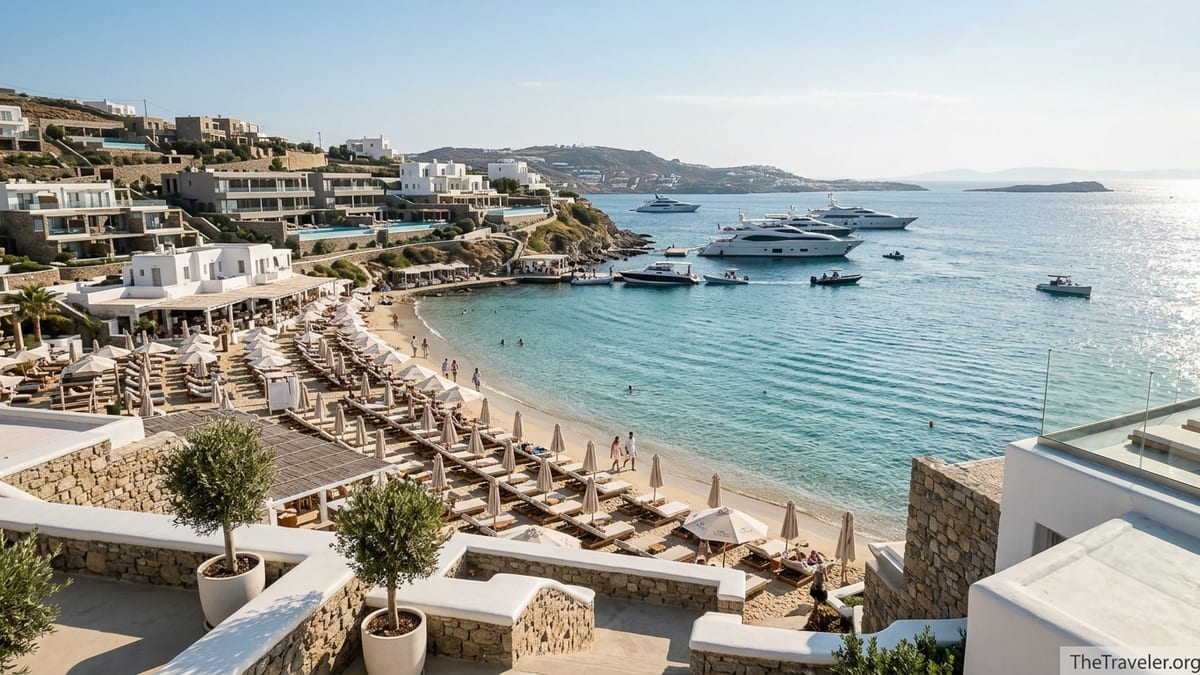
The Setting: A Compact Bay Built for VIP Living
Psarou Beach sits roughly 4 kilometers south of Mykonos Town, close to the better-known hub of Platis Gialos. The bay itself is small and sheltered, a neat crescent of pale sand and impossibly clear water protected from the northern meltemi winds that can whip other shores. That natural protection is one of the first reasons it attracts yacht tenders and day-trippers arriving in pressed linen rather than carrying beach mats.
Because the bay is compact, space is at a premium. Most of the beachfront is occupied by organized sunbeds belonging to high-end venues, with only a narrow strip left as fully public sand. On a July afternoon you might see a continuous line of branded umbrellas from one end of the beach to the other, backed by low-slung whitewashed buildings and the slopes of villas above. The geography creates an almost amphitheater-like feel where everyone, from the front-row loungers to the decks of anchored yachts, has a view of everyone else.
That layout feeds into Psarou’s social dynamic. People do not come here to disappear behind a book. They come to see and be seen, walking the shoreline in carefully chosen resort wear, stepping off polished RIB tenders or drifting between beach, restaurant and boutique. The mix of natural beauty and built-up glamour makes Psarou feel less like a simple Greek beach and more like a curated summer stage.
At the same time, access remains relatively easy compared to some more remote Cycladic coves. Taxis from Mykonos Town, pre-booked transfers from hotels and the popular water-taxi route along the south coast all stop here, meaning that even first-time visitors can fold a day at Psarou into a wider Mykonos itinerary without much effort.
Nammos: The Club That Defined the Psarou Beach Myth
Any discussion of luxury at Psarou inevitably begins with Nammos. Established in the early 2000s and now a brand with an international footprint, Nammos’ flagship on Psarou is beach club, fine-dining restaurant, party venue and fashion address rolled into one. Its signature turquoise-and-white umbrellas are the first thing many visitors notice as they step onto the sand, and for a growing number of travelers, “going to Psarou” essentially means “booking Nammos for the day.”
Prices reflect that reputation. Recent 2026 reports from Greek island travel specialists suggest a pair of sunbeds at Nammos can cost roughly 180 to 280 euros for a second-row set in high season, with front-row loungers frequently quoted in the 350 to 500 euro range per day, often coupled with a minimum food-and-drink spend that can start around 200 euros and climb significantly higher depending on location and demand. Travelers swapping tips online mention being quoted several hundred euros for a single set in August, particularly on weekends when the international jet set descends.
In return, guests get a fully choreographed beach experience. Staff ferry cold towels, iced water and cocktails directly to your lounger. Lunch might be a platter of just-landed seafood, sushi or a magnum of champagne delivered with theatrical flair. As the afternoon progresses, the soundtrack grows louder, bottles arrive with sparklers, and spontaneous table-dancing becomes a near-daily ritual during peak season. For many, that progression from languid sunbathing to full-blown party is precisely what justifies the cost.
Nammos has also given Psarou an additional layer of exclusivity off the sand. The complex includes a spa and access to yacht services, and it is directly linked to Nammos Village, an upscale shopping enclave behind the beach that brings together some of the world’s most recognizable luxury fashion and jewelry brands. A typical Psarou afternoon can easily include slipping from a luxury lounger to a designer fitting room in less than a minute.
Luxury Without the Spotlight: Hotels, Villas and Quieter Corners
Although Nammos and its music dominate the bay’s image, another reason Psarou stands out is the way it caters to travelers who want luxury without constant noise. Several boutique properties and villas cluster on the hillside and around the edges of the beach, marketed as much for privacy and design as for proximity to the party.
One of the best-known names here is Kensho Psarou, a design-forward boutique hotel built into the hillside with suites, private pools and a panoramic view across the bay. Guests can go from an infinity pool terrace with minimalist Cycladic architecture straight down to a reserved space on the sand, effectively treating Psarou as their front yard. Similarly, newer branded properties along the beachfront position themselves as full-service luxury resorts where the temptation to leave the hotel grounds is minimal.
For a slightly more low-key take on the Psarou experience, long-running restaurants like Cavo Psarou offer organized loungers and full beach service at prices that, while still far from budget, sit below the top-tier clubs. In June or September, for example, a first-row set of sunbeds here may carry a minimum spend in the region of 50 euros, giving visitors a way to enjoy the same translucent water and postcard scenery without signing up for the most eye-watering bills on the sand.
Those staying in nearby areas such as Platis Gialos or Ornos often split their days accordingly: perhaps one splurge at Nammos for the full “Psarou moment,” paired with more relaxed, moderately priced beach days elsewhere. That flexibility is part of Psarou’s appeal. You can book a villa with a private chef in the hills for discreet luxury, spend your afternoons on quieter loungers at the edges of the beach, and still be only a short stroll from the glitz should the mood strike.
Where Superyachts Meet Champagne Buckets
Psarou is one of the few beaches in Greece where the presence of superyachts feels routine rather than exceptional. On a typical August day, a string of sleek motor yachts and sailing vessels sits just offshore, with tenders shuttling guests directly to the private docks of beach clubs or to the shallow water line. Some yacht-charter brokers marketing Cyclades itineraries explicitly highlight Psarou as a key stop, describing afternoons spent anchored here before heading to more remote coves at sunset.
This relationship between the bay and the yachts goes beyond simple convenience. Nammos operates its own private dock and yacht services, positioning itself as an onshore extension of life aboard. Crews can arrange for multi-course lunches to be brought to the vessel, or their guests can step ashore for a few hours of people-watching and shopping before retreating back to the privacy of their decks. That seamless flow between boat and beach is one of the defining symbols of luxury at Psarou.
On land, the atmosphere reflects that maritime traffic. Beach menus prominently feature high-end champagnes by the bottle and magnum, rare spirits and premium Mediterranean wines. It is entirely possible for a group to spend as much in an afternoon at Psarou as they might for a week-long villa rental elsewhere in Greece, especially when bottle service, sushi platters and late-afternoon celebrations come into play.
The crowd that gathers here is correspondingly international. In peak months you are as likely to overhear conversations in Arabic, Italian or English as in Greek, with guests flying in from Dubai, London, New York and beyond. Social media has amplified this, with Psarou’s front-row loungers and yacht-dotted horizon frequently appearing in the summer feeds of influencers and celebrities, further reinforcing its status as the place in Greece to showcase a certain style of summer.
High-End Shopping and Dining Steps From the Sand
Another reason Psarou feels different from other Greek beaches is the density of luxury brands behind the shoreline. Nammos Village, a purpose-built open-air shopping center, houses a cluster of international designer labels in low, whitewashed buildings that mirror the island’s architecture while offering a distinctly cosmopolitan retail mix. Fashion-conscious visitors can spend an hour moving between upscale ready-to-wear, fine jewelry and accessories before heading back to their loungers as if they had never left the beach.
For many travelers, this combination of shopping and sea is precisely what justifies choosing Psarou over a quieter, more traditional bay elsewhere in the Cyclades. A typical day might involve a morning swim, a late lunch at one of the beachfront restaurants, and an afternoon trying on the latest resort collections or picking up a statement piece to wear that evening in Mykonos Town. The convenience is hard to overstate when everything is within a few hundred meters.
Culinary standards here generally track the pricing. Menus lean toward Mediterranean seafood, sushi, premium meat cuts and creative mezze, often with a heavy emphasis on presentation. A couple sharing a chilled local rosé, a crudo platter and a main course each can expect to pay significantly more than at a taverna in a nearby village, particularly when dining at the most fashionable addresses. Still, many guests note that the setting and level of service feel closer to a high-end city restaurant than to a typical seaside spot, which is exactly what Psarou’s venues are aiming to deliver.
At the same time, smaller operations and long-established local businesses add a layer of continuity beneath the gloss. Family-run spots that predate the current wave of ultra-luxury still serve Greek classics, coffees and simpler cocktails, providing a way to experience the bay at a slightly more grounded pace while watching the heightened theater of luxury unfold a few meters away.
Practicalities: Costs, Reservations and When to Go
For travelers considering Psarou, understanding the practical side is crucial. This is not a beach where you simply show up at midday in August and expect an affordable front-row lounger. High-season demand, especially at marquee venues such as Nammos, means reservations are essential. Many visitors now book sunbeds and lunch tables weeks in advance through online systems or hotel concierges, particularly for weekends and during late July and August.
Prices vary significantly depending on venue, row, and time of season, but it is realistic in 2026 to expect organized sunbeds at the premium clubs to start around the low hundreds of euros for a pair, with front rows and weekend slots costing considerably more. On top of rental or reservation fees, minimum spends are common, especially for the most coveted positions closest to the water. Meanwhile, more modestly priced sets at quieter sections or at restaurants with simpler offerings can bring the cost down closer to what travelers might encounter on other Cycladic islands, especially in shoulder months such as June or late September.
Reaching the beach itself is straightforward. Taxis from Mykonos Town take around ten minutes in light traffic, although during peak weeks journey times and prices can rise as demand for vehicles surges. Many visitors staying at nearby hotels opt for pre-arranged transfers or rental cars, while others rely on the regular water-taxi that plies the south coast between Ornos, Psarou, Platis Gialos and beyond, turning a beach day into a mini coastal cruise.
For a balance between atmosphere and comfort, many seasoned visitors recommend targeting June, early July or September. The water is warm enough for long swims, the beach clubs are in full swing, but the crush of August has yet to reach its peak. These months also make it marginally easier to secure reservations at popular venues and to enjoy the bay’s natural beauty before the decibel levels rise.
Is Psarou Right for You? Matching the Beach to Your Travel Style
Despite its reputation, Psarou is not the right fit for every traveler, and recognizing that is part of planning a satisfying Mykonos itinerary. Those who prize tranquility, low-key tavernas and long, empty stretches of sand may find the constant buzz of service, music and foot traffic overwhelming. For that audience, quieter beaches on Mykonos or neighboring islands will likely feel more rewarding.
On the other hand, if your idea of a perfect beach day includes attentive service, people-watching, a lively soundtrack and the option to jump from sea to high fashion in the space of half an hour, Psarou is hard to beat in Greece. It functions as a kind of outdoor living room for the global summer set, where a single afternoon can encompass swimming, fine dining, shopping and dancing without ever leaving the bay.
Travelers often choose to experience Psarou as just one element in a broader trip. A honeymooning couple might allocate one premium day here among more relaxed afternoons at Ornos or Elia. A group of friends celebrating a milestone birthday could build an entire long weekend around a villa in the hills above Psarou, a chartered yacht stop in the bay and a headline table at Nammos. Even cruise passengers with limited time on the island increasingly see a few hours at Psarou as a way to tap into the Mykonos myth in condensed form.
Ultimately, what makes Psarou one of Greece’s most luxurious beach destinations is not only what it offers but the sense of occasion it brings to something as simple as a swim. From the first step onto its soft sand to the last glance at the yachts glittering offshore, the bay is constructed to feel special, even if that specialness comes at a premium.
FAQ
Q1. Is Psarou Beach worth the high prices?
For travelers who enjoy upscale beach clubs, attentive service and a lively, glamorous atmosphere, many feel the cost is justified for at least one day. Those seeking quiet, traditional seaside experiences will likely find better value elsewhere on Mykonos or on neighboring islands.
Q2. How far is Psarou Beach from Mykonos Town?
Psarou is about 4 kilometers from Mykonos Town, typically a 10 to 15 minute drive depending on traffic. In peak summer, allow extra time, as roads to the southern beaches can become congested, especially in the afternoon.
Q3. Do I need to reserve sunbeds in advance?
Yes, in July and August it is strongly recommended to reserve sunbeds and lunch tables in advance at major venues, particularly on weekends. Same-day availability for front rows at the most popular clubs is often extremely limited or non-existent.
Q4. Can I enjoy Psarou without spending a fortune?
It is possible, but challenging in peak season. You can use the small public section of sand with your own towel and perhaps choose a more moderately priced restaurant for food and drinks. Visiting in June or September also helps keep costs lower compared to August.
Q5. What is the dress code at Psarou’s beach clubs?
Daytime attire is typically stylish beachwear: chic swimsuits, linen shirts, kaftans and designer sandals. In the evenings, many guests change into resort-casual outfits, such as summer dresses or tailored shorts and shirts, especially if staying for dinner or drinks.
Q6. Is Psarou suitable for families with children?
Families do visit Psarou, but it is primarily geared toward adults and groups of friends. High prices for sunbeds, a more party-focused atmosphere later in the day and limited space on the sand mean many families prefer quieter, more spacious beaches on Mykonos.
Q7. When is the best time of day to visit Psarou?
Mid-morning to early afternoon is ideal if you want calmer water and a more relaxed ambiance. After about 4 p.m., music and crowd energy typically increase, especially at the flagship beach clubs, making it livelier but also louder.
Q8. How do I get to Psarou without a car?
You can reach Psarou by taxi, hotel transfer, or the seasonal water-taxi service that runs along the south coast of Mykonos. During peak hours, pre-booking taxis or arranging transfers through your accommodation helps avoid delays.
Q9. Are there more affordable alternatives to Psarou on Mykonos?
Yes. Beaches such as Ornos, Platis Gialos, Agios Ioannis and Elia offer a mix of organized loungers and more traditional tavernas at a broader range of price points, while still providing beautiful water and reliable services.
Q10. Is Psarou Beach open all year?
The beach itself is accessible year-round, but most clubs, restaurants and organized sunbeds operate seasonally, typically from late spring through early autumn. The full luxury experience, including shopping and parties, is concentrated between roughly May and October.