


Ramsey Cascades looks deceptively gentle in photos: a lacy 100-foot waterfall spilling over mossy ledges, framed by bright rhododendron. On social media it’s often lumped in with drive-up overlooks and short strolls like Laurel Falls. In reality, Ramsey Cascades is one of the most demanding waterfall hikes in Great Smoky Mountains National Park, a route that has injured and exhausted more than a few visitors who assumed it was just another easy Smokies walk.
Get the latest updates straight to your inbox!
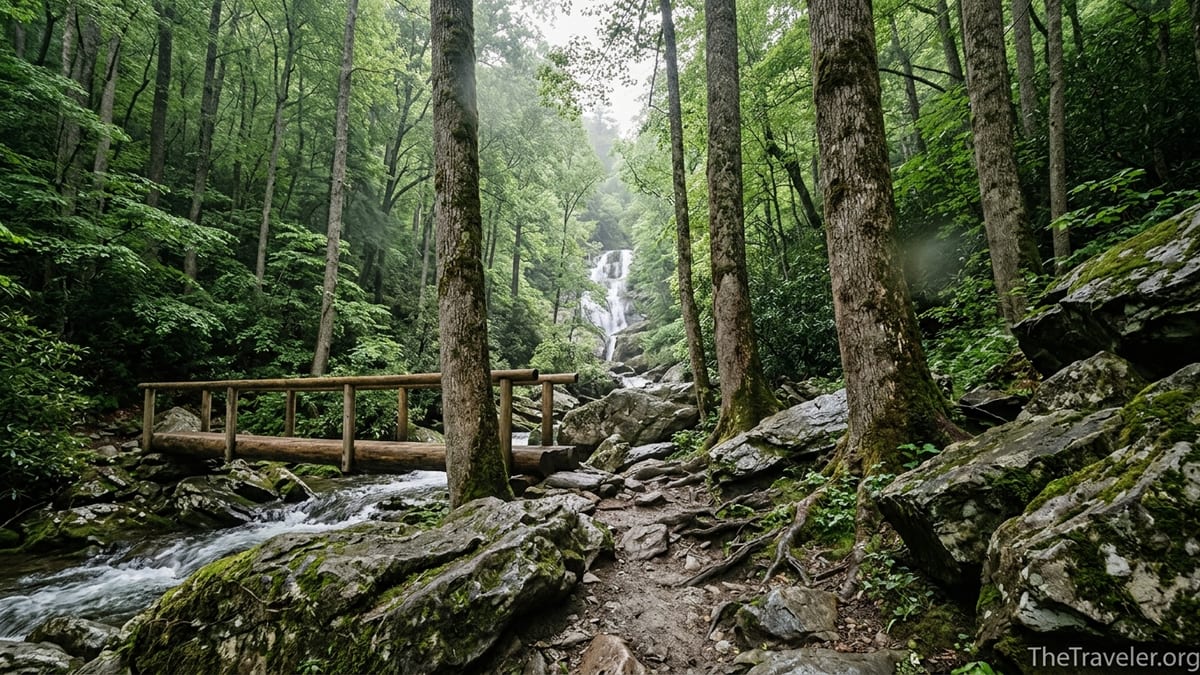
Ramsey Cascades by the Numbers: A Serious Mountain Hike
On paper, Ramsey Cascades already looks very different from the casual waterfall outings many visitors expect. The National Park Service describes the hike as an 8 mile round-trip trail with more than 2,100 feet of elevation gain, making it one of the steepest popular waterfall hikes in the park. That is roughly the same total climb you would tackle on a summit hike in many other mountain ranges, not a quick leg-stretcher after breakfast in Gatlinburg.
Trail maps and third-party hiking apps typically rate the route as “strenuous,” a label often overlooked by travelers scrolling quickly for “best waterfalls near Gatlinburg.” Unlike paved or partially paved classics such as Laurel Falls, every foot of Ramsey Cascades is a natural trail. Expect extended uphill grades, rock steps, and sections where your pace slows to under a mile per hour, especially in the final approach.
The waterfall itself adds to the misconception. At about 100 feet tall and spread across several rock shelves, Ramsey Cascades looks broad and inviting in photos. What the camera rarely shows is the narrow, boulder-filled amphitheater at its base and the sheer, wet rocks that have tempted visitors to climb despite repeated park warnings. The combination of long, steep trail and slick rock environment is exactly why the park emphasizes that this is not an entry-level outing.
Even fit day hikers report that Ramsey Cascades can feel longer than the mileage suggests. You will likely spend 3 to 5 hours on the move, plus time at the falls, which pushes this firmly into “half-day” territory. For many visitors arriving from low elevations or humid summer cities, the sustained climb and Smokies humidity can make the final mile feel like a true endurance test.
The Trail Itself: Roots, Rocks, and Real Exposure
The first couple of miles from the Ramsey Cascades trailhead can lull you into a false sense of security. The path begins on an old roadbed that gently parallels Ramsey Prong, with wide walking space and relatively even footing. Families with small children and visitors in running shoes often feel comfortable here, stopping at the river and assuming the rest of the trail is similar. It is not. After the old road ends, the route narrows and the character of the hike changes sharply.
Beyond roughly the halfway point, the trail becomes rocky, rooty, and noticeably steeper. Stone staircases, timber steps, and armored tread installed during the park’s Trails Forever rehabilitation work help protect the trail, but they also drive home the grade you are climbing. You will navigate tight switchbacks cut into the hillside, with drop-offs to the creek below that can feel exposed to anyone uneasy with heights or narrow footpaths.
Several log footbridges span tributaries and branches of Ramsey Prong. These bridges can be high above fast-moving water after heavy rain, and their rounded walking surfaces are slick when wet or frosty. While they have handrails on one side, they are still single-log structures that require stable balance and careful footing. Hikers uncomfortable with heights or narrow crossings often find these sections far more stressful than they expected from postcard-perfect waterfall images.
Near the end, the trail traverses jumbled boulders and roots as it hugs the river. In wet conditions, water may sheet across rocks and create shallow flows that demand slow, deliberate steps. This is the point where many casual hikers turn around, surprised by how “technical” the path feels compared with the family-friendly trails they sampled earlier in their Smokies vacation.
Conditions, Closures, and Why Timing Matters
Ramsey Cascades has seen significant disruption in recent years from flooding, trail damage, and rehabilitation work. A major July 2022 flood event washed out footlog bridges and damaged sections of Ramsey Prong Road and the trail itself. For months, the entire Greenbrier area, including Ramsey Cascades, experienced partial or full closures while crews rebuilt bridges and rerouted damaged sections. Even now, storm systems can temporarily close the road or trail when bridges, culverts, or tread are compromised.
Beginning in 2022, the park invested in a multi-year Trails Forever rehabilitation on Ramsey Cascades. This program focused on stabilizing eroded sections, constructing durable stone staircases and retaining walls, and improving drainage. The result is a safer, more sustainable route, but also one that underscores how rugged the terrain truly is. Recent local coverage in regional newspapers has highlighted the scale of the work: crews moving massive rock by hand, reconstructing long stretches of tread, and replacing critical log bridges.
Trail status and access can also be affected by wildlife. Seasonal bear activity, particularly in spring when food sources concentrate in certain drainages, has led to temporary closures of Ramsey Prong Road and the trail. Visitors who assume they can simply show up any day of the year risk disappointment or risky behavior, such as trying to walk in from further down the road or ignoring closure signs. In shoulder seasons, lingering ice on shaded sections and bridges can increase the difficulty considerably, even on otherwise pleasant days in March or early April.
Because conditions change quickly in the Smokies, treating Ramsey Cascades as a casual, last-minute add-on can lead to problems. In practical terms that means always checking the park’s current conditions page at least the night before, building a backup hike into your plan, and being willing to turn around if the river is running too high, thunderstorms are building, or fresh closure notices are posted at the Greenbrier entrance station.
Why Photos and Social Media Mislead So Many Hikers
The gap between expectation and reality at Ramsey Cascades is partly a product of how the hike is presented online. Scroll through typical social media posts and you will see people standing on big boulders in front of the falls, kids splashing in shallow pools, and wide-angle shots of the cascade framed by bright green foliage. Captions often read “best waterfall in the Smokies” or “must-do while in Gatlinburg,” with little mention of the climb or trail hazards.
What the images rarely show is the full context: sweaty hikers slumped along the trail on the return leg, the steep staircases and log bridges, or the narrow bench that forms the only safe viewing area near the falls. Influencers focused on aesthetics rarely note that it took them four or five hours of hiking to get the content they posted, or that they were wearing technical trail runners and carrying 2 liters of water in a hydration pack.
Online lists of “easy waterfall hikes in the Smokies” sometimes group Ramsey Cascades alongside destinations like Cataract Falls or the short spur to Spruce Flats Falls, even though those outings involve only a fraction of the distance and elevation gain. Some travel blogs recycle older or incomplete information, omitting notes about the trail’s “strenuous” rating or recent closures, which encourages visitors to treat it as interchangeable with half-mile photo-op walks from Newfound Gap Road pullouts.
The result is a pattern that local guides and rangers recognize immediately: visitors showing up at the trailhead in casual sneakers, carrying a single small bottle of water and no rain gear, confident because they have already “done” another Smokies waterfall earlier in the week. Many turn back before reaching the falls, and some push well past their comfort zone, risking exhaustion or slips in the final rocky approach.
Realistic Planning: Time, Gear, and Fitness
Planning Ramsey Cascades as a serious mountain day hike rather than a casual stroll changes everything about your experience. Most visitors should budget 5 to 7 hours door to door from Gatlinburg, including the approximately 30 to 40 minute drive to the Greenbrier area, a cautious pace on the trail, and time to rest at the falls. Starting before 9 a.m. is wise, especially in summer, to avoid afternoon thunderstorms and to leave ample daylight in case your pace is slower than expected.
Footwear and clothing should match the trail’s true character. Sturdy hiking boots or secure trail runners with good tread are strongly recommended, particularly for the wet rock near the falls and the rounded surface of the log bridges. Lightweight trekking poles help many hikers keep their balance on steep, rooty sections and reduce knee strain on the descent. A simple daypack stocked with at least 1.5 to 2 liters of water per person, a snack or light lunch, a light rain jacket, and a basic first-aid kit is a far better match than the minimal gear seen in many social media photos.
Fitness expectations matter just as much as gear. If your Smokies experience so far has been limited to short walks like the 1.3 mile round trip to Clingmans Dome’s observation tower or the roughly 2.6 mile hike to Laurel Falls and back, expect Ramsey Cascades to feel substantially more demanding. Aim to comfortably walk 6 to 8 miles on rolling terrain at home before your trip, and if you live at low elevation, remember that humidity and heat in East Tennessee during summer add a layer of difficulty that treadmills and suburban sidewalks cannot replicate.
Families debating whether to bring children should consider both distance and exposure. Older kids and teens who hike regularly can enjoy the challenge and the sense of achievement at the falls, but younger children may struggle beyond the halfway point, particularly on hot days. A realistic plan might involve one adult turning back early with tired kids while the strongest hikers continue on, rather than trying to push the whole group to the waterfall at all costs.
Safety at the Falls: Beautiful, Powerful, and Unforgiving
Even for hikers who handle the trail comfortably, the base of Ramsey Cascades presents serious hazards that are easy to underestimate. The National Park Service explicitly warns visitors not to climb the rocks around or up the falls and not to swim in the plunge pools. Slick, algae-coated stone and fast, channeled water flows can turn a minor slip into a life-threatening fall. The approach to the viewing area ends on uneven boulders gripped by tree roots, which can be treacherous when wet or icy.
The Smokies have a long history of accidents, injuries, and fatalities linked to waterfalls, and while official statistics are not broken out by individual falls, local rescue volunteers and rangers regularly cite Ramsey Cascades as a site where risky behavior can have immediate consequences. In practice, that risk often stems from tired hikers pushing closer for a better photo, climbing onto high boulders with no safe way down, or wading into pools to cool off without realizing how quickly footing can disappear under their feet.
Respecting the posted warning signs and natural barriers is more than a suggestion here. If the rocks look slick, they are. If the water is crashing hard enough to drown out conversation, it has the power to knock you off balance. Keeping a safe distance from the most turbulent sections, supervising children closely, and avoiding solo exploration off the main viewing area are simple steps that dramatically reduce the chance of turning a memorable hike into a rescue operation.
Finally, remember that the return trip is still four miles long and mostly downhill, demanding intact knees, ankles, and energy reserves. Eating a small snack at the falls, hydrating adequately, and putting on a light layer if you have cooled down in the spray can help you stay focused and sure-footed on the descent. The most common minor injuries on this trail are twisted ankles and slips on the way back, when attention drifts and fatigue sets in.
Responsible Alternatives for Casual Waterfall Seekers
None of this is meant to discourage capable hikers from visiting Ramsey Cascades. Instead, it is about matching the hike to your expectations and abilities. If you realize that 8 strenuous miles are more than you bargained for on a family vacation, the Smokies offer plenty of rewarding waterfall experiences that do qualify as more casual outings, especially around Gatlinburg and the park’s main corridors.
Laurel Falls, despite its ongoing rehabilitation closures as of 2025 and 2026, has traditionally been one of the most popular paved waterfall hikes, with a round-trip distance of about 2.6 miles. Abrams Falls, near Cades Cove, demands a bit more effort at around 5 miles round-trip, but still lacks the steep, technical feel of Ramsey Cascades, making it a more manageable challenge for a reasonably fit family. Porters Creek Trail, also in the Greenbrier area, offers gentler grades and historic homestead sites along with small cascades, and is often recommended by locals as a scenic alternative when Ramsey Cascades feels like too much.
Visitors staying in Gatlinburg or Pigeon Forge can also look to commercial guide services and outfitters that run guided waterfall hikes, especially for those navigating the park for the first time. While guides are not required for Ramsey Cascades, a guided outing on a shorter trail can provide a good benchmark of your group’s hiking comfort level before you commit to a more serious objective. Rental shops that outfit visitors with trekking poles, proper footwear, and daypacks can also help bridge the gap between “casual tourist” gear and what the Smokies’ backcountry truly demands.
Choosing a waterfall that matches your energy and experience does not make your trip less authentic. On the contrary, it helps ensure that the memories you take home are of mist on your face and forest quiet, not of aching joints and anxious glances at the clock as daylight fades. Ramsey Cascades will still be there on a future visit when you are ready to treat it as the demanding adventure it is.
The Takeaway
Ramsey Cascades is not a casual waterfall hike, no matter what the photos suggest. It is a demanding 8 mile round-trip journey with more than 2,100 feet of elevation gain, rugged terrain, narrow log bridges, and a powerful waterfall environment that punishes complacency. Treating it as a quick side trip from Gatlinburg sets visitors up for disappointment at best and dangerous situations at worst.
Approached with respect, preparation, and realistic expectations, however, Ramsey Cascades can be one of the most rewarding outings in Great Smoky Mountains National Park. It offers old-growth forest, rushing mountain water, and a towering cascade that feel worlds away from the parkway traffic below. The key is to plan as you would for any serious mountain hike: check current conditions and closures, start early, carry proper gear, know your limits, and stay conservative around waterfalls.
If you are not ready for that level of effort, the Smokies offer dozens of other waterfall experiences better suited to casual walkers and families, from mellow riverside strolls to moderate half-day hikes. Pick the adventure that matches your abilities now, and save Ramsey Cascades for the trip when you are eager, fit, and fully prepared to meet the Smokies on their own terms.
FAQ
Q1. How long does it take to hike Ramsey Cascades round-trip?
Most hikers should plan on 4 to 6 hours of actual hiking time for the 8 mile round-trip, plus additional time to rest, eat, and enjoy the waterfall.
Q2. Is Ramsey Cascades suitable for children or beginner hikers?
Only if they have prior experience with longer, steeper hikes. Many families with younger children turn around before the falls because of the distance, elevation gain, and rough footing.
Q3. What kind of shoes should I wear on the Ramsey Cascades trail?
Sturdy hiking boots or grippy trail running shoes are recommended. Casual sneakers, sandals, and fashion footwear are not appropriate for the steep, rocky, and often wet terrain.
Q4. Do I need trekking poles for this hike?
Trekking poles are not mandatory but are very helpful for balance on roots, rocks, and log bridges, and for reducing knee strain on the long downhill return.
Q5. Can I swim or wade in the pool at the base of Ramsey Cascades?
The National Park Service strongly discourages swimming or climbing on the rocks around the falls due to slick surfaces, strong currents, and past accidents and injuries.
Q6. Are pets allowed on the Ramsey Cascades trail?
No. Like most trails in Great Smoky Mountains National Park, Ramsey Cascades is closed to pets. Only service animals that meet specific federal guidelines are permitted.
Q7. When is the best time of year to hike Ramsey Cascades?
Spring and fall are generally best, offering cooler temperatures and, in spring, stronger water flow. Summer can be hot and humid, and winter often brings ice and slick conditions.
Q8. Do I need a permit or reservation to hike to Ramsey Cascades?
As of mid-2026, no day-use permit is required, but you should always check current park information for possible changes, temporary closures, or new management measures.
Q9. How much water and food should I bring?
Plan on at least 1.5 to 2 liters of water per person and enough snacks or a light lunch to keep your energy up over a 4 to 6 hour effort.
Q10. Are there toilets or services at the trailhead?
Basic restroom facilities are usually available at or near the trailhead, but there are no services on the trail itself, so come prepared with everything you need for the entire hike.