


High above the Arctic Circle in Finnish Lapland, Riisitunturi National Park spends several months of the year looking less like a real landscape and more like a scene lifted from a winter fairytale. Trees sag under impossible snow loads, the sky glows pink and blue long after noon, and a profound hush settles over the fells and frozen mires. For travelers willing to brave subzero temperatures and a long journey north, Riisitunturi delivers one of Europe’s most surreal and photogenic winter experiences.
Get the latest updates straight to your inbox!
A Remote Lapland Fell That Turns To Pure Snow Sculpture
Riisitunturi National Park lies in the municipality of Posio in southern Lapland, about an hour’s drive from the airport town of Kuusamo and roughly two and a half hours from Rovaniemi by car. In summer it protects old taiga forest and bogs, but in winter those same fells and spruce stands transform into something extraordinary. The fell tops reach just over 400 meters above sea level, but their exposed position makes them a magnet for cold air, wind and snow.
From December through March, the park’s dense spruce forests and open fells collect layer upon layer of snow and ice. By midwinter it can feel as if every branch, rock and trail marker has been wrapped in white. The main Riisitunturi trailhead sits near the end of a plowed road at Tolva, where visitors step straight from the parking area into a world of snow that often rises higher than a person’s knees.
For many travelers arriving from more temperate countries, the first steps along the Riisin rääpäsy winter trail feel almost disorienting. There are no sounds of traffic, very few buildings in sight and, on windless days, not even the rustle of branches. Only the crunch of snow under boots or snowshoes breaks the silence as the path begins to climb gently toward the fell.
The remoteness is part of the park’s magic. There are no ski lifts, no hotel complexes inside the park and only simple wilderness huts and shelters along the routes. Most visitors base themselves in Kuusamo, Ruka ski resort or in small guesthouses and cabins in Posio, driving in for a day trip. That low-key setup keeps Riisitunturi feeling like a genuine wilderness, even as its popularity with photographers and nature travelers grows every winter.
The “Crown Snow” Trees That Look Straight Out Of Fantasy
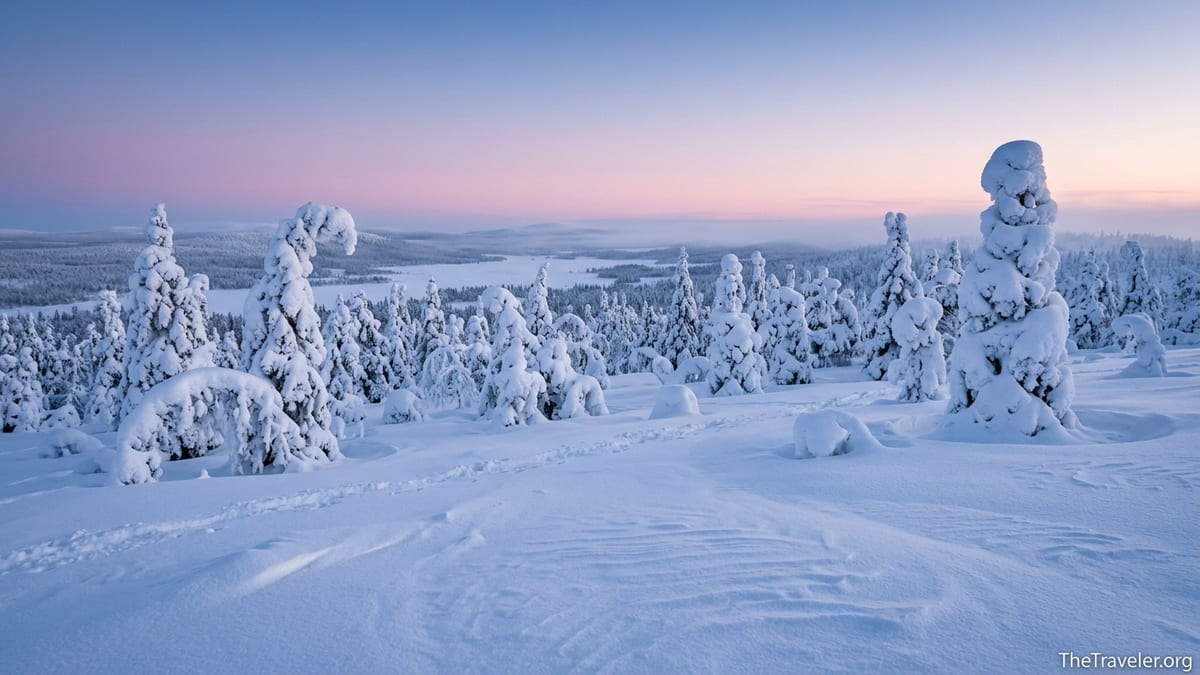
The single most surreal feature of Riisitunturi in winter is its “crown snow load,” known in Finnish as tykkylumi. This is not just ordinary powder resting lightly on branches. In Riisitunturi’s cold, humid climate, snow and hard rime ice accumulate on the crowns of trees over many weeks. The result is thick, heavy shells of white that bend spruces into arches, pyramids and towering pillars.
Walk a kilometer or two up from the parking area on a clear February afternoon, and the forest begins to resemble a sculpture park. Some trees stand several meters tall yet are so heavily coated that only a soft mound hints at their true shape. Others arc over the trail, creating natural tunnels where visitors pass underneath formations that resemble frozen waves or mythical creatures. Photographers often compare the scene to walking among giant snowmen carved by an unseen artist.
On the upper slopes of Riisitunturi Fell, wind shapes the crown snow into more streamlined, wind-swept forms. Here, the trees line up like a silent army facing the horizon, each one unique. Many visitors plan their hike to reach these higher sections during the “blue hour” of late afternoon. At that time, the snow absorbs the soft blue and pink tones of the sky, making the entire hillside glow in pastel colors that rarely appear this intensely farther south.
It is this combination of relentless snow accumulation and Arctic light that pushes Riisitunturi beyond “pretty winter scenery” into the realm of the otherworldly. Unlike many destinations that rely on decorative lights or man-made structures to create a festive atmosphere, Riisitunturi’s fairytale character is entirely natural, the product of weather, geography and time.
Arctic Light: Polar Nights, Pastel Days and Northern Skies
Riisitunturi’s winter fairytale is not only about snow. Light here behaves differently than in most of Europe, and that alone is enough to make a visit feel dreamlike. From early December to early January, the sun barely rises above the horizon in this part of Lapland. Instead of a bright midday, travelers experience a long twilight when the sky glows in shifting shades of indigo, peach and pale gold.
On a typical January day, hikers might start on the trail around late morning under a deep blue sky that gradually softens into pink near noon. Light filters through the forest in horizontal beams, backlighting the crown snow trees and setting crystals in the air sparkling. This low-angle light is exceptionally gentle on the eyes and on camera sensors, which is why many photographers choose Riisitunturi specifically during the heart of winter.
As the season progresses into February and March, days lengthen. The sun climbs a little higher, and the park sees more defined shadows and slightly brighter afternoons, though the pastel tones remain. On clear nights throughout the season, the lack of artificial light pollution makes Riisitunturi a strong location for viewing the northern lights. While many travelers book aurora excursions closer to Rovaniemi or Ruka, a guided evening snowshoe tour up Riisitunturi Fell can offer an even more atmospheric setting, with green and occasionally purple ribbons dancing above the sculpted trees.
Even on cloudy days, the light contributes to the fairytale mood. Overcast skies act as a giant softbox, smoothing out contrasts and turning the snow into a diffuse, glowing blanket. Photographers often mention that in Riisitunturi they can shoot all day without the harsh midday glare common in lower latitudes. The result is a visual calm that matches the physical stillness of the landscape.
Walking Inside The Fairytale: Trails, Shelters and Real Conditions
For most visitors, the main way to experience Riisitunturi’s winter landscapes is on foot, using either sturdy winter boots with traction aids or snowshoes. The popular Riisin rääpäsy winter route is roughly four to five kilometers, looping from the main parking area up onto the fell and back. Well-marked signposts and compacted snow underfoot make this route accessible to many reasonably fit travelers, though the short but steady climbs can feel challenging for those unused to winter hiking.
Along the route, simple wooden shelters and a day-use hut give the experience a cozy, storybook quality. Inside the hut, benches line the walls around a central stove. On busy days you may find small groups of Finnish families and international travelers cooking sausages over the fire, brewing coffee in blackened kettles and hanging gloves to dry. Firewood is typically provided by the park authorities, though visitors are expected to use it sparingly and follow basic etiquette, such as splitting more logs for the next group.
Weather, however, keeps the experience firmly rooted in reality. Temperatures in Riisitunturi from December to March often range from around minus 5 to minus 20 degrees Celsius, with occasional colder spells. Wind on the fell tops can make it feel significantly colder, especially after sunset. Travelers who arrive in lightweight fashion boots and thin gloves quickly discover that proper winter gear is nonnegotiable. Locals favor layered clothing, insulated waterproof boots, windproof outer shells and warm mittens rather than gloves.
Because conditions can change fast, many first-time visitors choose to join a guided tour from Kuusamo, Ruka or Posio. Typical half-day excursions include transport, snowshoes if needed, a guide who manages navigation in poor visibility, and a hot drink and snack for around the price of a mid-range restaurant meal in Finland. More experienced winter hikers sometimes drive themselves and explore independently, but they still keep a close eye on forecasts and daylight hours, particularly from December through January when usable light can be as short as a few hours.
Getting There: A Journey To The Edge Of Wilderness
Part of what makes Riisitunturi feel so magical is that reaching it requires a journey. Most international visitors fly into Helsinki, then continue north to Kuusamo or Rovaniemi by domestic flight. From Kuusamo airport, it is roughly an hour by rental car or prearranged transfer to the park’s main entrance near Posio. Travelers staying at Ruka ski resort often rent a car for a day and combine a visit to Riisitunturi with other regional highlights like the frozen waterfalls of Korouoma Canyon.
From Rovaniemi, the drive to Riisitunturi takes around two and a half hours in winter conditions, largely along maintained main roads. While the route is straightforward, winter driving in Lapland demands respect: roads can be icy, daylight is limited, and reindeer occasionally wander across the asphalt. Visitors who are not confident on snow and ice often opt for guided excursions that include transport. Several local operators run small-group trips from Rovaniemi and Kuusamo during peak winter months, especially from December through March.
Once at the trailhead, facilities are minimal but sufficient for a day out. There is usually a plowed parking area, information boards detailing the routes and basic pit toilets. There are no cafes or equipment rental shops at the entrance, so visitors are advised to bring everything they need from Posio, Kuusamo or Ruka. That typically means a thermos with hot drinks, snacks or sandwiches, extra layers, headlamps in midwinter and hand warmers for those not used to Arctic cold.
Accommodation options that keep the fairytale feeling going into the evening include lakeside cabins near Posio, glass-roofed igloo-style lodgings around Ruka and traditional log chalets with saunas. Many visitors structure their Lapland trip so that they spend a few nights in a resort with amenities, then one or two nights in more rural surroundings closer to Riisitunturi, combining comfort with immersion in the quiet winter landscape.
Sustainability and Respect in a Fragile Snow World
Riisitunturi’s surge in winter popularity has brought benefits to the small community of Posio and to local nature-based businesses, but it has also highlighted how delicate this snow world can be. The park’s crown snow trees are living organisms already under stress from heavy snow loads and cold. Stepping off marked routes to get a unique photo angle can compact snow around their roots and damage lower branches, especially when repeated by many visitors over a season.
Finnish park authorities and local tourism providers emphasize a “leave no trace” approach. On a practical level, this means staying on marked winter trails, using designated fire pits, packing out all trash and keeping noise to a minimum so that wildlife such as ptarmigan and reindeer are not unduly disturbed. Some guided tours build a brief discussion of local ecology into their outings, explaining how long it takes for a spruce to recover from broken branches or for sensitive mire vegetation to bounce back from trampling.
Over the past few years, new winter routes for activities such as fat biking and cross-country skiing have been developed just outside the most sensitive areas of the park. These give active travelers additional ways to enjoy the landscape while concentrating heavier use on tracks designed to withstand it. For visitors, choosing operators that clearly prioritize small group sizes, safety and environmental responsibility is a simple way to support the long-term health of Riisitunturi’s ecosystems.
Respect also extends to safety. Local rescue experts regularly remind winter hikers that even a fairytale landscape can become hazardous in a sudden snowstorm. Checking the forecast, telling someone your plan, carrying a fully charged phone and turning back if visibility drops are all normal parts of a responsible day out here. The goal is for Riisitunturi to remain an enchanting place that can be visited and photographed without putting either visitors or the environment at unnecessary risk.
The Takeaway
Riisitunturi National Park looks like a winter fairytale not because of marketing slogans, but because of a rare alignment of natural forces. The park’s modest but exposed fells collect extraordinary amounts of crown snow, coating every spruce and hilltop in thick white. Arctic light paints that snow in soft pastels through the polar day, while long nights bring the possibility of the northern lights shimmering above the frozen trees.
Yet beneath the dreamlike surface, Riisitunturi is a real, working landscape shaped by wind, cold and the steady rhythm of the seasons. Trails climb steadily rather than dramatically, fires in huts take time to coax to life and travel logistics require planning around winter roads and short daylight. Far from spoiling the magic, these practicalities deepen it, reminding visitors that this is not a theme park but a protected corner of Lapland where nature still sets the terms.
For travelers willing to journey to Posio in midwinter, dress for true Arctic weather and move at the slower pace that snow demands, Riisitunturi offers something increasingly rare in Europe: the feeling of stepping through a portal into another world, then returning home with the vivid sense that it was all, somehow, real.
FAQ
Q1: When is the best time to see the snow-covered “fairytale” trees in Riisitunturi?
January to early March usually offers the most reliable crown snow, with February often giving the best combination of deep snow cover and increasing daylight hours.
Q2: How difficult is the main winter trail for someone with average fitness?
The popular Riisin rääpäsy loop is short but has steady climbs. Most people with average fitness can complete it in a few hours, provided they have proper winter clothing and footwear.
Q3: Do I need snowshoes, or are winter boots enough?
In midwinter the main route is often compacted enough for good winter boots with traction aids. After fresh snowfall or off the main track, snowshoes make walking much easier.
Q4: Can I visit Riisitunturi from Rovaniemi as a day trip?
Yes, but it is a long day. The winter drive takes around two and a half hours each way, so many visitors either join a guided tour with transport or stay closer in Kuusamo, Ruka or Posio.
Q5: Is Riisitunturi suitable for children?
Families with school-age children often enjoy the park, especially the short trail to the first viewpoints and the hut with a warming fire. Very young children may struggle with the cold and deep snow.
Q6: Will I see the northern lights from Riisitunturi?
There is a good chance when the sky is clear and solar activity is strong, as light pollution is minimal. Many visitors plan one evening visit or guided tour specifically for aurora watching.
Q7: Are there any services or cafes at the trailhead?
No. The trailhead offers parking, information boards and basic toilets, but no food, rentals or shops. You should bring all snacks, hot drinks and gear with you.
Q8: How cold does it get, and how should I dress?
Temperatures often sit between minus 5 and minus 20 degrees Celsius in winter. Dress in layers, wear insulated waterproof boots, a windproof outer shell, a warm hat and thick mittens.
Q9: Is a guide necessary, or can I hike independently?
Experienced winter hikers often go independently on clear days. First-time Arctic visitors, or those coming from warm climates, typically benefit from a guide who manages navigation, safety and pacing.
Q10: Can I camp overnight in the park in winter?
Winter camping is possible for well-equipped, experienced visitors who understand Arctic conditions. Most travelers, however, choose to stay in heated cabins or hotels nearby and visit the park on day trips.