


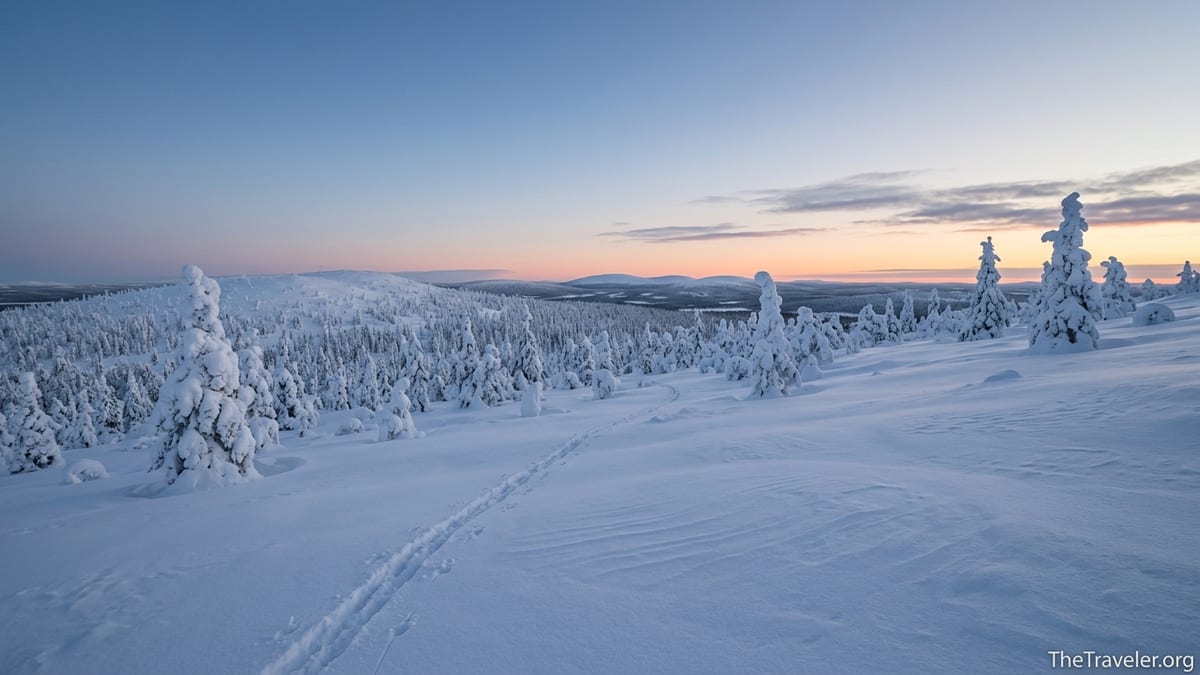
High on a frosted fell in southern Lapland, Riisitunturi National Park turns into one of Finland’s most otherworldly winter landscapes. Spruce trees freeze into heavy white sculptures, the horizon glows blue in the short polar daylight and silence settles over deep snowfields. For photographers and hikers who dream of crown snow, northern lights and minimalist winter scenes, Riisitunturi is a bucket-list destination that still feels wild and uncrowded. This guide explains how to visit specifically for hiking, photography and winter landscapes, with concrete information on timing, logistics, gear and trails.
Get the latest updates straight to your inbox!
Why Riisitunturi Is Special for Winter Photography
Riisitunturi National Park lies in the municipality of Posio in southern Lapland, roughly two hours’ drive from Rovaniemi. The park is relatively small by Lapland standards, but it sits on a high fell plateau where moist air from Lake Kitkajärvi meets cold inland temperatures. The result in midwinter is exceptionally heavy rime ice that coats the spruce trees from top to bottom, creating the famous "crown snow" shapes that draw photographers from all over Europe.
Compared with more developed resorts like nearby Ruka, Riisitunturi feels quiet and raw. There are marked winter trails and a wilderness hut, but no hotels or restaurants inside the park. You come here for the views and the stillness: rolling fells, open snowfields, bogs frozen into clean white plains and on clear days, orange and pink pastel skies that linger for hours at the horizon. For photographers, that long blue hour offers more workable soft light than you might expect from a place where the sun barely rises in December and January.
For landscape photography, Riisitunturi combines foreground interest and wide vistas in a compact area. A short 1.5 kilometer walk from the main parking area brings you to open slopes dotted with heavily loaded spruces, perfect for telephoto studies and minimalist wide shots. Experienced visitors often plan to walk the Riisin Rääpäsy loop in the afternoon, stay on the fell crest through sunset and civil twilight, then photograph the snow sculptures under stars or aurora before returning.
Because access is easy and elevation modest, Riisitunturi is also a realistic winter objective for reasonably fit travelers with no mountaineering background. With rental snowshoes and warm clothing from Rovaniemi or Ruka, you can join a guided day trip or, in good conditions, hike the main route independently while still getting the feel of Lapland’s high fells.
When to Go: Seasons, Light and Snow Conditions
Riisitunturi can be visited year round, but for iconic winter landscapes most photographers focus on mid-December to early March. The deepest crown snow usually forms after prolonged cold and humidity, often peaking sometime between late December and early February, although exact timing varies year by year. Many local guides recommend January as a sweet spot, when the snow load is heavy and days are slowly getting longer.
In late November and early December, you may already find good snow cover, but the trees might not yet be fully coated. Around Christmas and New Year, the park is at its most wintry, but days in Lapland are extremely short. Expect only a few hours of twilight-like daylight, which is beautiful for photography but can feel disorienting for first-time visitors. Plan your start times carefully and bring headlamps even for short outings.
By late February and March, the light becomes stronger and days longer. The snow sculptures can start to soften, but you gain more shooting time, clearer skies and better chances for combined aurora and landscape sessions. Many families choose March for a more relaxed experience with children, using the firmer snowpack and milder temperatures, often around minus 5 to minus 10 degrees Celsius instead of the minus 20 to minus 30 that are possible in January.
Summer and autumn are lovely for hiking, with marked trails over fells and through wetlands, but the photographic character is completely different: think cloudberry bogs, autumn colors and midnight sun rather than crown snow and northern lights. If your priority is winter landscape photography, it is worth accepting the colder temperatures and very short days to see Riisitunturi under full snow.
Getting There: From Rovaniemi, Ruka and Posio
The most common gateway for international visitors is Rovaniemi, about 190 kilometers south of Riisitunturi by road. Finnair, Norwegian and other carriers operate seasonal flights from Helsinki and selected European hubs to Rovaniemi, particularly between late November and March. From the airport, most travelers either rent a car or base themselves in Rovaniemi or Ruka and join a guided excursion to Riisitunturi.
Self-driving offers the most flexibility for photographers. The drive from Rovaniemi to the Riisitunturi main parking area near Tolva usually takes around two hours and fifteen minutes in winter conditions. Major car rental brands like Hertz, Avis and local companies at Rovaniemi Airport typically offer winterized vehicles with studded or friction tires as standard. In midwinter, day rates for a compact car can range from roughly 60 to 100 euros, depending on demand, with extra charges for one-way rentals and additional drivers.
If you are uncomfortable driving on snow and ice, consider staying in Ruka or Posio and booking a guided tour that includes transport. Several small operators based in Rovaniemi and Ruka sell day trips to Riisitunturi through major activity platforms and local hotels. A typical package might cost around 150 to 220 euros per person and include transfers, snowshoes, a guide, hot drinks and sometimes a simple lunch. These excursions usually last 4 to 8 hours door to door, with 2 to 4 hours of actual hiking and photography time in the park.
Public transport directly to the park is limited. There are long-distance buses to Posio and Ruka, and from there it may be possible to arrange a local taxi to the trailhead, but schedules and services change frequently. If you are traveling without a car and prefer not to book a full tour, contacting your accommodation in Posio or Ruka in advance to ask about current taxi prices and arrangements is advisable. Many guesthouse owners are used to arranging morning and evening transfers for hikers and photographers.
Key Trails and Viewpoints for Hikers and Photographers
Riisitunturi’s winter network is compact but varied, with routes suitable for beginners as well as more ambitious visitors. The classic choice for first timers is the Riisin Rääpäsy Trail, a 4.3 kilometer loop that climbs from the main parking area to the open fell and returns via slightly different terrain. In winter, this route is signed as a snowshoe trail and is usually walked clockwise, following blue-topped markers and well-trodden tracks once high season begins.
From the trailhead, it takes roughly 30 to 45 minutes for an average hiker with snowshoes to reach the first open slopes and crown snow trees, assuming moderate conditions. Photographers often budget significantly longer, stopping frequently to shoot. Plan at least three hours for the loop if you intend to work seriously with a camera, more if you stay out through sunset and darkness. The route has some short, steep sections but no technical exposure, and elevation gain is manageable for anyone of normal fitness used to winter walking.
More experienced visitors sometimes continue beyond the standard loop on the longer multipurpose track that runs about 20 kilometers through the area for skiing, snowshoeing and fat biking. This demands stronger navigation skills and stamina, and is usually not necessary for classic winter views, which are concentrated on the upper slopes of the main fell. If you are new to Lapland winter conditions, stick with Riisin Rääpäsy or the simple out and back to the Riisitunturi open wilderness hut near the twin summit, a roughly 1.5 kilometer uphill from the parking area.
For photography, two types of locations are particularly rewarding. The first are small groups of heavily loaded spruces on gentle slopes, ideal for isolating shapes against pastel skies or using telephoto compression. The second are higher, more open areas where you can see layers of snow-covered trees receding toward Lake Kitkajärvi and the distant fells. During clear nights, these spots make excellent stages for northern lights images, with strong foreground forms and relatively dark horizons.
Photographing Riisitunturi: Practical Tips and Gear
In winter at Riisitunturi, your biggest photographic challenge is not finding subjects but keeping yourself and your equipment functioning in deep cold. Temperatures can fall below minus 20 degrees Celsius, and wind on the exposed fell amplifies the chill. Dress with a proper base layer, thick insulating mid-layers and a windproof, snow-shedding shell. Many photographers use a down or synthetic parka over their shell while standing still, along with insulated over-mitts that can be pulled back to operate camera controls.
On the camera side, mirrorless and DSLR bodies from major brands like Canon, Nikon, Sony and Fujifilm cope well with the cold as long as batteries are managed carefully. Bring at least two to three spare batteries and keep them in an inner pocket close to your body. Swap them as performance drops rather than waiting for a full shutdown, and avoid changing lenses more often than necessary to protect the sensor from drifting snow and condensation.
Lens choice depends on your style, but many visiting photographers carry a wide-angle zoom around 16 to 35 millimeters for sweeping vistas and aurora, plus a standard zoom in the 24 to 70 or 24 to 105 millimeter range for isolating tree forms. Those interested in compressing layers of snow sculptures may add a 70 to 200 millimeter telephoto. A sturdy tripod with flip locks that can be operated with gloves is essential for night work and long exposures in dim blue hour light. Small accessories like lens cloths, chemical hand warmers, a headlamp with red mode and a thermos of hot drink make a disproportionate difference to comfort.
Because daylight is limited in midwinter, plan your photographic day around the slow gradient of light. Many photographers aim to start hiking late morning, reach the open fell for midday pastel glow, continue shooting through the muted "sunset" and stay into early night for stars or aurora if the forecast is promising. If you join a guided tour, check whether they plan for late returns; some operators offer specifically "evening crown snow and northern lights" excursions that time the walk for darkness.
Safety, Weather and Trail Etiquette
Riisitunturi feels gentle compared with alpine mountains, but winter conditions are serious. Weather can change quickly from clear to whiteout, and strong winds on the fell ridge can create dangerous wind chill. Before setting out, check the latest local weather forecast and any updates on trail conditions from Metsähallitus, the state agency managing Finland’s national parks. If forecasts mention storm winds or poor visibility, choose a shorter route or postpone your visit.
The marked winter trails largely avoid avalanche terrain, but snow can still be deep and uneven, especially after fresh falls. Snowshoes or at least winter boots with gaiters are strongly recommended for all off-road travel. Trails become packed over the season, but drifting snow can quickly obscure the line on open slopes. Carry a map or offline GPS with the route loaded, a fully charged phone and a headlamp with spare batteries. First-time visitors in deep winter often find that a guided tour effectively outsources route finding and risk assessment to someone familiar with local conditions.
Etiquette on the fell is simple: respect the fragile winter trees and other visitors. Avoid breaking branches or climbing on snow-loaded spruces for photos. Keep to marked routes where possible to reduce impact on the bog ecosystem hidden beneath the snow. If you meet cross-country skiers on shared sections of track, stay out of the set ski lanes to avoid damaging them. In the popular crown snow areas, give other photographers space and avoid walking into carefully composed scenes unless there is no alternative path.
There are no services inside the park beyond lean-to shelters, fireplaces and the simple open wilderness hut. Bring all food, hot drinks and emergency gear with you, and pack out your waste. In very cold weather, electronics can fail and minor mishaps become more serious quicker than in summer, so be conservative in your plans and always let someone know your intended route and return time.
Where to Stay and What It Costs
Since Riisitunturi has no accommodation inside the park, most visitors base themselves in Posio, Ruka or Rovaniemi. Posio, the nearest town, offers small hotels, cabins and guesthouses within a 30 to 45 minute drive of the trailhead. Prices for a basic double room or small cabin in winter can start around 80 to 130 euros per night, rising during peak holiday periods. Staying close by makes it easier to choose your shooting days according to weather, particularly if you rent a car.
Ruka, a well-known ski resort roughly an hour’s drive from Riisitunturi, has a wide range of apartments and chalet-style lodgings. In January and February, self-catering apartments for two to four people may cost from about 120 to 250 euros per night, depending on proximity to the slopes and services. Ruka’s advantage for photographers is the combination of Riisitunturi day trips with ski resort amenities, restaurants and other activities like husky sledding or snowmobile safaris on rest days.
Rovaniemi, about two hours away, is the main entry point and offers everything from budget hostels to higher-end design hotels. Winter rates vary widely but expect from roughly 80 euros per night for simple private rooms up to 250 euros and more for central hotels around Christmas. Many photographers choose to spend a few nights in Rovaniemi to enjoy Santa Claus Village, museums and city comforts, then shift to Posio or Ruka for a shorter, more intensive photography stay near Riisitunturi.
In terms of daily costs on the ground, plan for Lapland-level prices. A simple café lunch in Rovaniemi or Ruka might run 12 to 18 euros, while a restaurant dinner can easily reach 25 to 40 euros per person without drinks. Groceries for self-catering are more economical and widely available in all three hubs. Snowshoe or winter boot rental from outdoor shops in Rovaniemi or Ruka can range from around 15 to 30 euros per day, and guided Riisitunturi excursions, including transport, typically cost between 150 and 220 euros per person as noted earlier.
The Takeaway
Riisitunturi National Park is one of the most distinctive winter landscapes in Finland, and for photographers and hikers it offers a rare combination of accessibility and wildness. A half-day snowshoe from a plowed parking lot can take you into a world of sculpted crown snow, pastel skies and deep silence that feels far from ski lifts and busy resorts.
To make the most of a visit, time your trip between mid-December and early March, with a particular eye on January and February for reliable snow and atmospheric light. Decide early whether you will rent a car from Rovaniemi or rely on guided tours from Ruka or Posio, and book winterized accommodation that allows flexibility for chasing clear weather and aurora.
Pack as if you will be standing still in minus 20 degrees Celsius: layered clothing, warm boots, good gloves and spare camera batteries matter more than the newest lens. Start with the Riisin Rääpäsy trail, linger on the upper fell as light shifts through shades of blue and rose, and give yourself enough days that if one is windy and white, another may dawn clear and calm.
If you approach Riisitunturi with realistic expectations about cold, darkness and costs, it rewards you with images and memories that are difficult to find elsewhere in Europe. For anyone serious about winter landscapes, it deserves a place alongside better-known Lapland destinations, precisely because it still feels like a quiet, snow-laden corner of the north.
FAQ
Q1. Do I need a guide to hike Riisitunturi in winter?
Many visitors hike the main Riisin Rääpäsy trail independently in good weather, but first-time winter travelers often benefit from a guided tour, which includes navigation, safety oversight and transport from hubs like Rovaniemi or Ruka.
Q2. How difficult is the Riisin Rääpäsy trail?
The 4.3 kilometer loop is considered moderate: there are some short, steep sections, but no technical climbing. With snowshoes and normal fitness, most people complete it in 2 to 3 hours, not counting extended photography stops.
Q3. What kind of footwear is best for Riisitunturi?
Insulated waterproof winter boots combined with snowshoes are the most practical option in midwinter. At the very least, use high winter boots with gaiters, but snowshoes make walking in deep or drifted snow much easier and safer.
Q4. Can I see the northern lights from Riisitunturi?
Yes, Riisitunturi’s high, relatively open fell and distance from major light sources make it an excellent northern lights viewpoint on clear nights with aurora activity, provided you are prepared to stay out in deep cold after dark.
Q5. Are there toilets or shelters in the park?
There are basic dry toilets and simple shelters at the main trailhead and along some routes, as well as an open wilderness hut near the fell summit. Facilities are rustic, unstaffed and do not include food service or heating beyond a fireplace.
Q6. Is Riisitunturi suitable for children?
Families with children who are used to cold weather and hiking can enjoy short outings on the lower sections of the trail. In deep winter, it is wise to keep distances modest and ensure everyone has very warm clothing and backup gear.
Q7. What camera settings work well for snowy landscapes?
Many photographers start with aperture-priority mode around f/8, a slight positive exposure compensation to keep snow bright and low ISO where possible. For aurora and stars, manual mode, wide apertures and multi-second exposures on a tripod are typical.
Q8. How cold does it really get?
In midwinter, temperatures around minus 10 to minus 20 degrees Celsius are common on the fell, with occasional colder spells. Wind can make it feel significantly colder, so windproof outer layers and good face protection are important.
Q9. Can I visit Riisitunturi as a day trip from Rovaniemi?
Yes, many people do. Driving each way is around two hours and fifteen minutes in winter, so a day trip is feasible if you start early and are comfortable driving in snow, or if you join an organized excursion that handles transport.
Q10. Is mobile reception available in the park?
Coverage varies but is generally reasonable on the higher, more open areas, though there may be weak spots in valleys. Do not rely on constant signal and always carry a map or offline navigation backup for safety.