


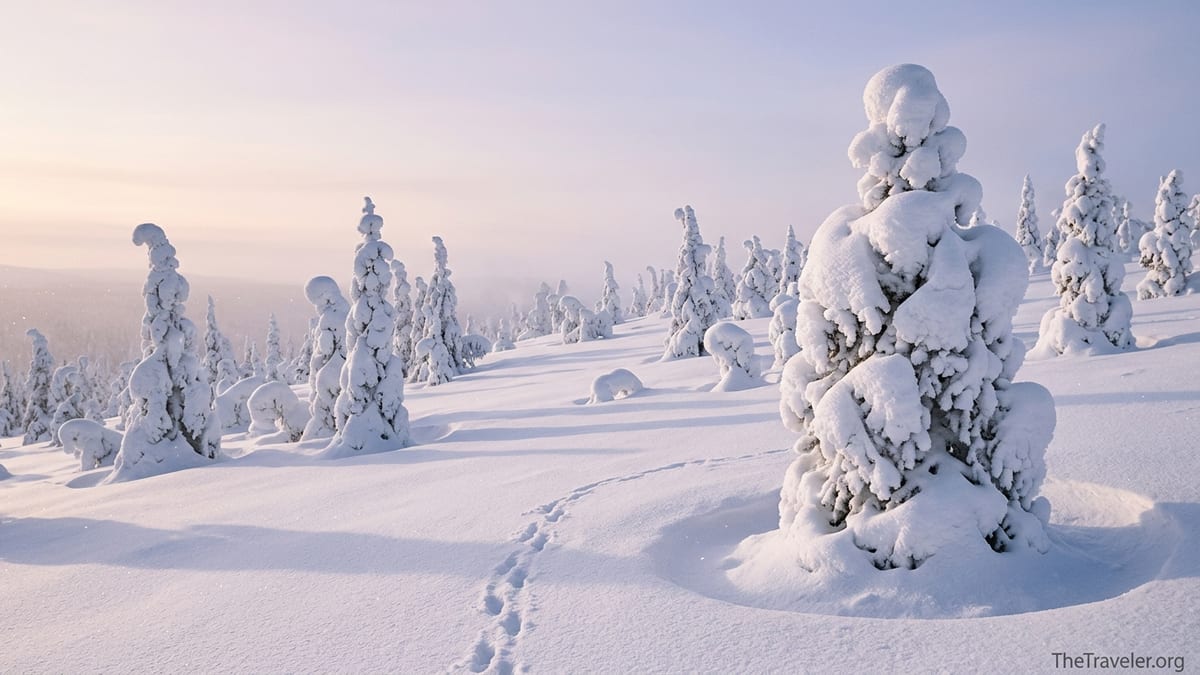
I thought I knew what to expect from Riisitunturi. I had seen the photographs of snow ghosts and frozen “aliens,” the candle-like spruces bowed under impossible loads of white. Yet standing on the ridge of this small Lapland fell, watching the last light of a polar afternoon wash the forest in pastel pink, it became instantly clear: the snow-covered trees of Riisitunturi are far more incredible than any photo suggests.
Get the latest updates straight to your inbox!
Where Riisitunturi’s Snow Forest Really Is
Riisitunturi National Park sits in Posio, a quiet municipality in Finnish Lapland, a little over an hour’s drive north of Kuusamo and roughly two and a half hours from Rovaniemi in good winter conditions. The park is compact by Lapland standards, but its location on a windswept fell and the way moist air rolls in from the nearby lakes give it a unique microclimate. In the middle of winter, the spruce trees on its slopes become coated in thick crown snow, locally called tykkylumi, that hardens around every needle and branch.
On paper, it sounds straightforward: a small protected area established in the early 1980s with marked trails, a day hut nicknamed “Hotel Riisi” near the main parking lot, and a reputation for gentle day hikes rather than hardcore expedition travel. In person, the first impression is how quickly you leave civilization behind. One moment you are tightening your boots beside Finnish families unloading sleds and thermos flasks. Ten minutes later, a short climb puts you among spruce trees so heavily loaded with snow that they have warped into bizarre shapes, their true form entirely buried.
The main winter routes begin from the Riisitunturi trailhead up a compacted snow track that most visitors manage in ordinary winter boots with traction aids or rental snowshoes. Even on busy days, the silence feels absolute once you gain a little height. The sound of your own breathing, the squeak of cold-packed snow underfoot and the distant hiss of wind across the fell ridge are constant reminders that you are in real Arctic weather, even though the car park is barely a kilometre behind you.
Why the Snow Trees Look So Surreal
Riisitunturi’s most famous feature is its snow-encrusted spruce forest, the same trees that dominate many other parts of Lapland yet appear almost unrecognizable here. Moist air from the nearby lakes and wetlands condenses and freezes on the windward side of the fell. Over weeks, then months, that frozen moisture builds up on branches and trunks. Instead of a light, powdery layer, the trees accumulate dense, sculptural shells of ice and snow that can weigh several tonnes in a good year.
Locals and photographers compare them to witches’ hats, hunched giants and frozen sentinels. On the ground, you realise how three-dimensional these shapes really are. One tree might lean low, forming an arch you can duck under. Another bulges into a rounded column with no visible branches, like a pillar of meringue. In some winters, especially after calm, cold spells in January and February, the forest transforms into a dense crowd of figures, each tree completely different from its neighbour even though they are all the same species.
Light is the second ingredient that photographs can only hint at. In midwinter, sunrise in Lapland can come close to 10:30 in the morning and sunset a few hours later. That compressed daylight means the sky often lingers in soft blue and pink tones, especially when high clouds diffuse the sun. On clear days, you can see the low orange disc of the sun sliding along the horizon while the sides of the snow sculptures facing away from it fall into deep cobalt shadow. Someone looking at an image might assume heavy editing. Standing there, you realise the pastel gradient in the sky and the soft glow on the snow are simply how the landscape looks for hours at a time.
When to Go for Peak Snow-Covered Trees
The most photogenic conditions for Riisitunturi’s snow trees usually occur between late December and early March, but timing in any specific season depends heavily on weather. A classic Lapland winter, with prolonged subzero temperatures and regular fresh snow, gradually builds the thick crown snow that visitors dream about. In these seasons, photographers leading tours out of Ruka or Posio often schedule their Riisitunturi visits in January and February, when the trees tend to be at their fattest and light is reliably soft.
Recent years have shown more variation. Some winters have started unusually mild, with rain or wet snow that strips branches before temperatures drop again. Other seasons have delivered textbook conditions, with reports from local guides in Posio describing “perfect tykky trees” well into March. Because a single warm, windy day can strip weeks of accumulation from exposed branches, it is wise to build flexibility into your itinerary. Travelers flying into Kuusamo or Rovaniemi often plan several potential Riisitunturi days within a one-week stay, adjusting based on the latest forecast and local advice from their accommodation hosts.
Daylight is another factor. In late December, the park can feel like perpetual twilight. That moody half-light creates ethereal images but limits the practical time you have to move safely along the trails. By mid-February the days are longer, often offering five to seven usable daylight hours plus an extended blue hour on either side. For many visitors, that window from late January through February offers the best balance of thick snow load, manageable cold and enough light to appreciate the forms in the forest without rushing.
What It Feels Like to Walk Among the “Snow Ghosts”
The first time you step into Riisitunturi’s upper forest on a calm winter day, the main sensation is scale. Photographs compress perspective. On the ridge paths, the snow figures tower over you, some easily twice human height. A narrow trail winds among them, occasionally squeezing between white walls where the packed route passes so close to the buried trunks that you could reach out and touch their icy skin.
Sound shifts with the weather. In deep cold, sometimes near minus 25 degrees Celsius, every footstep squeaks and the snow feels almost dry. Breath crystallises in the air and settles as a fine dust on scarves and camera straps. When a light wind moves through the trees, you might hear a distant creak as branches inside their snow casings flex. On milder days slightly below freezing, the snow softens. Small clumps drift down from higher branches with gentle thuds, reminding you why guides recommend avoiding standing directly under the heaviest, most bent shapes when the temperature is close to zero.
Most visitors follow one of the marked circular routes from the parking area, such as the shorter Riisin rääpäsy loop of around 4 kilometres or the longer Riisin rietas circuit of roughly 11 kilometres. The shorter loop climbs to panoramic viewpoints where the snow ghosts are densest and then returns past the day hut, making it accessible for families and casual hikers using rental snowshoes from nearby Posio or ski resorts like Ruka. On clear days you can see across a mosaic of frozen lakes and forested hills, all under a sky that seems improbably low and wide.
Inside the day hut, nicknamed Hotel Riisi, the atmosphere feels like an impromptu mountaintop café stripped of all commercial trappings. There is no counter, no barista and no menu. Instead you find wooden benches, a stove for making a fire with your own wood or the supplied logs when available, and a scattering of locals and travelers quietly thawing fingers over steaming mugs brought in thermos flasks. More than one visitor has remarked that the best hot chocolate of their life was sipped here, made from a supermarket packet at minus 20 outside, tasting priceless simply because of where they were.
Practical Tips for Visiting in Deep Winter
Despite its otherworldly look, Riisitunturi is relatively accessible for prepared travelers. Most international visitors base themselves in Rovaniemi or Kuusamo, both of which have small airports with winter flights from larger European hubs. From Rovaniemi, the drive to the park is roughly 2.5 hours in good conditions. From Kuusamo or the Ruka ski area, the drive can be closer to an hour and a half. Winter driving in Lapland is slow and deliberate, with snowpacked surfaces, occasional ice and minimal roadside lighting outside towns. Rental cars typically come with studded tyres in the snowy season, which significantly improve grip.
For those who prefer not to drive, many local tour companies based in Ruka, Kuusamo and Posio offer day trips that include transport, snowshoes, guiding and often warm drinks by a fire. Prices vary by season and group size, but a full-day guided excursion can commonly cost roughly the same as a day-long Northern Lights tour in the region. Travelers choosing this option trade the freedom to linger anywhere for the reassurance of someone experienced managing timing, safety and route choice in changing weather.
Clothing matters as much as logistics. Expect still-air temperatures somewhere between minus 5 and minus 25 in midwinter, with wind chill making exposed sections feel colder. A layered system with a moisture-wicking base, thick insulating mid-layer and windproof outer shell is standard. Many visitors from milder climates underestimate the need for high-quality mittens, insulated boots and a warm hat that covers the ears. Photographers who plan to stand still for long periods often slip disposable hand warmers into mitten liners and boots to extend their time outside. Even for casual walkers, a small daypack with an extra fleece, hot drink, snacks and a thin foam pad to sit on can turn a cold outing into a comfortable one.
Navigation on the marked routes is generally straightforward, thanks to poles and signs that protrude well above average snow height. However, heavy snowfall or drifting can obscure tracks in places. Travelers with limited winter hiking experience often stick to the shorter loops and avoid venturing off marked paths. Local outdoor experts frequently remind visitors that arctic conditions deserve respect even in a popular national park. Checking the latest weather forecast and daylight times for Posio the evening before your trip is a simple habit that pays off the next day when deciding how far to go.
Photography: Capturing What the Camera Keeps Missing
Riisitunturi has become a quiet star of winter photography, its snow ghosts appearing in portfolios from hobbyists and professionals across Europe and beyond. Yet almost every photographer who visits eventually admits that their images fall short of the lived experience. Part of the challenge is the landscape’s scale and subtlety. Wide shots of the fell can flatten the terrain, making towering shapes look small. Close-ups capture texture but lose the sense of being surrounded by dozens of figures in every direction.
Travelers aiming to photograph the snow trees often favour wide-angle lenses in the range of 16 to 24 millimetres on full-frame cameras, allowing them to include powerful foreground forms and layers of trees receding into the distance. Tripods become useful accessories when low light requires slower shutter speeds, especially in the blue hour before sunrise and after sunset. At the same time, equipment choices must be balanced against the reality of operating in extreme cold, where batteries drain quickly and bare fingers numb in seconds.
Smartphone photographers need not feel left out. Modern phones handle cold better than many expect if kept close to the body between shots. Simple techniques, like framing a single dramatic snow tree against the pastel horizon or using a friend in dark winter clothing as a scale reference, can produce images that tell a powerful story even on small sensors. What phones cannot capture as well is the dynamic range between brilliant snow in sunlight and deep shadow, which explains why many social media posts from Riisitunturi rely on gentle editing to bring the scene closer to what the eye saw.
Ultimately, the most important photographic advice here is to remember to put the camera away. After a burst of shooting, standing still on the ridge and just observing the shifting colours, the faint arc of the moon over the forest or a sudden ripple of aurora in the distance can become the strongest memory of the day. Many travelers later describe the quiet minutes without a device in hand as the moment Riisitunturi stopped being just a famous photo location and became a personal, almost intimate place in their own travel story.
How Climate and Crowds Are Changing the Experience
Riisitunturi’s popularity has grown rapidly in the last decade as winter images from the park have spread on social media and in mainstream travel coverage. What was once a quiet local hill with a handful of skiers and hikers now sees days when the main car park fills, especially during February school holidays in Finland and central Europe. For visitors, that can mean more people sharing the viewpoints, but also better-maintained winter trails and improved safety awareness, as local authorities adjust to increased use.
At the same time, guides and researchers working in the region have raised concerns about how changing winter conditions might affect the very snow formations that attract so many travelers. Warmer, wetter spells in the early and late parts of winter can interrupt the slow buildup of dense crown snow on trees. In such seasons, the forest still looks beautiful under ordinary powder, but the most extreme sculptural shapes may be fewer or shorter-lived. Long-term studies in the area highlight how sensitive snow load on spruce branches is to small shifts in temperature and moisture, and local tourism operators increasingly talk about the need to adapt, offering alternative experiences like aurora tours, snowshoeing in nearby forests or visits to frozen waterfalls when the tykky trees are not at their most impressive.
The growing interest in Riisitunturi has also prompted conversations about responsible visitation. Staying on marked routes protects fragile undergrowth and prevents dangerous shortcuts on steep, wind-loaded slopes. Carrying out all rubbish, using hut facilities thoughtfully and respecting the quiet that many people travel long distances to find are small but meaningful ways visitors can help ensure that the park retains its magic for future winters. Several local accommodations in Posio and Ruka now highlight these principles in pre-arrival information, reflecting a broader shift toward sustainable Arctic tourism.
For travelers, the most practical implication is to bring a flexible mindset. Some seasons will deliver the storybook forest that matches the most surreal photographs, every tree encased in white. Other winters may offer subtler scenes, with partially loaded branches and more visible trunks. In both cases, Riisitunturi rewards those who come ready to appreciate whatever form its winter takes, rather than chasing a single image seen on a screen.
The Takeaway
No gallery, no matter how carefully curated, can reproduce the feeling of standing among Riisitunturi’s snow-covered trees as the light slowly shifts across a short Lapland afternoon. Screens compress the space between snow figures that in reality stand several metres apart. They mute the hush that settles over the forest when the wind drops. They cannot show you how your eyelashes prick with frost or how the warmth of a thermos mug feels almost shocking after an hour on the ridge.
Yet those same photographs are often what draw travelers here in the first place. They are accurate in one important sense: the place really is as extraordinary as it looks, and in good winters perhaps even more so. The trees do bend into impossible shapes. The sky does turn shades of peach and lavender you might never have seen at home. The experience can feel, as many visitors say, like stepping into another world that somehow remains entirely natural.
For anyone planning a winter trip to Finnish Lapland, Riisitunturi deserves serious consideration alongside better-known names like Rovaniemi and the major ski resorts. With realistic expectations, solid winter clothing and a flexible schedule that respects the weather, you stand a good chance of finding yourself surrounded by snow ghosts that will stay in your memory long after your photographs have faded from your phone.
FAQ
Q1. Where exactly is Riisitunturi National Park located?
Riisitunturi National Park is in Posio, Finnish Lapland, roughly an hour to an hour and a half by car from Kuusamo and around two and a half hours from Rovaniemi in typical winter driving conditions.
Q2. When is the best time of year to see the snow-covered “ghost trees”?
The most reliable period for heavily snow-laden trees is usually from late January through February, though good conditions can extend from late December into early March depending on each winter’s weather.
Q3. Do I need snowshoes or special equipment to walk the trails?
In midwinter the main routes are typically compacted, so many visitors manage in sturdy winter boots with traction aids, but snowshoes or backcountry skis make walking easier and are recommended if snow is deep or fresh.
Q4. How cold does it get in Riisitunturi in winter?
Daytime temperatures often range from about minus 5 to minus 25 degrees Celsius, with occasional colder spells and wind chill making exposed areas feel significantly colder than the thermometer suggests.
Q5. Is Riisitunturi suitable for families and beginners?
Yes, the shorter marked loops from the main parking area are popular with families and first-time winter hikers, provided everyone has proper cold-weather clothing and you stay on the signposted trails.
Q6. Can I visit Riisitunturi without renting a car?
Yes, several local operators based in places like Ruka, Kuusamo and Posio run guided day trips that include transport, guide services and often snowshoe rental, making it possible to visit without driving yourself.
Q7. Are there services or cafés inside the national park?
There are no commercial cafés or restaurants inside the park itself, but there is a simple wilderness-style day hut near the main trails where visitors can warm up, rest and use the fireplace when wood is available.
Q8. Is it possible to see the Northern Lights from Riisitunturi?
Yes, on clear nights with auroral activity, Riisitunturi’s open fell and low light pollution make it a good place to watch the Northern Lights, though visibility always depends on space weather and cloud cover.
Q9. Do the trees always look like the famous photos?
Not always; in some winters or during warm or windy periods the snow load can be lighter or temporarily stripped, so the trees may appear less sculptural even though the landscape remains very scenic.
Q10. How can I visit Riisitunturi responsibly?
You can help protect the park by staying on marked trails, packing out all rubbish, using huts and fireplaces considerately, following local safety advice and being mindful of the quiet, remote character that makes the area special.