


Walk into Shanklin Old Village and it takes a moment to realise you have not slipped into a period drama. Thatched cottages lean companionably over narrow lanes, pub signs creak softly in the sea breeze and the sound of teacups and church bells seems to belong to another century. Yet this small corner of the Isle of Wight is very much alive, welcoming visitors with the rare feeling that time has slowed down just for them.
A Village Shaped by the Landscape
Shanklin Old Village feels timeless partly because it grew where nature allowed, not where a planner’s drawing board dictated. The cluster of cottages sits at the head of Shanklin Chine, a wooded coastal ravine that has cut back into the soft sandstone cliffs over thousands of years. The original settlement formed around a spring that emerges as a waterfall at the top of the chine, with houses on irregular plots rather than neat terraces. Stand on Church Road and look down towards the chine and you can still read that ancient pattern in the way roofs and gardens tumble towards the sea.
Unlike many seaside resorts that were purpose-built in the Victorian era, Shanklin was a modest agricultural and fishing community long before visitors arrived in great numbers. The Old Village grew slowly from a handful of farmsteads and cottages in the early 19th century, adapting existing buildings instead of sweeping them away. Today this means you can have a cream tea in a cottage that began life as a farmhouse and browse gift shops in what were once working homes and barns. The lack of a rigid street grid, the odd corners and unexpected views all help create the illusion that you have wandered into an older, slower version of England.
Because the village sits slightly above the modern town and the main beach, it also feels physically secluded. The road rises from the seafront and railway station, narrowing as it curves into the Old Village. Traffic slows, pavements tighten and suddenly you are in a human-scaled space where pedestrians and horse-drawn deliveries would once have set the pace. That subtle shift from coastal bustle to village calm is one of the reasons many visitors describe their first glimpse of the Old Village as a step back in time.
Thatched Cottages and Storybook Streets
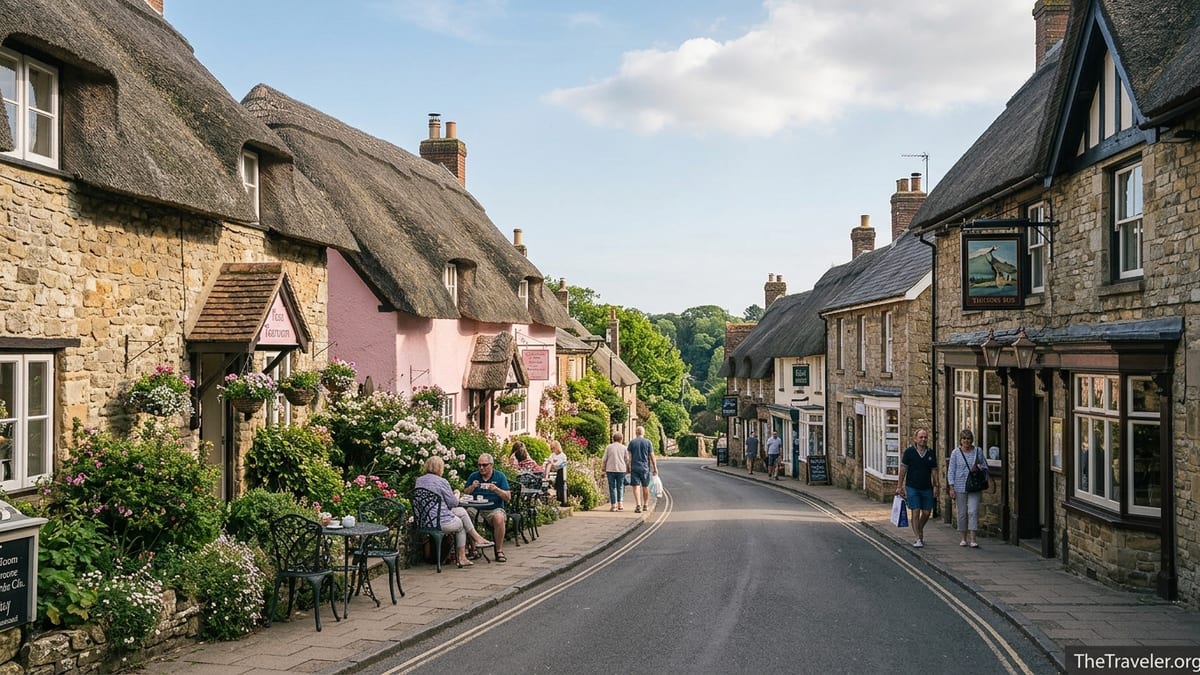
The most obvious reason Shanklin Old Village feels historic is written in water reed and straw. Thatch, once a commonplace roofing material, has almost disappeared from modern British towns. In Shanklin Old Village it is everywhere: on bow-fronted inns, crooked cottages and tiny shops with low doorways. Walk along Church Road or High Street and you will see ridgelines decorated with traditional patterns and, on one especially photographed roof at the Old Thatch Teashop, a thatched teapot and teacup perched playfully above the eaves.
Because the cottages were built or adapted over centuries, no two are identical. Some sit almost flush to the pavement, their upper floors overhanging like eyebrows, while others are set back behind miniature front gardens bordered with stone walls. Window frames are often painted in soft creams, greens and blues that complement the honey tones of the stone. Many properties carry discreet plaques noting their 18th or early 19th century origins, a reminder that these are not museum pieces but working buildings that have survived wars, winter storms and tourism booms.
The detailing rewards close inspection. Look up and you may spot timber-framed gables tucked between later stonework, or brick chimneys that have seen countless log fires. Iron drainpipes bear dates from the Victorian era. Decorative bargeboards on some roofs echo the cottage ornée style popular in the 1800s, when the Isle of Wight’s mild climate and picturesque scenery drew writers, artists and early holidaymakers. When you walk these streets at dusk, with warm light spilling from the leaded windows of the Village Inn or an old cottage-turned-restaurant, the effect is so complete that the sight of a modern car can feel like an intrusion from another age.
Tea Rooms, Inns and the Ritual of Slowing Down
Part of what makes Shanklin Old Village feel suspended in time is not only how it looks, but what people do there. The area is thick with tea rooms, inns and small restaurants that encourage lingering rather than rushing. The Old Thatch Teashop on Church Road, painted a soft pastel pink beneath its thatched roof, is a good example. Inside, mismatched china, lace tablecloths and handwritten menus set the tone, while outside a garden strung with bunting and dotted with quirky ornaments invites you to stretch a simple pot of tea into a full afternoon ritual.
A typical cream tea in one of the Old Village establishments might cost somewhere in the region of 8 to 10 pounds per person, including two scones, jam, clotted cream and a generous pot of tea. Portions are set with an old-fashioned sense of hospitality that suits the surroundings. At busier times you may find families sharing three-tier stands loaded with sandwiches and cakes, couples tucked into window seats watching passersby, and walkers nursing pots of Earl Grey after hiking the coastal path. The pace is dictated less by the clock and more by conversation and the slow disappearance of crumbs from delicate floral plates.
The pubs continue this theme of sociable timelessness. The Village Inn, for instance, combines low beams and dark wood with hearty pub classics. You might find a chalkboard advertising locally caught fish of the day or a Sunday roast with all the trimmings at prices broadly in line with other British coastal pubs. Step inside on a winter evening and the crackle of a fire, the murmur of chat at the bar and dogs settled contentedly under tables make it easy to imagine generations of villagers and visitors using this same room as their social anchor.
Shanklin Chine: A Romantic Ravine With a Wartime Secret
If the Old Village provides the architectural time travel, Shanklin Chine supplies the atmosphere. This steep, wooded ravine, dropping around thirty metres from the village to the shore, has drawn visitors since at least the early 19th century. The Victorians came here to promenade on the pathways, admire the waterfalls and sketch or paint the dramatic scenery. The poet John Keats stayed in Shanklin in 1819 and is said to have walked the chine while composing some of his most famous works, adding a literary layer to the site’s allure.
Today, entry to Shanklin Chine is by paid ticket, and the experience feels pleasingly traditional. You descend along well-kept paths and bridges, passing information boards about local wildlife, geology and history. In summer months the foliage is lush and green, with ferns, mosses and wildflowers lining the stream. In the evening, thousands of small lights pick out the falls and trees, giving the ravine the sort of romantic Victorian atmosphere that early tourists would have recognised, even if the technology behind it has changed.
The chine also tells a grittier story that anchors the village firmly in 20th century history. During the Second World War, the ravine was used for commando training and later carried part of the PLUTO pipeline network that secretly pumped fuel under the English Channel to support Allied forces after D-Day. Sections of preserved pipework and interpretation panels in the heritage centre bring this episode to life. Walking these shaded paths and imagining soldiers training for dangerous missions adds a surprisingly modern dimension to a place that otherwise feels firmly rooted in the distant past.
Everyday Life in a Living Time Capsule
One of the reasons Shanklin Old Village feels so immersive is that it is not a sealed heritage attraction. People live and work here. Behind the lace curtains and cottage doors are year-round residents juggling school runs and supermarket deliveries much like anywhere else. That continuity of use is what gives the village its subtle undercurrent of normality. You might see a postie weaving between visitors on the narrow pavements or a local resident emerging from a side door with a bag of recycling while, a few steps away, a family photographs the thatched roofs as if they have discovered a film set.
Shops reflect this mix of everyday and exceptional. Along the main curve of the Old Village you will find gift shops selling Isle of Wight fudge, postcards and hand-thrown pottery; small boutiques with seaside-themed homeware; and practical outlets selling walking gear and beach essentials. Many are independently owned, with opening hours that can vary slightly between high summer and the quieter months. Prices are broadly similar to other UK tourist villages: a locally made candle or ceramic mug might cost the equivalent of what you would expect to pay in a Cotswolds village store, while fridge magnets and simple souvenirs remain reasonably affordable for families on a budget.
Crucially, the Old Village has so far avoided the homogenised feel that can affect some popular seaside resorts. You will not find large chain coffee shops in the heart of the conservation area. Instead there are long-running family businesses, some of which have adapted over decades from grocers or general stores to modern cafes and tearooms. That continuity is part of what gives returning visitors a sense of recognition and comfort; they can still point out the cottage they remember from childhood holidays, even if its current menu has shifted from rock cakes to gluten-free brownies.
From Victorian Seaside Glamour to Modern-Day Getaway
To fully understand why Shanklin Old Village feels like a portal to the past, it helps to set it against the broader story of Shanklin as a resort. In the 19th century, with the growth of rail travel and the fashion for sea bathing, the town expanded dramatically along the cliff tops and seafront. Hotels and guesthouses appeared to serve visitors arriving from the mainland via ferries from Portsmouth and Southampton. For decades, the name Shanklin conjured up images of promenade strolls, bandstands and the now-lost Shanklin Pier with its amusements and concert pavilion.
Storm damage eventually destroyed the pier in the late 20th century, but that loss inadvertently strengthened the importance of the Old Village and Shanklin Chine as distinctive attractions. While other resorts updated themselves with modern arcades and high-rise developments, Shanklin’s most atmospheric corner stayed resolutely human in scale. Today, visitors can still enjoy the sandy beach and amusements on the Esplanade, but many choose to base themselves in or near the Old Village in small hotels, B&Bs and self-catering cottages that echo the character of their surroundings.
Accommodation prices vary by season, but a typical double room in a characterful guesthouse within walking distance of the Old Village might range from modest nightly rates in winter to mid-range prices in peak summer, comparable with other classic English seaside destinations. What you are largely paying for is the convenience of stepping out of your front door directly into a conservation area where the morning soundtrack is gulls and church bells rather than heavy traffic. For many repeat visitors, that experience is more than nostalgia; it is a deliberate antidote to modern life.
Practical Ways to Experience the Sense of Time Travel
There are simple, practical choices you can make that deepen the feeling of stepping back in time in Shanklin Old Village. One is to slow your pace and explore on foot at different times of day. Early morning, before most day-trippers arrive, offers a quiet, almost private version of the village. You might see delivery vans unloading fresh produce outside a cafe or staff sweeping cottage doorsteps and watering hanging baskets. Without the distraction of crowds, the smell of sea air and chimney smoke from breakfast kitchens stands out more sharply.
Another is to walk the old routes that link the village to its surroundings. Descending through Shanklin Chine to the beach follows in the footsteps of Victorian holidaymakers who once paid to make the same journey. Continuing along the coastal path towards Sandown or Ventnor gives a sense of how these towns form a chain of resorts along the bay, yet each retains its own texture. Inland, disused railway lines have been turned into walking and cycling paths, so you can leave the bustle behind and return to the Old Village along tree-lined tracks that feel removed from the present day.
Spending money locally is also a way to take part in the living history of the place. Opting for a cream tea in a thatched cottage rather than a takeaway coffee from elsewhere, booking a ticket to a performance at nearby Shanklin Theatre and choosing local artwork or crafts as souvenirs all help maintain the very businesses that keep the village character intact. Many visitors find that knowing their choices contribute to preserving the Old Village’s atmosphere makes their experience feel not only nostalgic, but quietly purposeful.
The Takeaway
Shanklin Old Village feels like stepping back in time because so many layers of the past remain visible and usable in daily life. The irregular streets that grew from farm tracks, the thatched cottages that still shelter tearooms and homes, the ravine of Shanklin Chine with its blend of romantic scenery and wartime history and the enduring rituals of cream teas and pub evenings all combine to create an environment that has changed more slowly than the world around it.
Yet this is not a theme park. It is a lived-in corner of a working seaside town that welcomes visitors while quietly preserving its own rhythms. Spend a day or two here and you will begin to notice small details: a cottage window filled with geraniums, the way fog drifts up from the sea on autumn evenings, the familiar creak of a pub sign every time the wind shifts. Those details, more than any grand attraction, are what make Shanklin Old Village feel as though the past is not behind you at all, but walking gently alongside.
FAQ
Q1. Where exactly is Shanklin Old Village located within Shanklin?
Shanklin Old Village sits at the southern end of the town, just above the head of Shanklin Chine and a short uphill walk from the seafront and main shopping streets.
Q2. Do I have to pay to visit Shanklin Old Village?
No, the Old Village itself is a public area with streets, shops and pubs that are free to wander. You only pay entry for specific attractions such as Shanklin Chine.
Q3. When is the best time of year to experience the village at its most atmospheric?
Late spring and early autumn are often ideal, with long evenings, flowers in bloom and fewer peak-season crowds, though the Old Village has charm year-round.
Q4. Is Shanklin Old Village suitable for visitors with limited mobility?
The area is compact but built on a slope, with some uneven pavements and cobbles. Those with limited mobility can still enjoy the main street, though steep parts may be challenging.
Q5. How long should I allow to explore the Old Village and Shanklin Chine?
Many visitors spend half a day exploring both, allowing a couple of hours for the chine and more time for tea, browsing shops and simply wandering the lanes.
Q6. Are there family-friendly places to eat in the Old Village?
Yes, most pubs and tea rooms welcome children and offer simple, familiar options such as sandwiches, jacket potatoes and smaller portions of main dishes.
Q7. Can I stay overnight in or near Shanklin Old Village?
There are several small hotels, guesthouses and self-catering cottages within easy walking distance, giving you the option to base yourself right by the historic streets.
Q8. Is parking available close to the Old Village?
There are public car parks within a short walk, as well as some on-street spaces around the edges of the conservation area. In high season it is wise to arrive earlier in the day.
Q9. What makes Shanklin Old Village different from other Isle of Wight villages?
The combination of concentrated thatched cottages, the dramatic setting above Shanklin Chine and the seamless mix of working homes, shops and eateries gives it a uniquely immersive historic feel.
Q10. Can I visit Shanklin Old Village by public transport?
Yes, Shanklin has a railway station linked to ferries from the mainland, and local buses stop within walking distance of the Old Village, making it accessible without a car.