


For most visitors, Vatican City means jostling through the Vatican Museums, shuffling beneath Michelangelo’s Sistine Chapel ceiling, and queuing on the cobbles of St. Peter’s Square. Yet just beyond those stone walls lies a very different Vatican: the Vatican Gardens, a 22-hectare green sanctuary that covers roughly half of the tiny state. For locals, clergy, and pilgrims, this hidden landscape is not just a pretty park but the quiet, beating heart of Vatican City.
Get the latest updates straight to your inbox!
A Hidden Landscape Behind the Vatican Walls
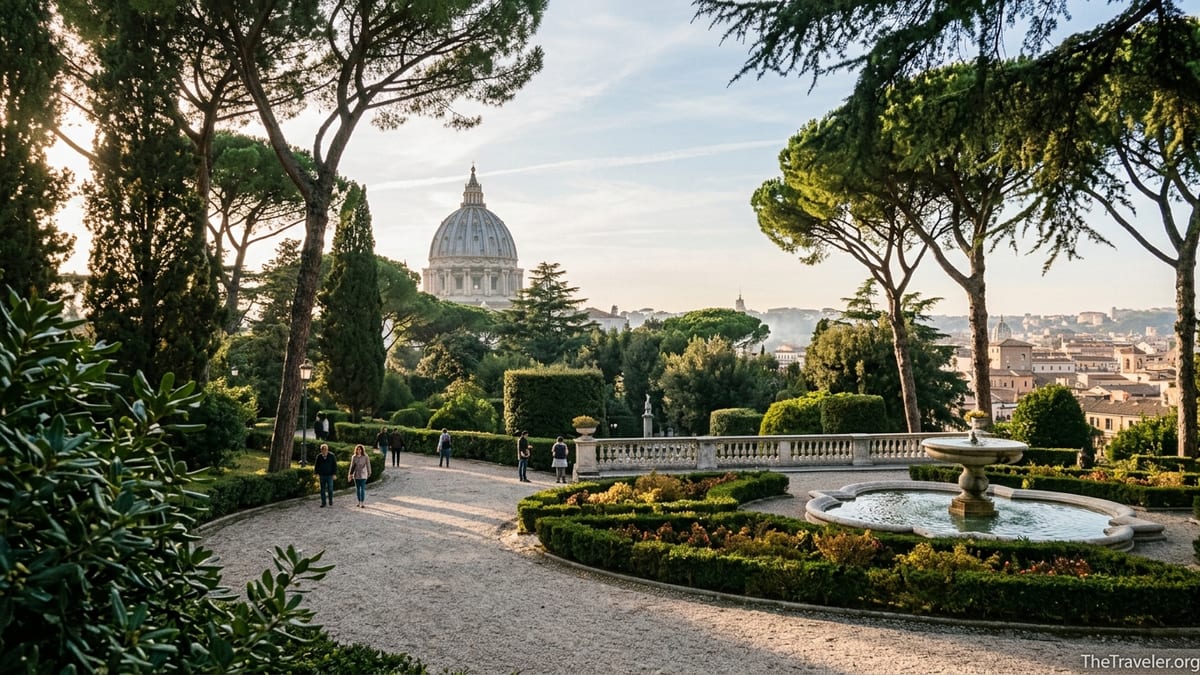
First-time visitors are often surprised to learn that more than half of Vatican City is garden, not marble. The Vatican Gardens stretch over about 22 hectares along the western side of the state, a gently rising patchwork of lawns, wooded slopes, and flowerbeds that most tourists only glimpse from a distant museum window. Historically enclosed for papal use since the late 13th century, these grounds remain private and tightly controlled, which is precisely why they feel so remarkably calm compared with the crowds outside.
Today, access is limited to guided visits arranged through the Vatican Museums. You cannot simply wander in from St. Peter’s Square; garden entry comes bundled with a museum ticket and must be reserved in advance. This controlled flow keeps daily numbers relatively low. While tens of thousands may pass through the Vatican Museums on a summer day, only a small fraction will walk the gravel paths of the gardens or ride the open minibuses that loop past the grottoes and pavilions.
This separation from the usual tourist circuit is important to locals and pilgrims. It means the gardens have not been transformed into another high-pressure sightseeing stop. Instead, they remain a working environment that houses the Vatican Radio headquarters, the Governor’s Palace, and even the papal heliport, quietly integrated into a landscape designed for contemplation as much as for administration.
The result is a physical and psychological buffer inside the world’s smallest state. As soon as you step through the internal gates with your guide, St. Peter’s dome reappears above tree canopies, buses and tour groups vanish from earshot, and the Vatican suddenly feels more like a secluded hill town than the center of global Catholicism.
Why Locals See the Gardens as the Vatican’s “Green Lung”
Romans often describe the Vatican Gardens as the city-state’s polmone verde, its green lung. In practical terms, the trees and lawns help cool the microclimate and filter some of Rome’s notorious traffic pollution. Yet the expression also captures how the space feels for residents and those who work inside the Vatican walls: a place to breathe, literally and figuratively, between liturgies, meetings, and relentless waves of visitors.
Within the gardens, tall umbrella pines cast wide pools of shade, cypress avenues climb the slopes, and small orchards and rose beds soften views of institutional buildings. Many areas have deliberately been maintained with a slightly informal, organic look rather than manicured perfection. Over the last decade, the gardening team has gradually shifted to more organic methods, reducing chemicals and emphasizing soil health, which has encouraged birds, butterflies, and small mammals to thrive among the stone balustrades and Marian shrines.
For Vatican staff and clergy, the value of this green buffer is hard to overstate. Even a short walk on a break can mean the difference between a day spent entirely in artificially lit offices and one punctuated by birdsong, flowing fountains, and the scent of laurels. During quieter seasons, you may glimpse priests walking between buildings along internal paths or small groups of employees taking a discreet pause on stone benches, using the gardens much as office workers elsewhere use a neighborhood park.
For locals in nearby Roman neighborhoods such as Prati, the gardens are also psychologically significant, even if they only occasionally have access. Knowing that such a large swathe of land has been preserved as green space within an otherwise built-up quarter of the city shapes how residents talk about the Vatican area. While many might pop into the basilica for evening Mass or walk through the square after work, they speak of the gardens almost with gratitude, as the part of Vatican City that has resisted being paved over or entirely devoted to tourist infrastructure.
A Pilgrim’s Quiet Counterpoint to St. Peter’s and the Museums
Pilgrims often arrive at the Vatican with a schedule packed tighter than a guidebook: a morning in the museums, a rush through the Sistine Chapel, a quick stop in the basilica, perhaps an audience with the Pope on Wednesday. By the afternoon, spiritual intentions can feel buried under logistics and queues. The Vatican Gardens offer an antidote to that experience, a space where the religious dimension of the visit can breathe again.
On a typical walking tour, which currently lasts around two hours and covers close to three kilometers of paths, the guide pauses not only for historical facts but also for moments of silence. Groups stop at Marian grottos modeled on Lourdes and Fatima, or at small chapels and shrines donated by Catholic communities from all over the world. For many pilgrims, these places feel more intimate than the grandeur of St. Peter’s, and it is not unusual to see someone lingering in quiet prayer after the group has moved on a few steps.
The gardens are also where some of the most personal connections between pilgrims and papal history are felt. Visitors walk the same alleys once used for solitary papal strolls, pass the modest papal farmhouse and older villas, or look back toward the apartments where past popes lived and prayed. Even the soundscape is different: instead of the murmur of tour groups and audio guides, you hear fountains, the rustle of leaves, and occasionally the toll of bells from the basilica carried up on the breeze.
For pilgrims traveling in parish groups or diocesan delegations, the contrast can be profound. Many organizers now deliberately schedule the gardens after the most intense parts of the Vatican program, using them as a retreat-like closure to the visit. A group might spend the morning shoulder to shoulder in the basilica and museums, then decompress in the gardens, sharing reflections while sitting along a shaded terrace with views over the Vatican walls to Rome’s rooftops beyond.
Spiritual Landscapes: Grottos, Shrines, and Symbolic Corners
Part of what makes the Vatican Gardens so meaningful is that they are not just decorative; they are saturated with theological and symbolic references that resonate with those who come as worshippers rather than simply as tourists. Many corners of the gardens echo stories and devotions from across global Catholicism, turning a simple stroll into a kind of outdoor pilgrimage.
One of the most visited sites is the Lourdes Grotto, a stone replica of the Marian shrine in France, which has been a place of papal prayer and community devotions for decades. Nearby, statues of saints and national patrons stand among pines and cypresses: a Mexican pilgrim might pause before an image of Our Lady of Guadalupe, while a Polish visitor might seek out memorials linked to John Paul II. Each community finds echoes of its own spiritual home within these Roman walls.
Other features blend art, history, and belief more subtly. Renaissance and Baroque fountains celebrate water as a symbol of life and baptism, while geometrically arranged flowerbeds recall the order of creation as imagined in early Christian thought. Even the placement of certain trees can carry meaning, such as ancient olive trees evoking Gethsemane or cedars referencing biblical Lebanon. Locals who have visited multiple times often develop personal rituals, returning to the same bench, grotto, or view as if to greet an old friend.
For pilgrims unused to religious art outside church interiors, encountering sacred images beneath open skies can be transformative. A statue seen in a side chapel might feel distant; the same figure encountered unexpectedly around a curve in a path, framed by jasmine or wisteria, can prompt a very different, more intimate response. The gardens thus function as a space where faith and everyday experience meet in a quieter, more personal way than in the monumental interiors nearby.
How Visiting the Gardens Works in Practice
The practicalities of visiting help preserve the calm atmosphere that locals and pilgrims value. Access is only possible on a guided tour, either on foot or by open minibus, and places are limited. In 2026, walking tours commonly start in the mid-morning, around 9:30 or 11:00, with minibus departures staggered through the morning up to early afternoon. This timing avoids the crush of early museum openings while still allowing visitors to continue into the galleries afterward.
Prices evolve over time, but as of mid-2026, a typical minibus tour booked through authorized operators starts around the low 40 euro range per adult, with slightly cheaper tickets for children and concessions. Walking tours are often priced similarly or just a little lower. The ticket covers the garden visit plus same-day entry to the Vatican Museums, effectively making the gardens a premium add-on to a standard museum visit. Because the tour slots are few compared to regular museum tickets, travelers are strongly advised to book 60 to 90 days in advance, especially for spring and autumn pilgrimage seasons when demand is high.
Logistically, the garden tour always comes before the museum visit. Once you pass security and meet your guide, you follow a set route through the gardens. At the end of the circuit, the group is funneled directly into the museums through internal passages, and there is no option to exit and return later. Visitors should plan accordingly: it is best to arrive with comfortable walking shoes, modest dress suitable for sacred spaces, a refillable water bottle for warmer months, and, if you are sensitive to the sun, a hat and light layers. The shaded paths help, but parts of the route are exposed.
Crucially, the guided format and the absence of casual foot traffic mean that the atmosphere stays measured even during peak season. Groups are generally limited in size, and the pace is deliberate rather than rushed. While you will be sharing the route with others, it rarely feels like the dense, shoulder-to-shoulder experience of the Raphael Rooms or the Sistine Chapel. This curated flow is one reason why many locals and seasoned Rome guides recommend the gardens to travelers who are anxious about crowds or easily overwhelmed by busy interiors.
A Place of Accessibility, Education, and Everyday Work
The Vatican Gardens are not a museum in the traditional sense, and that matters to the people who care about them. They are a living workplace, a place of prayer, and increasingly a space for educational and inclusive initiatives. Over recent years, the Vatican has tested special programs such as family-focused nature walks and multisensory visits designed for guests with visual impairments, using touch, sound, and scent to interpret the landscape and sculptures. These initiatives reveal another dimension to the gardens’ quietness: it allows for attention, patient listening, and the kind of learning that unfolds at walking pace.
Garden staff themselves view the space as something closer to a living laboratory than a static set of flowerbeds. Horticultural practices are constantly adjusted to balance aesthetic expectations with environmental concerns and limited water resources. When pilgrims and visitors notice composting areas, drip-irrigation lines among rose bushes, or wildflower strips left to grow a little longer, they are seeing the practical side of stewardship that underpins the beauty and serenity they enjoy for a morning.
Behind the scenes, the gardens also anchor the daily rhythm of Vatican City. Service vehicles move discreetly along internal lanes, technicians check aerials and communication structures hidden among the trees, and maintenance staff quietly tend paths before the first tour begins. Locals who work nearby are aware that the apparent stillness is in fact carefully managed. The serenity that pilgrims and visitors experience is the visible tip of a complex, ongoing effort to keep this enclave functioning smoothly.
This mix of devotion, education, and routine labor reinforces how locals think about the gardens: not as a pristine showpiece, but as an essential, breathing part of the Vatican’s daily life. The gardens absorb noise, offer shade, host prayer, and provide work. Their value is as practical as it is spiritual.
Planning Your Visit to Preserve the Quiet
Because the gardens are cherished as a refuge, respectful planning can help maintain the qualities that locals and pilgrims love. For those who want maximum quiet, late spring and early autumn weekdays tend to be gentler than mid-summer or major feast days, when group pilgrimages swell. Morning slots often provide fresher air and softer light. In high season, tours still feel manageable, but you are more likely to share the space with multiple groups, which can change the rhythm of the visit.
Small choices make a difference. Wearing shoes with quiet soles, keeping phone use to a minimum, and pausing conversations when guides invite silence near shrines all help preserve the contemplative mood. Many visitors choose to use the time as a kind of walking retreat, setting aside cameras for certain segments or taking only a few photographs at key viewpoints, such as the classic perspective of St. Peter’s dome rising above cypresses and stone balustrades.
Those traveling with children can treat the gardens as a chance to frame faith and history in terms of nature rather than rules. Encouraging younger visitors to notice details like carved papal coats of arms, the sound of different fountains, or the varied flags on small shrines from around the world turns the tour into an interactive exploration instead of a forced march. Several recent family-focused initiatives have quietly tested this approach, using scavenger-hunt style prompts to keep children engaged without disturbing the atmosphere.
For pilgrims, one of the most valuable planning decisions is where to place the gardens within the broader Vatican day. Many find that doing the garden tour after the most intense museum or basilica visits helps them process what they have seen. Others start with the gardens, using their calm as a spiritual warm-up before entering the crowds. Either way, the key is to leave a generous margin of time around the visit so that the quiet is not erased by rushing from one appointment to the next.
The Takeaway
In a city where every famous site risks becoming another crowded box to tick, the Vatican Gardens remain something different. Their restricted access, working character, and dense layering of history and devotion make them feel less like a tourist attraction and more like an introduction to the inner life of Vatican City. Locals and pilgrims value them because they preserve something that is increasingly rare around major monuments: genuine quiet, lived-in greenery, and space for unhurried attention.
To walk those paths is to glimpse a Vatican that most visitors never see, one where popes once paced in reflection, where today’s staff take modest breaks from their duties, and where shrines from across the Catholic world nestle among pines and fountains. For travelers willing to plan ahead and move at a slower pace, the gardens can become not just another stop in Rome, but the place where their understanding of the Vatican finally comes into focus.
FAQ
Q1. Can I visit the Vatican Gardens without a guided tour?
In practice, no. Access is restricted to official guided visits, either on foot or by minibus, usually booked in combination with a Vatican Museums ticket.
Q2. How far in advance should I book a Vatican Gardens tour?
Because daily places are limited and high season demand is strong, it is wise to book at least 60 days ahead, and up to 90 days for popular spring and autumn dates.
Q3. Are the Vatican Gardens suitable for visitors who dislike crowds?
Yes. While you will be in a group, numbers are controlled and the atmosphere is much calmer than in the museums or St. Peter’s, which many crowd-sensitive visitors appreciate.
Q4. What is the difference between the walking tour and the minibus tour?
The walking tour involves a few kilometers of gentle walking with more time to pause at shrines and viewpoints, while the open minibus tour covers similar highlights with less physical effort.
Q5. Do Vatican Gardens tickets include entry to the Vatican Museums and Sistine Chapel?
Yes. Garden visits are typically sold as combined tickets, giving you the tour plus same-day access to the Vatican Museums and the Sistine Chapel afterward.
Q6. Is there a dress code for visiting the Vatican Gardens?
Yes. The same modest dress code applies as in the Vatican Museums and basilica: shoulders and knees should be covered, and clothing should be respectful of a sacred setting.
Q7. Are the gardens accessible for people with limited mobility?
Some routes and the minibus option can accommodate those with limited mobility, but there are slopes and uneven paths. It is best to check accessibility details when booking and mention any specific needs.
Q8. Can I stay in the gardens after the tour ends to sit and reflect?
No. The gardens can only be visited during the guided portion. At the end of the tour, visitors are directed directly into the Vatican Museums, and lingering in the gardens is not allowed.
Q9. What time of day is best for a quiet visit?
Morning tours usually offer softer light and slightly cooler temperatures, especially in summer, while weekday visits outside major feast days tend to feel the most tranquil.
Q10. Why do locals and pilgrims consider the gardens spiritually important?
Because the gardens blend nature, prayer, and papal history, they provide a rare space in Vatican City where faith can be experienced in silence and greenery rather than only in monumental interiors.