


Sultanahmet is where first-time visitors fall in love with Istanbul, but it is also where many lose hours in ticket lines, turn up during prayer times, or rush through palaces minutes before closing. With Hagia Sophia, the Blue Mosque, Topkapi Palace, the Basilica Cistern and the Hippodrome all within a few blocks, it is easy to wander without a plan and miss the very highlights you came for. With a bit of strategy, though, you can see the essentials at a humane pace, understand what you are looking at, and still find time for a Turkish coffee in the shade.
Get the latest updates straight to your inbox!
Understanding the Layout of Sultanahmet Before You Start
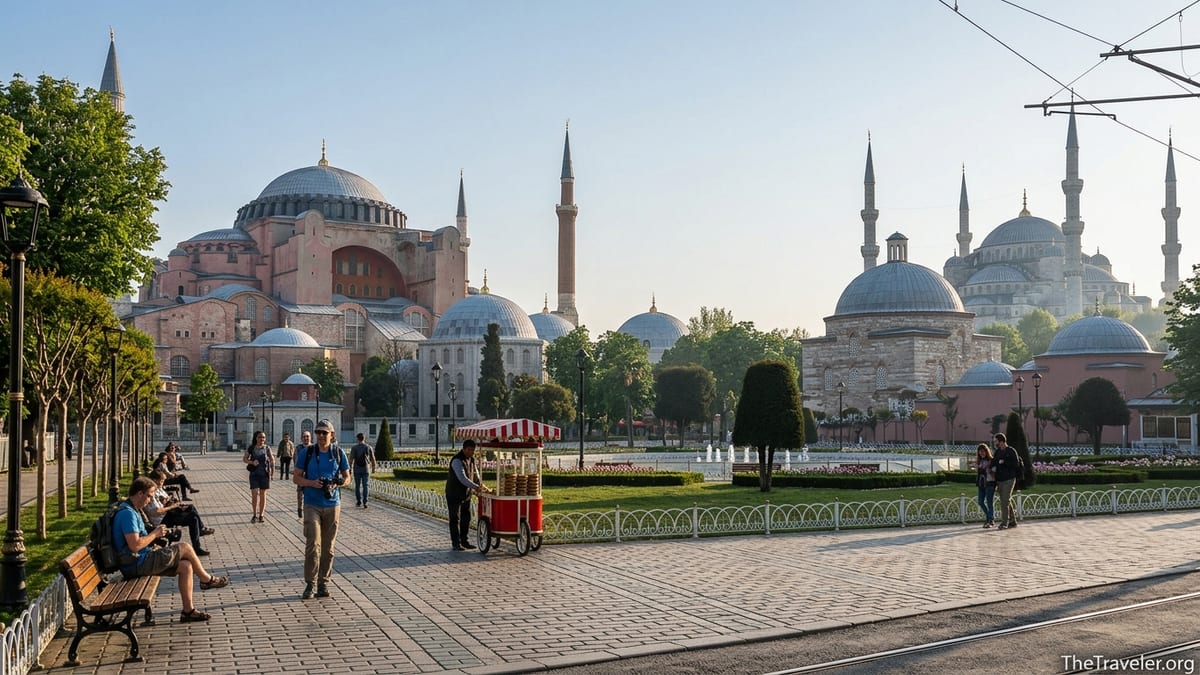
Sultanahmet is compact, but the big sights are spread across a gentle hill that rises from the Hippodrome up toward Topkapi Palace. Picture the Hippodrome and Blue Mosque at the center, Hagia Sophia directly opposite on the other side of the tram tracks, Topkapi Palace and the Archaeology Museums behind Hagia Sophia toward the Bosphorus, and the Basilica Cistern tucked just off the main tram avenue. This layout means you can walk between all the major monuments in under ten minutes, but the elevation and crowds can still make the day feel long if you zigzag unnecessarily.
For most visitors, a sensible loop starts at Hagia Sophia in the early morning, continues through the Hippodrome and Blue Mosque, then heads up to Topkapi Palace and the nearby museums before dropping down to the Basilica Cistern. If you are staying in Sultanahmet, you can simply walk to the square. If you are coming from Beyoğlu or Karaköy, the T1 tram line to Sultanahmet stop is usually the most efficient option, dropping you between Hagia Sophia and the Basilica Cistern. Taxis can get stuck in traffic on the narrow streets and may drop you a few minutes’ walk away due to pedestrianized areas, so it is worth allowing extra time if you rely on a cab.
Remember that the square itself is open 24 hours and feels very different at different times of day. Early mornings are often peaceful, with locals walking dogs or commuting to work and only a handful of tour groups. By late morning and early afternoon, long queues form outside Hagia Sophia’s gallery entrance and Topkapi’s ticket office, while the Hippodrome fills with day tours. Late evening, around sunset and just after, the area quiets again, with both mosques beautifully lit and far fewer visitors on the benches.
Timing Your Day Around Prayer Times, Lines and Closures
The single most important rule for exploring Sultanahmet is to respect that two of its major monuments, Hagia Sophia and the Blue Mosque, are active mosques. They remain open to worshippers during prayer, but close to tourists for portions of the day. Practically, this means you should avoid arriving at either mosque in the 30–45 minutes before the midday (Dhuhr), mid-afternoon (Asr) or sunset (Maghrib) prayers. Exact times shift daily with the sun, but most hotel receptions and café staff in Sultanahmet can check that day’s schedule for you, and you will also see prayer times posted near the mosque entrances.
Hagia Sophia currently requires a paid ticket for non-Muslim visitors to access the upper gallery, where most of the historic mosaics and views are. Expect prices to be in the region of a few dozen euros equivalent per person by mid-2026 for foreign visitors. Queues at the on-site ticket office tend to peak between about 10:30 and 14:30, especially on weekends and during European school holidays. Arriving at or very close to opening, typically around 9:00, or coming after 17:00 often means shorter lines and a less crowded interior, even if you still need to wait for controlled entry to the gallery level.
Topkapi Palace has its own rhythm. As of 2025 and 2026, it is generally open daily except Tuesdays, with the museum closing around 18:00 and the ticket office shutting roughly an hour earlier. Many travelers discover the Tuesday closure only when they reach the gate, so if you are in Istanbul for a short stay, check your days carefully and avoid planning your only Sultanahmet day for a Tuesday. The palace also handles large group tours in the late morning and early afternoon; if you can enter by about 9:30, you will often enjoy quieter courtyards and shorter waits at security.
The Basilica Cistern, now fully restored and dramatically lit, works well as either an early-morning stop before the major sites or an end-of-day visit when the heat and glare of the square become tiring. It generally remains open into the evening, and many travelers appreciate the cool air and moody atmosphere after a long day of walking in the sun. Because visitor numbers are controlled at the entrance, queues can snake around the corner in mid-afternoon; if you see a long line after lunch, it may be worth coming back after dinner when day tours have left.
Hagia Sophia and the Blue Mosque: Seeing the Icons Properly
Hagia Sophia is the emotional centerpiece of Sultanahmet, and it is worth planning at least 60 to 90 minutes inside rather than racing through for a few quick photos. Once you enter the upper gallery, you can see the layering of Byzantine and Ottoman history in a single glance: golden Christian mosaics in the upper arches, enormous Islamic calligraphic roundels hanging from the gallery, and the marble floor worn smooth by centuries of processions. Audio guides and app-based tours are widely available at the entrance or through reputable local operators, and can be more informative than trying to follow a guide waving a flag in a packed group of forty.
Because the building is undergoing long-term restoration, expect to see scaffolding or partially covered sections inside. This does not necessarily ruin the experience, but it does mean some of the classic full-dome views are currently interrupted. In practice, most visitors find that focusing on smaller details helps: the deeply carved marble door frames, the mix of stone colors in the columns, and the view down to the main prayer hall from the south gallery. If you are on a budget, consider whether a paid guided tour is worth it for you; many independent visitors manage well with a downloadable guide for a fraction of the price.
The Blue Mosque, just across the Hippodrome, remains free to enter, though donations are appreciated. As with Hagia Sophia, non-worshipping visitors enter outside prayer times and often queue along the outer courtyard. Since a major multi-year restoration finished in 2023, the interior tiles and calligraphy look freshly cleaned, and the lighting is more even. You will be asked to remove your shoes and carry them in supplied plastic bags. Dress codes are enforced, especially in busy seasons: shoulders and knees should be covered, and women are expected to cover hair. Free scarves and wraps are usually available at the entrance if you are not prepared, but bringing your own is more comfortable and avoids any queues.
To experience both icons without crowd fatigue, many travelers visit one in the early morning and the other later in the afternoon or early evening. For example, you might start your day with opening-time entry at Hagia Sophia, break for coffee or breakfast on a side street, then visit the Blue Mosque an hour or two before sunset, when the courtyard is bathed in warm light and the call to prayer echoes around the Hippodrome. If you are staying nearby, an after-dinner stroll back to the square to see both façades illuminated is an easy way to appreciate them without any lines at all.
Topkapi Palace and the Surrounding Museums: Planning a Half Day
Where Hagia Sophia and the Blue Mosque provide vertical drama, Topkapi Palace spreads horizontally over a large complex of courtyards, pavilions and gardens perched above the Bosphorus. It was the political and ceremonial heart of the Ottoman Empire for centuries and is now part of the UNESCO-listed Historic Areas of Istanbul. Because it is large and layered, a full visit easily takes two to three hours, and more if you linger over the imperial kitchens or the treasury. Trying to squeeze Topkapi into the last hour of your day almost guarantees frustration as staff begin to usher visitors out just as you reach the most interesting sections.
Current combined tickets for foreign visitors typically cover the main palace, the Harem apartments and sometimes Hagia Irene, with prices that, by mid-2026, are commonly in the low thousands of lira range for the full package. At the gate you will see separate counters for tickets and security checks; queues are shorter at opening time and again in the late afternoon. If you buy tickets online through reputable providers, you may still need to queue for security but will usually skip the main ticket line. When comparing prices, bear in mind that some “skip the line” offers include a short introductory tour by a licensed guide, which can help you orient yourself before exploring on your own.
Inside, the Harem is one of the most atmospheric sections, with tiled corridors, wooden lattice screens, and private apartments used by the sultans and their families. Since the Harem is now often included in the main ticket, you should plan time for it rather than treating it as an optional add-on. Many independent visitors report that focusing on just a few key stops within Topkapi works better than attempting to read every label. For instance, you might prioritize the Harem, the Imperial Council chamber and the treasury, home to the famous Topkapi Dagger and a glittering collection of ceremonial objects.
Just outside Topkapi’s main gate, the Istanbul Archaeology Museums offer a quieter, more traditional museum experience and are usually much less crowded than the palace. The complex includes the Archaeology Museum, the Museum of the Ancient Orient and the Tiled Kiosk Museum, with combined tickets that remain significantly cheaper than the big-name monuments. If you are interested in classical antiquity or want to understand the region before and beyond the Ottoman period, an hour here can be deeply rewarding. On a hot day, the shaded courtyard with café seating in front of the museum buildings also provides a welcome break from the packed square below.
The Hippodrome, Basilica Cistern and Lesser-Known Gems
The Hippodrome, today a long rectangular park between the Blue Mosque and the tram tracks, is free and open at all hours. It can be easy to treat it as just a thoroughfare between sights, but spending even fifteen minutes here can make the rest of Sultanahmet click into place. This was the social and political stage of Byzantine Constantinople, where chariot races, imperial ceremonies and sometimes riots unfolded. As you walk along the central axis, you will pass the Egyptian Obelisk, the Serpent Column and the Walled Obelisk, each from a different period and layered with its own history. Benches along the edges are a good place to pause, listen to street musicians and watch the flow of visitors.
A few minutes’ walk away, the Basilica Cistern offers something entirely different: an underground forest of columns reflected in shallow water, softly lit and often accompanied by atmospheric music. Originally a Byzantine water reservoir, it now functions purely as a visitor site, with carefully controlled entry. Updated lighting installations highlight the Medusa head column bases and other sculptural details without overwhelming them. Ticket prices for foreign visitors are notably lower than Hagia Sophia or Topkapi, but still significant enough that it is worth checking current rates shortly before you travel. Because the floor can be damp and slightly uneven in places, flat, non-slip shoes are more comfortable than sandals with smooth soles.
To escape the crowds completely, consider detouring to Little Hagia Sophia (Küçük Ayasofya), about a ten-minute walk downhill from the Hippodrome. This small former church turned mosque predates the main Hagia Sophia and has a much more intimate scale. Entry is free outside prayer times, and you will often share the space with only a handful of worshippers and curious visitors. Another underappreciated stop is the Mosaic Museum, tucked behind the Blue Mosque, which preserves sections of a vast Byzantine palace floor mosaic in situ. It is a compact site, so even a focused thirty-minute visit adds depth to your understanding of the area without overwhelming your schedule.
Practical Strategies to Avoid Crowds, Scams and Fatigue
Sultanahmet’s popularity means it attracts not only tour buses but also aggressive sales tactics and the occasional scam. Around Hagia Sophia and the Blue Mosque, it is common to be approached by self-described “students” or “local guides” who start with friendly small talk and then steer you toward a carpet shop or an overpriced private tour. A polite “no thank you” and continuing to walk is usually enough. Licensed guides wear official badges and either operate from designated stands or are clearly part of pre-booked small-group tours rather than lingering around the square looking for clients.
Ticket pricing can be confusing, especially at Hagia Sophia, where different options exist for prayer-area access and the paid gallery experience. Signs at the official ticket counters are sometimes only partly translated or use unfamiliar terms such as “balcony” or “gallery.” If the explanation from staff or a seller sounds unclear or too rushed, step back, read the official boards carefully and only then decide what to buy. Many recent visitors report being nudged toward the most expensive combined options without a clear explanation of what cheaper tickets include. When in doubt, ask specifically what areas your ticket covers and whether it is valid for a timed entry slot or an open window.
Heat and queueing can exhaust even enthusiastic sightseers. In summer, midday sun on the open stone of the Hippodrome and around the mosque courtyards can feel intense, reflecting off pale surfaces and leaving little shade. Carry a refillable water bottle, as small kiosks and café stands around the square sell bottled water at higher tourist prices. For a quick, local-feeling break, step one or two streets back from the main square into neighborhoods like Küçük Ayasofya or the streets behind the Archaeology Museums, where tea gardens and family-run lokantas serve reasonably priced set lunches that local office workers actually eat.
Footwear and modest clothing also affect how smooth your day feels. Between security checks, bag scanners and occasional pat-downs at mosque entrances, having a small, well-organized day bag helps. Pack a lightweight scarf or shawl, especially if you plan to enter mosques, and consider wearing slip-on shoes or trainers that are quick to remove. Even if you usually rely on ride-share apps in other cities, Sultanahmet works best on foot; the cobblestones, tram tracks and pedestrianized lanes make walking faster than any vehicle for most short hops.
Building a Realistic One-Day or Two-Day Sultanahmet Plan
If you have only one full day in Sultanahmet, the key is to be honest about your priorities. A realistic one-day itinerary might start with an early entry at Hagia Sophia, followed by a walk through the Hippodrome and a mid-morning visit to the Blue Mosque. After lunch on a side street away from the square, you could devote your afternoon to Topkapi Palace and its Harem, then finish with an early evening visit to the Basilica Cistern when day tours thin out. This plan touches all the major highlights without rushing, assuming you move steadily and keep breaks focused.
With two days, you can slow down, repeat favorite places at different times of day and include lesser-known sites. On day one, you might concentrate on Hagia Sophia, the Hippodrome, the Blue Mosque and the Basilica Cistern, leaving time for a coffee break in a courtyard café and an unhurried dinner. On day two, you could dedicate a morning and early afternoon to Topkapi Palace and the Archaeology Museums, then explore Little Hagia Sophia, the Mosaic Museum or even stroll down to the waterfront at Gülhane Park. This kind of pacing not only prevents burnout but also leaves room for weather changes, sudden closures or simply the desire to linger in a view a little longer.
Whatever your timeframe, building flexibility into your plan will serve you better than packing every hour. Long queues at a single site, a sudden closure for official visits, or a particularly moving moment inside one of the mosques may nudge your schedule around. It can help to identify one “essential” and one “nice-to-have” for each half day. For instance, you might decide that seeing the interior of Hagia Sophia is non-negotiable on your first morning, while climbing into the Blue Mosque’s courtyard for photos becomes a bonus if prayer times or crowds allow.
The Takeaway
Exploring Sultanahmet without missing its biggest highlights is less about racing between monuments and more about matching your energy and curiosity to the rhythm of the city. The area’s compact size tempts visitors to see it all in a single sweep, yet the real rewards come when you slow down enough to notice how the call to prayer rolls from minaret to minaret, how Byzantine stonework sits beside Ottoman tiles, and how everyday Istanbul life continues in the side streets just beyond the postcard views. Careful timing around prayer hours and closures, realistic expectations about queues and ticket prices, and a willingness to step a block away from the main square when you need a break can transform what might have been a rushed checklist into a memorable, layered experience.
If you approach Sultanahmet with a simple plan, comfortable shoes, and an understanding that not every corridor or mosaic needs to be seen to feel the place, you will leave with a clear sense of why this small hill overlooking the Bosphorus has shaped empires and imaginations for more than fifteen centuries. Your photos will be better, but more importantly, your memories will be richer, anchored not only in the famous domes and minarets but also in the quieter courtyards, underground cisterns and side-street tea glasses that make the neighborhood feel alive.
FAQ
Q1. Can I visit Hagia Sophia and the Blue Mosque in the same morning?
You can, but it is usually more pleasant to visit one in the morning and the other later in the afternoon or early evening to avoid crowd fatigue and prayer-time closures overlapping.
Q2. How much should I budget for entry fees in Sultanahmet?
Exact prices change often, but foreign visitors typically spend the equivalent of several dozen euros on tickets if they visit Hagia Sophia’s gallery, Topkapi Palace with the Harem and the Basilica Cistern in a single trip.
Q3. Is it worth buying tickets online in advance?
Buying online from reputable providers can save time at Hagia Sophia and Topkapi Palace by skipping the main ticket line, but you will still queue for security checks and controlled entry times, especially in peak season.
Q4. What should I wear to visit the mosques in Sultanahmet?
Dress modestly with shoulders and knees covered. Women are expected to cover their hair inside mosques, and everyone must remove shoes before entering the prayer halls, so slip-on footwear is practical.
Q5. Are there good places to eat near the major sights that are not tourist traps?
Yes. Streets a few blocks away from the main square, such as those around Little Hagia Sophia or behind the Archaeology Museums, have small lokantas and cafés where locals eat and prices are more reasonable than right on the Hippodrome.
Q6. Is the Istanbul Museum Pass a good deal if I only stay around Sultanahmet?
If you plan to visit several paid museums and palaces in a short time, the pass can offer savings, but for a quick visit focusing on just one or two major sites, buying individual tickets often works just as well.
Q7. How early do I need to arrive to avoid lines at Hagia Sophia?
Arriving close to opening time, around 9:00, usually offers the shortest queues, especially outside peak summer months and weekends, though controlled entry to the upper gallery can still create short waits.
Q8. Is it safe to walk around Sultanahmet at night?
In normal conditions, the area around the square, main streets and tram line is busy and generally feels safe into the evening, though you should take normal big-city precautions with bags and valuables.
Q9. Can I take photos inside the mosques and Topkapi Palace?
Photography without flash is usually allowed in most areas, but you should avoid photographing people at prayer, follow any posted signs, and respect staff instructions in sensitive sections like certain rooms of the Harem or treasury.
Q10. How much walking is involved in seeing all the main highlights?
The distances between sights are short, but a full day can easily involve several kilometers of walking on cobblestones, steps and sloping streets, so comfortable shoes and occasional breaks are essential.