


More news on this day
Long queues and mounting frustration at Sydney Airport in recent weeks have often been explained as a problem with air traffic control staffing, but industry data and official reports point to a more complex mix of causes behind the disruption.
Get the latest news straight to your inbox!
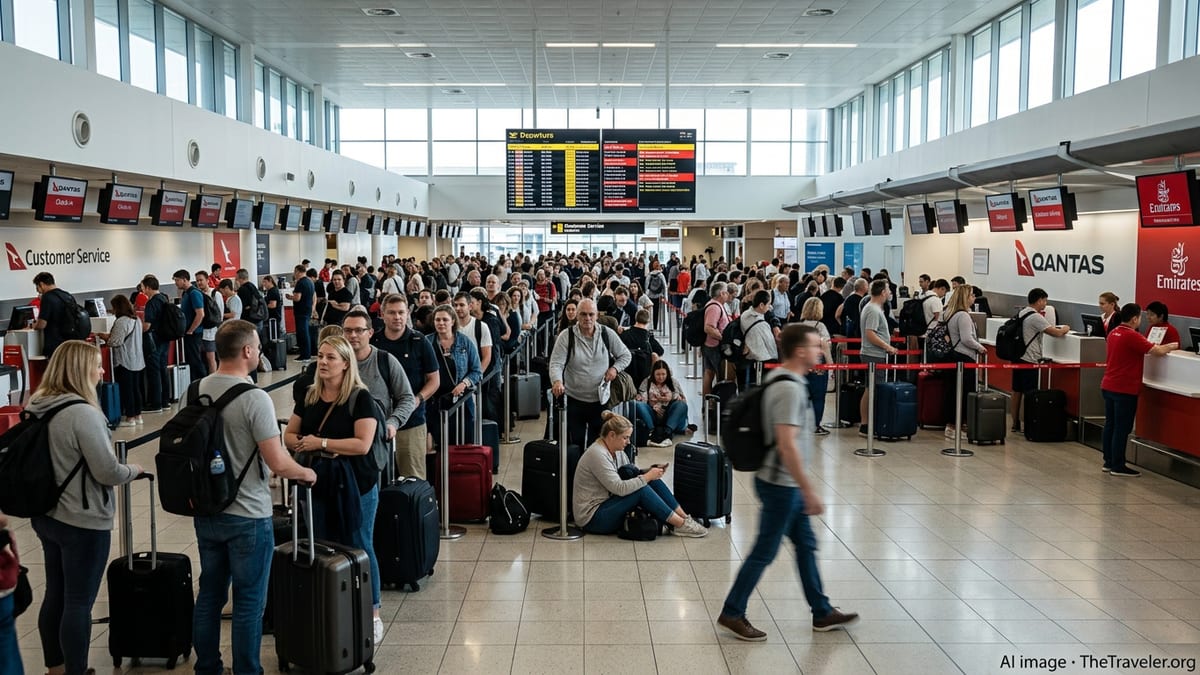
Staffing pressures in the tower under intense scrutiny
Reports from Australia’s national air navigation provider show that staffing shortages in Sydney’s control tower and terminal control unit have periodically forced tighter limits on aircraft movements, triggering ground delays and cancellations across airline networks. In early August 2026, reduced air traffic movements ordered for safety reasons led to widespread schedule disruption at Sydney, with knock-on effects for other major airports.
Separate reporting on a recent near miss on the ground involving Jetstar and Qatar Airways aircraft has intensified focus on how workload and staffing intersect with safety at busy times. Publicly available information indicates that a ground controller and tug operator were stood down pending investigation, while movement rates were temporarily restricted during the morning peak.
Regulators have also been alerted to concerns from within the air traffic control workforce. A confidential safety report published by the national transport safety investigator in July highlighted claims from an experienced controller that training for Sydney’s reconfigured terminal airspace, linked to the forthcoming Western Sydney International Airport, was being compressed in the context of a “staffing crisis”.
At the same time, network overviews released by Airservices Australia show that the proportion of ground delay at Sydney directly attributed to air traffic management has fallen compared with the height of the post‑pandemic recovery, even as passenger numbers have continued to climb.
Airlines, ground handling and the ripple effect on punctuality
While tower staffing attracts public attention, aviation performance reports and parliamentary evidence suggest that airline scheduling decisions, crew and aircraft availability, and ground handling capacity remain major drivers of whether flights depart on time from Sydney.
Industry submissions to government inquiries into airport performance note that airlines often operate tightly banked schedules through Sydney, using high aircraft utilisation to maximise fleet efficiency. When weather or flow restrictions reduce the declared runway capacity, these tightly packed schedules leave little slack, so relatively small constraints can cascade into long queues at gates and departure holding points.
Evidence given at Senate estimates hearings earlier this year also pointed to non‑ATC causes for significant disruption on particular days, including lightning in the vicinity of the airfield that prevented ramp workers from loading and unloading baggage for extended periods. In these cases, public information shows that no delays were formally recorded as being caused by air traffic control, even though passengers still experienced lengthy waits on the tarmac.
Airport and airline representatives have previously pointed to labour shortages and high turnover in ground handling as a continuing constraint on operations. When aircraft arrive late, or turnaround teams are stretched across multiple gates, on‑time performance at Sydney can deteriorate quickly, regardless of tower staffing levels.
Weather, curfew and movement caps limit catch-up options
Sydney’s operating rules and geography add structural constraints that can magnify the impact of any disruption, whatever its initial cause. The airport is subject to a legislated curfew during night hours and a movement cap that strictly limits the number of take-offs and landings permitted in each rolling hour.
Information published by Sydney Airport explains that when storms, low cloud or strong winds force air traffic managers to slow the arrival and departure rate, airlines and the airport have only limited scope to recover later in the day. Once a backlog of delayed flights has built up, the hourly cap restricts how quickly the queue can be cleared, which can leave passengers waiting on board or in terminals even after the weather has improved.
Official submissions from Sydney Airport to federal reviews describe the airport as particularly vulnerable to off‑schedule operations because of these caps. When earlier disruptions push flights outside their intended time bands, aircraft may be required to wait on the ground or in holding patterns until a new slot within the movement limit becomes available, extending delays that were initially triggered by factors such as storms or upstream congestion.
Airservices network performance summaries also indicate that, across Australia’s major airports, weather and airport works frequently contribute a comparable or greater share of delay minutes than air traffic management interventions, reinforcing that passengers at Sydney are often feeling the combined impact of several constraints at once.
Pilot groups highlight systemic issues beyond the tower
Pilot representatives and safety commentators have increasingly framed Sydney’s reliability problems as the outcome of systemic pressures rather than the fault of any single group of workers. Industry commentary in recent weeks has pointed to long‑running concerns about staffing, training and complexity in air traffic control, but has also drawn attention to airline scheduling practices and regulatory settings.
Material tabled with government inquiries by airport and airline bodies shows that airlines have at times blamed unreliable air traffic control staffing for poor punctuality at Sydney. However, analysis of delay attribution data published by Airservices indicates that, across several months, only a minority of total ground delay hours at Sydney were formally assigned to air traffic management, with the balance arising from airline, airport and weather‑related causes.
Some submissions from airport groups have also accused certain airlines of so‑called “slot hoarding,” where historic departure slots are retained even when on‑time performance is consistently poor. According to these documents, the result can be banked periods in which too many flights are scheduled relative to realistic runway and terminal capacity, increasing the likelihood of queues whenever an operational constraint arises.
Pilot groups have argued that without changes to the broader slot and scheduling framework, simply hiring more controllers will not completely resolve the pattern of rolling delays seen at Sydney, particularly during peak holiday and business travel periods.
What stranded passengers can realistically expect
For travellers caught up in queues at Sydney Airport, the complexity of the causes has practical implications. Public information issued by Sydney Airport advises passengers that Airservices Australia sets the number of planes that can land and depart based on weather, runway works and other safety considerations, while individual airlines decide how to adjust their schedules and manage rebooking and compensation.
Consumer guidance from government and industry bodies explains that responsibility for care and financial redress generally depends on whether a delay is deemed within an airline’s control. When disruption stems from crew rostering, aircraft maintenance or ground handling constraints, passengers may have stronger grounds for assistance than in cases involving thunderstorms or air traffic flow management restrictions for safety reasons.
Given the mix of contributors to recent disruption at Sydney, analysts suggest that passengers should pay close attention to airline notifications and publicly available delay attribution data where it is provided. This can help clarify whether a long wait is primarily linked to weather, network‑wide constraints or issues specific to a particular carrier’s operations.
At the same time, continuing investigations into recent safety events and staffing concerns mean that further scrutiny of air traffic control, airport management and airline practices at Sydney is likely. Any resulting changes to training, scheduling rules or capacity management could shape how often travellers find themselves delayed at Australia’s busiest international gateway in the months ahead.
ABC News coverage of recent Sydney Airport delays
Guardian analysis of Sydney air traffic control safety concerns
Sydney Airport submission on delays, caps and air traffic staffing