


More news on this day
A growing clash between airlines, regulators and frustrated travelers is reshaping who gets blamed when flights run late, as new U.S. rules, data and high profile meltdowns sharpen the focus on what counts as an “airline caused” delay.
Get the latest news straight to your inbox!
New Rules Turn Delays Into a Higher-Stakes Fight
Flight delays have long been part of air travel, but in the United States the question of who is responsible has become more consequential since mid 2024. The Federal Aviation Administration Reauthorization Act, signed on May 16, 2024, tied new consumer refund rights to cancellations and “significant” delays, effectively turning delay attribution into a financial and reputational issue for carriers.
Guidance from the U.S. Department of Transportation (DOT) explains that for cancellations and delays of three hours or more on domestic flights, and six hours or more on international services, airlines must notify passengers of their refund rights and provide automatic refunds when travelers are eligible. These requirements apply even to previously purchased nonrefundable tickets, raising the stakes whenever a schedule disruption crosses that threshold.
The DOT’s updated refund rule, combined with existing obligations under its enhanced passenger protections and the long running Airline Cancellation and Delay Dashboard, has created clearer distinctions between disruptions within an airline’s control and those attributed to the broader aviation system or weather. As a result, the party blamed for a delay now faces not only public criticism but also potential refund liabilities and closer regulatory scrutiny.
At the same time, federal rulemaking underway on “Rights of Airline Passengers When There Are Controllable Flight Delays or Cancellations” is examining whether carriers should be required to offer compensation, meals, hotel rooms and ground transport when disruptions are considered controllable. The outcome of that process could further intensify debates over which delays belong on the airline’s ledger.
Airlines, FAA and Weather: Competing Narratives on Cause
Publicly available federal data has clarified that many delays have complex causes, yet airlines and regulators increasingly emphasize different parts of the story. The DOT requires major carriers to classify delays into broad categories such as air carrier, late arriving aircraft, national aviation system, extreme weather and security. That framework is designed to distinguish issues like maintenance or crew scheduling from air traffic constraints or storms.
Recent FAA summaries highlight that, in 2024, a majority of delays were associated with weather and other operational constraints in the national airspace system, while a very small share was tied directly to air traffic controller staffing. The FAA also states that it does not cancel flights itself and that travelers must contact their airline for explanations and rebooking, reinforcing the view that carriers remain responsible for how they manage their schedules around system conditions.
Airlines, for their part, increasingly point to air traffic control and weather when notifying passengers about disruptions, a pattern visible in both carrier communications and traveler reports shared online. Because many contracts of carriage limit reimbursement when delays are categorized as air traffic control or weather related, how an individual disruption is labeled can determine whether a traveler receives hotel vouchers, meal credits or only an apology.
This divergence between statistical breakdowns and customer facing narratives is fueling skepticism among frequent flyers and aviation observers. The more frequently airlines cite air traffic control or weather in messages, the more pressing the question becomes of whether those classifications reflect genuine system constraints or strategic attempts to avoid providing compensation.
High Profile Meltdowns Redraw the Lines of Responsibility
Large scale disruptions over the past two years have further complicated the blame game by exposing how intertwined airline decisions and system factors can be. The January 2023 outage of the FAA’s NOTAM system, which temporarily halted U.S. departures, showed how a single government system failure could cascade through airline schedules and generate days of knock on delays even after the technical problem was resolved.
More recently, a massive operational breakdown at Delta Air Lines in July 2024, linked to a third party software issue and legacy IT infrastructure, triggered thousands of cancellations and delays over several days. Public coverage indicates that the DOT later classified this disruption as a controllable event from the airline’s perspective, despite its roots in a global IT incident affecting multiple industries. That classification has become a reference point in debates over when an airline can reasonably claim a problem was beyond its control.
These incidents illustrate how modern aviation networks are vulnerable to both internal weaknesses, such as outdated scheduling systems or overoptimistic timetables, and external shocks like technology outages or severe storms. When cancellations spike after such events, regulators and airlines often review the same chain of circumstances yet arrive at different conclusions about which links were unavoidably external and which reflected carrier choices.
As investigations unfold, travelers watch closely to see whether a disruption is deemed controllable. That label not only influences potential refunds and accommodations but also shapes public expectations for future accountability when similar problems arise.
Data Transparency Gives Travelers New Leverage
Behind the scenes of every delay, a growing volume of data is changing how blame is assigned and contested. Since 2003, the Bureau of Transportation Statistics has collected detailed on time performance and cause coding for millions of domestic flights each year. Analysts and independent researchers now use this data to study patterns such as how often late arriving aircraft, crew availability or airline scheduling practices drive downstream delays.
The DOT’s Airline Cancellation and Delay Dashboard translates some of this granular reporting into consumer friendly comparisons of what major carriers promise during controllable disruptions. Travelers can see at a glance which airlines commit to meals, hotel rooms or rebooking when a delay is considered within the airline’s control, and which provide more limited assistance.
Alongside official dashboards, public interest groups and data focused travelers have built tools and visualizations that highlight how causes of delays vary by route, season and airline. While these analyses do not resolve individual disputes at the gate, they give consumers broader context when airlines attribute a disruption to weather or air traffic control despite clear skies or minimal congestion elsewhere in the system.
For passengers contesting a denial of compensation or a rejected refund claim, the combination of DOT rules, carrier customer service plans and historical delay data provides more evidence to support formal complaints. That growing body of information is gradually shifting the balance from opaque explanations toward documentation that can be checked and challenged.
What the New Era Means for Travelers
For travelers, the intensifying dispute over who is to blame for delays has tangible implications. New refund rules mean that for longer disruptions, particularly those involving cancellations or multi hour delays, passengers have clearer rights to get their money back rather than accept credits they did not choose.
At the same time, the line between a controllable delay and one attributed to weather or the national airspace system now plays an even larger role in determining what help is offered at the airport. As federal rulemaking on passenger rights progresses, travelers may see movement toward a model where more forms of compensation are standardized when airlines are found responsible.
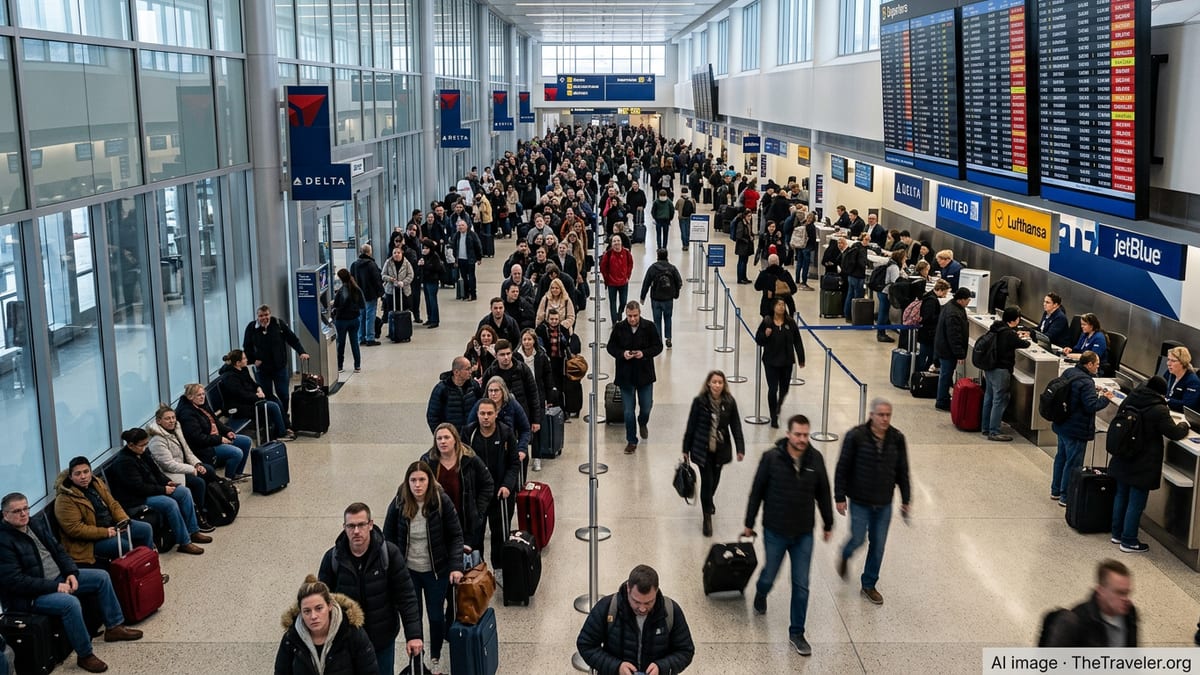
The current environment encourages passengers to pay closer attention to how a delay is described in airline messages, app notifications and gate announcements, and to compare those explanations with available information from FAA flight data and DOT guidance. As public data and legal protections expand, the tug of war over blame is likely to intensify every time a departure board fills with red.
For now, the flight delay blame game is no longer just about frustration at the departure gate. It is increasingly about regulatory definitions, data driven attribution and financial responsibility in an industry where every minute of delay can carry a growing cost.
U.S. DOT Airline Cancellation and Delay Dashboard
DOT Refunds and Other Consumer Protections Final Rule