


The New Jersey Turnpike is one of the busiest toll roads in the United States, running from the Delaware Memorial Bridge near the Delaware state line to the approaches of the George Washington Bridge and Lincoln Tunnel in North Jersey. If you are planning a trip in 2026, understanding how tolls are calculated, where you can enter and exit, and how to use the service areas for fuel and food can save money, reduce stress, and make your drive smoother.
Get the latest updates straight to your inbox!
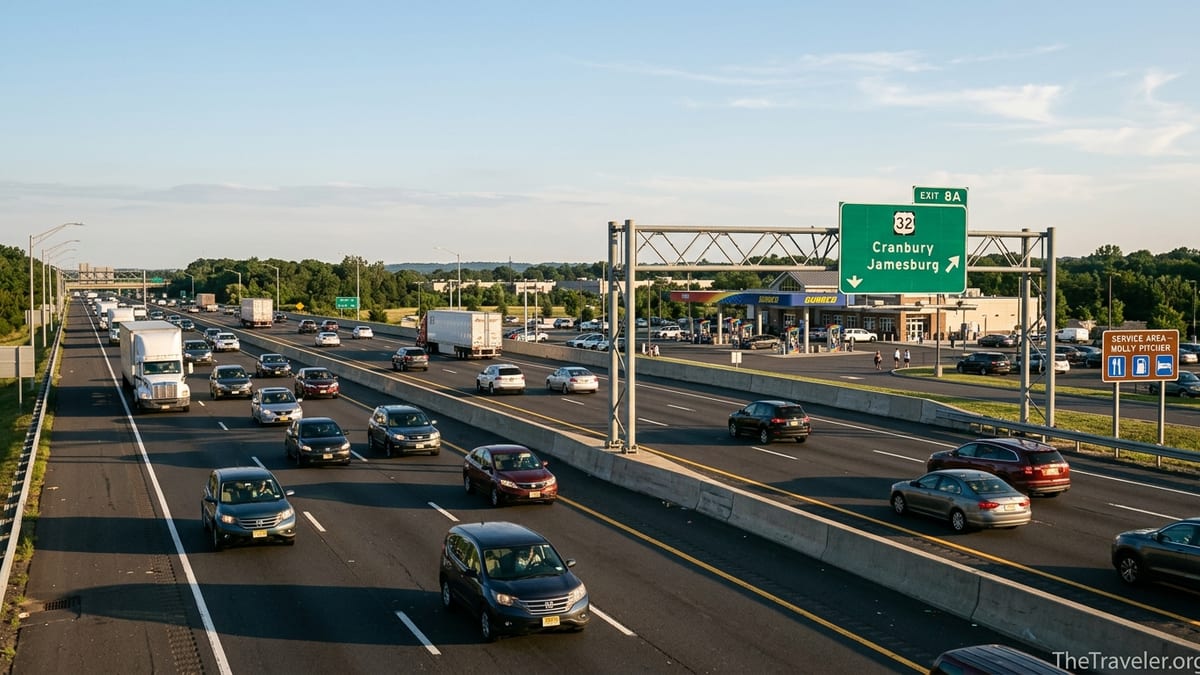
How the New Jersey Turnpike Is Laid Out
The New Jersey Turnpike runs roughly 122 miles from Exit 1 near the Delaware Memorial Bridge in the south to the northern complex around Exits 18E and 18W in Ridgefield Park. It serves major cities such as Camden, Trenton, New Brunswick, Newark and Jersey City, and connects directly with key routes like Interstate 295, Interstate 195, the Garden State Parkway and Route 3. The road is signed as Interstate 95 for much of its length, though drivers simply see it as "the Turnpike."
From Exit 6 near Florence Township north to Exit 14 in Newark, the Turnpike splits into an inner car-only roadway and an outer roadway that carries both cars and trucks. In practice, that means a driver in a sedan leaving Philadelphia for Newark Airport might choose the inner car lanes after Exit 6 for a slightly smoother ride, while a moving truck heading to the Meadowlands would need to stay in the outer roadway with trucks. Electronic signs and overhead gantries clearly mark the split so you can choose the correct roadway well in advance.
Exits are numbered from south to north, beginning with Exit 1 for the Delaware Memorial Bridge and ending with Exit 18W for I-80 and I-95 north toward the George Washington Bridge. There are also lettered variants like 6A, 7A and 8A that serve specific communities or industrial areas. For example, Exit 7A connects directly to Interstate 195, which leads to the Six Flags Great Adventure area and the Jersey Shore, while Exit 8A is heavily used by truckers reaching large warehouse parks in Monroe Township and South Brunswick.
At the northern end, the roadway splits again into an eastern and western spur. The eastern spur connects toward the Lincoln Tunnel and the George Washington Bridge via Exits 16E and 18E, passing near the Meadowlands Sports Complex. The western spur, serving Exits 16W and 18W, provides another route to the same region and often sees heavier truck traffic. For a family driving to a Sunday football game at MetLife Stadium, the choice between the spurs can affect which exit they use and how they approach the parking lots.
How Tolls Work on the Turnpike in 2026
The New Jersey Turnpike uses a distance based toll system. Most drivers take a ticket or have their entry recorded electronically when they enter the highway, then pay a toll when they exit. The amount depends on how far they have driven, the class of vehicle and whether they pay in cash or with E ZPass. Passenger cars are classified as Class 1, while vehicles with more axles, such as buses and tractor trailers, fall into higher, more expensive classes.
As of early 2026, the maximum toll for a Class 1 passenger car traveling the full length of the Turnpike from Exit 1 to Exit 18E or 18W is about 22 dollars when paying cash and around 21.88 dollars with standard E ZPass. Drivers with New Jersey issued E ZPass tags receive an off peak discount of roughly 25 percent during weekday non rush hours, bringing the maximum end to end toll closer to the mid 16 dollar range when entering during those off peak windows. Peak hours, which include weekday morning and evening rush periods and all day on Saturdays and Sundays, are charged at the higher rate.
For a more typical trip, consider a driver who joins the Turnpike at Exit 7A near Interstate 195 and exits at Exit 14 in Newark to reach Newark Liberty International Airport. In 2026, that passenger car trip during peak hours would generally cost only a fraction of the full length toll, often in the high single to low double digits, depending on the exact entry and exit combination. A similar drive at an off peak time with a New Jersey E ZPass can be several dollars cheaper, which adds up for frequent commuters.
Cash remains accepted at staffed toll booths at many exits, but the Turnpike encourages electronic payment through E ZPass to speed up traffic flow. Some northern barrier plazas and newer ramps rely more heavily on electronic tolling, and rental car companies commonly provide E ZPass transponders for visitors. A traveler renting a car out of Newark Airport, for example, might find a small daily fee charged by the rental company for using their E ZPass device on top of whatever tolls they actually incur along the Turnpike.
Paying Tolls: E ZPass, Cash and Missed Payments
E ZPass is the most convenient way to pay tolls on the New Jersey Turnpike, especially for drivers who will use the road more than once or twice. Tags issued by New Jersey and neighboring states are accepted, and New Jersey issued tags qualify for the local off peak discounts. A commuter who drives from Exit 9 in East Brunswick to Exit 14 in Newark five days a week can save a noticeable amount over a month by entering the road outside the morning and evening rush and paying through a New Jersey E ZPass account.
Cash payment is still possible at many interchanges, where toll booths have staffed lanes and automatic coin or bill machines. However, choosing a cash lane usually means slowing down, waiting behind other vehicles and handling change. For example, a family road trip from Maryland to New England might involve stopping at the cash plaza near the Delaware Memorial Bridge at Exit 1 and again when leaving near Exit 18 in North Jersey, adding several minutes of delay at busy times compared with passing through dedicated E ZPass express lanes.
If a driver passes through an E ZPass lane without a valid tag or with insufficient funds, the system records their license plate and generates a toll by mail or toll violation notice. Out of state drivers, such as someone visiting from Ohio who inadvertently uses E ZPass only lanes around Exit 15W, may later receive a bill at the address registered to the vehicle. These invoices typically include the toll amount and may add administrative fees if not paid promptly. Checking your mail and resolving any notices quickly can prevent additional penalties.
Drivers who miss a ticket at entry or are unsure how much they owe can usually obtain help at staffed toll plazas. It is better to explain the situation to an attendant immediately than to guess at an exit, particularly in complex areas like the interchange around Exits 15E, 15W and 15X serving the Newark and Jersey City region. In many cases, attendants can look up your likely entry point and adjust the toll accordingly, avoiding an automatic maximum charge.
Using Exits Strategically to Save Time and Money
Because tolls are distance based, choosing the right exit can slightly reduce costs while also shaping how smoothly you reach local roads. For example, drivers heading to downtown New Brunswick from points south often face a choice between Exit 9 for Route 18 and Exit 8A for local roads through Monroe and South Brunswick. Although Exit 9 sits a bit farther north, it leads directly into New Brunswick via a major arterial, which can be faster during the day. Exit 8A might be cheaper by a small margin but could add time as you thread through warehouse areas and local traffic.
In North Jersey, the choice among Exits 15E, 15W and 15X can be confusing. Exit 15E feeds into local roads toward Jersey City and the Holland Tunnel, while Exit 15W connects to Interstate 280 and Route 21 toward Newark and the western suburbs. Exit 15X exists primarily to serve Secaucus Junction rail station. A traveler aiming for Manhattan’s Midtown may find it easiest to use Exit 16E toward the Lincoln Tunnel from the eastern spur, while someone headed to Newark’s Ironbound neighborhood might exit at 15E or 15W depending on their exact destination.
At the northern end, Exits 18E and 18W deliver drivers to separate approaches to Interstate 95, Interstate 80 and the George Washington Bridge area. For instance, a driver headed from central New Jersey to Paramus shopping centers might exit at 18W and follow I 80 west and local routes north, avoiding some of the heaviest eastbound bridge traffic. Those bound for the upper level of the George Washington Bridge, on the other hand, are more likely to follow signs from 18E or 18W into the main bridge approaches.
In southern New Jersey, Exits 4 and 5 provide alternative ways to connect to the Philadelphia area and the New Jersey suburbs across the Delaware River. Exit 4 leads to Route 73 for access to the Tacony Palmyra and Betsy Ross bridges, while Exit 3 farther north connects to Route 168 and the Walt Whitman Bridge corridor via local roads. Travelers heading to the Camden Waterfront or sports complex often choose Exit 3 or even Exit 1 combined with Interstate 295, depending on traffic conditions and personal comfort with urban driving.
Service Areas: Food, Fuel and Facilities
The New Jersey Turnpike features a series of full service rest areas located directly along the highway between exits. These plazas offer fuel, restrooms, food courts and convenience stores, and many of them are named after notable New Jersey historical figures and cultural icons. For example, travelers heading north in central New Jersey encounter the Molly Pitcher Service Area in Cranbury Township, while those farther north may stop at the Thomas Edison or Joyce Kilmer service areas.
Inside a typical Turnpike service area in 2026, you can expect to find at least one major fuel brand with multiple gas and diesel pumps, a fast food cluster that might include familiar national chains like Starbucks, Burger King or Popeyes, and a convenience shop selling snacks, drinks and travel supplies. Prices are often slightly higher than in nearby towns, but the trade off is the ability to refuel and rest without leaving the highway. A family driving from Baltimore to Boston, for instance, might plan to refuel at the Clara Barton Service Area near Exit 1 in South Jersey and then grab coffee and restrooms at Thomas Edison Service Area closer to Exit 11.
Amenities vary, but many of the larger plazas include ATMs, picnic tables, pet walking areas and basic automotive supplies such as windshield washer fluid and motor oil. During busy holiday weekends, it is common to see charter buses unloading passengers at these stops, with groups queuing at restrooms and coffee counters. In winter, some service areas may host temporary stands selling hot chocolate, while in summer, you might find coolers stocked with cold bottled drinks and ice.
Service areas are typically accessible from both northbound and southbound directions via separate ramps that loop off and back onto the Turnpike. Drivers should pay attention to signage to ensure they stay on the mainline when they intend to continue their trip. Exiting accidentally to a service area usually only costs a few minutes, but attempting to back up on the shoulder or cut across lanes to avoid the ramp is dangerous and strictly prohibited.
Planning Stops and Managing Long Drives
For long distance travelers, planning stops before entering the Turnpike can make the drive more pleasant and predictable. A typical strategy for a six hour trip might involve one fuel stop and one longer food and restroom break. For example, a driver heading from Washington, D.C. toward Hartford, Connecticut might plan to enter the Turnpike at Exit 1, stop for fuel and a quick snack at the John Fenwick or Clara Barton service areas in southern New Jersey, and then schedule a longer meal break at a northern plaza like Joyce Kilmer, which often has a wider selection of food choices.
Families with children often build in extra time at service areas with more open space so kids can stretch their legs. Some plazas have small grass strips and picnic benches that work well for a brief picnic when the weather is pleasant. A parent might pack sandwiches in a cooler and use the service area only for restrooms and drinks, reducing the cost of on site fast food while still taking advantage of the convenient facilities.
Truck drivers and commercial vehicle operators use Turnpike service areas not only for fuel but also for required rest breaks. Overnight parking rules vary, and spaces can fill up quickly, particularly near industrial corridors around Exits 8A, 10 and 13. A long haul driver might target an early evening arrival at Joyce Kilmer or Vince Lombardi Service Area near the Meadowlands to secure a spot before designated truck lots are full. Passenger drivers should avoid using truck only parking rows so that commercial drivers can comply with rest regulations.
Weather can also shape how you use service areas. In heavy rain or snow, ducking into a service plaza for 20 or 30 minutes can provide a safe pause while conditions improve. During summer heat waves, taking a short break in an air conditioned building and topping up coolant or washer fluid can reduce the risk of mechanical issues later in the drive. The Turnpike Authority often uses digital message boards near service areas to share updates about weather, congestion or incidents ahead.
Safety, Enforcement and What to Do in Emergencies
Because the New Jersey Turnpike carries a high volume of mixed traffic, from local commuters in compact cars to cross country tractor trailers, safety is a constant concern. The posted speed limit is generally 65 miles per hour for cars across most of the mainline, though it may drop near complex interchanges, toll plazas and areas under construction. State troopers regularly patrol the highway, focusing on speeding, aggressive lane changes and distracted driving. For example, a driver weaving between lanes near the car truck split around Exit 6 can quickly attract attention and risk a citation.
If your vehicle breaks down on the Turnpike, the safest move is to pull as far onto the right shoulder as possible, turn on hazard lights and remain in the vehicle with seat belts fastened unless there is an immediate danger such as smoke or fire. Roadside assistance trucks contracted by the New Jersey Turnpike Authority regularly patrol the highway and can provide basic help such as tire changes, small fuel top offs and towing to nearby exits. Many service areas also have phones or information desks where you can request additional aid.
In an emergency, dialing 911 from a mobile phone is the fastest way to reach help, but drivers can also use the dedicated Turnpike emergency number posted on mile markers and signs. Providing your approximate mile marker, direction of travel and the nearest exit number helps dispatchers send assistance quickly. For example, reporting a collision "northbound near mile 95, between Exits 7A and 8" gives responders enough detail to find the scene even in heavy traffic.
Weather related closures are less common on the Turnpike than on some smaller roads, but significant snow or ice storms can lead to reduced speed limits, temporary truck bans or partial lane closures. Message boards and alert systems operated by the Turnpike Authority give real time information, and state and regional news outlets often report on major disruptions. Planning around these advisories, especially during winter holidays, can prevent long unexpected delays.
The Takeaway
Driving the New Jersey Turnpike in 2026 is more straightforward when you understand its basic structure, toll rules and support facilities. The highway’s numbered exits, dual car and car truck roadways, and northern spurs may look complex at first glance, but each element follows a consistent logic that becomes familiar after a few trips. Knowing in advance which exit serves your destination and whether you should be in the inner or outer roadway can make merges and lane changes calmer, particularly during peak travel times.
Tolls on the Turnpike depend on distance, vehicle type and how you pay, with E ZPass offering the most convenience and, for New Jersey issued tags, meaningful off peak discounts. Planning your route and estimating toll costs before you travel can help you budget and choose entry and exit points smartly. Using service areas strategically allows you to refuel, eat and rest without leaving the highway, which is especially valuable on longer drives or when traveling with children or pets.
Above all, treating the Turnpike as a managed corridor, rather than just a fast shortcut, leads to a safer and more comfortable experience. Keep an eye on signs, respect speed limits, use the appropriate lanes, and take advantage of the service areas, emergency patrols and electronic information boards. With a little preparation, your next trip along the New Jersey Turnpike can be efficient, predictable and far less stressful than many first time drivers expect.
FAQ
Q1. How much does it cost to drive the full length of the New Jersey Turnpike in a car?
As of early 2026, a passenger car traveling from Exit 1 to Exit 18 typically pays around 22 dollars in cash or slightly less with standard E ZPass, with lower off peak rates for New Jersey issued E ZPass tags.
Q2. Do I need E ZPass to use the New Jersey Turnpike?
No, E ZPass is not required, but it is strongly recommended. Cash payment is still accepted at many interchanges, though some lanes and ramps are E ZPass only and using a tag usually means faster travel and, for New Jersey accounts, off peak discounts.
Q3. How do I know which exit to use for my destination?
Each exit is clearly numbered and signed for the major roads and communities it serves. Check your route ahead of time using a GPS app or map and look for the exit that names the city, highway or landmark nearest your destination, such as Exit 9 for New Brunswick or Exit 14 for Newark Airport.
Q4. Are service areas open 24 hours a day?
Fuel stations and restrooms at most Turnpike service areas generally operate 24 hours a day, seven days a week, though individual restaurants inside may have shorter hours. Late at night, you can usually still find gas, restrooms and a convenience store even if some food counters are closed.
Q5. Can I sleep in my car at a New Jersey Turnpike service area?
Short rest breaks in your vehicle are common, especially for tired drivers, but overnight parking rules vary and some plazas restrict extended stays. Commercial drivers often have designated truck parking, and all travelers should follow posted signs and avoid leaving vehicles unattended for long periods.
Q6. What happens if I enter an E ZPass only lane without a tag?
If you pass through an E ZPass lane without a working tag, cameras will record your license plate and a bill or violation notice will be mailed to the registered owner. Paying promptly usually limits additional fees, while ignoring notices can lead to higher penalties.
Q7. How can I estimate my tolls before a trip?
You can approximate costs by checking current toll schedules published by the New Jersey Turnpike Authority and using online toll calculators. Enter your planned entry and exit points, vehicle type and payment method to get a realistic estimate before you travel.
Q8. Are there special lanes for cars only on the Turnpike?
Yes. Between Exit 6 and Exit 14, the Turnpike has inner car only lanes and outer lanes for both cars and trucks. Overhead signs clearly direct passenger vehicles into the car lanes, which often provide a somewhat smoother flow for long distance trips.
Q9. What should I do if my car breaks down on the Turnpike?
Move onto the right shoulder as far as safely possible, turn on your hazard lights and remain in the vehicle unless there is an immediate danger. Call 911 or the Turnpike emergency number, provide your direction and approximate mile marker, and wait for assistance from state police or Turnpike service trucks.
Q10. Is the New Jersey Turnpike the same as the Garden State Parkway?
No. The New Jersey Turnpike and the Garden State Parkway are separate toll roads run by the same authority. The Turnpike carries more long distance and truck traffic, while the Parkway functions more as a commuter and shore route, though many drivers use both in a single trip.