


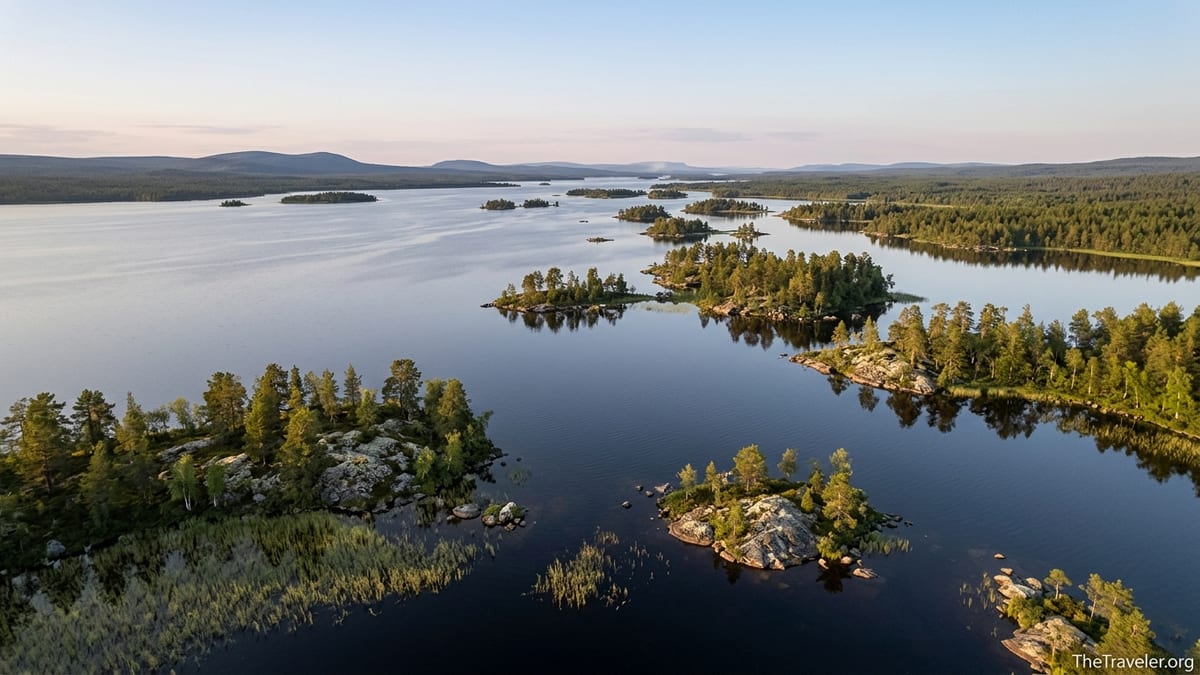
On a calm autumn evening on Lake Inari, the loudest sound is often the crackle of driftwood in a fire and the soft hiss of a kettle coming to the boil. No traffic hum, no distant chairlifts, no strip of resort lights on the opposite shore. Just a huge slate-grey lake, low islands thick with dwarf birch and pine, and, if you are lucky, the first faint traces of the aurora threading the sky. In a continent where even remote valleys now buzz with drones and tour buses, Lake Inari in Finnish Lapland feels like one of the last places that has quietly resisted the urge to become a theme park.
Get the latest updates straight to your inbox!
A Vast Arctic Lake at the End of the Road
Lake Inari sits far above the Arctic Circle in the municipality of Inari, northern Finland. It is the third-largest lake in Finland and among the biggest in Europe’s far north, covering more than 1,000 square kilometres and punctuated by some 3,000 islands. Yet when you stand on the rocky shore near Inari village or at a tiny harbor in Nellim, what you notice is not its size but its emptiness: no marinas packed with yachts, no chain hotels towering over the waterfront, and no ring road encircling the lake.
Reaching Inari requires intent. From Helsinki, most travelers connect via the small Ivalo Airport and then drive about 40 minutes north along a mostly empty highway through pine forest and open tundra. Bus services exist but are limited, and once you arrive in Inari village, there is no dense web of shuttles or sightseeing buses. Distances are large, and the nearest sizable downhill ski resort or shopping mall is hours away. That mild difficulty of access is one of the reasons the lake has sidestepped the kind of mass tourism seen in many Alpine and Mediterranean regions.
Even at the height of summer, you can paddle for hours among Inari’s islands without meeting more than a handful of other boats. Local outfitters in Inari village and Nellim rent canoes and arrange guided trips, but group sizes are usually small, sometimes capped at 6 to 8 people. A typical full-day guided fishing and wilderness excursion on the lake might cost in the region of 120 to 180 euros per person, including warm clothing, gear and a simple meal cooked over an open fire on an island. Prices like this keep operations sustainable without pushing companies to chase ever-higher visitor numbers.
Crucially, there is almost no shoreline sprawl. Outside a few clusters of cabins, guesthouses and marinas around Inari village and tiny communities like Nellim and Sevettijärvi, the lake’s edge is a continuous fringe of forest and rock. Drive the roads that skirt parts of the shore and you will see far more reindeer on the tarmac than hotel billboards. The geography itself reinforces the sense that Lake Inari is a place you travel to slowly and explore modestly, rather than “do” in a long weekend.
Protected Wilderness on Nearly Every Horizon
Look at a map of northern Finland and you quickly see why Lake Inari feels so untouched. The municipality of Inari is enormous by European standards, and a large majority of its land area is under some form of protection. Around the lake lie vast national parks and designated wilderness areas, notably Lemmenjoki National Park to the southwest, Urho Kekkonen National Park farther south and east, and the Vätsäri Wilderness Area stretching along the lake’s northeastern shore all the way to the Norwegian border.
Lemmenjoki, Finland’s largest national park, covers a huge plateau of fells and river valleys where marked trails soon give way to pathless tundra. Urho Kekkonen National Park, easily reached from Saariselkä and Kiilopää, is popular with hikers and skiers but still contains a large core where there are few or no marked routes, only old reindeer tracks and river valleys. To the northeast of Lake Inari, the Vätsäri Wilderness Area is even more strictly protected: a mosaic of small lakes, wetlands and bare fells where development is almost entirely absent. From the water, this protection translates into a continuous backdrop of intact forest and low hills with almost no visible infrastructure.
On practical level, this protection means strict rules about building, motorised access and resource extraction. For visitors, it manifests in the kind of details you notice on a long day trip: landing on a mossy island where the only human marks are a small fire ring of stones and perhaps an old log bench, or hiking for a full afternoon without encountering a single signpost. Finnish outdoor culture centres on “everyman’s rights,” allowing people to roam, pick berries and camp lightly, but the national parks and wilderness areas around Lake Inari add another layer of legal and cultural protection that keeps the landscape looking and feeling remarkably unmodified.
Local experience providers work within these frameworks. A small wilderness company on the eastern shore near Vätsäri might offer a handful of simple lakeside cabins, guided fishing trips and private sauna evenings, but is limited in how much new construction it can add and where it can drive snowmobiles or boats. Operators in Saariselkä taking guests into Urho Kekkonen National Park advertise hut-to-hut trips that rely on existing open wilderness huts rather than building new lodges deep in the park. The result is a tourism model that leverages the wild character of the area instead of gradually eroding it.
Silence, Dark Skies and the Luxury of Space
Walk a few minutes away from the main road in Inari on a winter evening and you quickly notice the silence. Snow muffles footsteps, engines are few, and there is often no mechanical noise at all. On the lake itself, particularly on the eastern and northern shores, it can feel as if sound has been switched off. For many visitors from central Europe or North America, that quiet is startling. It is not simply the absence of city noise, but the absence of the background hum of dense tourism: no music from après-ski bars, no gondola motors, no parking lot announcements echoing across the ice.
That pervasive quiet pairs with darkness that is increasingly rare in Europe. While Inari village and nearby accommodation clusters do have streetlights, the luminous footprint is small. A short snowshoe or car ride away, you can stand on the ice under a sky that feels properly dark. On clear winter nights, temperatures often drop well below freezing and stars sharpen. The aurora, when active, can appear as broad curtains rippling over the frozen lake, with reflections shimmering in the snowdrifts or in patches of open water near islands.
The lack of crowding is another part of the lake’s appeal. Even at popular spots like Ukonkivi, a sacred island outcrop that features on many boat tours, it is not unusual to be in a group of fewer than a dozen people. On a weekday in late September, you might be the only one disembarking from a small boat to climb the short path to the summit. Out on the water in summer, kayakers weave through narrow channels between islands without jockeying for space, simply because there are so few other craft around. There are no large cruise ships or party boats, only small local vessels and private fishing boats.
For travelers used to “overtourism,” these details matter. A day trip may involve making coffee over a driftwood fire on an empty island instead of queuing for a table at a lakeside café, or stopping at a simple wilderness lean-to with a guestbook instead of a fully serviced hut. In many parts of Europe, such experiences are now the preserve of a few remote corners of the Alps or the Highlands. Around Lake Inari, they are routine.
Sámi Culture Rooted in the Landscape
Part of what keeps Lake Inari feeling authentic is that it is not just a playground or backdrop. It is also the heartland of the Inari Sámi, one of several Sámi groups indigenous to the region of Sápmi, which spans parts of northern Finland, Sweden, Norway and Russia. Inari village serves as an important local hub, with institutions dedicated to preserving Sámi languages, arts and traditions. Rather than building glossy theme parks, local communities have tended to create small-scale cultural experiences rooted in everyday life.
On the shore of the lake and in adjacent villages, family-run reindeer farms welcome visitors in small groups to learn about herding traditions, feed reindeer and share a simple meal around an open fire. A typical visit might cost around 90 to 130 euros per person for a few hours, including transfers, warm clothing and lunch. Instead of staged performances, guests are often introduced to contemporary Sámi life: how families balance reindeer herding with other work, how they navigate land-use changes, and why maintaining access to traditional grazing and fishing grounds around Lake Inari matters so deeply.
In the summer, visitors can join guided cultural walks in lakeside Sámi villages such as Nellim, where preserved log buildings, drying racks for fish and meat, and old boats show how closely daily life used to be tied to the water. At a small Sámi cultural village experience by the lake, you might see fish hanging to dry, traditional net-making tools, and a smoke sauna, with a guide explaining in both Finnish and English how these practices helped families endure long winters.
This living cultural context creates a different atmosphere from many European resort regions where heritage is presented mainly as a spectacle. Around Lake Inari, you are always aware that reindeer herds move across the same frozen lakes you are crossing on skis, and that fishing huts on the islands are still used by local families. Respect for these ongoing livelihoods is built into local tourism guidelines, from where snowmobile routes can cross reindeer grazing grounds to how visitor numbers are managed at sacred sites like Ukonkivi.
Low-Key Tourism Rather Than Mega-Development
Lake Inari’s tourism infrastructure is deliberately modest. Inari village has a handful of mid-sized hotels, a smart but unpretentious lakeside hotel with cottages, a couple of supermarkets, a fuel station and several tour operators offering activities between roughly 80 and 200 euros per person depending on the length and type of excursion. Nearby, small cabin villages and glass igloo resorts dot the forest, but these are spread out and rarely visible from the lake itself. There are no high-rise resorts clutching the shoreline and no sprawling second-home subdivisions.
On the eastern side of the lake near the Vätsäri Wilderness Area, accommodation tends to be even more restrained. Guests might stay in restored early 20th century Sámi farm buildings or simple wooden cabins with shared facilities and private saunas, designed to blend into their surroundings. Many of these properties are run by local families who also guide fishing, hunting or berry-picking trips. The capacity of such establishments is often fewer than 30 beds, making it impossible to suddenly flood the lake with hundreds of new visitors in a single season.
Winter activity companies offer snowmobile safaris, ice fishing trips, snowshoe walks and aurora hunts, but usually with small group sizes and fixed routes that minimise disturbance. A three-hour snowmobile excursion on the lake might cost around 160 to 220 euros per person, including thermal suits, helmets and guiding. Operators emphasise safe speeds, sticking to marked trails and keeping noise to a minimum near reindeer pastures and village areas. This contrasts sharply with busier alpine resorts where fleets of snowmobiles fan out every evening purely in search of thrills.
Pricing also plays a subtle role. Travel to Inari is not cheap, especially for visitors connecting from elsewhere in Europe or North America, and activity prices reflect the costs of operating in a remote Arctic environment. This naturally filters visitor numbers and tends to attract travellers who value quietness and nature over nightlife and shopping. For local authorities and businesses, that is by design: the goal is not maximum volume, but a steady flow of guests who stay longer, spend thoughtfully and help support year-round employment without overwhelming the environment.
Wild Experiences Still Feel Genuinely Wild
Many places in Europe sell the idea of wilderness; Lake Inari comes closer to delivering it. Multi-day canoe journeys among the islands involve real route-finding, weather judgment and self-sufficiency. Paddlers often carry everything they need for several days, from tents and food to repair kits, and rely on basic lean-tos or wild camping spots rather than serviced campsites. On a still summer night, camping on a small island of heather and stunted pine, with only the sound of waves and the occasional call of a bird, it is easy to feel that you are a long way from the crowded continent.
Winter adventures are equally raw. Cross-country skiers leaving the trailheads in nearby Urho Kekkonen National Park can spend days moving between open wilderness huts heated only by wood-burning stoves. In March and April, when days are longer and snow conditions stable, it is common for experienced Finns to ski 15 to 25 kilometres per day, carrying their food and sleeping bags, and sharing a basic bunkroom with whoever else happens to arrive. There is no booking system for most of these huts, no staff on site and no paid services beyond the occasional nearby sauna. The system works because of a strong culture of trust and low visitor pressure.
Even shorter guided excursions retain that wild edge. A “wilderness and fishing trip” offered by local outfitters typically takes you well beyond the immediate vicinity of Inari village or Nellim. You might travel by small motorboat or snowmobile for an hour before the guide cuts the engine and glides into a quiet bay ringed by forest. Equipment is unloaded, a hole is drilled in the ice or nets are set in open water, and lunch is cooked over an open fire. There is usually no shelter beyond a simple tarpaulin or lean-to, no toilet block and no mobile phone reception in parts of the lake’s more remote reaches.
Conditions also remain uncompromising. Weather on the lake can change rapidly, with sudden winds whipping up short, steep waves that test even experienced boaters. In winter, temperatures can sink to minus 30 degrees Celsius or lower, making correct clothing and know-how essential. Local guides watch forecasts carefully and will cancel or adjust trips when needed, but the underlying reality is that Lake Inari is still a place where nature calls the shots. That palpable sense of risk is exactly what many visitors feel has been smoothed out of more commercialised European destinations.
Traveling Responsibly in a Fragile Arctic
Lake Inari’s apparent untouched quality is not accidental. It depends on a web of decisions and behaviours, from zoning rules set by the Finnish authorities to the daily choices made by visitors. For travellers, experiencing the lake without eroding what makes it special means leaning into a slower, more considerate style of trip. That can start with simple decisions: visiting outside the busiest Christmas and New Year weeks, staying four or five nights instead of two, and choosing locally owned accommodation over anonymous international chains.
On the ground, it means respecting both the landscape and the people who depend on it. That might involve keeping a generous distance from reindeer, even when they wander photogenically down the village street, and following your guide’s instructions about where it is acceptable to stop snowmobiles or drones. On summer hikes and canoe routes, it is standard practice to pack out all rubbish, use existing fire rings rather than building new ones, and avoid camping on islands or shores that show signs of being used for reindeer herding or fishing.
Opting for small group, low-impact activities helps too. Instead of a high-speed snowmobile safari, you might choose a guided snowshoe walk through old-growth forest, or a silent aurora hunt on cross-country skis. In summer, a slow electric boat excursion to cultural sites on the lake can be a way to see more of Inari without adding noise and exhaust to the environment. Some local companies already advertise electric or low-emission options and frame them as a selling point rather than a sacrifice.
Finally, listening to local voices is part of traveling well here. Taking time to visit a Sámi cultural centre or join a storytelling evening, asking questions respectfully and buying handicrafts directly from artisans all help ensure that tourism revenue supports those with the deepest roots in the region. When visitors understand why a small rocky island has spiritual significance, or why a particular bay is crucial for reindeer in spring, they are more likely to tread lightly. In an era when many wild places feel more curated than lived in, that kind of relationship between travellers and hosts is itself a rare thing.
FAQ
Q1. Where exactly is Lake Inari and how do I get there?
Lake Inari is in Finnish Lapland, above the Arctic Circle in the municipality of Inari. Most visitors fly to Ivalo Airport and continue by bus, private transfer or rental car for about 40 minutes north to Inari village, the main gateway to the lake.
Q2. When is the best time of year to visit Lake Inari?
Winter from December to March is ideal for snow-based activities and northern lights, while June to early September offers mild temperatures, long days and good conditions for hiking, canoeing and fishing. Autumn, from late August to September, can be especially beautiful with colourful foliage and fewer insects.
Q3. Is Lake Inari suitable for first-time Arctic visitors?
Yes, provided you book guided activities and follow local advice. Inari village has hotels, shops and tour operators, but the surrounding nature is genuinely wild, so beginners should avoid venturing far onto the lake or into the wilderness alone without proper skills and equipment.
Q4. Do I need a car to explore the area around Lake Inari?
A car is very useful, especially in summer, because distances are long and public transport is limited. However, in winter many visitors manage without a car by staying in Inari village and joining guided activities that include transfers.
Q5. Can I see the northern lights over Lake Inari?
Yes. The Inari region sits under the auroral oval, so on clear nights between roughly late August and early April there is a good chance of seeing the northern lights. Dark, open areas on or near the lake provide excellent viewing conditions with minimal light pollution.
Q6. What kind of accommodation is available around Lake Inari?
You will find small hotels, lakeside cabins, glass igloo-style suites and simple wilderness huts or cabins. Many places are family-run and relatively small, often with on-site saunas and direct access to the lake or nearby trails rather than resort-style amenities.
Q7. Is it possible to explore Lake Inari independently by canoe or kayak?
Experienced paddlers can rent canoes or kayaks and plan multi-day trips among the islands, but conditions can be challenging and weather changes quickly. First-time visitors usually start with guided day trips or overnight excursions organised by local outfitters who know the safe routes and landing places.
Q8. How expensive is it to visit Lake Inari compared with other parts of Europe?
Costs are generally higher than in southern Europe. Accommodation, restaurant meals and guided activities reflect the remote Arctic location, with typical day tours often costing more than 100 euros per person. Careful planning, self-catering and traveling outside peak holiday periods can help manage the budget.
Q9. Are there any cultural considerations I should be aware of when visiting Sámi areas?
Respect for Sámi culture is important. Ask permission before photographing individuals in traditional dress, avoid disturbing reindeer and treat sacred or historical sites with care. Choosing Sámi-owned or Sámi-led experiences, and buying handicrafts directly from artisans, is a good way to support the community.
Q10. How can I visit Lake Inari in an environmentally responsible way?
Travel in the shoulder seasons if possible, stay longer rather than hopping quickly between destinations, choose small-group or low-impact activities, and follow local rules on camping, campfires and wildlife. Using existing trails and fire sites, minimising waste and supporting local businesses all help keep Lake Inari feeling as untouched as it does today.