


High above the Arctic Circle, where spruce forest thins into tundra and winter light hovers low on the horizon, the Sámi Museum in Karasjok offers something many travelers say they miss elsewhere in the north: a chance to engage with Indigenous Arctic culture on Sámi terms. Rather than a quick photo with a reindeer or a staged “traditional” show, this museum invites visitors into a living story of land, language, politics and art that stretches across northern Norway, Sweden, Finland and Russia.
Get the latest updates straight to your inbox!
The First National Sámi Museum and Why It Matters
The Sámi Museum in Karasjok, officially called Sámiid Vuorká-Dávvirat / De Samiske Samlinger, opened in 1972 as Norway’s first dedicated Sámi museum. Located in the heart of Finnmark, in a town where Sámi language is widely heard on the street and the Sámi Parliament stands a short walk away, it serves as both a cultural archive and a contemporary meeting place. For travelers, that combination is powerful. It means you are not just looking at artifacts from a vanished past, but stepping into a community that is actively shaping its future.
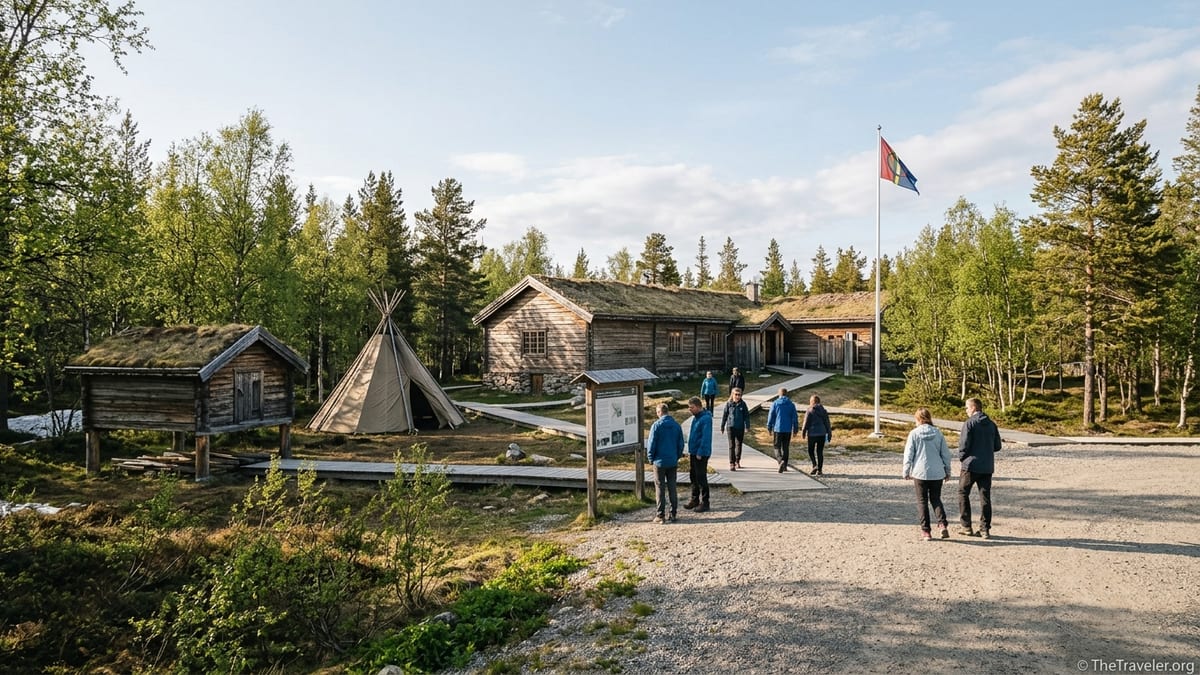
Karasjok is small and remote by most standards, with only a few thousand residents, yet the museum holds one of the largest collections of Sámi cultural objects in Norway. Exhibits range from everyday household tools to ceremonial drums, winter clothing and silverwork. The building itself, a low timber structure surrounded by birch and pine, feels distinctly northern without slipping into theme-park aesthetics. You are reminded that this is a working museum staff enter storage rooms, researchers consult archives, school groups pour in on weekday mornings.
Because the museum is part of the RiddoDuottarMuseat foundation, which manages four Sámi museum units across western Finnmark, it is also tied into a wider network of coastal, inland and reindeer-herding communities. That regional scope helps counter the common myth that there is just one “Sámi culture.” Displays and explanations show Inland reindeer herders alongside Coastal Sámi fishers and river communities, giving visitors a sense of the diversity inside Sápmi, the Sámi homeland that stretches across national borders.
For travelers who may have only encountered Sámi culture as a brief segment on a northern lights tour, this depth matters. It provides the historical and political context often missing from commercial experiences, and it does so in a setting led and curated by Sámi professionals rather than through an outside gaze. You are not simply learning about the Sámi; you are visiting one of their own institutions.
From Nomadic Tents to Parliament: Everyday Life on the Tundra
One of the most immediate ways the Sámi Museum brings Arctic Indigenous life into focus is through its presentations of daily living environments. Inside the main building, you might step into a reconstructed lávvu, the conical tent used by reindeer-herding families on migration routes. Reindeer hides on the floor, soot-darkened poles, a central hearth and simple cooking gear turn what might be a romantic icon into a more tangible living space. Labels explain how such dwellings were packed up, moved and reassembled throughout the year, and how they coexist today with cabins, apartments and modern infrastructure.
Nearby, exhibits on reindeer husbandry move beyond the postcard image of a herder in colorful gákti clothing with a lasso. You can see handmade harnesses for sled reindeer, robust winter coats stitched from reindeer and goat fur, and tools used in seasonal roundups. A short video might show snowmobiles and GPS ear tags in the same landscape, underscoring how herding has adapted to highways, hydro projects and changing climate. For a traveler who may only encounter reindeer at a tourist feeding camp, this is a rare window into the economic, legal and ecological realities behind the animals on the postcard.
The museum also highlights fishing and river life, especially significant for communities across the Deatnu (Tana) and other Arctic rivers. Nets, boats and fish-drying equipment are displayed with explanations about seasonal salmon runs, traditional knowledge of currents and rapids, and the recent conflicts over fishing rights and conservation measures. Instead of a generic “Sámi fishers,” you see how particular rivers, regulations and political decisions shape livelihoods today.
All of this everyday material culture is framed in relation to contemporary institutions. Many visitors combine the museum with a walk to the Sámi Parliament building in Karasjok, where modern Sámi political life is centered. The juxtaposition is part of the lesson: the same people who once lived in mobile tent camps now draft language policy, negotiate with energy companies and sit in national parliaments. The museum gives you the grounding to understand what that transformation means.
Spiritual Traditions, Suppression and Resilience
For many visitors, some of the most memorable parts of the Sámi Museum involve spiritual life and its suppression. Sámi spiritual leaders, known as noaidi, once used drums, joik chanting and ritual journeys as part of healing and community ceremonies. Missionaries and colonial authorities confiscated and destroyed many drums, banned joik and pushed forced conversions, leaving a painful gap in the record.
Because original ceremonial drums are rare and sensitive objects, museums like Sámiid Vuorká-Dávvirat often work with replicas, careful photography and storytelling rather than large dramatic displays. You might see high-quality reproductions of drum faces, with symbols representing mountains, lakes, reindeer and Christian churches sharing the same surface. Curators explain that these objects record a worldview in which landforms, animals and spiritual forces are in constant relation, and where Christianity was at times incorporated rather than simply imposed.
Exhibits do not shy away from colonial policies. Norwegianization campaigns in the 19th and 20th centuries sought to suppress Sámi language, spirituality and cultural expression. School registers, photographs and personal testimonies document how children were punished for speaking Sámi, how sacred landscapes were flooded for hydropower dams and how cultural artifacts were removed to southern museums. For a traveler, this context transforms Arctic scenery from a neutral backdrop into a contested cultural landscape where churches, river crossings and even place names carry difficult histories.
At the same time, the museum highlights resilience and contemporary revitalization. You might learn about the return of repatriated artifacts from national institutions, or see examples of modern joik performances and Sámi church art that weave traditional motifs into new forms. Traveling onward to Inari in Finnish Lapland, visitors find similar themes at the Siida Sámi Museum and Nature Centre, where a renewed core exhibition opened in the early 2020s and tells a parallel story of loss, revival and political awakening. Seeing both museums on the same journey can deepen your understanding of cross-border Sámi spiritual and cultural continuity.
Textiles, Duodji and the Politics of Design
Colorful clothing often draws a traveler’s eye first, and the Sámi Museum uses this curiosity to open a nuanced conversation about identity, regional belonging and appropriation. Traditional clothing, known as gákti, is displayed not as a timeless costume but as part of a living design system. Different cuts, colors and details signal whether a person comes from coastal or inland areas, from Karasjok or Kautokeino, from Inari or Skolt Sámi communities, and whether garments are meant for everyday work, ceremonies or official occasions.
In glass cases you might see a winter gákti with bands of red, blue and yellow, heavy wool skirts or trousers and thick woven belts decorated with brass elements. Nearby, footwear made from reindeer hide with upturned toes and felted wool liners reveals how form follows function in Arctic environments. Each piece is accompanied by explanations about materials, sewing techniques and the social codes embedded in the designs. This level of detail helps you understand why generic “Sámi-style” souvenirs sold in some tourist shops, often made outside Sápmi, are controversial.
The museum also foregrounds duodji, a broad Sámi term for traditional handicrafts that includes carved wood, bone, horn and textiles. Hand-carved coffee spoons, intricately patterned knife sheaths, and birch-bark containers sit beside more contemporary interpretations of duodji in jewelry and home decor. Many visitors use the museum shop, or nearby workshops and galleries in Karasjok and Inari, to seek out authentic duodji pieces directly from Sámi makers. Prices can feel higher than factory-made souvenirs a reindeer-horn handled knife or silver brooch may run well over what you would pay for mass-produced trinkets but the museum context helps you see why: they are heirloom objects and part of a knowledge chain rather than simple décor.
There is also a subtle political dimension to these design stories. Through wall texts and short film clips, curators address how colonial collecting practices once treated Sámi clothing and crafts as exotic curiosities, divorced from the communities that made them. Today, institutions like Sámiid Vuorká-Dávvirat and Siida collaborate with duodji artisans to set ethical guidelines for acquisitions and exhibitions, and to support living craft economies. For travelers, engaging with this ecosystem buying directly from Sámi-owned businesses, asking where and by whom an item was made is one practical way to support cultural continuity rather than exploitation.
Art, Activism and Contemporary Sámi Voices
One of the reasons the Sámi Museum offers such a deep look into Arctic Indigenous culture is its commitment to contemporary art. The Karasjok museum holds a major collection of Sámi contemporary artworks, including painting, sculpture, prints and mixed media pieces. This is not an add-on; it is central to how the institution tells its story. Where earlier generations of museums froze Indigenous peoples in an ethnographic past, Sámi curators insist on centering living, evolving voices.
In practice, this might mean that a visitor moves from a display of early 20th century reindeer harnesses directly into a room with bold graphic prints critiquing land grabs, or a video installation that overlays archival footage of river fishing camps with present-day interviews about climate change and legal battles. Pieces by well-known Sámi artists explore themes like self-determination, gender, queerness, and the impact of wind farms on reindeer migration. Labels are typically offered in a combination of Sámi, Norwegian and English, inviting a broad audience into these conversations.
Art also becomes a bridge between different parts of Sápmi. Joint exhibitions with museums in Tromsø, Inari and northern Sweden show how Sámi artists constantly respond to each other across borders. A traveler might first encounter a particular artist in Karasjok, then see their work again in a gallery in Tromsø or at the Siida museum, realizing that they are following the threads of an internal Sámi dialogue rather than isolated “local crafts.” This multi-stop exposure turns a trip through northern Scandinavia into an education in Arctic Indigenous modernism.
For visitors used to seeing Indigenous art framed mainly as souvenir or folklore, this focus on contemporary practice can be eye-opening. It underscores that issues like land rights, language revitalization and environmental protection are not abstract talking points but daily realities that shape what artists choose to depict. Spending time in the museum’s art galleries, and perhaps picking up a small print or catalogue in the shop, allows you to carry some of those questions with you as you continue your journey through the Arctic.
Stepping Outside: Open-Air Museums and Seasonal Landscapes
In summer, one of the museum’s most compelling elements is its open-air section, where historic buildings and structures from different Sámi regions are set in the surrounding forest. Modest turf-roofed houses, storage sheds lifted on stilts, and traditional reindeer corrals sit among birches and scrub pines. Walking these paths, you can imagine how families once organized their seasonal movements between river valleys, forest pastures and coastal fishing sites.
This open-air approach ties Karasjok to similar Sámi-focused museums across the region. In Inari, the Siida museum’s outdoor area shows a range of riverboats, smoke saunas and summer dwellings from northern Finland, while in Umeå in northern Sweden, the Västerbottens Museum includes historic Sámi camps within a larger open-air complex. Experiencing more than one of these sites reinforces the idea that Sámi culture is not confined to a single national or architectural style. Instead, it bends to particular rivers, forests and coastlines, all of which you can see and feel underfoot.
Because of the subarctic climate, your experience of these spaces will change dramatically with the season. In early summer, wooden walkways can be damp with meltwater and clouds of mosquitoes hover in the still air. In late autumn, frost crystals sparkle on wooden railings and the low sun throws long blue shadows across the museum grounds. In midwinter, some outdoor elements may be buried under snow, but that very obscuring illustrates a key part of Arctic life: infrastructure comes and goes with the seasons, and people adapt accordingly.
Planning-wise, this means checking opening hours for the open-air areas and dressing for conditions. In June and July, a light windproof jacket, hat, insect repellent and sturdy shoes will make lingering among the buildings more pleasant. In February, when daytime temperatures can drop well below freezing, most of your visit may be indoors, with shorter photo stops outdoors for those willing to brave the cold. Either way, the museum grounds become a small, walkable microcosm of a much larger landscape of movement and adaptation.
How to Visit Respectfully and Get More From Your Time
One of the quiet strengths of the Sámi Museum is the way it encourages visitors to move beyond passive looking toward more engaged and respectful travel. Practical steps start before you arrive. Reading a short overview of Sámi history, learning how to pronounce “Sápmi” and “gákti,” and understanding that there are multiple Sámi languages can help you navigate exhibitions and conversations with more confidence. Museums in Tromsø, Helsinki and Stockholm often provide useful background if Karasjok or Inari are later stops on your itinerary.
On site, most travelers will spend at least two to three hours exploring the main exhibitions and open-air areas. Buying a combined ticket that includes temporary exhibitions and guided tours, when available, can be worthwhile. Guides sometimes expand on topics like land rights or language policy that only appear briefly on wall texts. If you have time, consider pairing the museum with a visit to the Sámi Parliament in Karasjok or the Sámi Cultural Centre Sajos in Inari, where you can see how political and cultural institutions sit side by side.
Respectful behavior also means understanding that Sámi people are not cultural props. Taking discreet photographs of exhibitions is usually allowed, but pointing cameras directly at staff or local visitors without asking is not. When participating in commercial experiences, such as reindeer sled rides or joik performances, look for Sámi-owned operators, ask how activities are connected to real herding or cultural practices, and be wary of experiences that present Sámi life solely as entertainment. The context you gain at the museum will make it easier to spot the difference between a carefully staged show and a collaboration grounded in community priorities.
Finally, supporting Sámi institutions and businesses has tangible effects. Museum tickets, catalogues purchased from the shop, meals at Sámi-run cafés and stays in family guesthouses in Karasjok, Inari or Kautokeino feed into local economies. Over the course of a week in the region, choosing a handful of such options instead of generic chains can shift a noticeable portion of your travel budget toward Indigenous-controlled projects, helping ensure that the deep cultural narratives you encounter at the museum continue to evolve on Sámi terms.
The Takeaway
For many travelers, the Arctic begins as a landscape of lights, snow and wildlife, framed more by marketing images than by lived realities. The Sámi Museum in Karasjok, together with sister institutions in Inari, Umeå and across Sápmi, offers a chance to flip that perspective. Inside its timber walls and along its forest paths, the north comes into view as an Indigenous homeland, thick with stories of movement, resilience, creativity and political struggle.
Spending a day at the museum will not make you an expert on Sámi history or contemporary debates, just as a single hike cannot reveal all the dimensions of a wilderness area. But it can fundamentally change how you see everything else on your Arctic journey, from roadside reindeer migrations to place names on a map. You begin to understand that what might look like empty tundra or anonymous forest is, in fact, a densely inhabited cultural landscape.
In an era when Indigenous communities worldwide are asserting control over how their cultures are represented, the Sámi Museum stands as a leading example in the Arctic. It is a place where artifacts return, languages are spoken, artists experiment and visitors are invited into complex conversations rather than simple performances. For those willing to listen and look closely, it offers one of the deepest and most respectful introductions to Arctic Indigenous life you are likely to find.
FAQ
Q1. Where is the Sámi Museum in Karasjok, and how do I get there?
The museum is in Karasjok in Norway’s far north, near the Finnish border. Most visitors arrive by car or regional bus from towns like Alta, Lakselv or Kautokeino, often combining the visit with a wider road trip through Finnmark.
Q2. How much time should I plan for a visit?
Plan at least two to three hours to see the main exhibitions and the open-air area in summer. If you enjoy reading detailed texts or want to join a guided tour, half a day is a comfortable minimum.
Q3. Are exhibits available in English?
Yes. Wall texts and labels are typically presented in Sámi and Norwegian with English translations. Audio-visual materials and brochures are often multilingual, making the museum accessible to most international visitors.
Q4. Is the museum suitable for children?
It is generally child friendly. Younger visitors often enjoy the open-air buildings, reindeer-related exhibits and hands-on elements. However, some sections dealing with assimilation policies and cultural suppression may be better discussed with older children and teens.
Q5. Can I see live reindeer at the museum?
The museum focuses on culture and history rather than keeping live animals, so there are usually no resident reindeer. Many travelers pair their visit with a separate excursion to a Sámi-owned reindeer herd elsewhere in the region.
Q6. When is the best season to visit?
Summer and early autumn are ideal for combining indoor exhibitions with the open-air museum and longer walks around Karasjok. Winter visits offer a strong atmosphere and possible northern lights, but outdoor areas may be snow covered and daylight hours are short.
Q7. How does this museum differ from Sámi experiences on typical tours?
Unlike brief stops for photos or performances, the museum is a Sámi-run institution that offers historical depth, contemporary art and nuanced discussion of politics, land rights and language. It provides context that can help you better understand any other Sámi experiences on your trip.
Q8. Is photography allowed inside?
Photography without flash is generally permitted in many areas for personal use, but restrictions may apply to particular objects or temporary exhibitions. Always check posted signs and follow staff guidance.
Q9. Can I buy authentic Sámi handicrafts at or near the museum?
Yes. The museum shop usually sells books, prints and duodji, and there are additional Sámi-run craft shops and workshops in Karasjok and nearby communities. Ask where and by whom items were made to ensure you are supporting Sámi artisans.
Q10. How does visiting the Sámi Museum benefit local communities?
Entrance fees, shop purchases and the time you spend in Sámi-owned cafés, guesthouses and galleries in and around Karasjok contribute directly to local economies and cultural institutions, helping sustain the very traditions and contemporary projects you have come to learn about.