


Few places in Barcelona capture the energy of the city like Plaça de Catalunya. This vast central square is far more than a convenient landmark on the map. It is where metro lines intersect, airport buses arrive, grand boulevards begin and shoppers spill out of department stores with bags in hand. For many travelers, it is the place they cross through again and again, turning a simple plaza into a familiar reference point that anchors every stay in the Catalan capital.
Get the latest updates straight to your inbox!
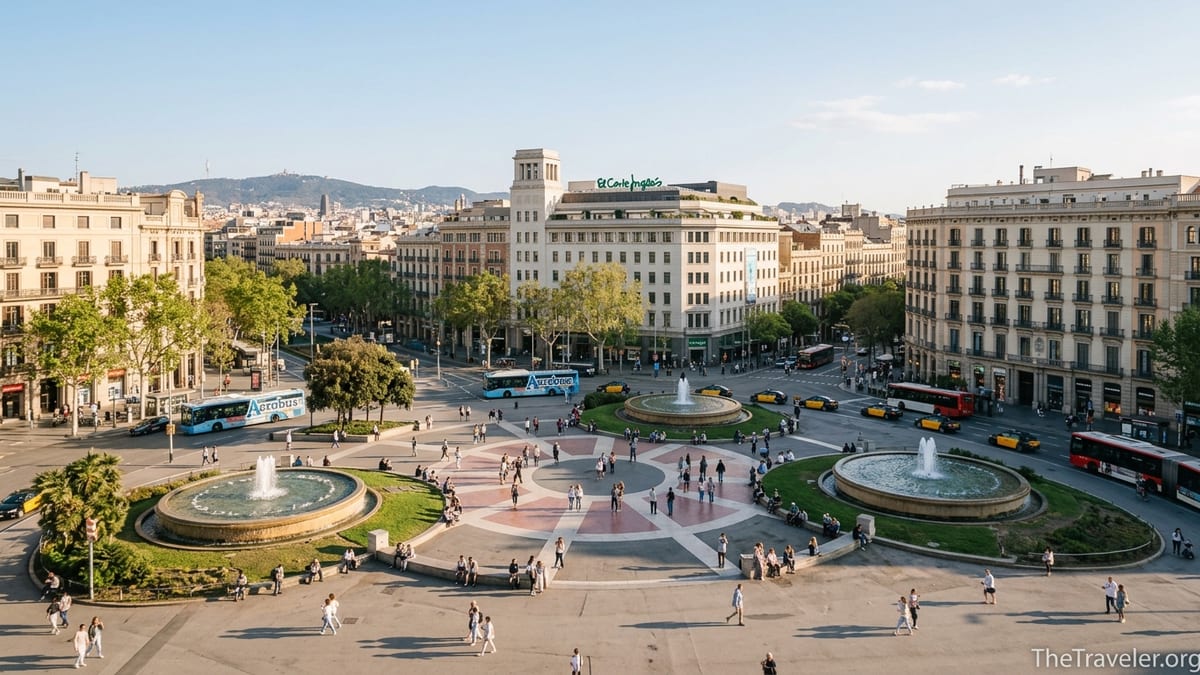
The Natural Heart and Orientation Point of Barcelona
Travelers keep coming back to Plaça de Catalunya because it works as an instant compass for the entire city. Geographically it sits between the historic core of the Barri Gòtic and El Raval and the grid of the Eixample. From the square’s central fountains you can literally see the city unfold in different directions: the wooded slopes of Montjuïc to one side, the elegant façades of Passeig de Gràcia on another, and the narrow streets leading into the Gothic Quarter just beyond the traffic lights.
In practical terms this means that many days in Barcelona begin or end here. A couple staying in an Airbnb near Passeig de Gràcia might walk five minutes down to the square each morning to decide whether to head toward the cathedral, the beach or up to Gaudí’s modernist landmarks. New arrivals often use Plaça de Catalunya as a mental reset button: if they get disoriented in the medieval backstreets, they simply follow signs or ask for “Plaça Catalunya” and navigate again from there.
The square’s size also contributes to its appeal. With open paved areas, sculptural groups and clusters of trees, it feels spacious even at busy hours. Visitors who arrive jet-lagged often pause on the low walls by the fountains, watching commuters flow past and children chase the many pigeons that have long been part of the scene. Within an hour of landing, they have a feel for Barcelona’s rhythm simply by sitting in this one spot.
A Powerful Transport Hub That Simplifies Every Trip
One of the most important reasons travelers return to Plaça de Catalunya is its role as a multi-layered transport hub. Under the paving stones lies one of Barcelona’s key station complexes, serving metro lines, suburban Rodalies trains and the Ferrocarrils lines that run toward Tibidabo and inland towns. For visitors, this translates into straightforward connections to many of the city’s biggest sights without complicated changes.
Metro lines serving the Catalunya station make it easy to switch between popular areas. A family staying near the Sagrada Família can ride the metro down, emerge on the square, then walk directly down La Rambla for a stroll to the waterfront. On another day they may transfer here to the Ferrocarrils heading toward Tibidabo for a day of funicular rides and panoramic views. Because so many routes cross under the plaza, it is common for visitors to find themselves changing trains here multiple times during a week-long stay.
Plaça de Catalunya also functions as a key node in the airport transfer network. The Aerobus service that links Barcelona–El Prat Airport with the city has long used the square as its main urban stop, and even temporary relocations during construction work tend to be only a short walk away. Many independent travelers choose this option because it is predictable, avoids the stress of navigating unfamiliar suburbs, and drops them right in the middle of the city where onward taxis, metro lines and hotels are close at hand.
On the surface, the square is a magnet for city buses and hop-on hop-off sightseeing services. It is common to see travelers comparing maps near the bus bays, deciding whether to take a public bus toward the beach in Barceloneta or to join a tourist route that loops past Camp Nou and the Olympic Ring. Because so many options start and end at Plaça de Catalunya, it becomes a repeated stop in any sightseeing schedule.
Gateway to Barcelona’s Iconic Boulevards and Neighborhoods
Another reason visitors constantly find themselves back in Plaça de Catalunya is that it anchors several of Barcelona’s most iconic streets. La Rambla, the tree-lined pedestrian boulevard that heads toward the sea, begins directly at the southern edge of the square. Many first-timers spend their first evening strolling from the fountains of Plaça de Catalunya down past flower stalls, living statues and café terraces toward the Columbus Monument and the port.
On the opposite side, the square spills into Passeig de Gràcia, one of Europe’s most elegant shopping avenues. Within ten to fifteen minutes on foot, travelers can reach Casa Batlló and La Pedrera, two of Antoni Gaudí’s most famous buildings. A typical day might see a visitor admire the modernist façades along Passeig de Gràcia in the morning, then return through the plaza on the way back to their hotel, stopping for an espresso at one of the corner cafés as rush-hour traffic builds around them.
The square also borders streets that lead directly into the Gothic Quarter and El Raval. From the northeastern corner, narrow lanes pull you into a maze of medieval alleys lined with indie boutiques and tapas bars, while the western side flows toward El Raval’s multicultural streets and the contemporary buildings of the MACBA. Because Plaça de Catalunya is the common starting point for all these very different atmospheres, travelers often trace their days in Barcelona as a series of loops that all begin and end here.
Even for repeat visitors who know the city well, the square remains the default rendezvous point. Friends flying in from different countries will often send a message reading “See you by the central fountain at 6,” knowing that no one will struggle to find it. From there they can decide spontaneously whether to dip into the old town, head for a rooftop drink or walk up to the Eixample for dinner in a trendy bodega.
Shopping, Rooftops and Everyday City Life
Plaça de Catalunya is also a powerful draw for travelers because it concentrates so many shopping and dining options into a compact area. On one side of the square stands the large El Corte Inglés department store, a magnet for visitors looking for Spanish brands, cosmetics and homeware. Many travelers pop in not only to browse the fashion floors but also to take advantage of practical services such as tax-free shopping counters and a well-stocked supermarket in the basement for picnic supplies.
Above the retail floors, the top levels of El Corte Inglés house a food court and café spaces that have become minor attractions in their own right. From here, visitors can enjoy panoramic views over the plaza and across the rooftops of the Eixample while sampling affordable dishes ranging from Iberian ham plates to paella-style rice, salads and pastries. A typical traveler might order a coffee and a slice of tortilla in the late afternoon, grab a window seat and watch the last Aerobus of the day roll into the square far below.
Around the perimeter of Plaça de Catalunya and on the first blocks of nearby streets, international chains mix with local boutiques. Shoppers can move quickly between well-known global brands and smaller Catalan labels without covering long distances. On a busy Saturday, it is not unusual to see visitors emerge from a sportswear store with a bag of FC Barcelona merchandise, cross the square to pick up gourmet turrón for gifts, then head up to the rooftop café to rest their feet.
Because these shops and eateries are not purely tourist-focused, they offer an authentic glimpse of day-to-day life in the city. Office workers queue at sandwich counters at lunchtime and families choose weekend outfits in the children’s sections. Travelers who return to Barcelona years later often remark that while individual shopfronts may change, the overall bustle of commerce around Plaça de Catalunya feels reassuringly familiar.
Festivals, Fountains and Everyday Spectacle
Beyond transport and shopping, Plaça de Catalunya keeps drawing visitors because something is almost always happening here. The square’s generous open space makes it an ideal stage for official celebrations, cultural programs and seasonal events that spill into the wider center. Over recent years, the city has used the plaza for large-scale activities that attract both locals and tourists, from open-air concerts to family-friendly workshops.
During the Christmas period, the square is often at the heart of the city’s festive programming. In recent seasons Barcelona has organized a dedicated Christmas festival here, with illuminated installations, performance areas and stalls selling crafts and treats. Travelers staying near the square can simply step outside after dark and be surrounded by music, families queuing for children’s activities and warm light reflecting off the fountains. It becomes a easy alternative to more crowded historic markets deeper in the old town.
Even outside specific events, the square itself offers a kind of ongoing street theater. Buskers set up at the edges with acoustic guitars, dancers rehearse choreographies near the trees and political groups occasionally gather for demonstrations. On sunny weekends, you might see a group of skaters practicing tricks at one corner while, on the opposite side, a city-sponsored information booth hands out maps and guides. For many travelers, these small unplanned moments are what make repeated visits to Plaça de Catalunya memorable.
The fountains and statues scattered around the plaza provide both visual interest and convenient meeting places. On hot summer days, children run through the spray when the wind shifts, while parents watch from nearby benches. Photographers often circle the central water features, trying to capture reflections of surrounding buildings in the ripples at golden hour. This constant interplay between formal civic design and everyday use is a big part of the square’s enduring charm.
A Safe, Central Base for First-Timers and Repeat Visitors
For many travelers, one of the practical reasons they gravitate toward Plaça de Catalunya is that staying nearby simplifies everything. Hotels, hostels and serviced apartments around the square offer direct access to transport while keeping major sights within walking distance. A couple visiting for a long weekend can comfortably see La Rambla, the Gothic Quarter, Passeig de Gràcia and parts of El Raval without using public transport at all, simply radiating out on foot from their accommodation near the plaza.
The area also feels active at most hours of the day, which many visitors interpret as an extra layer of comfort. Early in the morning, travelers catching the first Aerobus to the airport share the pavements with workers on their way to offices in the Eixample. Late into the evening, there are usually people waiting at taxi ranks, diners finishing late meals and groups of friends crossing between nightlife districts. While pickpocketing can be an issue anywhere in central Barcelona, the combination of wide open space, traffic and the steady presence of both tourists and locals means that Plaça de Catalunya rarely feels deserted.
This sense of centrality makes the square an excellent base for exploring beyond the city core as well. Visitors planning a day trip to Montserrat, Sitges or coastal towns often start by taking a short walk to the nearby regional train stations connected via Catalunya. After a day of hiking or beach time, they return to the same familiar square in the evening, grabbing a quick snack from a café or supermarket before heading back to their hotel.
Over time, frequent travelers to Barcelona often develop small rituals around Plaça de Catalunya. Some make a point of standing by the fountains to take a quick photo every trip, creating an informal visual diary of visits. Others always schedule their last coffee in Barcelona at one of the terrace cafes on the square, watching the constant movement of buses and pedestrians before heading out to the airport. The square turns from a simple transit node into a personal landmark that anchors travel memories.
The Takeaway
Plaça de Catalunya manages to be several things at once: a transport hub, shopping district, cultural stage and civic living room. It is the point where airport arrivals meet friends, where metro commuters emerge into sunlight and where visitors from around the world pause on benches to decide what to do next. Its utility is undeniable, but so is its atmosphere. The constant movement of people, the shifting light on façades and the sightlines down Barcelona’s grand avenues make it a place travelers rarely visit only once.
Whether you are planning your first trip to Barcelona or returning for the third or fourth time, chances are your path will cross Plaça de Catalunya more than any other spot in the city. Use it as your anchor: arrive from the airport, get your bearings, watch the crowds and set off in a new direction each day. In the process, you will likely find that this busy square quietly becomes the backdrop to many of your strongest memories of the Catalan capital.
FAQ
Q1. Where exactly is Plaça de Catalunya located in Barcelona?
Plaça de Catalunya sits at the junction between the historic old town and the Eixample district, roughly halfway between the waterfront and the upper parts of the city. It marks the point where La Rambla begins and where Passeig de Gràcia and several major streets converge, which is why it is often described as Barcelona’s central square.
Q2. Is Plaça de Catalunya a good area to stay for first-time visitors?
Yes, many first-time visitors choose accommodation around Plaça de Catalunya because it offers easy access to metro lines, airport buses, shops and key sights. From here you can walk to La Rambla, the Gothic Quarter, Passeig de Gràcia and parts of El Raval, which makes it especially practical for short stays of three to five days.
Q3. How do I get from Barcelona airport to Plaça de Catalunya?
The dedicated airport bus service, commonly known as the Aerobus, has long run frequent services between Barcelona–El Prat Airport and Plaça de Catalunya. Even during temporary changes to specific stop locations due to construction, services still terminate very close to the square, and staff on site can direct travelers to the correct boarding point.
Q4. What metro lines serve Plaça de Catalunya?
The station complex under Plaça de Catalunya is served by several metro and suburban rail lines, which connect the square to many neighborhoods and attractions. Visitors typically use these lines to reach areas such as Sagrada Família, Camp Nou, Montjuïc and the beachfront, often with a simple change or two using Catalunya as a central interchange.
Q5. Are there good shopping options at or near the square?
Yes, there are extensive shopping options around Plaça de Catalunya, including the large El Corte Inglés department store directly on the square and many international and local brands on surrounding streets. Travelers can find everything from fashion and electronics to gourmet food products and souvenirs within a few blocks.
Q6. Can I find affordable places to eat around Plaça de Catalunya?
The area around the square has a wide range of cafés, bakeries, fast-casual spots and sit-down restaurants at different price points. Many visitors choose the food hall and cafés on the upper floors of nearby department stores for reasonably priced meals with good city views, while side streets leading toward the Gothic Quarter and Eixample offer plenty of tapas bars and bistros.
Q7. Is Plaça de Catalunya safe at night?
Plaça de Catalunya is usually busy until late evening, with people changing transport, shopping or returning to hotels, and this steady activity contributes to a general feeling of safety. As in any major city center, travelers should still keep an eye on bags and pockets, especially in crowds and near metro entrances, but violent incidents are uncommon and the area is well lit.
Q8. What events or festivals take place in Plaça de Catalunya?
The city often uses Plaça de Catalunya for public events throughout the year, including cultural programs, open-air performances and seasonal celebrations. Around Christmas, for example, the square has hosted light installations, family activities and markets that attract both residents and tourists, turning the area into one of Barcelona’s main festive hubs.
Q9. Are there good viewpoints of the square?
Yes, some of the best viewpoints of Plaça de Catalunya are from the upper floors and rooftop cafés of nearby buildings, especially the larger department stores. From these vantage points, visitors can look down on the fountains, statues and intersecting avenues, and capture wide photos of the city’s central crossroads at different times of day.
Q10. How much time should I plan to spend at Plaça de Catalunya?
There is no fixed amount of time to spend at the square itself, since many visits are tied to passing through for transport or shopping. However, allowing at least an hour to sit by the fountains, explore nearby streets and perhaps visit a rooftop café will give you a good sense of why this space is considered the heart of Barcelona, and you will likely find yourself returning naturally throughout your stay.