


Plaça de Catalunya has long been described as the heart of Barcelona: a vast, triangular square where grand boulevards converge, flanked by department stores, historic cafes and constant movement. Yet as the city grapples with overtourism and rising local frustration, many visitors now wonder if it is still worth lingering here, or if it has become just a stressful place to change metros and catch the Aerobús to the airport. In 2026, the reality lies somewhere in between: Plaça de Catalunya remains a busy transport interchange, but it also offers views, food and people-watching that can enrich a stay in Barcelona when approached with realistic expectations.
Get the latest updates straight to your inbox!
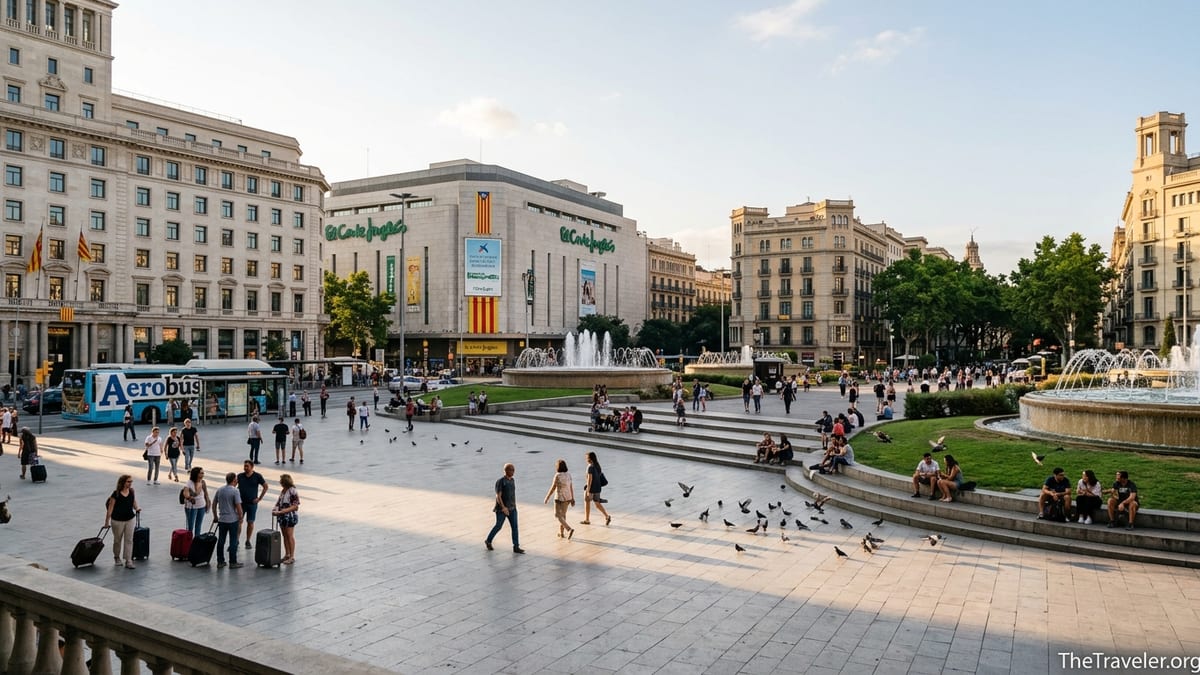
The Square at the Center of Everything
Plaça de Catalunya sits between the medieval streets of the Gothic Quarter and El Raval to the south, and the 19th century Eixample grid to the north. Stand in the middle of the square and you can physically see Barcelona’s layers: the shaded entrance to La Rambla on one side, the elegant Passeig de Gràcia stretching toward Gaudí’s Casa Batlló and La Pedrera on the other. For most visitors, it is the first open space they encounter after emerging from the metro or the Aerobús, and the place where they orient themselves in the city.
This role as a crossroads is not new. The modern square was laid out in the early 20th century as a monumental civic space, and it has since hosted demonstrations, celebrations and open-air concerts. Today the fountains, stone benches and statues still anchor that sense of grandeur, even if the constant roll of wheeled suitcases and tour groups can distract from the architecture. On a sunny afternoon, you may see office workers cutting across the plaza, teenagers sitting on the steps around the fountains and families pausing to let children chase pigeons.
For a first-time visitor, a short stop in the square helps you understand Barcelona’s geography. You can mentally map that a ten-minute walk down La Rambla leads to the Columbus Monument and the port, while a similar walk up Passeig de Gràcia reaches some of the city’s most famous Modernista buildings. Many guided walking tours of the Old City either begin or end in or near Plaça de Catalunya precisely because it is such an obvious meeting point that almost every traveler can find.
Transit Hub: Useful, Crowded and Sometimes Overwhelming
In practical terms, Plaça de Catalunya is one of Barcelona’s key transport interchanges. Beneath the square lies the Catalunya station, where metro lines L1 (red) and L3 (green) come together, alongside regional Rodalies trains and FGC suburban lines such as L6 and L7. For travelers, this means you can get here directly from neighborhoods such as Sants, Gràcia or Sant Andreu with a single metro ride, and then walk to your hotel in the center without needing a taxi.
Above ground, the square is the terminus for the Aerobús, the dedicated airport bus that links central Barcelona with both terminals at El Prat. Services typically run every few minutes during the day, and the ride into town often takes around 35 minutes depending on traffic. For many visitors arriving with luggage, the routine is now almost automatic: step off the plane, follow the Aerobús signs, buy a ticket from the machines or driver, and ride to Plaça de Catalunya before switching to the metro or walking to nearby accommodation in El Raval or the Gothic Quarter.
The same connectivity that makes Plaça de Catalunya convenient can also make it feel exhausting. At peak times, especially mid-morning in high season and early evening on weekdays, sidewalks around the bus stops and metro entrances can become extremely congested. Lines for the Aerobús can snake across the pavement, tour groups cluster under shaded corners with their guides, and commuters try to push through. It is not unusual to see newly arrived travelers standing to the side with a suitcase, scrolling on their phones to figure out which direction to walk, only to be buffeted by the flow of people.
If you are expecting a serene square, you will likely be disappointed. But if you treat it as a practical gateway that happens to offer some worthwhile detours, the crowds become more tolerable. Many repeat visitors now use Plaça de Catalunya primarily for transit, but deliberately schedule their strolls and photo stops early in the morning or later in the evening, when the intensity drops and the square’s lines and fountains are easier to appreciate.
What You Actually See and Feel on the Ground
Visually, Plaça de Catalunya is dominated by large stone buildings and open sky rather than ornate monuments. Long, pale paving slabs reflect the light, especially on clear days, creating a bright, almost Mediterranean glare in late morning. The fountains, which often run throughout the day, add a sense of coolness and movement, while flocks of pigeons give the square a slightly chaotic, lived-in quality. For photographers, the most compelling images tend to come from the edges, where you can frame a fountain, a statue and the surrounding buildings together.
The immediate surroundings are commercial rather than atmospheric: you will find the El Corte Inglés department store occupying one entire side of the square, several global fast-food chains, chain coffee shops and a few more traditional cafes radiating into the nearby streets. For some travelers this is a drawback compared with the narrow lanes of the Gothic Quarter, but for others it makes the square a practical place to pick up basics such as a Spanish SIM card, a pair of forgotten sunglasses or a quick takeaway coffee before a day of sightseeing.
The mood shifts with the time of day. Around 8 or 9 a.m. on a weekday, you might share the square mostly with commuters and local students heading for buses and trains, which gives it a more “everyday city life” feel. By late morning in peak season, groups from cruise ships and organized tours start to arrive, often identifiable by colored lanyards and listening devices. In the evening, you may encounter buskers playing guitar near the metro entrances, small street performances and couples sitting on the edge of the fountains watching the sky fade over the rooftops.
Occasionally, Plaça de Catalunya is also a stage for demonstrations and rallies, especially around political events or on dates such as Catalonia’s National Day. In recent years, protests linked to housing costs and overtourism have sometimes passed through central squares, and visitors might see banners or hear chants. Most of these gatherings are peaceful and well-policed, but they are a reminder that for locals, this is not just a postcard setting but a civic space where real city tensions play out.
Views and Food: The Rooftop Factor
One reason Plaça de Catalunya remains attractive for many travelers is hidden above street level. The top floors of the El Corte Inglés store house a large, modern food court area often referred to as La Plaça Gastro Mercat or La Plaça Gourmet Cafeteria. From here, floor-to-ceiling windows and some terrace seating offer sweeping views over the rooftops of the Gothic Quarter, the towers of the cathedral, and the long line of Passeig de Gràcia disappearing toward the hills. On clear days you can even glimpse Tibidabo in the distance.
The food options in this space cater more to convenience than fine dining, but they cover a wide range: Spanish-style tapas plates, paella portions suitable for solo travelers, salads, burgers, sushi, and pastries. Recent visitors describe paying roughly 10 to 15 euros for a plate of paella or a combo meal, which is not the cheapest in Barcelona but reasonable given the central location and the view. Because it operates as a self-service cafeteria, it is easy to mix and match smaller dishes, making it a practical stop if different members of a group want different cuisines.
For many, the rooftop becomes a sort of urban observatory. Travelers who arrive just before sunset can choose a table by the window, order a drink or dessert and watch the sky gradually tint pink above the city’s mix of old and new buildings. Photography enthusiasts come up for wide, high-angle shots of the square below and the surrounding streets. Solo travelers often appreciate the low-pressure seating, where you can linger over a coffee with a guidebook or simply rest your feet after a long day without the formality of a sit-down restaurant.
Because this rooftop is inside a department store and accessed by elevator, it is also a useful fallback on days of hot sun, wind or light rain. Even when the ground-level square feels too exposed or hectic, the top-floor food court can be relatively calm, offering a chance to regroup, check maps, plan the next metro connection and decide whether to head toward La Rambla, Passeig de Gràcia or the smaller streets of El Born.
Shopping and Services: Practical Rather Than Picturesque
If your mental image of a European city square is a ring of independent cafes and artisan boutiques, the commercial reality around Plaça de Catalunya might feel underwhelming. Much of the square’s perimeter is occupied by large, modern retail buildings: the flagship El Corte Inglés, fashion chains, bank branches and travel agencies. That said, these services can be extremely useful, especially at the beginning or end of a trip.
Inside El Corte Inglés, travelers will find multiple floors of clothing, electronics, luggage, cosmetics, home goods and a supermarket section in the basement. This is the kind of place where you can replace a broken suitcase, pick up a plug adapter, buy extra baby supplies or grab Spanish snacks for a train journey. Visitors have noted that prices are not bargain-basement, but the convenience of having everything under one roof in a central, easily navigable location can outweigh the cost, particularly when time is limited.
Plaça de Catalunya also concentrates essential services that independent travelers often need. Several mobile phone providers maintain retail outlets in or just off the square, so you can arrange an eSIM or physical SIM for Spain and the wider EU within an hour of arriving. Tourist information offices nearby can supply free city maps, metro diagrams and advice on current events or museum opening hours. Banks and ATMs around the square allow you to withdraw euros, though it is still wise to check withdrawal fees with your own bank before you travel.
For many visitors, this practical side of Plaça de Catalunya becomes part of the first-day ritual: change some money if necessary, buy or top up a T-usual or similar transport card for the metro and buses, stock up on groceries at the supermarket in El Corte Inglés, and then walk to their accommodation. None of this is particularly glamorous, but it can make the rest of the stay smoother, freeing up time later for exploring neighborhoods that feel more distinctively Barcelonian.
Safety, Scams and Crowd Management
As one of Barcelona’s busiest public spaces, Plaça de Catalunya understandably attracts pickpockets and opportunistic scams. While the square is not inherently dangerous, visitors should keep baseline big-city precautions in mind. The most common issues involve distraction thefts: someone may ask for directions, bump into you near a metro entrance, or create a commotion while an accomplice tries to access a bag or pocket. Travelers who sling a backpack over one shoulder or keep wallets in back pockets are particularly vulnerable in crowded spots around the bus stops or ticket machines.
Simple habits help. Many regular visitors keep valuables in a money belt or an interior zipped pocket, wear a crossbody bag positioned in front, and avoid placing phones on tables unattended. When using the Aerobús ticket machines or topping up a metro card, it is sensible to keep one hand on your luggage and to avoid displaying large amounts of cash. If someone approaches offering unsolicited help with a ticket machine, it is perfectly acceptable to decline politely or to seek assistance from uniformed staff instead.
Police presence in and around Plaça de Catalunya is usually visible. Patrol cars, officers on foot and sometimes mounted police circulate through the square, especially during busy hours and in high season. This can be reassuring, though it does not eliminate petty theft entirely. Recent visitor reports often describe feeling generally safe in the area, even at night, while still noting the need to stay alert in crowds and on public transport.
Another factor that shapes the experience here is the broader conversation about mass tourism in Barcelona. In the last few years, images of protests and slogans targeting overtourism have circulated widely on social media, sometimes creating the impression that visitors are not welcome. On the ground in Plaça de Catalunya, what most travelers actually encounter are everyday residents passing through, staff working in shops and cafes, and other visitors. Respectful behavior, such as avoiding noisy drinking in the square late at night, not blocking pavements with luggage and being considerate when photographing people, goes a long way toward maintaining a positive atmosphere.
How to Make Plaça de Catalunya Worth Your Time
The key to appreciating Plaça de Catalunya in 2026 is to adjust your expectations and use it strategically. Rather than planning to spend half a day here, consider it a 30- to 90-minute stop built around something practical you already need to do. For example, you might ride the Aerobús from the airport, drop into El Corte Inglés to buy a metro pass and some snacks, then head up to the rooftop food hall for a light lunch with a view before walking down Passeig de Gràcia toward Casa Batlló.
Timing makes a difference. If your schedule allows, visit early in the morning on a weekday for a quieter look at the architecture and statues, or aim for the golden hour before sunset for photographs and a drink overlooking the skyline. Midday in high summer can be the least pleasant time, not only because of the crowds but also the heat radiating from the paving. On particularly hot days, many travelers now opt to treat Plaça de Catalunya purely as a transport node, passing through quickly on their way to cooler, tree-shaded streets deeper in the Eixample or along the waterfront.
It can also help to combine the square with nearby attractions that contrast with its atmosphere. From the north side, you are a short, straightforward walk from the first Modernista buildings on Passeig de Gràcia; from the south, La Rambla and the entrance to the Gothic Quarter lie just a few minutes away. Many visitors now treat Plaça de Catalunya as a “hub and spoke” starting point: take a quick look, sort out practical matters, then walk out along one of the connecting avenues to experience the parts of the city they truly came to see.
For returning travelers, Plaça de Catalunya may hold more emotional than aesthetic value. People who first visited Barcelona years ago often describe a particular sensation when they emerge into the square again: the sound of water in the fountains, the familiar outline of the surrounding buildings and the sense of the city radiating in all directions. Even if they no longer linger for long, the square still feels like a marker that they have arrived in Barcelona.
The Takeaway
So is Plaça de Catalunya still worth visiting, or has it become just a hectic transit hub? The answer depends on what you expect from it. If you are looking for an intimate, charming plaza lined with independent cafes and quiet corners, you will likely be happier elsewhere in Barcelona, in neighborhoods such as Gràcia or in smaller squares within the Gothic Quarter. Plaça de Catalunya is big, busy and unapologetically urban, more about movement and logistics than romance.
However, if you treat the square as a functional gateway that also offers a few rewarding moments, it still earns its place on a thoughtful itinerary. The rooftop views from El Corte Inglés, the convenience of the Aerobús and the metro connections, and the chance to watch the city pulse around you for a short while all add dimension to a stay in Barcelona. Use it to get your bearings, to regroup between sights and to see how locals and visitors intersect in the city’s daily life.
In 2026, Plaça de Catalunya is not the most beautiful or atmospheric place in Barcelona, but it remains one of the most useful and revealing. A brief, intentional visit can give you a sense of how the city works, while leaving plenty of time to explore the more distinctive streets and squares that lie only a few minutes’ walk away.
FAQ
Q1. Is Plaça de Catalunya safe to visit, especially at night?
In general, Plaça de Catalunya is busy and feels reasonably safe, including in the evening, thanks to regular foot traffic and visible police patrols. The main concern is pickpocketing rather than violent crime, so standard big-city precautions are important, such as keeping bags zipped, avoiding displaying valuables and staying alert in crowded areas around metro entrances and bus stops.
Q2. How do I get from Barcelona Airport to Plaça de Catalunya?
The most straightforward option is the Aerobús, which runs from both airport terminals to Plaça de Catalunya in roughly 35 minutes depending on traffic. You can buy tickets from machines, online or directly from the driver. Alternatively, you can take the airport metro line and change to L1 or L3 to reach Catalunya station, or use the suburban train to Passeig de Gràcia and walk about ten minutes to the square.
Q3. Is Plaça de Catalunya a good place to stay in Barcelona?
Staying near Plaça de Catalunya is very practical if you prioritize transport connections and centrality. You will be within walking distance of La Rambla, the Gothic Quarter and Passeig de Gràcia, and you can easily reach the airport and other neighborhoods by metro or bus. However, the area can be noisy and busy, so light sleepers or travelers seeking a more residential atmosphere might prefer nearby districts like Eixample or Gràcia and visit the square when needed.
Q4. Are there good food options around Plaça de Catalunya?
The immediate square is dominated by chains and fast-food outlets, but there are worthwhile options. The rooftop food court inside El Corte Inglés offers a range of dishes from paella portions to sushi and burgers, with excellent views over the city. In the surrounding streets toward the Gothic Quarter and Eixample, you will also find cafes, bakeries and more traditional restaurants within a five- to ten-minute walk.
Q5. Can I get good city views from Plaça de Catalunya?
At ground level, views are mostly of the square itself and surrounding buildings. For more impressive panoramas, head to the top floor of El Corte Inglés, where large windows and some terrace areas overlook the rooftops of the Old City, Passeig de Gràcia and, on clear days, the hills behind Barcelona. Many visitors consider this rooftop outlook one of the main reasons to linger in the area.
Q6. Is Plaça de Catalunya worth visiting if I am short on time?
If your time in Barcelona is very limited, you do not need to spend long in Plaça de Catalunya, but it is still likely to feature in your trip because of its role as a transport hub. A brief stop to get your bearings, pick up a transport card or enjoy the rooftop view can be worthwhile, especially since the square connects quickly to major sights along La Rambla and Passeig de Gràcia.
Q7. What is the best time of day to visit Plaça de Catalunya?
Early morning and the hour before sunset are generally the most pleasant times. Mornings tend to be quieter, with more locals commuting than tour groups, while the evening light is ideal for photos of the fountains and surrounding architecture. Midday, especially in high season, can feel hot and congested, so many travelers choose to pass through quickly during that period rather than linger.
Q8. Are there public toilets in or near Plaça de Catalunya?
Dedicated public toilets directly in the square are limited, but visitors often make use of facilities in nearby cafes, fast-food restaurants or inside El Corte Inglés, where restrooms are signposted on several floors. It is customary in Spain to buy at least a drink or small item if you use a private establishment’s facilities, so plan a short cafe stop if you know you will need a restroom.
Q9. Does Plaça de Catalunya host events or protests I should be aware of?
Plaça de Catalunya is a common gathering point for demonstrations, cultural events and celebrations, especially on major dates in the Catalan and Spanish calendar. Most are peaceful and well-organized, but they can lead to temporary crowding or disruptions to traffic and public transport. If you are visiting during a significant holiday or when protests are in the news, it is worth checking local information sources for any planned events in the square.
Q10. Is Plaça de Catalunya suitable for families with children?
The open space, fountains and wide pavements can appeal to children who want to run around a little after being on a plane or train, and there are benches where parents can sit and supervise. However, the area around the bus stops and metro entrances can get very crowded, so it is important to keep a close eye on younger children and hold hands when crossing busy sections. Many families find it works best as a short stop or meeting point rather than a place to spend extended time.