


Few European cities are as defined by their public squares as Barcelona, and two of its most emblematic are Plaça de Catalunya and Plaça Reial. One is the city’s beating transport and shopping hub, the other an intimate palm-lined courtyard famous for nightlife and neoclassical arcades. Both leave a mark on visitors, but in very different ways. If you only have limited time in Barcelona, which square is likely to leave a bigger impression on you?
Get the latest updates straight to your inbox!
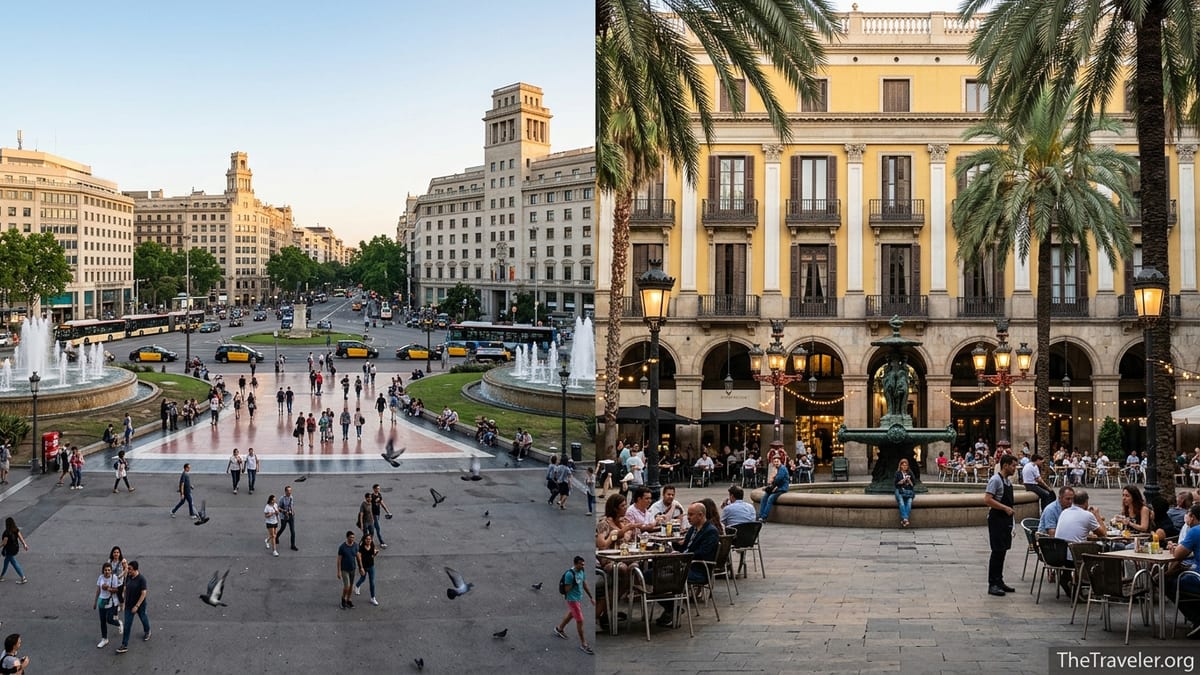
First Impressions: City Hub vs Hidden Courtyard
Arriving at Plaça de Catalunya, most travelers feel they have landed in the center of Barcelona’s universe. This is where the city’s wide Eixample boulevards meet the medieval streets of the Gothic Quarter and El Raval. Buses, taxis and commuters swirl around a broad open space lined with department stores, banks and hotels. Fountains spray into the air, pigeons circle in chaotic flocks and street performers occupy the corners. It feels busy, practical and urban, less a postcard and more a real European city square doing real work.
Plaça Reial could not be more different in how you first encounter it. Walking down La Rambla, you duck through a short passageway near the Liceu metro and suddenly emerge into a porticoed, palm-filled courtyard that feels almost theatrical. Yellow-painted neoclassical buildings with wrought-iron balconies rise above a central fountain, flanked by elegant lampposts designed by a young Antoni Gaudí. The space is enclosed, human-scaled and instantly photogenic. Many visitors remember the surprise of that first step into the square as one of their standout Barcelona moments.
For some travelers, the scale and energy of Plaça de Catalunya is what defines Barcelona: a big, confident Mediterranean metropolis. For others, the atmosphere of Plaça Reial, with its shaded terraces and echo of live music at night, creates a more vivid emotional memory. Your own first impression will likely depend on whether you are more drawn to urban drama or to intimate architectural set pieces.
In practical terms, you are almost certain to cross Plaça de Catalunya at least once if you use public transport or airport buses, while Plaça Reial still feels like a discovery, especially if you wander La Rambla without studying a map in advance.
Architecture & Atmosphere: Open Monument vs Neoclassical Theater
Architecturally, Plaça de Catalunya is a broad, open composition more about vistas than about the buildings themselves. Several grand early 20th-century facades house banks, offices and the flagship branches of chains like El Corte Inglés. Sculptures dot the square, and large circular and rectangular fountains anchor the space, but it remains essentially a transit plateau. Its beauty is more apparent in the golden light of late afternoon, when the stone glows and office workers pause on benches, than under the harsh midday sun.
Plaça Reial is the opposite: a tightly framed neoclassical set-piece built in the mid-19th century to replace a demolished Capuchin convent. Uniform facades create a continuous arcade at ground level, now home to busy restaurants and bars. Above, regularly spaced balconies and shuttered windows lend rhythm and order. Tall palm trees punctuate the interior, while the central “Three Graces” fountain and Gaudí’s ornate lampposts provide sculptural focus. Taken together, it feels like a ready-made film set; photographers often come at sunrise to capture the square empty of crowds.
The atmosphere follows the architecture. Plaça de Catalunya is extroverted and noisy, with traffic circulating around it and people continuously crossing. Street musicians may play on the edges but you rarely linger in the center for more than a few minutes. By contrast, Plaça Reial is inward-looking. Sitting at a terrace table under the arches, you may spend an hour watching kids chase pigeons around the fountain, guitarists setting up for an evening set and waiters weaving between tightly packed tables.
If architectural coherence and a strong sense of place matter to you, Plaça Reial almost always leaves the stronger visual impression. Plaça de Catalunya’s impact comes less from beauty and more from scale and function, like standing in the middle of a living transport diagram.
Location & Connectivity: Why Plaça de Catalunya Dominates Your Itinerary
From a traveler’s logistics point of view, Plaça de Catalunya is the main compass point of Barcelona. The Aerobús from the airport, airport trains via nearby Passeig de Gràcia, regional FGC lines and several metro lines all meet here. An underground complex of platforms sits beneath the square, and above ground, multiple city bus lines terminate along its edges. If you are staying only a couple of nights and arriving without a car, this is almost certainly your first major landmark in the city.
Walk a few minutes in any direction and you reach key areas: south along La Rambla towards the Gothic Quarter and the waterfront, north along Passeig de Gràcia to reach Gaudí’s Casa Batlló and La Pedrera, or east along the pedestrian shopping street Portal de l’Àngel towards Barcelona Cathedral. It is very common, for example, to arrive via Aerobús at Plaça de Catalunya, walk five minutes down Portal de l’Àngel to your hotel near the Gothic Quarter, and later return to the square to catch a bus to Park Güell.
Plaça Reial, by contrast, is more of a delightful detour than a transit node. It sits just off the lower section of La Rambla in the Gothic Quarter. The nearest metro stop, Liceu, is about two or three minutes away on foot. From the square you can walk to the waterfront and Barceloneta beach in around 15 to 20 minutes, or to Barcelona Cathedral in roughly 10 minutes. This makes it a wonderful base if you want to be embedded in the old city, but you will usually pass through Plaça de Catalunya, or at least its surrounding streets, when changing between neighborhoods.
Because of this, Plaça de Catalunya often leaves a bigger impression in terms of mental mapping: visitors recall it as “where everything started and connected.” Even if Plaça Reial is more charming, it is entirely possible to miss it if you do not venture off La Rambla into the side passages. In short, Catalunya shapes how you navigate Barcelona, while Reial shapes how you feel Barcelona.
What You Actually Do There: Shopping, Strolling or Lingering Over Tapas
What you end up doing in each square strongly colors which one you remember more vividly. Around Plaça de Catalunya, activity centers on shopping and transit. On the north and east sides of the square, major department stores and international brands pull in crowds. Portal de l’Àngel, leading from the square towards the Gothic Quarter, is one of Spain’s most sought-after retail streets, lined with fashion names and shoe stores. Many travelers stop here to pick up practical items, from a replacement suitcase wheel to extra layers in winter sales.
You might, for instance, arrive mid-morning from the airport, roll your luggage into a hotel just off Plaça de Catalunya, and then walk across the square to buy a local SIM card in a phone shop. After a first exploratory stroll down La Rambla and through the Boqueria market, you return via the square to have a quick coffee at a chain café before hopping on the metro. The memories you form are about movement, errands and the sense of joining local commuters rather than long, lazy pauses.
Plaça Reial, on the other hand, is built for lingering. Almost its entire perimeter is a ring of terraces: tapas bars, mid-range restaurants, cocktail lounges and a few more casual spots serving patatas bravas, calamari and jugs of sangria or local vermut. Prices here are higher than in less central neighborhoods; paying the equivalent of 4 to 6 euros for a small beer or soft drink on the terrace is common, with main dishes often starting around the mid-teens in euros. You are paying for the setting as much as for the food.
A typical evening might see you secure a table just before sunset, order a couple of tapas plates and a glass of cava, and simply watch the square transition from daytime families and tour groups to couples and groups of friends heading out for the night. Street musicians often drift through, and on some nights you may hear fragments of flamenco guitar or see a busker juggling near the fountain. For many visitors, that slow immersion in the square’s rhythm is what lingers in memory long after the details of what they ate have faded.
Day vs Night: When Each Square Shows Its Character
By day, Plaça de Catalunya is at its most functional. Office workers cut diagonally across the paving slabs, tourists consult maps and children chase pigeons near the fountains. This is a good time to appreciate its role as a civic space: demonstrations, cultural events and public celebrations are often staged here, and you may stumble upon temporary installations or market stalls around local festivals. In the early morning, before the buses and crowds build, photographers sometimes capture the fountains and sculptures under soft light with relatively few people around.
At night, however, Plaça de Catalunya quiets down compared with the surrounding streets. Traffic continues to circulate and buses run late, but few people linger in the center after dark. The square feels like a large, illuminated roundabout anchoring the city rather than a destination in its own right. If you are staying in a hotel overlooking the square, you may enjoy night-time fountain views from above, but you are unlikely to choose the benches here for a late drink.
Plaça Reial is the reverse. During the morning, it is calmer and can feel almost relaxed. Café terraces host breakfast plates and cortados, and hotel guests emerge slowly. Around lunchtime, tour groups begin to arrive, taking photos of the fountain and Gaudí lampposts, but there is often still space to sit in the shade. In high summer, siesta hours can be surprisingly quiet as the sun beats down into the square.
After dark, Plaça Reial truly comes into its own. Restaurants fill, queues form outside well-known music venues like the long-running jazz club Jamboree, and the soundscape shifts to a mix of clinking glasses, snatches of conversation in multiple languages and bass lines from bars under the arcades. It can feel intoxicating, especially on a warm summer evening. For travelers who go out at night in Barcelona only once or twice, an evening in Plaça Reial can easily overshadow daytime impressions of Plaça de Catalunya.
Costs, Crowds & Safety: What to Expect in Each Square
Both squares are extremely central and, as a result, crowded and touristed much of the year. This has consequences for prices and for how carefully you should look after your belongings. Around Plaça de Catalunya, cafés and restaurants on the immediate perimeter often charge more than comparable spots just a few streets away. The same applies to retail: flagship stores here rarely have the deepest discounts compared with outlets farther afield, although seasonal sales can still offer good value.
Plaça Reial’s terraces are known for being relatively expensive for what they offer. Paying a couple of euros more for the same espresso or beer than in a local bar in a residential neighborhood is common. Some visitors accept this premium as the cost of occupying a table in such a spectacular setting. Others choose to eat in nearby side streets of the Gothic Quarter, where independent tapas bars and small bistros often provide better price-to-quality ratios, then return to the square afterwards just for a drink.
In terms of safety, Barcelona is generally considered safe in terms of violent crime, but both squares sit in areas frequently cited for pickpocketing and petty theft. Around Plaça de Catalunya, the crowds generated by metro entrances, airport buses and shopping streets create classic conditions for distraction-based theft: a spill on a jacket, someone asking for signatures, or jostling near escalators. Simple precautions like keeping your phone in a zipped front pocket, wearing your bag across your body and avoiding leaving wallets or phones on café tables go a long way.
Plaça Reial, particularly late at night, requires the same awareness you would bring to any busy nightlife zone in a major European city. The mix of crowded terraces, people drinking and narrow exits under the arcades provides opportunities for quick grabs of bags or jackets. Many locals suggest enjoying the square but not lingering alone in the small hours. Families and daytime visitors generally find both squares comfortable, but if you are traveling with children you may want to visit Plaça Reial earlier in the evening and avoid the latest weekend hours when the atmosphere becomes more overtly party-oriented.
Who Each Square Suits Best
For first-time visitors who want to get their bearings quickly and cover a lot of ground, Plaça de Catalunya is hard to beat. Staying in a hotel or apartment within a five- or ten-minute walk gives you straightforward access to most of the city: you can roll your suitcase from the airport bus, walk to both the Gothic Quarter and Eixample, and use the square as a fixed reference point whenever you are lost. Travelers who appreciate big-city energy, easy public transport connections and straightforward shopping will likely find that Plaça de Catalunya defines their Barcelona experience.
Plaça Reial speaks more directly to travelers who prioritize atmosphere over convenience. Couples on a romantic break, architecture enthusiasts and night owls are often captivated by its combination of arcades, palms and nightlife. If you choose accommodation in or near the Gothic Quarter and spend evenings exploring wine bars and small restaurants, Plaça Reial may become your de facto living room, a place you cross or sit in every night even if you sleep on a quieter side street nearby.
Budget-conscious travelers may feel more ambivalent about Plaça Reial. It is a wonderful place for one splurge drink or an atmospheric breakfast, but regularly dining here can eat into your budget quickly. Plaça de Catalunya, by contrast, gives you immediate access to a wider range of price points, from fast-food chains and inexpensive bakeries to mid-range sit-down restaurants on neighboring streets.
Solo travelers might find Plaça de Catalunya more comfortable after dark simply because it remains more of a transit space; you are rarely the only person moving briskly to or from the metro. That said, many solo visitors also enjoy an early evening drink in Plaça Reial, leaving before the nightlife becomes intense. Your personality and travel style play an important role in determining which square feels “yours.”
The Takeaway
So which Barcelona square leaves a bigger impression, Plaça de Catalunya or Plaça Reial? In practice, they imprint in different ways. Plaça de Catalunya is the city’s central nervous system, the place where your airport bus arrives, where you change from metro to regional trains, and where major shopping streets radiate outwards. Its memory is tied to movement, orientation and the sensation of being in the middle of a large, modern Mediterranean metropolis.
Plaça Reial, by contrast, is where time seems to slow. The neoclassical arcades, Gaudí lampposts, palm trees and central fountain create a setting that feels uniquely “Barcelona.” Add the buzz of terraces and nightlife, and you have a square that many visitors recall instantly when they picture the city years later. If you ask a traveler for their most vivid square memory, they are more likely to describe sipping a drink in Plaça Reial than waiting for a bus in Plaça de Catalunya.
If your priority is efficiency and connectivity, Plaça de Catalunya will probably matter more to your trip. If what you seek is a scene that feels cinematic, romantic or distinctly local, Plaça Reial usually leaves the deeper emotional mark. The ideal Barcelona visit includes both: mornings crossing Plaça de Catalunya on your way to museums and neighborhoods, and at least one long evening under the palms of Plaça Reial, watching the square’s life unfold around you.
FAQ
Q1. Which square is better to stay near for a first visit, Plaça de Catalunya or Plaça Reial?
For a first visit, staying near Plaça de Catalunya is generally more practical because you are close to major transport links, airport buses and several neighborhoods, though staying near Plaça Reial offers a more atmospheric old-town experience if you prioritize nightlife and character over convenience.
Q2. Is Plaça Reial safe at night?
Plaça Reial is busy and generally feels safe for most visitors, but like any nightlife hub you should watch your belongings, avoid displaying valuables and try not to walk alone in the very late hours when crowds thin and people have been drinking.
Q3. Are restaurants in Plaça Reial very expensive?
Prices in Plaça Reial are higher than in many residential neighborhoods; you can expect to pay a noticeable premium for drinks and meals compared with streets a few minutes’ walk away, essentially paying extra for the prime location and historic setting.
Q4. Can I reach both squares easily by metro?
Yes, Plaça de Catalunya is served by multiple metro and train lines in a major underground hub, while Plaça Reial is a short walk from Liceu metro station on La Rambla, making both accessible even if you stay in other parts of the city.
Q5. Which square is better for families with children?
Plaça de Catalunya offers more open space for children to run around, easy access to public transport and daytime activity, while Plaça Reial can be enjoyable earlier in the day but becomes crowded and focused on nightlife later, which some families may prefer to avoid.
Q6. Where will I find better shopping, near Plaça de Catalunya or Plaça Reial?
Plaça de Catalunya is the better base for shopping, with major department stores on the square and busy retail streets like Portal de l’Àngel and Passeig de Gràcia beginning nearby, while Plaça Reial itself is more about dining and nightlife than shopping.
Q7. Are there notable landmarks to see in each square?
In Plaça de Catalunya, the main landmarks are the fountains, sculptures and surrounding historic facades, while in Plaça Reial the key features are the neoclassical arcades, central fountain, palm trees and the ornate lampposts designed by Antoni Gaudí.
Q8. Which square is better for photography?
Plaça Reial is typically more rewarding for photography because of its symmetrical arcades, palm trees and central fountain, especially at sunrise or early evening, whereas Plaça de Catalunya works best for capturing the scale and movement of the city rather than detailed architectural shots.
Q9. Can I easily walk between Plaça de Catalunya and Plaça Reial?
Yes, walking between the two squares is straightforward; it usually takes around 10 to 15 minutes at a relaxed pace along La Rambla or nearby side streets, so you can comfortably include both in a single outing.
Q10. If I only have one evening in Barcelona, which square should I choose?
If you have just one evening, most travelers will find Plaça Reial more memorable, as dining or having a drink under its palm trees and arcades captures the city’s atmosphere in a way that tends to stay with you longer than a visit to Plaça de Catalunya.