


Naples is a city of castles, but two fortresses dominate most first-time itineraries: seafront Castel dell’Ovo and hilltop Castel Sant’Elmo. Both are free or affordable, both come wrapped in centuries of legend and military history, and both promise sweeping views of the Bay of Naples. Yet they leave very different impressions on travelers. This guide compares the two in practical, on-the-ground terms so you can decide which fortress deserves your limited time, or how to experience both without rushing.
Get the latest updates straight to your inbox!
First Impressions: Sea-Level Legend vs Hilltop Citadel
Your emotional response to each fortress usually starts with how you arrive. Castel dell’Ovo rises almost directly from the water at the end of a short causeway, framed by fishing boats and restaurant terraces. From the Lungomare promenade you see its pale stone walls jutting into the bay, with Vesuvius in the background. It feels approachable and human scale, more like a village bastion than an intimidating stronghold.
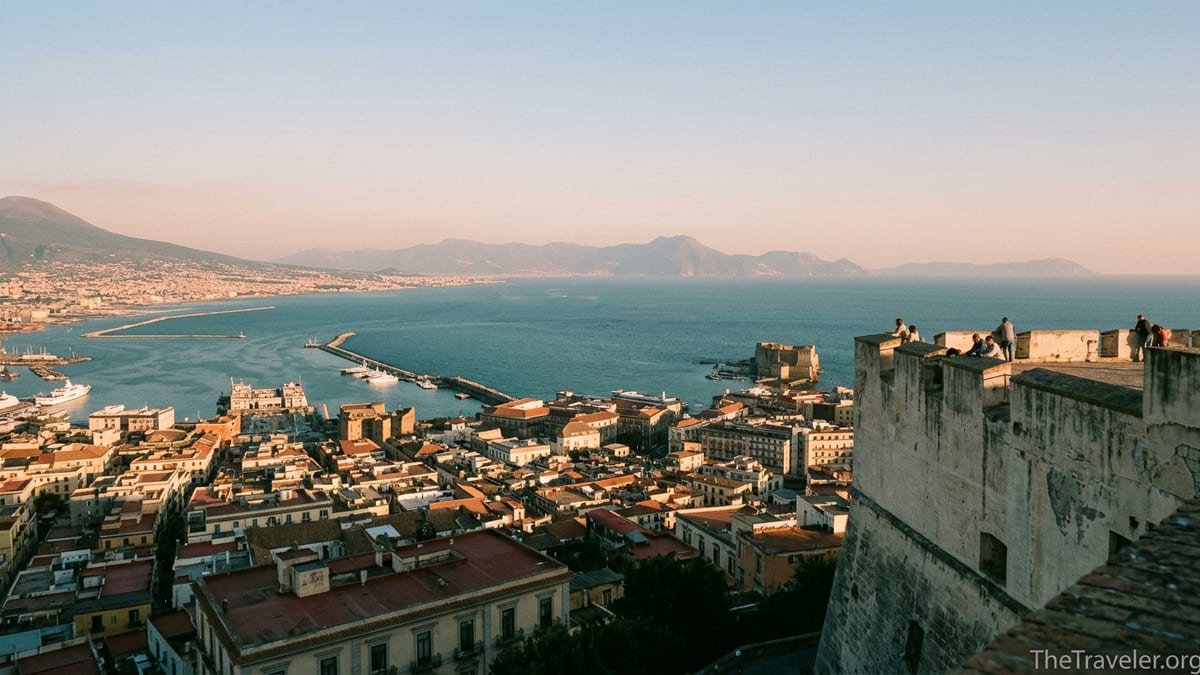
Castel Sant’Elmo makes a very different entrance. Perched around 250 meters above sea level on Vomero Hill, it appears as a massive stone star when seen from the historic center. By the time you step out of the Montesanto or Morghen funicular stations and climb the final slope, you are conscious of having reached the city’s lookout and last line of defense. The walls tower overhead, and the city falls away on every side.
For many travelers, Castel dell’Ovo impresses as an atmospheric backdrop to an evening stroll along the waterfront. In contrast, Castel Sant’Elmo feels like a destination in its own right, something you plan half a day around, with the funicular ride, the climb and the panoramic terraces all part of the experience.
If your idea of a memorable fortress is tied to its setting as much as the stone itself, the sea versus summit contrast is the single biggest factor in which one will stay with you longer.
Architecture and Atmosphere: Empty Shell or Star-Shaped Giant
Architecturally, Castel dell’Ovo is the older and more layered site. Built on the former islet of Megaride, where Greeks first settled Naples, it evolved from a Roman villa into a fortified complex, later strengthened under Norman and Angevin rule. Today, visitors wander through bare courtyards, arched passageways and exposed stone halls. The interiors are largely empty, used occasionally for exhibitions or events, so what strikes you most is the raw masonry and the sense of age.
The castle’s nickname, Egg Castle, comes from a medieval legend that the poet Virgil hid a magical egg in its foundations and that the city’s fate depended on it remaining intact. This story, still mentioned on Naples tourism materials and in local tours, adds a slightly fantastical aura to an otherwise austere structure. You may not find much in the way of signage or furnishings, but you do feel the weight of time in the thick walls and salt-weathered surfaces.
Castel Sant’Elmo, by contrast, is a classic 16th century bastioned fortress, laid out in a dramatic six-pointed star plan. Walking along its angular ramparts, you see how it was designed to command overlapping lines of fire and withstand artillery. Inside, the spaces are more coherent and better curated, linked to the Museo del Novecento which occupies part of the complex. Even if you are not an art specialist, the juxtaposition of contemporary works with the old stone gives the building a sense of ongoing life.
Atmospherically, dell’Ovo feels almost like a forgotten shell where history has ebbed away, leaving views and legends behind. Sant’Elmo feels like a living citadel: cleanly restored, actively used for exhibitions and concerts in the main parade ground, and still very much part of Naples’ cultural calendar. Travelers who enjoy tangible architecture and well-maintained spaces usually find Sant’Elmo more impressive in structural terms.
Views and Photography: Waterfront Horizon vs 360-Degree Panorama
If you are mainly chasing views of the Bay of Naples, both castles deliver, but in very different ways. From Castel dell’Ovo’s upper terraces you look back toward the city’s seafront, with the curve of Via Caracciolo, the Castel Nuovo skyline and the bulk of Vesuvius framed behind fishing boats. In late afternoon, the sun falls behind you, illuminating the city in soft light that is excellent for photos. Many visitors combine a quick climb to the top with a drink on nearby Borgo Marinari, capturing dusk shots of lamps reflecting on the water.
However, the perspective from dell’Ovo is essentially one-sided: you face inland and along the bay. For a full sense of the city’s geography, it is Sant’Elmo that makes jaws drop. From the ramparts you get near 360 degree vistas, from the port and Castel dell’Ovo itself far below, round to the sprawl of the Spanish Quarters, then across to Vesuvius, the Sorrento Peninsula and, on clear days, Capri and Ischia on the horizon.
Photographers in particular tend to rate Sant’Elmo higher. The height allows you to capture both the domes of the historic center and the bay in a single frame. Evening is prime time: locals recommend arriving 45 to 60 minutes before sunset in spring or autumn to claim a spot along the walls, watch the city lights flicker on and then stay through blue hour. Because the castle closes around early evening most of the year, sunset timing is crucial, but even midday the depth of field and layered rooflines make for striking images.
If your strongest travel memories come from panoramic cityscapes, Castel Sant’Elmo almost always leaves a bigger impression. If you prefer water-level shots and reflections, Castel dell’Ovo’s lower, more intimate viewpoint might align better with your aesthetic.
Practicalities: Location, Access and Ticket Costs
Practical considerations also influence which fortress feels more rewarding. Castel dell’Ovo enjoys a central, flat location. From Piazza del Plebiscito it is about a 10 to 15 minute walk along the waterfront, and many visitors simply drift toward it while exploring the Santa Lucia district. The approach via the stone causeway is nearly level, which makes it manageable for most mobility levels. When open, entry is typically free or very low cost, though temporary closures for restoration have become more common, so it is worth checking locally whether the interior is accessible or only the exterior and nearby marina.
Castel Sant’Elmo requires more planning. The most straightforward access for visitors staying in the historic center is the Montesanto funicular or the Central funicular up to Vomero, with single rides costing around the price of a city transit ticket, often about 1 to 1.50 euros. From the upper stations, expect a 5 to 10 minute uphill walk on paved streets. For those willing to climb, the historic Pedamentina steps offer a scenic staircase route from near the Certosa di San Martino, but the descent is steep and not ideal in poor weather.
Ticket prices at Sant’Elmo are still relatively modest by European standards. Recent visitor reports and local information points indicate entry around 6 euros for adults, with reductions for EU youth and combined tickets sometimes available with the Certosa di San Martino museum next door. There is usually no need to book in advance; you pay directly at the entrance turnstile, often by card or cash. The castle normally opens from morning until late afternoon or early evening, with a weekly closing day, often Tuesday, and occasional extended evening hours for events.
From a logistical viewpoint, Castel dell’Ovo wins for spontaneity and cost when fully open, while Sant’Elmo asks a little more effort and a small ticket investment. For many travelers, that extra effort is precisely what makes Sant’Elmo feel more like a special excursion than a casual stop.
History and Storytelling: Mythic Foundations vs Military Strategy
Both fortresses have long, complex histories, but they tell different stories. At Castel dell’Ovo, the narrative centers on myth, early settlement and the castle’s changing roles over time. Standing in its courtyards, you can imagine the Roman villa that once occupied the site, or the Angevin rulers who used it as a royal residence before shifting their court to the newer Castel Nuovo. The Virgil egg legend gives guides an easy storytelling hook, and you will often hear it referenced on walking tours of the seafront.
Interpretive material inside dell’Ovo is limited compared with a fully curated museum. You may see occasional panels for temporary exhibitions, but there is no dense layer of labels and reconstructions. Some travelers appreciate this minimalism, saying it leaves space for imagination. Others leave wishing they had more context about the sieges, political intrigues and transformations that shaped the structure.
Castel Sant’Elmo tells a more focused tale of military engineering and urban control. Its star-shaped plan, bastions and thick ramparts are textbook examples of early modern fortress design. From the walls you can see exactly why Naples’ rulers wanted a stronghold here: cannons placed on the parapets would have dominated both the bay and any internal uprisings in the streets below. The attached Museo del Novecento adds another layer, connecting the fortress to Naples’ 20th century artistic life, with paintings, photographs and installations that often reference the city’s turbulence.
Travelers who thrive on understanding how cities worked as political and military systems tend to be more impressed by Sant’Elmo’s clarity of story. Those attracted to legends, layered uses and the idea of a castle as a living part of the waterfront fabric often connect more strongly with dell’Ovo.
On-the-Ground Experience: How Much Time Each Deserves
In practical trip planning terms, Castel dell’Ovo can be comfortably visited in 45 to 60 minutes, including the walk out from the promenade, a circuit of the ramparts and some photos. Many visitors pair it with a waterfront lunch or dinner, choosing one of the small trattorias or seafood restaurants clustered around Borgo Marinari. In that sense, the castle is as much part of a broader seafront experience as a standalone attraction.
Castel Sant’Elmo usually deserves at least 1.5 to 2 hours. That includes entry, a full circuit of the walls, time to pause at multiple view points and, if you are interested, a short visit to the museum spaces. If you add in the funicular rides, a coffee or aperitivo on Vomero and perhaps a stroll through the adjacent Certosa di San Martino, it easily grows into a half-day outing. Many travelers who rush it regret not leaving time just to sit on the parapet and watch the city move below.
In terms of crowd dynamics, dell’Ovo’s lower location means it sees a steady stream of both locals and visitors, especially on weekends when Neapolitans promenade along the Lungomare. There is usually space to move, but the atmosphere can be busy, particularly in high season evenings. Sant’Elmo, despite being famous for its views, still feels more spacious once you are inside the walls. Even on popular days, you can usually find a quiet stretch of rampart or a corner of the main courtyard to yourself.
For travelers deciding where to allocate limited time, the rule of thumb is simple: if you only have a quick window and are already by the seafront, dell’Ovo is low-effort and satisfying. If you can commit a morning or afternoon, Sant’Elmo gives more room for reflection and a deeper sense of place.
Which Fortress Leaves a Bigger Impression for Different Travelers
Ultimately, the question of which fortress is more impressive depends on your travel style. Budget-conscious visitors, families with strollers and those with limited mobility often favor Castel dell’Ovo. Its flat approach, frequent free entry and combination with gelato stops or a stroller-friendly promenade make it a gentle highlight that blends seamlessly into a relaxed day by the sea.
Photographers, history enthusiasts and travelers seeking a single unforgettable view of Naples usually nominate Castel Sant’Elmo as the stronger experience. The physical journey up by funicular or on foot reinforces the sense of arrival, the vistas have a clear wow factor, and the fortress itself feels like a concrete lesson in how the city was defended and controlled.
Many repeat visitors end up regarding the two as complementary. One typical pattern is to visit dell’Ovo on the first afternoon in Naples, using its terraces and the Lungomare to get oriented to the bay, then plan Sant’Elmo for a later day when you are ready to see the city as a whole from above. Seen together, they bracket Naples between sea and hill, past legend and disciplined fortification.
If your trip allows only one, ask what you want to remember when you think back on Naples. If you picture waves lapping at stone, fishing boats and an easy walk from your hotel, Castel dell’Ovo may define the city for you. If you imagine terracotta roofs, distant islands and the feeling of standing at the top of a densely layered metropolis, Castel Sant’Elmo is more likely to stay burned into your memory.
The Takeaway
Castel dell’Ovo and Castel Sant’Elmo both earn their place on a Naples itinerary, but they speak to travelers in different ways. Dell’Ovo is about intimacy: the close sound of the sea, the low walls, the sense of old stone slowly merging with the waterfront life around it. It asks little of you in time or money and gives back a gentle introduction to the city’s maritime face.
Sant’Elmo is about perspective and power. With its star-shaped plan and sweeping parapets, it places you above Naples in every sense, inviting you to grasp the city’s geography and history in a single turn of the head. It demands a bit more planning, a ticket and a climb, but rewards that effort with some of the strongest visual memories many travelers take home from southern Italy.
For most visitors, the honest answer to which fortress leaves a bigger impression is this: Castel dell’Ovo charms you, but Castel Sant’Elmo overwhelms you. If you can, experience both, starting by the water and ending on the hill. If you must choose, let your own travel priorities decide whether it is gentle charm or commanding panorama that you want to define your days in Naples.
FAQ
Q1. If I have time for only one fortress in Naples, should I choose Castel dell’Ovo or Castel Sant’Elmo?
If you have to choose, Castel Sant’Elmo generally offers the more dramatic overall experience, thanks to its commanding 360 degree views and monumental star-shaped layout. Pick Castel dell’Ovo instead if you prefer an easy, atmospheric stop on the seafront and have limited time or mobility.
Q2. How long should I plan to spend at each castle?
Most visitors spend around 45 to 60 minutes at Castel dell’Ovo, especially if they combine it with a stroll along the waterfront or a meal nearby. Castel Sant’Elmo usually deserves at least 1.5 to 2 hours inside the walls, and closer to half a day if you include the funicular ride, time for photos, and a visit to the neighboring Certosa di San Martino.
Q3. Which fortress has better views for photography?
Castel Sant’Elmo wins for sheer range and drama, with near 360 degree panoramas over the bay, Vesuvius and the historic center. Castel dell’Ovo offers beautiful but more limited views back toward the seafront and volcano from sea level, ideal for waterfront and sunset shots rather than full cityscapes.
Q4. Is either castle suitable for travelers with limited mobility?
Castel dell’Ovo is generally easier for those with limited mobility, thanks to its flat approach along the causeway and seafront promenade. Castel Sant’Elmo involves a funicular ride followed by an uphill walk and stairs, although once inside, many of the ramparts and courtyards are on relatively level surfaces. Always check the latest local advice on lift access and conditions.
Q5. Do I need to book tickets in advance for Castel Sant’Elmo?
At present, most visitors buy tickets for Castel Sant’Elmo on site, either by card or cash, and advance booking is not usually required on regular days. During special evening openings, concerts or high holiday periods, it is wise to check for any updated ticketing policies or combined offers with nearby museums.
Q6. Are there good food and drink options near the castles?
Yes. Around Castel dell’Ovo you will find numerous seafood restaurants, pizzerias and cafes in Borgo Marinari and along the Lungomare, making it easy to combine your visit with a meal. Near Castel Sant’Elmo, the Vomero district offers plenty of bars, gelato shops and trattorias within a short walk of the funicular stations.
Q7. When is the best time of day to visit each fortress?
Castel dell’Ovo is pleasant throughout the day, but late afternoon and early evening often bring softer light and a relaxed promenade atmosphere. Castel Sant’Elmo is particularly impressive from late afternoon to sunset, when the city and bay glow below, though you should check closing times to ensure you can enjoy the views without rushing.
Q8. Are the castles suitable for children and families?
Both can work well for families, but in different ways. Castel dell’Ovo is easier with young children and strollers because of its flat access and quick visit time. Castel Sant’Elmo appeals to older children who enjoy castles, views and the funicular ride, though parents should keep a close eye on kids near the ramparts.
Q9. Can I visit both Castel dell’Ovo and Castel Sant’Elmo in one day?
Yes, it is quite feasible. A common strategy is to explore Castel dell’Ovo in the morning or just after lunch as part of a waterfront walk, then head up to Vomero by funicular in the afternoon for Castel Sant’Elmo and nearby viewpoints. Allow enough buffer for transport, queues at the funicular and time to enjoy the panoramas without feeling rushed.
Q10. Is Castel dell’Ovo currently open to visitors?
Castel dell’Ovo has periodically closed parts of its interior for restoration, even when the exterior area remains accessible. Before your visit, it is sensible to confirm the current status locally through tourist information points or hotel staff so you know whether you can explore the ramparts inside the walls or only enjoy the views from the surrounding waterfront.