


Pitti Palace is not just another museum stop in Florence. It is a vast former Medici residence packed with Old Master paintings, royal apartments, fashion and jewelry collections, plus direct access to the Boboli Gardens hillside. For a first-time visitor, the scale and ticket options can be confusing, and a little planning makes the difference between an overwhelming blur and one of the most memorable days of your trip.
Get the latest updates straight to your inbox!
Understand What Pitti Palace Actually Includes
First-time visitors are often surprised to learn that “Pitti Palace” is really a whole museum complex. Inside the massive 15th-century palace you will find the Palatine Gallery with densely hung Renaissance and Baroque paintings, the opulent Royal and Imperial Apartments, the Gallery of Modern Art, the Museum of Costume and Fashion, and the Treasury of the Grand Dukes with jewelry and precious objects. Just behind the palace stretch the Boboli Gardens, an enormous formal park that climbs the hill above the city. You will not realistically see everything in a single rushed hour; it is closer in scale to a small museum district than a single building.
On a practical level, this means you should decide in advance what matters most. For example, an art lover might focus on the Palatine Gallery’s Raphaels and Titians, then quickly walk through the Royal Apartments. A traveler with kids or someone already “museumed out” after the Uffizi may prefer to spend only one to two hours indoors, then head straight out to Boboli for shaded paths, fountains and views. If you arrive expecting “just another palace,” the layered options and multiple entrances can feel disorienting; knowing the layout helps you hit your priorities calmly.
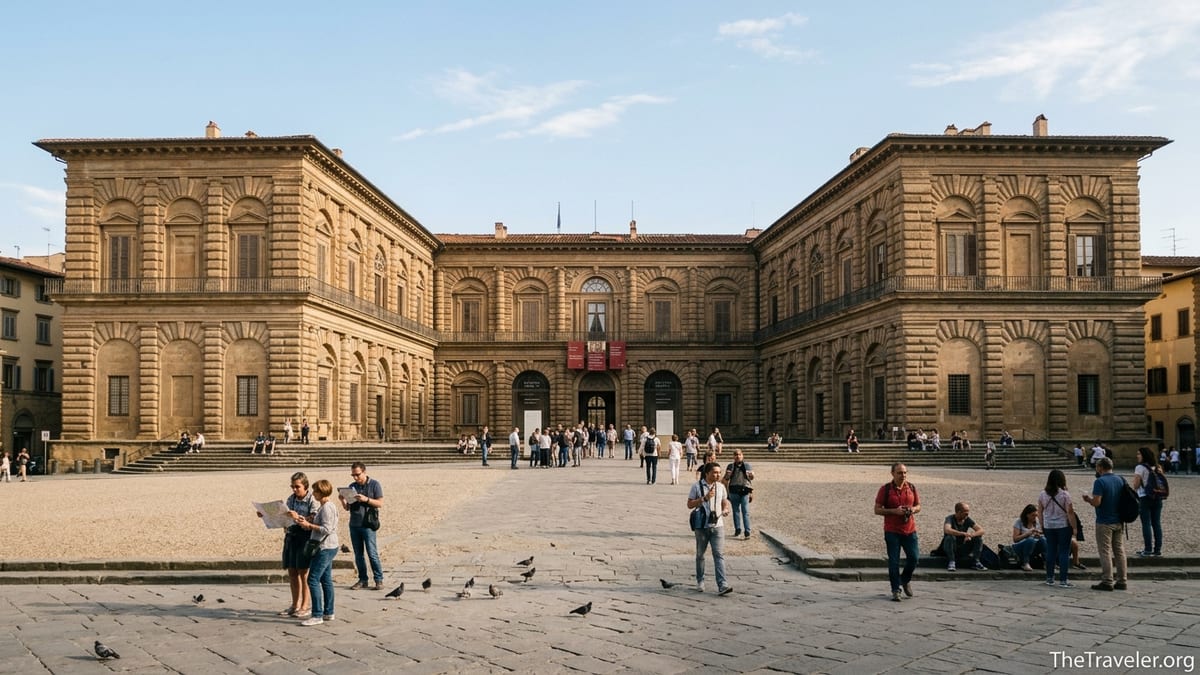
The palace itself sits in the Oltrarno district, just over the Arno River, with its broad stone façade dominating Piazza de’ Pitti. When you step into the square you will see separate lines for ticket holders and same-day buyers, plus an entry toward the gardens at the back of the building. Allow a few minutes simply to orient yourself, especially if you are coming directly from a timed reservation at the Uffizi or crossing Ponte Vecchio with the crowds.
Because the complex is managed together with the Uffizi, the same overall rules apply inside: security screening at the entrance, limits on large bags and professional photography equipment, and a generally quiet, museum-like atmosphere even in the more “royal home” sections. Treat it as both a palace and a serious art museum and you will have the right expectations.
Tickets, Passes and How Much to Budget
As of mid 2026, a standard adult ticket bought for the day of your visit is typically in the mid-teens of euros for the Pitti museums alone, with a few euros more if you book ahead online through the official Uffizi ticketing system that covers Uffizi, Pitti and Boboli together. There is usually a small booking fee per ticket when you buy in advance, but this is worth considering in high season because the separate pre-booked line at Pitti tends to move faster than the same-day purchase queue in the square.
If you know you will also be visiting the Uffizi Gallery and Boboli Gardens, look at the combined passes administered by the Uffizi system. A common option is a multi-day pass around the 40 euro mark that covers Uffizi, Pitti Palace and Boboli Gardens over five consecutive days. This can be good value if you plan to spread big museum visits across your stay and do not want to cram Uffizi and Pitti into a single exhausting day. For example, many travelers book Uffizi on a Wednesday morning, Pitti on Thursday afternoon, and Boboli Gardens on Friday morning using the same pass.
There are also garden-focused tickets that combine Boboli Gardens with nearby Bardini Gardens on the same hillside behind the palace. As of 2026, a Boboli plus Bardini ticket bought on the day at the official ticket offices costs in the mid-teens of euros for adults, with lower reduced prices. This is separate from the Pitti museums ticket. It can be a sensible choice on a hot summer day when you mainly want green space and views, perhaps after a quick look at the palace façade from Piazza de’ Pitti without going indoors.
For a straightforward first visit that includes the palace interiors and Boboli, many travelers either buy the dedicated combined Pitti plus Boboli option for that day or rely on the broader Uffizi–Pitti–Boboli multi-day pass. Expect to spend roughly 25 to 40 euros per adult if you are including both art and gardens, a little less if you are only seeing the palace, and more if you add guided tours or audio guides. Family budgets add up quickly, so it is worth pricing the passes for your travel dates rather than queuing multiple times for separate same-day tickets.
Opening Hours, Best Times and How Long to Stay
Pitti Palace and its main museums generally open around 8:15 in the morning and close in the early evening, usually a little before 19:00, with last admission typically half an hour to an hour before closing. The complex is closed on Mondays, as well as on New Year’s Day and Christmas Day, and there is often a free-entry first Sunday of the month that attracts substantial crowds. Always double check hours just before you go, because seasonal adjustments and special events can slightly shift exact times.
For a first visit, two to three hours inside the palace is a realistic minimum to see the Palatine Gallery and sample the Royal Apartments without rushing past every room. If you are an art enthusiast, you could easily spend four hours or more among the painting-filled galleries alone; the Palatine Gallery walls are hung almost floor to ceiling, and simply taking in the Raphael portraits, Titian works and Baroque canvases takes time. Add at least another one to two hours if you plan to walk the Boboli Gardens paths up to the viewpoints and back down.
The most comfortable times of day are generally early morning or late afternoon on weekdays. Arriving near opening, between 8:15 and 9:00, you may find relatively short lines at security and a calmer atmosphere in the Palatine Gallery. By late morning and early afternoon, especially from May through September, school groups and cruise ship excursions can fill the central rooms. Late afternoon, for example entering around 16:00, can also feel more relaxed, and if you head into Boboli by about 17:00 you may catch softer light over the city.
One concrete way to structure your time is to reserve a late-morning slot at the Uffizi on one day, have lunch nearby, then walk over Ponte Vecchio and simply explore Oltrarno without going inside Pitti. On the following day, arrive at Pitti for opening and devote your morning to the palace, followed by a leisurely stroll through Boboli and perhaps a late lunch on nearby Santo Spirito square. Breaking it up like this avoids “art fatigue” and spreads security lines and fixed timed entries across your stay.
What Not to Miss Inside: Galleries, Apartments and Highlights
Inside the palace, the star attraction for many visitors is the Palatine Gallery on the first floor. Here, the walls are crowded with works by Raphael, Titian, Rubens and other Renaissance and Baroque masters, hung in the 17th-century style rather than as sparse modern displays. The feeling is more like stepping into a lavish aristocratic collection than a conventional white-wall museum. As you move through the rooms, glance up as well as around: many ceilings are richly frescoed, and the gilded stucco frames are artworks in themselves.
Next to the Palatine Gallery are the Royal and Imperial Apartments, a suite of former Medici and later Habsburg-Lorraine and Savoy rooms. They are usually visited on a set route, sometimes with scheduled or accompanied entries, so you may find that access works in timed group batches. Expect to see heavy silk wall coverings, carved beds, portraits of royal family members and state reception rooms. These spaces help you imagine life when the ruling family moved here from Palazzo Vecchio and made Pitti their main residence across the river.
On upper levels, the Gallery of Modern Art showcases 19th- and early 20th-century Italian works, including Macchiaioli paintings, often in lighter, less crowded rooms overlooking Oltrarno. For visitors who feel saturated by religious Renaissance art, this change of style can be refreshing. Elsewhere in the complex, the Museum of Costume and Fashion displays historical clothing, theater costumes and sometimes contemporary fashion exhibits, while the Treasury of the Grand Dukes features jewelry, silver and other luxury objects originally belonging to the Medici and their successors.
Because you cannot see everything in equal depth on a first visit, choose two main areas to prioritize. A common combination is Palatine Gallery plus Royal Apartments, or Palatine Gallery plus Costume and Fashion if you have an interest in textiles and design. If you only have 90 minutes inside, focus almost entirely on the Palatine Gallery and accept that the rest will be a quick sample; you can always return on another trip. Many travelers report that lingering in just three or four rooms, really looking at a few paintings and furnishings, felt more rewarding than racing through the entire complex with barely a pause.
Boboli Gardens: Terrain, Heat and Practical Tips
Boboli Gardens begin immediately behind Pitti Palace, but once you are inside it becomes clear that this is a large historic park, not a small palace backyard. Paths climb steadily uphill, some paved in gravel or uneven stone, winding past sculpted hedges, fountains, grottoes and outdoor sculptures. On a warm afternoon in July, walking from the palace level up to the higher viewpoints can feel like a moderate hike rather than a casual city stroll, especially for small children or anyone sensitive to heat.
For a first visit, wear comfortable walking shoes rather than sandals with slick soles or thin dress flats. Surfaces can be dusty, uneven and, after rain, a bit slippery. There is very little shade on some of the main axial paths, so a hat, sunscreen and a refillable water bottle are practical necessities in late spring and summer. In August, many visitors plan their Boboli time for morning or late afternoon to avoid the strongest sun between roughly 12:00 and 16:00. In cooler months, the gardens can feel fresh and airy, though damp paths and occasional closures for maintenance are possible.
Benches and low walls along the way give you chances to rest, but do not expect manicured lawns where you can picnic freely everywhere. Regulations change, and staff may ask you not to sit on certain edges or grassy slopes. Instead, think of Boboli as an open-air museum of Italian Renaissance garden design, similar in spirit to a museum where you walk through carefully composed vistas. A realistic plan for a first-time visitor is to walk the main axis up to one or two panoramic points, linger at a fountain or sculptural group, then loop back by a slightly different route rather than trying to cover every side path.
If you are traveling with children, Boboli can be a welcome place to let them move more freely after indoor museum time, but it still involves rules. Running and ball games are not allowed near fragile features, and there are ponds and steep drops in places that require supervision. Consider bringing a light snack to enjoy on a bench with a view over Florence’s terracotta rooftops as a reward for the uphill stretch, while keeping expectations realistic for very young kids who may tire quickly.
Practicalities: Bags, Dress, Facilities and Accessibility
Security procedures at Pitti Palace are similar to those at other major Florentine museums. You will pass through a metal detector and bag check at the entrance, and large backpacks, oversized bags and items like tripods or selfie sticks are normally not allowed into the galleries. There is a cloakroom where staff can store larger items, but space is limited, so avoid arriving straight from the train station with full luggage. A small daypack, handbag or camera bag is usually fine if it can be quickly inspected.
Official rules focus on preserving the collections and maintaining a respectful environment rather than on strict dress codes. Casual clothes such as jeans, T-shirts and comfortable dresses are perfectly acceptable, and many visitors wear the same sightseeing outfits they use at the Uffizi or Accademia. What you should avoid are intentionally theatrical costumes, very elaborate photo-shoot outfits or accessories that could be considered disruptive, as these can raise questions from staff. Remember that Florence can be very hot in summer and that air conditioning inside historic buildings is often limited, so breathable fabrics and layers you can remove are far more important than formality.
Restrooms, a bookshop and small café or refreshment points are located within the palace complex, but they can be busy at peak hours. Plan ahead by using facilities before entering and carrying a small bottle of water; refill when you find fountains or café stops. If you are visiting with someone who has mobility concerns, ask staff at the entrance about lift access and the best internal routes. The palace does offer step-free or reduced-step paths to many areas, but extremely old structures inevitably include some narrow passages and spots with limited access.
In the gardens, accessibility is more challenging because of slopes and uneven surfaces. There are some more level sections and partial routes that wheelchair users or those with limited mobility can enjoy, but not all viewpoints will be practical. If you rely on a mobility aid, it may be worth focusing more on the palace interiors and enjoying a shorter, carefully chosen stroll in Boboli rather than attempting longer uphill walks. Florence’s tourist information points and the Uffizi-managed sites publish general accessibility notes that you can consult shortly before your visit to see the latest guidance.
Choosing When in Your Trip to Go and What to Pair It With
One of the biggest strategic questions for a first-time visitor is where Pitti Palace fits into a broader Florence itinerary. Because it is located on the Oltrarno side of the river, many travelers naturally combine it with wandering artisan streets nearby or with an evening in the Santo Spirito area. For example, you might plan a morning visit inside Pitti, then head to a simple trattoria on a side street behind the palace for lunch, followed by a relaxed coffee in Piazza Santo Spirito and a sunset walk up to Piazzale Michelangelo.
If your time in Florence is very short, such as one full day and two nights, you may have to choose between Pitti and other major sites like the interior of the Duomo or an in-depth visit to Santa Croce. Those interested primarily in painting and Medici history often prioritize the Uffizi and Pitti combination, using a multi-day pass and skipping some smaller churches. Others with a strong interest in sculpture or civic history might prefer the Duomo complex and the Bargello, leaving Pitti for a future trip. There is no single “correct” choice, but being honest about your own interests prevents you from cramming Pitti into an already overloaded final afternoon.
Season also matters. In winter, Boboli’s trees may be bare and the gardens quieter, but the palace interiors feel especially rich and atmospheric on a cold day. In high summer, the green shade and open spaces of the gardens are a major draw, while the palace galleries can feel warm even with fans and limited cooling. In shoulder seasons like April, May, September and October, both experiences are pleasant, and early evenings in the gardens can be particularly beautiful.
Think as well about crowd patterns linked to events in Florence. Fashion trade shows at the nearby Fortezza da Basso and public holidays can nudge overall visitor numbers upward, which you may feel indirectly at Pitti. Booking ahead for the big museums during such weeks and allowing flexible time for wandering the Oltrarno streets and lesser-known churches will help you avoid frustration.
The Takeaway
Pitti Palace rewards visitors who arrive with a plan. Knowing that it is a multi-museum complex rather than a single short palace tour, understanding the basic ticket and pass options, and having a sense of how long you will spend in each main area allow you to shape the visit around your own energy and interests. Two to three hours inside for a first visit, plus extra time for Boboli Gardens if the weather is kind, is a solid baseline.
Comfortable shoes, realistic expectations about crowds and temperatures, and a willingness to leave some wings for another trip will help you enjoy the palace rather than feel overwhelmed by it. Pausing in a single frescoed room of the Palatine Gallery or on one shaded bench in Boboli can be more memorable than racing to tick off every gallery and path.
Placed at the edge of Florence’s more lived-in Oltrarno quarter, Pitti also offers a natural transition from high Renaissance splendor to quieter streets, craft workshops and neighborhood trattorias. Plan your visit as a full half-day experience rather than an isolated museum stop, and your first encounter with Pitti Palace is likely to become one of the defining memories of your time in Florence.
FAQ
Q1. How much time do I need for a first visit to Pitti Palace?
Most first-time visitors should plan on two to three hours inside the palace itself, plus another one to two hours if they want to explore Boboli Gardens at a relaxed pace.
Q2. Do I need to buy Pitti Palace tickets in advance?
Advance purchase is not mandatory, but in busy months it can save you time by letting you use the pre-booked line and avoid uncertainty about same-day availability.
Q3. What is the best time of day to visit Pitti Palace?
Early morning around opening time or late afternoon on weekdays are usually most comfortable, with fewer crowds in the galleries and gentler light in the gardens.
Q4. Is Pitti Palace suitable for children?
Yes, but you should keep expectations realistic. The ornate rooms and art can fascinate some children, while others may prefer a shorter palace visit followed by time to move around in Boboli Gardens.
Q5. Can I visit Pitti Palace and the Uffizi Gallery on the same day?
It is possible, especially with a multi-day combined pass, but doing both in depth on the same day can be tiring. Many travelers spread them over two days instead.
Q6. Are there places to eat near Pitti Palace?
Yes. The streets behind the palace and around nearby Piazza Santo Spirito have many cafés, bakeries and trattorias, making it easy to combine your visit with lunch or an early dinner.
Q7. Is Pitti Palace accessible for visitors with limited mobility?
The palace offers lifts and accessible routes to many areas, though some historic sections remain challenging. The gardens have slopes and uneven paths, so a shorter, carefully chosen route is often best.
Q8. What should I wear when visiting Pitti Palace and Boboli Gardens?
Comfortable, weather-appropriate clothing and good walking shoes are most important. Avoid theatrical costumes or bulky accessories, and dress for heat in summer when interiors can feel warm.
Q9. Can I take photos inside Pitti Palace?
Photography for personal use is generally allowed without flash or tripods, but rules can change and some temporary exhibitions may have stricter restrictions, so always follow staff instructions.
Q10. Is it worth visiting Boboli Gardens if I am short on time?
If you have at least an extra hour and the weather is pleasant, even a short walk along the main paths with a view over Florence can be rewarding. If time is very tight, prioritize the palace interiors.