


High above the chaos of Naples’ historic center, Castel Sant’Elmo rises from the hill of Vomero like a stone star. Travelers ride the funicular up once for the view and then find themselves returning on every future trip to the city. It is not just a fortress or a lookout point. It is a place where Naples suddenly makes sense from above, where contemporary art lives inside medieval walls, and where a quiet walk along the ramparts can be as memorable as a plate of spaghetti alle vongole down in the Spanish Quarter.
Get the latest updates straight to your inbox!
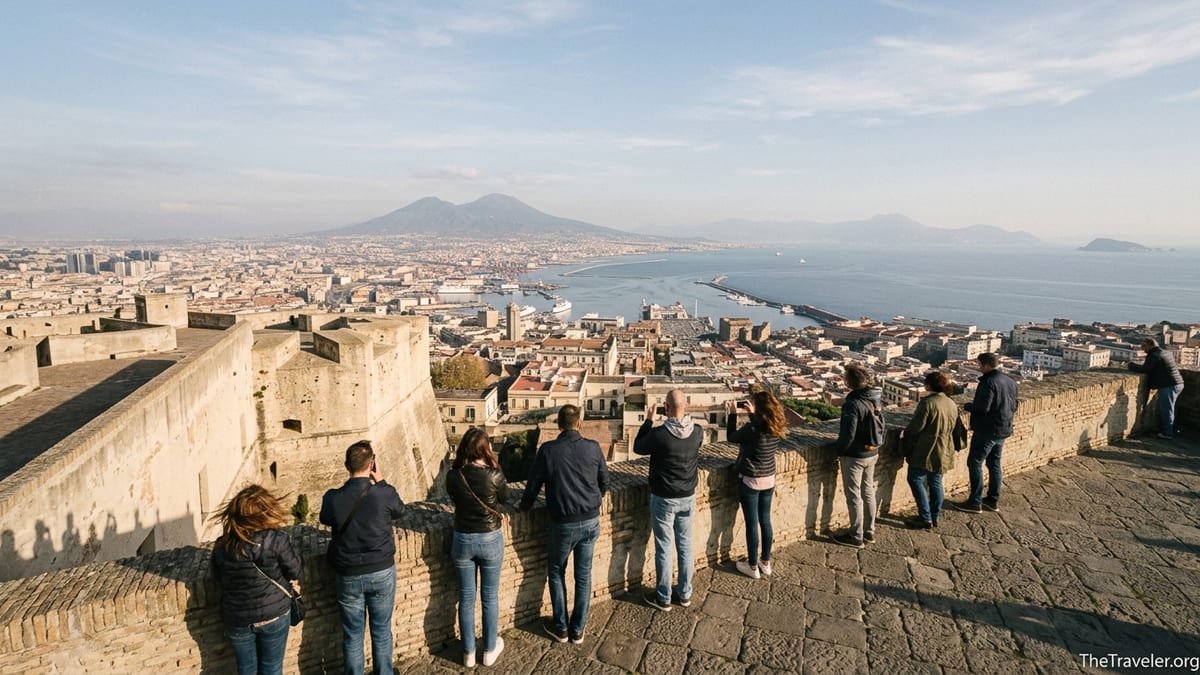
A Hilltop Panorama That Never Feels the Same Twice
Most visitors first come to Castel Sant’Elmo for the view, and that view is the main reason they keep coming back. The fortress crowns the Vomero hill next to the Certosa di San Martino, one of Naples’ highest and most visible landmarks, with a 360 degree outlook over the city and the Bay of Naples. From the ramparts you see the curve of the waterfront from Mergellina to the port, the cone of Vesuvius, Capri floating in the distance and, far below, the grid of streets around Via Toledo. Even repeat visitors report that the city feels different every time depending on haze, clouds and season.
Because Castel Sant’Elmo is open during both morning and late afternoon hours in most months, travelers often time their visits differently on each trip. One year it might be a crisp winter morning when snow dusts Vesuvius in the distance. On another return visit they choose a humid June evening, walking the open-air ramparts while the sun sinks behind the island of Ischia. Many say that seeing Naples at blue hour from here, with the city lights coming on and ferries tracing lines across the bay, becomes a personal ritual every time they are back in town.
Practicalities also help make this panorama accessible. The castle typically opens from around 8:30 in the morning and stays open into early evening, with slightly shorter hours in winter and longer ones in summer, although travelers should always check locally for updated times. Because of this generous schedule you can fit a visit before a day trip to Pompeii or after an afternoon wandering Spaccanapoli. Those who return to Naples regularly often plan one relaxed day “above the city” when they know they can simply ride up to Vomero and let the view reset their internal map.
Atmosphere: A Quiet Escape From Naples’ Frenzy
Another reason travelers keep revisiting Castel Sant’Elmo is the contrast it offers with the dense streets below. Even in high season, the wide star shaped bastions and long corridors can feel surprisingly calm compared with places like Piazza del Plebiscito or the crowded alleys around Via dei Tribunali. The thick tufa stone walls dampen noise, and the plateau of the Piazza d’Armi, the main internal courtyard, has space to sit, stroll and simply watch the light move across the bay.
For many, this calm becomes a reliable refuge on repeat trips. A couple staying near Piazza Dante, for example, might find the noise of scooters and bar terraces wearing after a few days. They learn that within 25 to 30 minutes they can be on the castle terrace, leaning on the parapet with a espresso from a nearby Vomero café. On future visits to the city, when they feel overwhelmed by the historic center’s intensity, they instinctively ride the Montesanto funicular back up to Castel Sant’Elmo, knowing that the air will be cooler and the crowds thinner.
The microclimate is another subtle draw. The hilltop location of Vomero often catches breezes that never quite reach the narrow streets of Quartieri Spagnoli. In July and August, when temperatures in central Naples can sit over 30 degrees Celsius in the afternoon, the fortress terraces can feel several degrees cooler with more open shade. Travelers who learn this trick tend to schedule repeat visits in the hottest part of the day, using Castel Sant’Elmo as a natural air conditioned break between museum visits and pizzeria dinners.
Contemporary Art Inside a Medieval Fortress
Castel Sant’Elmo is not only a viewpoint but also home to the Museo Napoli Novecento 1910–1980, a permanent collection dedicated to twentieth century art connected to Naples. Inside the former Carcere Alto, or upper prison block, visitors find paintings, sculptures and graphic works by artists linked to movements from Futurism to Neorealism. These include names such as Emilio Notte, Renato Barisani and other Neapolitan or Italy based artists whose work reflects the city’s social and political changes across the century.
This unusual combination of austere stone corridors with bold modern canvases is one of the things that convinces culture focused travelers to return. Someone who visits the castle on a first trip purely for the skyline might duck into the museum almost by accident, then end up spending an hour with a series of works depicting wartime Naples or the postwar reconstruction years. When they come back to the city a few years later, they often discover that new acquisitions or temporary displays have been added, because the museum was conceived as a “progressive” or evolving project rather than a static collection.
Contemporary art events and installations occasionally use the open spaces of the castle as well. In recent years Castel Sant’Elmo has hosted outdoor sculpture, photography exhibitions and performances in the Piazza d’Armi, especially during cultural festivals in spring and autumn. While the exact program changes every year, regular visitors know to check local listings, particularly if they are traveling in May or October when Naples often schedules citywide art events. The possibility of seeing both medieval architecture and current creative work in the same visit keeps the site relevant even for those who know the views by heart.
Easy Access With the Funicular and Local Transport
For a hilltop fortress, Castel Sant’Elmo is relatively easy to reach, and that convenience is another reason travelers return repeatedly. The most popular route is via the Montesanto funicular, a century old line that climbs from the district near Piazza Montesanto up to Morghen station in Vomero. From Morghen it is roughly an eight to ten minute uphill walk through residential streets to the castle entrance on Via Tito Angelini, following brown tourist signs marked for Sant’Elmo and the Certosa di San Martino.
For many visitors, riding the funicular becomes part of the ritual. A single urban ticket usually costs a little over one euro and covers the short funicular journey, valid for about 90 minutes on local transport within the city. Frequent travelers learn to pick up tickets at a tobacconist before they get in line for the cars, especially at busy times when the small ticket booths can be crowded. Others choose a day pass that includes metro and funicular lines, using the same card to go from their accommodation near Napoli Centrale up to Vomero and back down again after sunset.
Alternative routes give repeat visitors variety. Some choose Metro Line 1 to Vanvitelli station and then walk about fifteen minutes uphill, stopping for a sfogliatella and coffee at one of the cafés along Via Scarlatti. Others hail a taxi from the seafront near Castel dell’Ovo and ask to be dropped near San Martino, enjoying the viewpoints along the upper access road. Because the journey is short, taxi fares are usually manageable if shared between friends. Over time, many travelers develop their preferred way of “going up to the castle,” whether that means the old funicular from Montesanto or a leisurely climb from Chiaia through the tree lined streets of Vomero.
Affordable, Flexible and Easy to Combine With Other Sights
Compared with many major European monuments, Castel Sant’Elmo remains relatively affordable. Standard adult tickets are typically only a few euros, and some days or time slots may be reduced or free for European Union residents under a certain age, teachers or other categories. Pricing and concessions can change, so visitors should always confirm at the official ticket office or tourist information points, but many report that an hour on the ramparts here costs less than a coffee and pastry in central Naples.
Because the visit is modular, travelers can easily combine the castle with other nearby attractions and keep returning without repeating the same experience. A common pattern is to visit Castel Sant’Elmo in the late afternoon for the views and then walk next door to the Certosa di San Martino, whose museum captures baroque Naples and its maritime and religious history. On another trip, someone might spend more time inside the Novecento museum and then wander down into the shopping streets of Vomero, finishing with aperitivo in Piazza Vanvitelli rather than going straight back to the historic center.
The surrounding neighborhood also offers practical advantages that draw visitors back. Vomero has supermarkets, pharmacies and casual trattorie used by locals rather than tourists, so repeat travelers often time errands around a visit to the castle. They might schedule a Saturday morning grocery run near Piazza Fuga, ride the funicular up, stop for a stroll around Castel Sant’Elmo, and then head back down to their rental apartment in the old town. In this way the fortress gradually shifts from a one time sightseeing stop into part of their everyday routine in Naples.
Different Faces Across Seasons, Times of Day and Weather
One of the main reasons Castel Sant’Elmo inspires repeat visits is that it looks and feels different at various times of year. In spring, blooming trees and green patches on surrounding hills frame the city, and visibility across the bay tends to be clearer. In midsummer, the late sunset means that locals come up after work, and the ramparts may echo with snatches of Neapolitan and Italian conversation as people lean on the walls and take photos. In autumn, storms sometimes roll in from the sea, dramatically changing colors from bright blue to steel grey in minutes.
Travelers learn quickly that clouds and even light rain can create spectacular conditions. On a November afternoon, low sun might break through stormy skies, spotlighting the dome of the Galleria Umberto or the white facade of the Royal Palace against a dark backdrop. Photographers often plan multiple visits in one trip, returning if the first day is hazy, because they know that a north wind overnight can clear the air and reveal snow on distant mountain ranges behind Vesuvius in winter.
Night visits, when available during special openings or summer events, add another dimension that many are keen to repeat. The city becomes a sea of lights with ferries and cruise ships marked by strings of bulbs. From the high walls, visitors can trace traffic along Via Marina, see fireworks from neighborhood festivals and hear faint music rising from the Lungomare. People who have seen Naples only from street level after dark often describe their first night visit to Castel Sant’Elmo as transformative, and that memory is a powerful reason to come back.
Living History in Stone
Although its atmosphere today is peaceful, Castel Sant’Elmo has a long and sometimes turbulent history that fascinates travelers who return to explore it in more depth. A fortification existed on this hill as early as the Angevin period, and the current star shaped fortress largely dates from sixteenth century Spanish rule. Its six pointed plan, dry moat and thick tufa ramparts were designed for artillery, and walking the perimeter still gives a sense of how seriously Naples was once defended from potential attacks by sea or by land.
Inside, the architecture tells quieter stories. The small seventeenth century church of Santa Maria del Pilar sits just before the main entrance, and the brick and stone corridors of the former prison blocks house the Novecento museum today. Travelers who revisit the castle often start to notice small details they missed the first time, like the carved coats of arms over gateways, names and symbols scratched into the walls by former inmates or soldiers, and the way certain corners frame Vesuvius exactly between two battlements.
Because the site has remained in use through different regimes, from Spanish to Bourbon to modern Italy, the fortress also acts as a physical timeline. On one visit a traveler might focus on the medieval and early modern elements, imagining cannon placements aimed at ships in the bay. On another they might pay more attention to twentieth century history, including the postwar period when the castle was adapted for cultural use. This layered sense of time adds depth to repeat visits, especially for those who like to understand how Naples has evolved from royal capital to contemporary port city.
The Takeaway
Castel Sant’Elmo rewards the traveler who treats Naples not as a one time bucket list destination but as a city to return to again and again. The combination of vast panorama, surprising calm, evolving contemporary art and easy access by funicular means that each visit can be slightly different in mood and focus. One year it may be a quick detour for sunset photos, another year a half day spent exploring museum rooms and tracing the street grid of the Spanish Quarter from above.
Because entry remains relatively inexpensive and the fortress sits beside everyday residential streets of Vomero, returning to Castel Sant’Elmo never feels like repeating a crowded attraction purely for the sake of it. Instead, the ritual of riding up the hill, stepping through the heavy gate and walking out onto the ramparts becomes a way of checking back in with Naples itself. For many travelers, the moment they see the star shaped walls on the skyline again is when they know they are truly back in the city.
FAQ
Q1. How much time should I plan for a visit to Castel Sant’Elmo?
Most travelers find that 1 to 2 hours is enough for the views and a quick look at the museum, but you could easily spend longer if you enjoy photography or contemporary art.
Q2. What is the easiest way to get to Castel Sant’Elmo from the historic center?
The most straightforward option is to take the Montesanto funicular up to Morghen station and then walk about 8 to 10 minutes uphill following signs for the castle and San Martino.
Q3. Is Castel Sant’Elmo suitable for children and families?
Yes, families often enjoy the open spaces and views, though parents should keep a close eye on children near ramparts and stairs, and bring hats and water in warmer months.
Q4. Are there places to eat or drink near the castle?
There is usually at least a small café or kiosk nearby, and the Vomero neighborhood around Via Scarlatti and Piazza Vanvitelli, a short walk away, has many bars, bakeries and pizzerias.
Q5. Can I visit Castel Sant’Elmo and the Certosa di San Martino on the same day?
Yes, they stand next to each other on the hill, and many visitors combine both sites in one half day, often visiting the monastery museum first and then the castle for late afternoon light.
Q6. Do I need to book tickets for Castel Sant’Elmo in advance?
For a standard daytime visit, advance booking is usually not necessary, and many travelers simply buy tickets at the entrance, although special evening events may require reservations.
Q7. Is Castel Sant’Elmo accessible for visitors with limited mobility?
Parts of the site involve ramps, uneven paving and some stairs, but there are also more level areas; visitors with mobility needs should check locally about current access arrangements and lifts before going up.
Q8. When is the best time of day to enjoy the view?
Clear mornings are good for sharp visibility across the bay, while late afternoon and sunset offer softer light and a chance to see the city gradually light up after dark.
Q9. Are there guided tours available at Castel Sant’Elmo?
Occasionally local guides or cultural organizations offer tours that cover both the fortress and the Novecento museum; many travelers also choose to visit independently with a guidebook or audio guide.
Q10. Is Castel Sant’Elmo worth visiting if I have already seen other castles in Naples?
Yes, even if you have visited Castel dell’Ovo or Castel Nuovo, Sant’Elmo offers a very different experience thanks to its hilltop location, panoramic views and focus on twentieth century art.