


Naples is a city of dramatic vantage points and storied bastions, and two fortresses dominate most visitors’ itineraries: hilltop Castel Sant’Elmo, hovering above the city, and seafront Castel dell’Ovo, anchored in the Bay of Naples. Both promise views, history and atmosphere, but they offer strikingly different experiences. If you only have time for one, which fortress is more likely to leave a lasting impression?
Get the latest updates straight to your inbox!
First Impressions: Hilltop Sentinel vs Castle on the Sea
Your first glimpse of each fortress sets the tone for the visit. Castel Sant’Elmo rises above Naples on the Vomero hill at around 250 meters, a massive star-shaped silhouette that you notice from almost anywhere in the city. As you approach from the funicular station at Morghen or Vanvitelli, it feels like you are climbing toward an outlook that belongs to the sky rather than the streets.
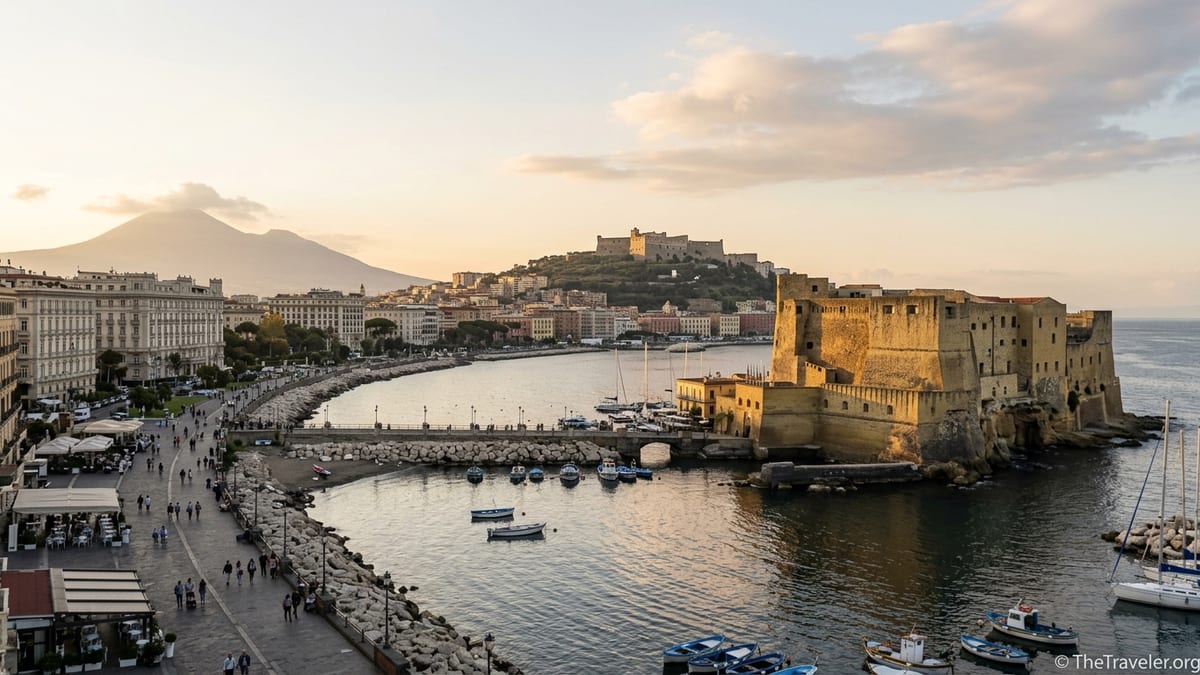
Castel dell’Ovo could not be more different. You meet it at sea level, at the end of a low causeway from the Santa Lucia waterfront. It occupies the former island of Megaride, now linked to the shore by a short bridge, so that as you walk out toward its yellowish tufa walls you are flanked by water, fishing boats and the bobbing masts of the small marina at Borgo Marinari.
In practical terms, this means Sant’Elmo feels like a destination excursion, something you plan an afternoon around, while Castel dell’Ovo often slides naturally into a waterfront stroll or a pre-dinner wander along the Lungomare. Both can be visited without guided tours, and both are manageable for a couple of hours, but they frame the city in such opposite ways that many travelers remember them as entirely different kinds of experience.
If your idea of a memorable fortress leans toward vast horizons and commanding perspectives, Sant’Elmo will likely hit harder. If you instinctively gravitate to sea air, old harbors and an easy, romantic walk, Castel dell’Ovo tends to steal the show.
Views and Photography: The Panorama Question
Naples is a city where viewpoints are travel experiences in their own right, so it makes sense to ask which fortress delivers the stronger visual payoff. At Castel Sant’Elmo, the answer is almost literal: you get an almost 360 degree panorama over the entire urban basin. From the ramparts you can trace the curve of the bay from Posillipo to the port, see Mount Vesuvius rising over the city, and on clear days pick out the islands of Capri, Ischia and Procida sitting low on the horizon.
For photographers, Sant’Elmo offers textbook wide-angle opportunities. A full-frame camera with a 16–35 mm lens lets you capture sweeping skylines from the stone terraces, especially around late afternoon when the sun begins to soften over the sea to the west. Even with a smartphone, panoramic mode from the south-facing walls can produce some of your best shots in Naples, especially if you include a bit of the bastion stone in the foreground for scale.
Castel dell’Ovo, by contrast, gives you a more intimate set of compositions. Looking back toward the city, the ramparts frame a layered view: the curve of the Lungomare, the domes and apartment blocks of Chiaia and Santa Lucia, and Vesuvius beyond. Turning outward, you get close-up scenes of the small harbor, fishermen repairing nets, and children jumping from the rocks on summer afternoons. Golden hour here is less about total panorama and more about warm side-light catching the castle walls and the facades of the grand hotels along Via Partenope.
If you are chasing the single most expansive view of Naples, Sant’Elmo has the advantage. If what you want is atmospheric waterfront photography, with reflections on the bay and evening lights coming up along the promenade, Castel dell’Ovo is more rewarding. Many visitors end up doing both: Sant’Elmo for an afternoon sky-wide vista, and dell’Ovo for a softer, sea-level sunset.
History and Legends: Military Muscle vs Myth and Memory
Historically, Castel Sant’Elmo was a serious piece of military hardware. Its current star-shaped form dates to the 16th century Spanish period, when it was rebuilt as a modern fortress with angular bastions designed to resist cannon fire. From its position on Vomero hill it controlled approaches by land and sea, and for centuries it functioned as both a defensive stronghold and a prison. Walking along its broad ramparts and thick walls, you sense its primary purpose was control rather than comfort.
Today, several areas of Sant’Elmo host exhibitions and cultural events. Temporary art installations and contemporary shows occasionally fill some of the interior spaces, but for most visitors the structure still reads as a vast open shell of bastions and corridors. It is impressive in a sober, austere way, especially if you have an interest in military architecture.
Castel dell’Ovo carries a more layered, almost storybook history. It occupies the site of ancient Greek and Roman settlements, and later became a royal residence during the Norman and Angevin periods. Its Italian name, literally "Egg Castle," comes from a medieval legend that the poet Virgil placed a magical egg in its foundations, and that the fate of the city was tied to the egg’s safety. Even if you take the story as folk invention, it adds a note of whimsical charm that visitors tend to remember.
Inside, Castel dell’Ovo is largely bare, with open courtyards, walkways, and the remains of old halls. In contrast to Sant’Elmo’s more forbidding feel, dell’Ovo’s mix of myth, royal history and seafront setting makes it easier to imagine the lives of people who passed through here: monks in its earliest religious phases, monarchs and their courts, and later the fishermen of Borgo Marinari who lived literally in its shadow.
Atmosphere and Surroundings: Neighborhood Vibes Matter
What happens before and after the castle visit often shapes the memory as much as the site itself. Castel Sant’Elmo sits above the elegant residential district of Vomero. When you arrive via the funicular from Montesanto, Centrale or Chiaia, you step into streets lined with bakeries, gelaterie and local boutiques, along with quieter squares where residents linger over coffee. From there, a ten minute uphill walk along well-worn pavements and stairways brings you to the entrance of the fortress.
Pairing Sant’Elmo with the neighboring Certosa di San Martino, a former Carthusian monastery turned museum, creates a full cultural half day. Many travelers visit the Certosa first for its cloisters and art, then climb a little farther to the castle ramparts. On the way back down, you can detour to viewpoints like Belvedere San Martino or follow the historic Pedamentina di San Martino stairway, which drops dramatically toward the Spanish Quarters and gives yet another sequence of views over the city.
Castel dell’Ovo, by contrast, is embedded in one of Naples’ most scenic strolling areas. The approach from Piazza del Plebiscito and the Royal Palace leads naturally to Via Partenope and the car-free stretch of Lungomare Caracciolo. Here you find grand seafront hotels, popular seafood restaurants, gelato counters and bars with outdoor terraces looking straight across the bay to Vesuvius. The small island area of Borgo Marinari at the foot of the castle is ringed with waterside restaurants and sailing clubs, giving the immediate surroundings a leisurely holiday feel.
Because of this, the castle visit often merges seamlessly with a longer waterfront walk, perhaps starting with an espresso in Santa Lucia, then exploring the castle, and finishing with an early evening aperitivo watching the light change over the bay. If you are choosing which place will give you a bigger impression of Naples’ daily life and street energy as well as its monuments, Castel dell’Ovo has the richer immediate context.
Access, Tickets and Practical Details
Reaching Castel Sant’Elmo requires a little more planning. From the historic center, most visitors take one of the funicular lines up to Vomero. The Montesanto and Centrale lines are common choices, and the ride itself is part of the fun, climbing steeply between buildings. From the top station it is an uphill walk of roughly ten minutes to the fortress entrance, partly along regular streets and partly on sloping paths or steps. The walk is not difficult but does involve gradients, so anyone with mobility issues should allow extra time.
Ticket prices to Sant’Elmo are generally modest by European standards, typically under 10 euros for adults, with reduced or free entry for certain age groups and on selected cultural days. Opening hours usually run from morning through late afternoon or early evening, with longer summer hours, but times can change for events or maintenance. It is wise to check locally or via your accommodation for the current schedule, especially if you are visiting in winter or on a Monday when some Italian sites close or operate shorter hours.
Castel dell’Ovo is logistically simpler. It stands at the end of a short causeway off the Lungomare, about a fifteen to twenty minute walk from Piazza Municipio or Toledo if you are coming from the city center. The approach is flat from the main waterfront, and the castle itself involves internal ramps and stairs to reach the upper terraces. Entry is often free or priced very low, which means you can treat it as a spontaneous stop during a seaside walk without worrying about getting full value from a ticket.
In practice, visitors with limited time or energy often find Castel dell’Ovo easier to fold into a busy Naples itinerary, especially if they are staying in Chiaia or near Santa Lucia. Sant’Elmo, by contrast, rewards those willing to allocate a dedicated slot in the day and commit to the short climb. If you are traveling with a stroller or have difficulty with slopes, Castel dell’Ovo is more forgiving, though the upper ramparts of either site will still require some stair-climbing.
Which Fortress Suits Which Traveler?
The question of which castle leaves a bigger impression is not only about architecture or views; it also depends on the kind of traveler you are. If you are a photographer, urban landscape lover, or someone who likes to understand the geography of a city from above, Castel Sant’Elmo almost always ranks as a highlight. Standing on its vast terraces, you can see how the dense historic center, the port, the modern districts and the hills all interlock, which helps you mentally organize everything you have been walking through at street level.
Travelers with a strong interest in fortifications, warfare, or the strategic side of urban history also tend to prefer Sant’Elmo. The star-shaped bastions, angular corners and sheer size of the structure tell a clear story about Naples’ role as a key stronghold in the Mediterranean, especially under Spanish rule. Combined with a visit to the Certosa di San Martino next door, it turns into an in-depth look at how power and religion shaped this hillside over centuries.
On the other hand, visitors who care most about atmosphere, food and a more relaxed sense of place often come away more attached to Castel dell’Ovo. The fortress is embedded in an everyday seafront of joggers, families out for a Sunday walk, teenagers eating pizza on the rocks and couples sharing gelato along the promenade. A typical evening might see you wander the castle ramparts for half an hour, then sit down at one of the restaurants in Borgo Marinari for a plate of spaghetti alle vongole as the lights of the bay come up.
If you are traveling as a family with children, Castel dell’Ovo can be more immediately engaging. The approach across the causeway, the small harbor and the surrounding cafes relieve the pressure of a focused “monument visit,” and the kids can watch boats and street performers along the Lungomare before or after. For solo travelers and couples interested in quieter, contemplative spaces and grand perspectives, Sant’Elmo’s elevated solitude may feel more memorable.
Design, Scale and Emotional Impact
Beyond logistics and surroundings, there is the emotional resonance of the architecture itself. Castel Sant’Elmo is defined by its star plan and its massive tufa walls. As you walk inside, you move through broad courtyards and open spaces that can feel almost empty, which throws your attention outward to the views. This combination of austere geometry and endless horizon creates a slightly surreal sense of standing apart from the city, watching it from a safe, silent distance.
For some, this detachment is exactly what makes Sant’Elmo unforgettable. After days in Naples’ intense alleys, the quiet stone platforms feel like a reset button, a place to breathe above the noise. The scale of the bastions and the clarity of the air up here on a good day can lodge in the memory as that single “big” image of Naples: the volcano, the bay, the entire sprawl beneath your feet.
Castel dell’Ovo, by contrast, is tightly woven into its setting. The building itself is smaller, its forms more irregular, shaped by centuries of additions and repairs. Interior courtyards open onto glimpses of the sea; narrow passages lead to sudden terraces; the uneven paving and worn stone give the sense that this is a place people have simply used, rather than a monument carefully curated. The emotion here is not awe from a distance but a quieter intimacy, the feeling of being at the city’s edge where water, myth and history meet.
Emotionally, many visitors describe dell’Ovo as romantic rather than imposing. The sight of Vesuvius framed between parapets, the sound of water slapping at the rocks below, and the easy transition from castle walls to a trattoria table contribute to an impression that is gentler but also deeply rooted in the day-to-day life of Naples.
The Takeaway
So which fortress leaves a bigger impression: Castel Sant’Elmo or Castel dell’Ovo? If you measure “impression” in terms of sheer panorama and architectural power, Sant’Elmo probably wins. Its star-shaped bastions and wide terraces deliver an unforgettable overview of Naples and its bay, the kind of sweeping image you are likely to recall first when you think back on the city.
If, however, you define impression as a blend of scenery, atmosphere and everyday life, Castel dell’Ovo makes a strong claim. Its setting on the water, its legends and its integration with the Lungomare and Borgo Marinari bring together the key ingredients of the Neapolitan seafront in a compact, easy-to-enjoy package.
For many travelers, the ideal answer is not choosing but sequencing. Use Castel Sant’Elmo early in your trip to get your bearings and understand the geography of Naples from above. Then end a later afternoon at Castel dell’Ovo, folding the visit into a slow walk along the waterfront and dinner by the sea. Seen together, the two fortresses frame the city between hill and harbor, and it is that combined memory that tends to linger longest.
FAQ
Q1. If I have time for only one fortress, which should I choose?
If you want the most dramatic citywide view and do not mind a hill climb, choose Castel Sant’Elmo. If you prefer an easier, sea-level visit with waterfront atmosphere, pick Castel dell’Ovo.
Q2. Are there entrance fees for Castel Sant’Elmo and Castel dell’Ovo?
Castel Sant’Elmo usually charges a modest admission fee, often under 10 euros, while Castel dell’Ovo is frequently free or very low cost. Always check current prices locally because they can change.
Q3. Which fortress is better for sunset views?
Both are excellent, but in different ways. Castel Sant’Elmo offers a sweeping, elevated sunset across the bay, while Castel dell’Ovo gives a more intimate waterfront sunset with reflections on the sea and easy access to bars and restaurants afterward.
Q4. How much time should I plan for each visit?
Most visitors spend about one to two hours at either site. At Sant’Elmo, factor in extra time for the funicular ride and walk from the station. At Castel dell’Ovo, expect to add time for a stroll on the Lungomare or a drink in Borgo Marinari.
Q5. Is either fortress suitable for travelers with limited mobility?
Castel dell’Ovo is generally more accessible because the approach from the waterfront is flat, though internal ramps and stairs remain. Castel Sant’Elmo involves an uphill walk from the funicular station and more pronounced gradients inside, which can be challenging for some visitors.
Q6. Can I visit both fortresses on the same day?
Yes. A realistic plan is to go up to Castel Sant’Elmo in the late morning or early afternoon for the panoramic views, then head back down and visit Castel dell’Ovo in the late afternoon followed by an evening walk along the waterfront.
Q7. Are guided tours necessary or useful?
Both fortresses can be visited independently, and many travelers are satisfied with exploring on their own. If you have a strong interest in history or architecture, a guided tour or private guide can add depth, especially at Sant’Elmo where the military design is more complex.
Q8. Which area is better for food and drinks before or after the visit?
Castel dell’Ovo has the advantage here, surrounded by the restaurants of Borgo Marinari and the Lungomare’s seafront bars. Around Castel Sant’Elmo you will find cafes and eateries in Vomero, but the castle itself is less directly integrated with dining options.
Q9. What is the best way to reach Castel Sant’Elmo from the historic center?
Most visitors take a funicular from the lower city, such as the Montesanto or Centrale line, up to Vomero and then walk about ten minutes uphill to the fortress. Taxis or ride-hailing are alternatives if you prefer to avoid the walk.
Q10. Is it safe to visit these areas in the evening?
Both Vomero around Castel Sant’Elmo and the Santa Lucia and Lungomare area near Castel dell’Ovo are generally considered safe, especially along main routes. As always, use normal city precautions, stick to well-lit streets, and follow local advice from your accommodation.