


Ask travelers what surprised them most about Oslo, and many will mention Vigeland Sculpture Park. Set inside the leafy Frogner Park, this vast open-air artwork by Norwegian sculptor Gustav Vigeland is often described as beautiful, unsettling, moving and oddly uplifting, all at once. First-time visitors expecting a quiet city park find themselves walking through more than 200 larger-than-life sculptures that trace the entire arc of human life, from birth to death, in a way that feels both intimate and monumental. It is an experience that stays with people long after their trip to Norway is over.
Get the latest updates straight to your inbox!
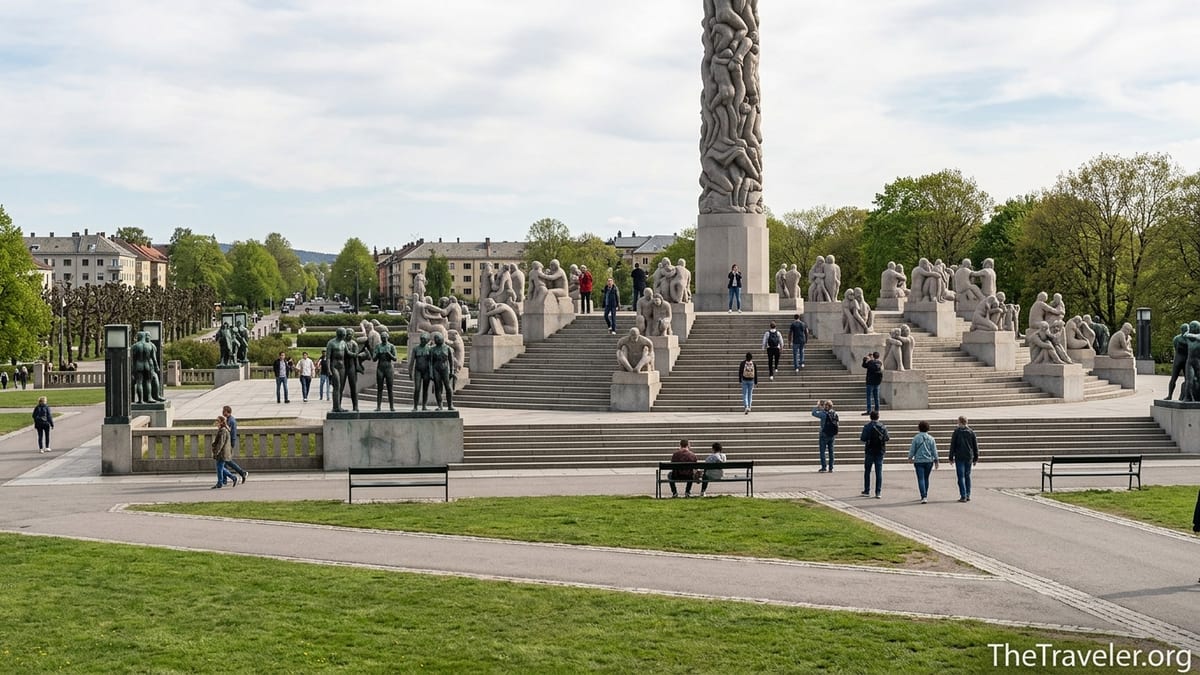
A Monumental Artwork Hiding in a Neighborhood Park
Part of what makes Vigeland Sculpture Park so striking is the contrast between expectation and reality. On a tram ride from Oslo’s central station, the park appears as a typical neighborhood green space in Frogner, an upscale residential district a short ride west of the city center. Yet once you pass the wrought-iron main gate, you step into the world’s largest sculpture park created by a single artist, covering roughly 80 acres and showcasing more than 200 bronze, granite and wrought-iron works by Gustav Vigeland.
Many visitors arrive with only a vague idea that there will be “some statues in a park.” Walking up the long central axis, they gradually realize they are inside a carefully choreographed installation: a main gate, a tree-lined bridge lined with figures, a powerful bronze fountain, a monumental stairway and, at the highest point, the famous granite Monolith towering about 17 meters above the plateau. The scale of this sequence is unexpected in a free, ungated public park that locals use daily for jogging, dog walking and picnics.
The first-time impact is intensified by how accessible it all feels. There are no turnstiles or ticket booths to enter the sculpture area, and you can approach the works as closely as you like. Where many major art experiences unfold behind glass in paid museums, Vigeland’s life’s work stands outdoors in the open air, with Oslo residents commuting on tram 12, families pushing strollers and teenagers on bikes weaving casually past some of Norway’s most famous cultural treasures.
Because Frogner Park is one of Oslo’s main “green lungs,” you may arrive on a summer afternoon to find Norwegians grilling on disposable barbecues, children playing near the ponds and office workers stretched out on the grass beside Vigeland’s figures. For first-time visitors, this mix of extraordinary art and ordinary everyday life can feel almost surreal, turning what could have been a formal art pilgrimage into something far more approachable and human.
Raw Human Emotion, Literally Cast in Bronze
Vigeland’s sculptures are unforgettable because they do not idealize the human body or shy away from strong emotions. Instead of heroic warriors or aristocrats, you see ordinary men, women and children in strikingly candid situations: a father tossing his child into the air, lovers curled around each other, an old woman clinging to a younger relative, children squabbling, and, in one of the most photographed works, a small boy in the middle of a full tantrum.
That boy, known as “Sinnataggen” or “The Angry Boy,” stands on the central bridge among 58 bronze sculptures. Newcomers often laugh out loud when they see his furrowed brow, clenched fists and determined stomp captured in mid-stride. Many notice that his outstretched hand has been polished bright by countless people touching it for luck or a photo. It is common to see first-time visitors, phones in hand, lining up to mimic his pose or crouching down to match his eye level, a simple interaction that suddenly turns high art into something playful and familiar.
Elsewhere on the bridge the mood shifts. A muscular man appears to be fending off a writhing cluster of toddlers. Couples embrace and separate. Parents cradle infants while staring into the distance. These scenes are not accompanied by explanatory plaques. Instead, travelers from all over the world are left to interpret them themselves, often projecting their own experiences of family, conflict, love or loss onto the figures.
Because the bodies are naked and unidealized, they feel oddly timeless. Travelers used to sleek contemporary sculpture are often struck by the rough texture of the bronze, with visible tool marks and a patina deepened by decades of Oslo rain and snow. Standing close, you see veins on a foot, creases in a neck, the slack jaw of a sleeping child. That unfiltered physicality is part of why many first-time visitors describe the park as emotionally intense, even if they would not normally think of themselves as “art people.”
The Shock of the Monolith and the Circle of Life
For many people, the moment they first see the Monolith from up close is when Vigeland Park truly imprints itself on their memory. After climbing a broad granite staircase flanked by intertwined stone figures, you reach a circular plateau where 36 groups in granite surround the column. At the center rises a single block of granite, carved into 121 human figures clambering upward, wrapped around each other in a seemingly endless vertical struggle.
The Monolith is impressive on a purely physical level: one enormous stone raised and carved over many years by a small team of stonemasons, now piercing Oslo’s often overcast sky. But it is the expression on the faces and the tangle of limbs that tend to stay with visitors. Some figures appear to be helping each other; others seem desperate, exhausted or determined. First-time visitors often instinctively walk around the column several times, tracing different paths with their eyes, trying to take in the full density of the composition.
On busy summer days, you will see groups of travelers from cruise ships, backpackers with cameras and local families all mingling on the steps. A teenager might sit scrolling on a phone under a statue of an elderly couple leaning on each other, while a guide explains in English, Spanish or German that Vigeland saw the Monolith as a kind of human totem, a metaphor for humanity’s yearning and interconnectedness. Even without any explanation, the sheer concentration of bodies and expressions hits most people viscerally.
Just beyond the Monolith, the park’s central axis continues past a sculpted sundial and ends at the “Wheel of Life,” a granite ring of intertwined adults and children that seems to float above its base. The ring motif repeats the idea of human continuity in a more compact form. Travelers who have just walked past sculptures of newborns, adolescents, parents and the elderly often stop here in quiet reflection, feeling the narrative arc of the park come full circle.
An Open-Air Narrative of Birth, Aging and Death
First-time visitors are often surprised to discover that Vigeland Park is not simply a collection of standalone sculptures but a deliberate narrative. Starting at the main gate and following the straight axis over the bridge, past the fountain and up to the Monolith, you are effectively walking through a story about human life. The figures around the bronze fountain, for example, show children and adults intertwined with large, stylized trees, a recurring symbol of growth, shelter and the passage of time.
Many of the granite groups on the plateau near the Monolith explore aging and mortality even more directly. One sculpture shows a circle of adults holding hands around small children, suggesting protection and continuity. Another portrays an older man sitting with his head bowed while younger figures move around him. Because these compositions are open to interpretation, people bring whatever they are dealing with in their own lives to the viewing: new parents see the exhaustion of childcare, adult children see the vulnerability of aging parents, and older visitors may see echoes of their own life stories in the stone.
The absence of clothing, accessories or specific historical references keeps the focus squarely on universal experiences. There are no uniforms or fashion trends to date the figures, no mythological symbols that require art-historical knowledge. A visitor from Tokyo, São Paulo or Chicago can recognize the same tender or painful moments in a granite group that a local Oslo resident sees. That universality can be particularly powerful for travelers who have just spent days comparing European cathedrals or royal palaces. In Vigeland Park, the sacred subject is everyday human life.
Because the park is open every day of the year, the atmosphere of this narrative changes with the seasons. A first-time visitor in January might experience the sculptures under a layer of snow, with pale blue winter light and temperatures well below freezing, emphasizing themes of endurance and stillness. In July, by contrast, the same figures are bathed in long evening light, with the sounds of children playing nearby, making the cycle of life feel more hopeful and expansive.
Art You Can Touch, Climb and Stumble Upon
Another reason Vigeland Park leaves such a strong impression is how physically close visitors can get to the works. In many parts of the park there are no ropes, barriers or guards. Children clamber onto the bases of some granite groups, people lean against the bridge railings next to bronze figures, and more than a few travelers attempt their own yoga-like poses to mirror the sculptures for photographs.
Travelers who arrive on a self-guided visit quickly discover that the park rewards wandering. You might leave the central axis to follow a side path and suddenly find yourself in a quieter area with smaller bronze groups or wrought-iron gates decorated with human figures and symbolic lizards or dragons. Couples on evening walks pause at more intimate pieces partially hidden by trees. Someone out for a jog might loop past the Monolith every day without stopping, while a first-time visitor spends twenty minutes studying a single pair of figures on a bench.
The high level of access does not mean the park is chaotic. Oslo residents are generally respectful, and signs ask visitors not to climb on the sculptures themselves. Still, compared with the stricter atmosphere of many major museums in Europe, the chance to move freely among masterpieces is memorable. Travelers often comment afterward that Vigeland Park made them feel less intimidated by art in general, because they could engage with it in such an everyday setting.
This openness extends to time and cost. The sculpture park itself has no entry fee and no closing gate, so you can visit at sunrise in midsummer, take a late-evening stroll under the Nordic sky, or drop by for a quick look between other Oslo sights without worrying about ticket times. For budget-conscious travelers or families comparing cities across Scandinavia, the combination of world-class art and completely free access contributes strongly to the park’s lasting appeal.
Reaching the Park and Making the Most of a First Visit
Part of the park’s impact comes from how easy it is to slot into a short Oslo itinerary. Many cruise passengers and weekend visitors only have one full day in the city, yet they still manage to experience Vigeland Park without feeling rushed. From central Oslo, you can reach the main entrance in about 10 to 15 minutes using regular public transport, such as tram line 12 toward Majorstuen, which stops near the prominent gate facing Kirkeveien. Buses also run to stops around Frogner Park, making it straightforward to include the sculptures between visits to the harborfront or the museums on Bygdøy peninsula.
First-timers often underestimate how much walking is involved once inside. The main axis from gate to Wheel of Life is long, with several sets of steps, so comfortable shoes are important, especially if you are combining the park with other sightseeing. In summer, it is common to see visitors arrive in mid-afternoon with a coffee from a nearby kiosk, slowly make their way across the bridge while stopping for photos, then climb to the Monolith in time for soft evening light around 7 or 8 pm.
For a deeper understanding, some travelers book guided walking or cycling tours that include the park, often combining it with other highlights like the Royal Palace and Akershus Fortress. Guides explain Vigeland’s collaboration with the city of Oslo in the early 20th century, point out details visitors might otherwise miss and share stories, such as how the bronze fountain was originally planned for a different location before being installed here. Other visitors choose a more reflective experience, bringing a picnic and spending several hours slowly exploring the sculptures at their own pace.
Across Kirkeveien from the main park stands the Vigeland Museum, housed in the sculptor’s former studio and residence. Many first-time visitors do not realize it is there, but those who cross the street and pay the modest admission fee gain extra context, seeing plaster models of the Monolith figures, early sketches and works in wood and clay. Combining the free outdoor park with an hour or two in the museum can turn a casual stroll into a more complete understanding of Vigeland’s life and artistic evolution.
The Takeaway
Vigeland Sculpture Park leaves such a strong impression on first-time visitors because it transforms a simple walk in a city park into a powerful encounter with human experience. Without relying on grand religious or political themes, Gustav Vigeland created a monumental, cohesive installation that speaks directly to universal emotions: joy, grief, desire, conflict, tenderness and the quiet acceptance of aging.
The setting magnifies that impact. Few other places combine world-class art, completely free access, and a relaxed atmosphere where locals and visitors share the same paths. The ability to approach the sculptures up close, to visit at different times of day and in all seasons, and to see how Oslo residents have woven them into daily life all contribute to the sense that this is not just a tourist attraction but a living part of the city.
For travelers planning an Oslo itinerary, that means Vigeland Park is more than a box to tick. It is a space where you can pause amid a busy trip and confront, in stone and bronze, the same questions that shape your own life: what it means to grow up, to love, to raise children, to grow old and, eventually, to let go. Many visitors leave with a camera full of photos and a sense that they have glimpsed something honest and enduring. That lingering feeling is why so many people, when asked what to see in Oslo, tell others simply: whatever you do, do not skip Vigeland.
FAQ
Q1. Where is Vigeland Sculpture Park and how do I get there from central Oslo?
Vigeland Sculpture Park is inside Frogner Park, west of central Oslo. From the city center, tram line 12 toward Majorstuen or several city buses reach stops near the main gate in about 10 to 15 minutes, making it easy to combine with other sights in one day.
Q2. Does it cost anything to visit Vigeland Sculpture Park?
No, entry to the sculpture area in Frogner Park is free, and there are no turnstiles or ticket booths. You only pay if you choose to visit the nearby Vigeland Museum across the street, which has a separate, modest admission fee.
Q3. How much time should a first-time visitor plan for the park?
Most first-time visitors spend between one and two hours walking the main axis from the gate over the bridge to the Monolith and Wheel of Life, stopping for photos and reflection. If you also explore side paths, relax on the grass or visit the Vigeland Museum, allow half a day.
Q4. What is the best time of day or year to experience the park?
In summer, early morning or late evening often offers softer light, fewer crowds and pleasant temperatures. In winter, the park can be atmospheric under snow and low Nordic light, though you should dress warmly. Because it is open year-round, any season provides a different but rewarding experience.
Q5. Are there guided tours available, or is it better to explore on my own?
Both options work well. Many visitors enjoy self-guided walks, discovering the sculptures at their own pace. Others join guided walking or bicycle tours that include the park, gaining insight into Gustav Vigeland’s life, the symbolism of the Monolith and the history of the installation.
Q6. Is Vigeland Park suitable for children and families?
Yes, families visit frequently, and children often enjoy the dramatic poses and expressive faces of the sculptures, especially The Angry Boy on the bridge. Parents should be aware that all figures are nude, which is normal in Scandinavian art but may prompt questions from younger kids.
Q7. What should I wear or bring for a comfortable visit?
Wear comfortable walking shoes, as the park’s central axis is long and includes stairs near the Monolith. In cooler months, bring warm layers, gloves and a hat, since the park is exposed to wind. In summer, sunscreen, water and perhaps a picnic blanket will help you enjoy the lawns around the sculptures.
Q8. Can I take photos and are tripods allowed?
Photography for personal use is widely accepted, and visitors regularly take photos throughout the park. Small tripods are generally tolerated if used considerately, but on particularly busy days or during tours, it is courteous to avoid blocking pathways or the view of other visitors.
Q9. Is the park accessible for visitors with limited mobility?
The main paths through Frogner Park are paved and relatively flat up to the fountain, and there are benches along the way. The staircases leading up to the Monolith plateau can be challenging for some, but even without climbing them you can still experience many of the key sculptures along the bridge and in nearby areas.
Q10. How does the Vigeland Museum complement a visit to the sculpture park?
The Vigeland Museum, located across the street from the park, occupies the sculptor’s former studio and home. Inside, you can see plaster models of the Monolith figures, early works and sketches that reveal how Vigeland developed his ideas, adding context and depth to what you have seen outdoors.