


If you want Oslo to feel simple, walkable and unintimidating from the moment you arrive, base yourself in Bjørvika. This once-industrial waterfront right next to Oslo Central Station has become the city’s most convenient neighborhood for first-time visitors, with major sights, hotels and restaurants packed into a compact, pedestrian-friendly area along the fjord.
Get the latest updates straight to your inbox!
Why Bjørvika Makes Oslo Effortless
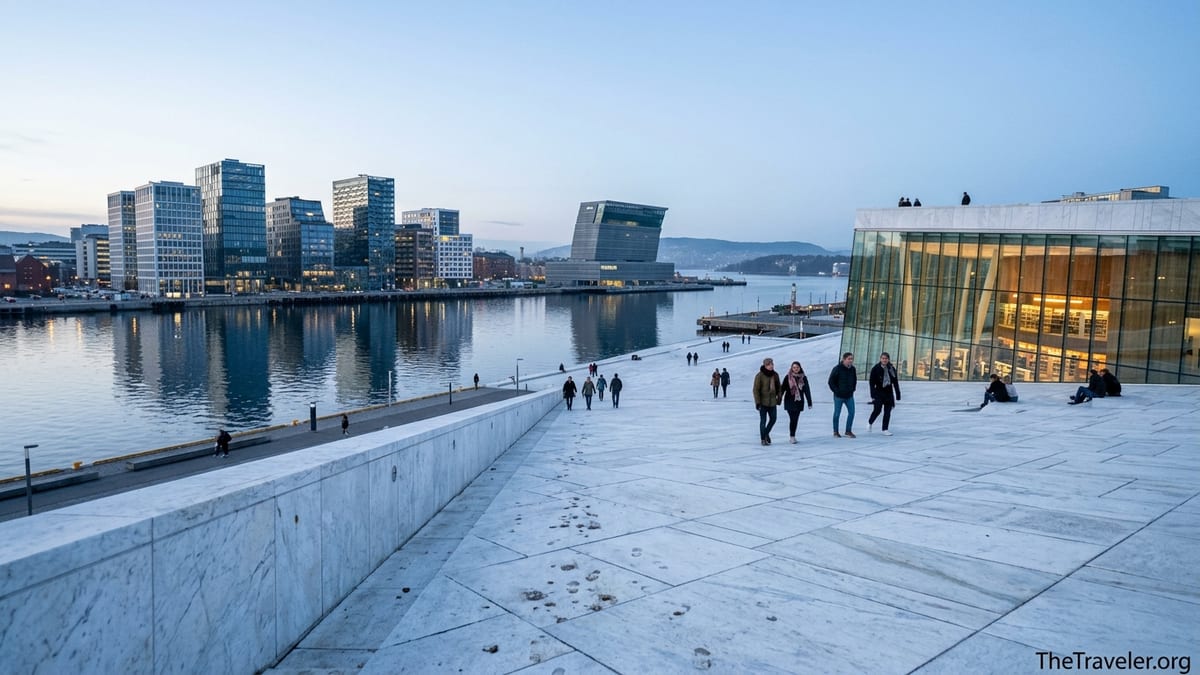
Bjørvika sits at the head of the Oslofjord, immediately southeast of Oslo Central Station, and has been transformed from rail yards and container docks into a showcase of contemporary Norway. Today it is home to the white-marble Oslo Opera House, the tilted glass tower of the Munch museum, and the angular Deichman Bjørvika main library, all within a 5 to 10 minute walk of each other. Staying here keeps most of your first-time must-sees on your doorstep, so you spend more time exploring and less time figuring out transit.
The area is also a transport hub. Oslo Central Station, right behind the Opera House, is where airport express trains from Oslo Airport Gardermoen arrive roughly every 10 minutes during the day. From a hotel in Bjørvika you can walk to or from the airport train in under five minutes, which is especially helpful on short city breaks or early departures. Local trains, regional services and city trams also converge here, making day trips to places like Lillehammer or Fredrikstad straightforward.
For visitors who like to get oriented on foot, Bjørvika’s layout is simple. Two main axes define the neighborhood: the fjord promenade that runs from the Opera House toward Sørenga’s sea baths, and Dronning Eufemias gate, the wide boulevard behind the waterfront lined with the Barcode skyscrapers. Between them are car-light streets, public plazas and footbridges, so you can walk safely at almost any hour, including in winter when sidewalks are maintained but can still be icy.
Crucially, Bjørvika is new enough that most buildings have been designed with ground-floor cafes, bakeries and supermarkets built in. That means you can land at Oslo S, check into a nearby hotel, and be sipping coffee at a sidewalk table or stocking up on groceries within minutes, without needing to figure out where “downtown” is first.
Best Bjørvika Hotels for a Stress-Free Stay
For pure convenience, Thon Hotel Opera is hard to beat. The property stands on Dronning Eufemias gate right beside Oslo Central Station and a couple of minutes’ walk from the Opera House. Reviews consistently highlight its easy airport-train access and fjord views from upper floors. Typical nightly rates for a standard double hover around the mid-range, though prices spike during big events. Breakfast is included and known locally for being generous, with hot dishes, smoked fish, breads and fresh fruit, which can offset Oslo’s high cafe prices if you plan a light lunch later.
Clarion Hotel Oslo is another strong choice within Bjørvika itself. Located close to the Munch museum, it offers contemporary rooms with colorful Scandinavian decor and large windows facing the fjord or the Barcode towers. Guests appreciate that you can step outside and be on the waterfront promenade in under a minute, and that the walk to Oslo S is flat and straightforward even with luggage. Clarion’s on-site bar and restaurant help if you arrive late and do not feel like hunting for dinner, and room rates tend to sit in the same bracket as Thon Hotel Opera, with occasional good weekend deals outside peak summer.
Travelers who like a little more independence can look at serviced apartments in the area. Several local operators manage short-stay apartments in residential buildings around Bjørvika and Sørenga, usually modern one- and two-bedroom units with kitchenettes and laundry facilities. These are especially useful for families, longer stays, or visitors who want to cook some meals at home to manage costs. Expect prices that are comparable to or slightly higher than a mid-range hotel room, but with more space and the ability to self-cater.
If you prefer boutique character yet still want easy access to Bjørvika, Amerikalinjen near Jernbanetorget is worth considering. It is housed in the former headquarters of a historic shipping line and is just a short walk across the tracks from the Opera House. Guests praise its design and breakfast, and you can still reach the Bjørvika waterfront in about five minutes on foot, making it a good compromise between classic city-center atmosphere and modern fjordfront Oslo.
Where to Eat in and Around Bjørvika
Bjørvika’s restaurant scene has matured quickly as more residents and offices have moved in. One of the standout Nordic-inspired options is Vaaghals, set along Dronning Eufemias gate in the Barcode row. The kitchen focuses on Norwegian ingredients and a sharing-style menu. You might find dishes built around local lamb, root vegetables and barley, or platters of cured fish and fresh-baked bread meant for the whole table to share. Prices reflect Oslo’s general level: a main course often lands in the mid to upper range, with a full dinner with drinks for two easily reaching a few hundred US dollars, but visitors often praise the quality and the chance to sample modern Norwegian flavors in a relaxed, unstuffy setting.
For something more casual and broadly appealing, Sumo Bjørvika sits right on the waterfront near the Barcode towers. It serves pan-Asian dishes like sushi rolls, poke bowls and noodles, and is popular with both office workers and travelers thanks to its fjord views and approachable menu. Expect to pay roughly what you would at similar mid-market Asian restaurants in other European capitals, with lunch sets helping keep costs lower. Because of its location, it can be a pleasant choice for an early evening meal before a performance at the Opera House or a stroll along the promenade.
High-end diners sometimes plan their Oslo trip around a table at Maaemo, the city’s celebrated three-Michelin-star restaurant located not far from the Bjørvika district. Reservations need to be made well in advance, and the tasting menu is a significant splurge, typically several hundred euros per person before wine. The experience focuses on tasting Norway through seasonal produce, seafood and preserved ingredients, presented in a minimalist dining room. For many visitors it is a once-in-a-lifetime meal that pairs well with a stay in Bjørvika because the restaurant is a short taxi or tram ride away, avoiding a long return trip late at night.
Asian fusion options extend to Nodee Barcode and nearby rooftop venues on the city side of the tracks, where you can find sashimi platters, bao and cocktails with skyline views. Within Bjørvika itself, the bar and cafe spaces inside the Opera House and the Munch museum are reliable for lighter meals, coffee and pastries. In practice, this means you can move from a morning on the Opera House roof to a museum visit to a waterfront lunch without leaving the neighborhood or needing to plan complex logistics.
Everyday Convenience: Cafes, Groceries and Getting Around
One of Bjørvika’s biggest advantages for visitors is how easy daily life feels. Ground floors of residential towers host mini-supermarkets, bakeries and coffee bars where locals pick up their morning espresso or fresh bread. International chains sit alongside Norwegian brands, so you can choose between familiar names and local roasteries. A typical coffee costs a little more than in many European cities, but cafe culture is strong, and sitting outside even on a cool day with a blanket is part of the experience.
Most travelers will find that they can walk from their hotel to a grocery store in under five minutes, which is useful for buying snacks, bottled water or ingredients for simple dinners if you are staying in an apartment. Prices in Norwegian supermarkets are higher than in southern Europe but usually far lower than eating out for every meal. Picking up yogurt, fruit and bread for breakfast or picnic lunches is a straightforward way to stretch your budget while still enjoying a restaurant meal once a day.
Public transport from Bjørvika is straightforward if you want to explore beyond the waterfront. Trams and buses stop near Oslo S and along nearby streets, and the city’s ticketing system covers trams, buses, metro and many ferries with the same passes. For example, a 24-hour ticket typically costs the equivalent of a modest lunch and allows unlimited rides within the central zone, which is useful if you plan to head up to Grünerløkka for coffee, to the Bygdøy peninsula for museums, or to the Holmenkollen area for views over the city.
Walking remains the best way to appreciate how Bjørvika fits into the rest of Oslo. From the Opera House, you can follow the harbor promenade west toward Aker Brygge and Tjuvholmen, passing the medieval Akershus Fortress and the City Hall along the way. This stroll, which can be comfortably done in an afternoon, shows the contrast between old stone fortifications, 20th-century civic buildings and the new glass-and-steel developments, all framed by the fjord.
Signature Bjørvika Experiences You Should Not Miss
Walking on the roof of the Oslo Opera House is perhaps the single most distinctive Bjørvika experience, and it is free. The building’s white marble slopes rise directly from the water, and gently angled ramps and steps lead visitors to the top. From there you look out over the fjord, the Munch museum’s leaning tower, the Barcode skyline and the trains sliding in and out of Oslo S. In summer, locals sit on the tiles in T-shirts; in winter, you will see people carefully navigating in boots, and the light can be remarkably crisp on clear days.
A visit to Deichman Bjørvika, the city’s main public library, is another highlight that costs nothing unless you stop for coffee. The building is immediately behind the Opera House and offers six floors of reading rooms, quiet corners and fjord views framed by dramatic interior atriums. Visitors often remark that it feels more like a cultural center than a traditional library, with design exhibitions, children’s spaces and work areas filled with laptops. You do not need a library card to enter, and it is an excellent place to warm up on a cold day or enjoy a quiet hour between sightseeing stops.
The Munch museum, a few minutes’ walk along the waterfront, houses the world’s largest collection of works by Edvard Munch, including multiple versions of “The Scream.” Entry tickets are priced in line with major European art museums and can be purchased in advance or on-site, though popular times can be busy in high season. Many visitors combine the museum with a coffee in its upper-level cafe, which offers views back toward the Opera House, or continue walking to Sørenga, where wooden piers and sea baths extend into the fjord.
In summer, the Sørenga area turns Bjørvika into an urban beach district. Floating docks, diving platforms and ladders give direct access to the fjord, and people swim, sunbathe and picnic long into the light evenings. Facilities such as outdoor showers and nearby cafes make it feel surprisingly resort-like for a spot so close to the city center. Even if you do not plan to swim, watching locals enjoy the water on a warm evening gives a strong sense of Oslo’s outdoor lifestyle.
Planning an Easy Bjørvika-Based Itinerary
Because so much of what you might want to do in Oslo sits within or next to Bjørvika, you can plan an itinerary that minimizes backtracking. On your arrival day, check into your hotel or apartment, then take a simple loop: stroll across the Opera House roof, explore the public spaces inside Deichman Bjørvika, and walk along the waterfront toward the Munch museum. If you are arriving in the afternoon or evening, this short circuit offers a strong first impression without needing to understand the wider city layout.
On your first full day, allocate a morning for the Munch museum and a relaxed lunch nearby. In the afternoon, continue along the harbor promenade toward Sørenga for a swim or waterside drink in summer, or simply to enjoy the walk and views in cooler months. On the way back, time a dinner reservation at Vaaghals or another Barcode restaurant, which lets you experience the illuminated towers and the contrast between the glass skyline and the water after dark.
Another day can focus on connecting Bjørvika to the rest of Oslo. Start again at the Opera House, then follow the waterfront west toward Akershus Fortress and the historic center. Spend time at Aker Brygge’s wooden piers and Tjuvholmen’s modern art scene, then return via Karl Johans gate, the main shopping street, which leads back toward Oslo S. This “ring” route gives a sense of how compact Oslo is and how Bjørvika functions as its contemporary gateway.
If you plan day trips by train, basing yourself in Bjørvika further reduces friction. A morning departure to a nearby town like Drammen or a longer ride inland for hiking requires only that you cross the plaza to Oslo S. You do not need to factor in extra time for cross-city transit, and you can return in the evening to familiar streets, a favorite local cafe and a waterfront sunset walk.
The Takeaway
Bjørvika offers something that many capital-city districts struggle to combine: immediate arrival convenience, major cultural landmarks and a sense of being right on the water, all in a scale that feels manageable after a long flight. Hotels like Thon Hotel Opera and Clarion Hotel Oslo put you within a few minutes’ walk of both the airport train and the Opera House, while serviced apartments and nearby boutique options add variety for different travel styles and budgets.
With serious cooking at places such as Vaaghals, casual fjordfront meals at spots like Sumo Bjørvika, and the option to splurge at restaurants like Maaemo, you can tailor your dining to the occasion, whether that is a quick bowl of noodles after a museum visit or a multi-course Nordic tasting menu. Everyday conveniences like supermarkets, bakeries and direct tram and train connections make the neighborhood easy to live in for a few days, not just to sightsee.
Most importantly, Bjørvika simplifies your Oslo visit without sacrificing character. Between the sloping marble roof of the Opera House, the glass and steel of the Barcode towers, the quiet interiors of Deichman Bjørvika and the lively Sørenga waterfront, you experience the city’s contemporary identity from morning to night. For many travelers, that combination makes Bjørvika the smartest base for an effortless, rewarding first encounter with Oslo.
FAQ
Q1. Is Bjørvika a good area to stay in Oslo for first-time visitors?
Yes, Bjørvika is ideal for first-timers because it sits next to Oslo Central Station and concentrates major sights like the Opera House, Munch museum and Deichman library within a short, level walk.
Q2. How long does it take to get from Oslo Airport to a Bjørvika hotel?
The airport express train from Oslo Airport Gardermoen to Oslo Central Station takes around 20 minutes, and most Bjørvika hotels are a further 3 to 5 minutes’ walk from the platforms.
Q3. Are Bjørvika hotels much more expensive than staying elsewhere in Oslo?
Room rates are generally in line with other central Oslo hotels. You pay a premium compared with outlying districts, but you save time and transport costs by being next to Oslo S and the main waterfront sights.
Q4. Is Bjørvika safe to walk around at night?
Bjørvika is a busy, well-lit neighborhood with offices, residences and cultural venues, and most visitors feel comfortable walking there at night, though normal big-city awareness is still recommended.
Q5. Do I need to use public transport if I stay in Bjørvika?
If your focus is the central sights, you can do much of your exploring on foot. Public transport becomes useful for reaching neighborhoods like Grünerløkka, Bygdøy or Holmenkollen, but is not essential for daily basics.
Q6. Can I swim in the fjord near Bjørvika?
Yes, in the warmer months many locals swim at Sørenga’s sea baths, a short walk from the Opera House, where floating docks and ladders provide easy access to the fjord.
Q7. Is it necessary to buy tickets in advance for the Munch museum?
Buying tickets in advance is recommended in high season or on weekends to avoid waiting, but on quieter days you can often purchase entry on arrival without long lines.
Q8. Are there affordable food options in Bjørvika?
While many waterfront restaurants are mid- to high-priced, you will also find cafes, bakeries and supermarkets where you can pick up reasonably priced breakfasts, snacks or picnic supplies.
Q9. Is the Oslo Opera House roof always open to visitors?
The roof is generally open to the public around the clock, though access can be temporarily restricted during extreme weather or special events, so it is wise to check conditions on the day.
Q10. How many days should I plan in Oslo if I base myself in Bjørvika?
Two full days allow you to see the main Bjørvika sights and explore the central waterfront, while three to four days give enough time for additional neighborhoods and a possible day trip by train.