


Vigeland Sculpture Park in Oslo is one of Scandinavia’s most distinctive outdoor art experiences: a surreal landscape of more than 200 bronze and granite figures scattered across manicured lawns and tree lined avenues in Frogner Park. Before you go, it helps to understand how the park is laid out, when to visit, and how to navigate the sculptures without feeling rushed. This guide brings together practical opening hours, transport details, and map based tips so you can make the most of your time on the ground.
Get the latest updates straight to your inbox!
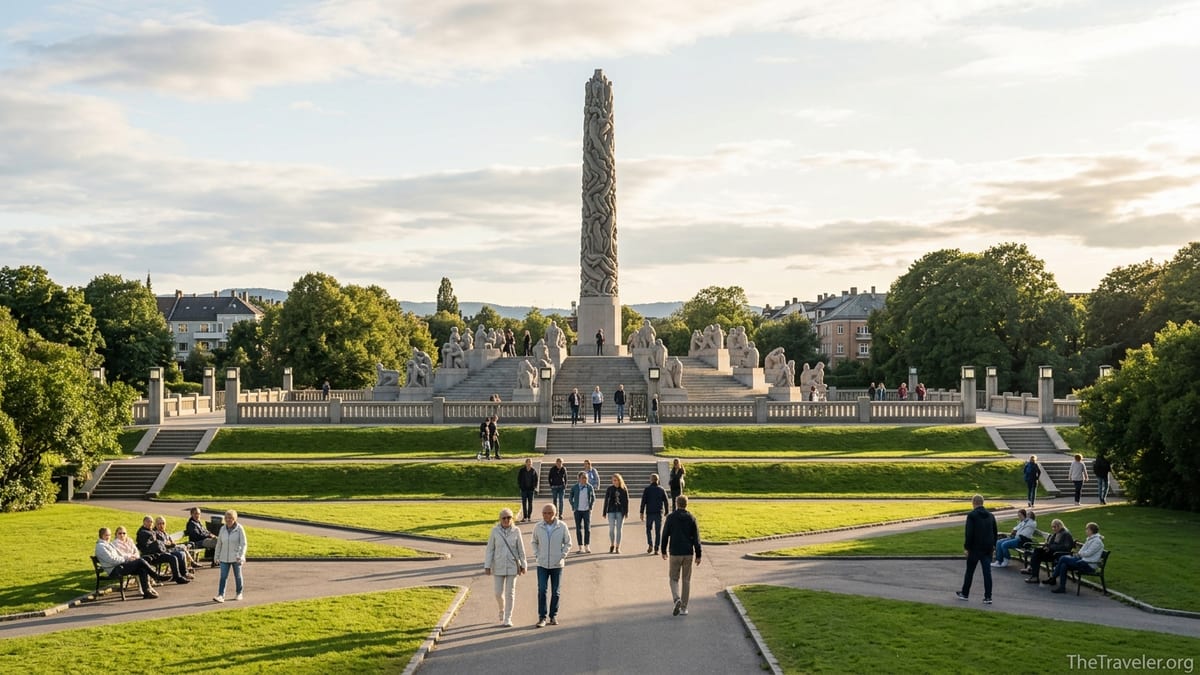
Where Exactly Is Vigeland Sculpture Park and What Is It
Vigeland Sculpture Park, often simply called Vigelandsparken, sits inside Frogner Park in the affluent Frogner district a few kilometres northwest of central Oslo. Locals usually say they are going to Frognerparken, while visitors tend to use the name Vigeland Park, but they are talking about the same green expanse, with the sculptural installation forming its dramatic central axis. The park is part of the city’s largest public green space and one of Norway’s most visited attractions, drawing well over a million visitors in a typical year.
The sculptures are the life work of Norwegian artist Gustav Vigeland, who spent the last decades of his life creating a unified vision of the human life cycle. As you walk from the ornate main gate to the famous Monolith plateau you pass through scenes of families playing, couples embracing and children tumbling, all rendered in bronze or stone. Because everything is outdoors, the experience changes with the seasons. In summer, lawns fill with picnickers and late evening sun glows on the sculptures, while in winter the same figures emerge out of snowdrifts and pale blue light.
For orientation, the park’s main entrance is near Nobels gate 32 in the western part of Oslo. Many travellers staying around Oslo Central Station or the City Hall area will find that it takes about 15 to 20 minutes to reach the park by metro or tram, then a short walk. You do not have to pass through any ticket gate to enter the sculpture area. Once you step through one of the iron gates from the surrounding streets or residential blocks, you are already inside Frogner Park and free to start exploring.
Although maps and guidebooks sometimes single out the “Vigeland Sculpture Park” as if it were a separate venue, there are no physical borders between that section and the wider Frogner grounds. This means you can easily combine a focused sculpture walk with a more relaxed wander past rose gardens, playgrounds and the nearby outdoor public pools in summer, all without ever showing a ticket.
Opening Hours, Best Times of Day and Seasonal Considerations
One of the biggest advantages of planning a visit here is that the sculpture park is open 24 hours a day, every day of the year. There are no gates that close at night and no restricted morning hours, so you can walk through at sunrise in June or under streetlights on a January evening. Entry to the outdoor sculpture area is free, which makes it an easy stop even on a tight Oslo budget or during an overnight layover.
Although there are no official opening hours for the grounds, practical access can feel different depending on the time of day. In high summer, Oslo enjoys very long daylight hours, with the sky staying light until late evening. Travellers arriving in July, for example, often choose to visit around 8 or 9 pm after a day of museums in the city centre. At that time, tour groups have usually gone, temperatures are milder, and you can photograph the statues in soft, low angle light without jostling for space on the bridge.
Mornings are another good choice if you prefer a quieter atmosphere and fewer people in your shots. Commuters use the paths to cross Frogner Park between about 7 and 9 am on weekdays, but they move quickly and rarely linger at the sculptures. Many travellers staying near Majorstuen station stop by the park before breakfast, enjoy a short loop past the Monolith and wheel sculptures, then continue their day elsewhere in the city. By late morning from May to September, coach tours begin to arrive, and the central terraces around the Monolith and the famous “Angry Boy” statue can feel crowded.
In winter months, short daylight is the main factor. Sunrise can be as late as mid morning in December, and it gets dark by mid afternoon, so plan your sculpture walk for the brightest part of the day. Paths are generally cleared, but they can remain icy after snow, so allow extra time and wear shoes with good grip. Because the park is open at all hours, you can still stroll under the lamps in the early evening, but expect a very different, moodier experience as snow, fog or low clouds alter visibility and the details of the sculptures.
How to Get to Vigeland Sculpture Park
Vigeland Sculpture Park is straightforward to reach on Oslo’s public transport system, which is integrated across metro, tram, bus and local trains. Most visitors arrive via the T bane metro to Majorstuen station. All main metro lines from central Oslo stop there, so if you are travelling from Oslo S (Oslo Central Station) or Jernbanetorget you can simply take the next westbound train towards Majorstuen, then follow signs or a map for Frognerparken. It is roughly a 10 to 15 minute walk through residential streets before the park opens up ahead.
Several tram lines run even closer to the main gates. The most commonly used route for visitors is the tram line that stops at “Vigelandsparken” or “Frogner plass,” both only a few minutes’ walk from the sculptures. If you are staying near the City Hall or National Theatre, the tram is often the most direct option. It allows you to step off, walk a short distance past apartment buildings and cafes, and suddenly find yourself at one of the wrought iron park entrances without having to navigate the busier Majorstuen crossroads.
Bus routes operated by Ruter, the regional transport authority, also serve the area. Travellers with accommodation in the Grunerløkka or Tjuvholmen neighbourhoods, for example, sometimes take a bus directly to a stop next to Frogner Park instead of backtracking into the metro tunnel network. Current lines and stop names can change over time, so it is worth opening the Ruter journey planner on your phone, entering “Vigelandsparken” or “Frognerparken” as your destination, and checking which option is fastest at the moment you travel.
If you prefer to arrive under your own steam, Oslo’s bike share scheme and rental bikes offer a pleasant way to access the park in good weather. From the City Hall area, it typically takes around 15 to 20 minutes to cycle west through tree lined streets and residential districts to Frogner. Drivers should expect residential parking rules in the streets surrounding the park and limited designated spaces, so unless you are staying nearby and already have a car, public transport remains the easier and more sustainable choice.
Understanding the Layout: Maps and Key Areas
On a map, the Vigeland installation runs along a clear north south axis within Frogner Park. Entering from the southern or main gate, you first cross a wide bridge lined with bronze sculptures, then climb gradually up through terraced lawns towards the circular plateau where the Monolith rises from a ring of stone figures. Beyond that lies a further area with a stone wheel sculpture and more lawns, but most visitors focus on the bridge, the fountain and the Monolith terrace.
Paper city maps available from Oslo’s tourist information points usually highlight the park clearly, often under the label “Vigeland Sculpture Park” or “Vigelandsanlegget.” These help you see its relationship to the rest of the city, including nearby attractions such as the Oslo City Museum on the east side of Frogner Park and the popular Bygdøy peninsula museums a short bus ride away. Many travellers download an offline map before arriving so they can navigate without using mobile data. Once you zoom in, you will see individual paths, small ponds and side entrances that may not be obvious from signs alone.
Within the park itself, you can expect simple orientation panels at some entrances and near the central terrace. These usually show a stylised plan of the main sculptures so you can decide whether to walk the standard route south to north, or to branch off through lawns and rose gardens. Some visitors choose to start not at the main gate but at a quieter side entrance near residential streets to the west, then gradually work towards the busier Monolith area, using the park’s straight avenues as a guide.
If you like to have a more detailed reference in hand, several guidebooks to Oslo include dedicated fold out maps of Vigeland Park with numbered sculptures. A practical approach is to keep a digital map open on your phone and drop a pin at your entrance point. That way, after an hour of wandering between sculptures you can easily find your way back to the closest tram or metro stop, rather than trying to retrace your exact route between identical looking lawns.
Visitor Information on Facilities, Tickets and Accessibility
The most important piece of visitor information is that there is no admission fee to the outdoor sculpture park and no ticket office on site. You can come and go as you please. This makes Vigeland an easy repeat stop during a longer stay in Oslo. For example, many travellers staying in nearby neighbourhoods weave the park into their daily routine, perhaps jogging past the sculptures in the early morning and returning later with a coffee and camera.
Facilities in and around Frogner Park vary by season. In summer, small kiosks and cafes near the main paths sell coffee, ice cream and simple snacks. On a warm July afternoon, it is common to see visitors pick up a takeaway sandwich or bakery pastry from a nearby corner shop or cafe, then picnic on the lawns between sculpture groups. Public toilets are available within the wider Frogner grounds, although the exact opening hours can vary, especially outside the peak season, so it is wise to use facilities at a cafe or metro station before a long wander.
Accessibility is generally good. The main paths along the sculpture axis are broad, paved and suitable for wheelchairs and strollers, though gradients become steeper as you approach the Monolith terrace. There are steps at certain points, but it is usually possible to find ramped or gently sloping alternatives if you take a slightly longer route around. In winter, snow clearance can be uneven on side paths, but the central axis tends to be prioritised. Travellers with mobility concerns often find it easiest to approach from the tram stops closest to the main gate, reducing the distance from public transport to the broad central paths.
For those who want to deepen their understanding of Gustav Vigeland’s work, the Vigeland Museum stands just south of the park in a former studio building. Unlike the outdoor park, the museum usually charges an admission fee, with set opening hours that differ from the 24 hour access outside. Many visitors plan a half day that starts in the museum to see models, sketches and more delicate works indoors, then moves into the park itself to see how those ideas were translated into monumental stone and bronze.
Planning Your Visit: Routes, Photography and Etiquette
You can see the main highlights of Vigeland Sculpture Park in about one to one and a half hours if you walk steadily along the central axis and stop at the fountain and Monolith. However, many travellers underestimate how absorbing the details can be. Photographers, art lovers and families with children often find themselves staying longer as they examine individual expressions, humorous scenes or the way light changes across the stone surfaces.
A simple route begins at the southern gate near the main tram stop, continues over the bridge where you will quickly spot the small “Angry Boy” statue, and climbs towards the fountain at the centre of the park. From there, stairs and ramps lead up to the Monolith terrace, where you can spend time circling the great column and the ring of surrounding figures. Heading further north brings you to the wheel sculpture and quieter lawns, from where you can either loop back along side paths or exit through an upper gate and make your way towards another public transport stop.
Photography is allowed throughout the sculpture park, and visitors are constantly framing the human figures against Oslo’s skies. Early morning or late evening often yields the most atmospheric images, especially in summer when golden light rakes across the granite. In peak times, be patient around popular statues and avoid climbing on the sculptures themselves or blocking narrow steps. Tripods are rarely necessary and can be awkward in crowds, so most travellers rely on handheld shots from phones or compact cameras.
As a public park, Frogner is also a space for local residents walking dogs, exercising or reading on benches. Respect this shared use by keeping to paths where grass is signed as protected, disposing of any litter in bins, and keeping noise reasonable, especially during early and late hours when apartment windows overlook the grounds. Swimming in ornamental ponds or fountains is not allowed, and children should be supervised around water features and higher terraces. Treat the sculptures as artworks, not playground equipment, and you will help preserve the park’s unique atmosphere for everyone.
The Takeaway
Vigeland Sculpture Park is one of those places that feels very different from traditional museum visits, yet gives a deep and sometimes surprising insight into Norwegian culture and ideas of human life. Its greatest practical advantage is simplicity. The grounds are open at all hours, entry is free, and regular metro, tram and bus lines make it one of the easiest major sights in Oslo to reach on your own, even if you arrive for only a short stay.
To get the most from your time, think carefully about when you go and how you move through the park. An early morning walk before museums open, a long summer evening picnic after a day of sightseeing, or a short winter loop during the brightest hour of daylight will each offer a very different atmosphere. Use a city map or offline navigation app to understand where the main axis sits within Frogner Park, and do not hesitate to wander off the standard route to discover quieter lawns and side paths.
With a little planning around opening hours, transport and layout, Vigeland Sculpture Park becomes not just an item to tick off a list but a place to linger, reflect and return to. Whether you spend an hour tracing the central sculptures or an entire afternoon alternating between art and relaxation on the grass, this open air gallery at the heart of Oslo is likely to stay with you long after you leave.
FAQ
Q1. What are the opening hours of Vigeland Sculpture Park
The outdoor Vigeland Sculpture Park inside Frogner Park is open 24 hours a day, every day of the year, and there is no ticket or closing time.
Q2. Is there an entrance fee to visit the sculptures
No, entry to the outdoor sculpture area is completely free. You can walk in and out of the park as you like without passing a ticket office.
Q3. How do I get to Vigeland Sculpture Park from central Oslo
Most visitors take the metro to Majorstuen station and walk about 10 to 15 minutes, or use a tram that stops at Vigelandsparken or Frogner plass just outside the main gates.
Q4. How long should I plan for a visit
If you follow the main axis past the bridge, fountain and Monolith, allow about one to one and a half hours. Art enthusiasts or photographers often stay two to three hours.
Q5. Are there maps available of the park
Yes. Many Oslo tourist maps highlight Vigeland Sculpture Park clearly, and offline phone maps show paths and entrances. Orientation boards in the park itself indicate the main sculpture groups.
Q6. Is the park suitable for wheelchairs and strollers
The central paths are wide and paved, making them generally suitable, though the slope up to the Monolith terrace is steeper. Some side routes include steps, so you may need to choose gentler paths.
Q7. Can I visit Vigeland Sculpture Park in winter
Yes. The park remains open, and seeing the sculptures in snow and low winter light can be very atmospheric. Just be prepared for cold temperatures and potentially icy paths.
Q8. Are there toilets and places to buy food nearby
Public toilets exist within the wider Frogner grounds, and in warmer months kiosks and nearby cafes offer snacks and drinks. Hours are more limited outside the main summer season.
Q9. Is photography allowed in the park
Photography is allowed throughout the sculpture park. Be considerate of other visitors when taking photos, avoid climbing on sculptures, and take care around steps and water features.
Q10. What is the difference between Frogner Park and Vigeland Park
Frogner Park is the larger public park, which includes lawns, rose gardens and playgrounds. The term Vigeland Sculpture Park usually refers to the central area within Frogner that contains Gustav Vigeland’s sculptures.