


Vigeland Sculpture Park in Oslo is one of Scandinavia’s most distinctive outdoor art experiences: more than 200 granite, bronze and wrought-iron sculptures spread along a green axis in Frogner Park, all created by one artist, Gustav Vigeland. With no labels beside the works and a layout that stretches for close to a kilometre, the park can feel overwhelming on a first visit. With a little planning, though, you can navigate directly to its most famous sculptures and still leave time to wander, picnic and people-watch like a local.
Get the latest updates straight to your inbox!
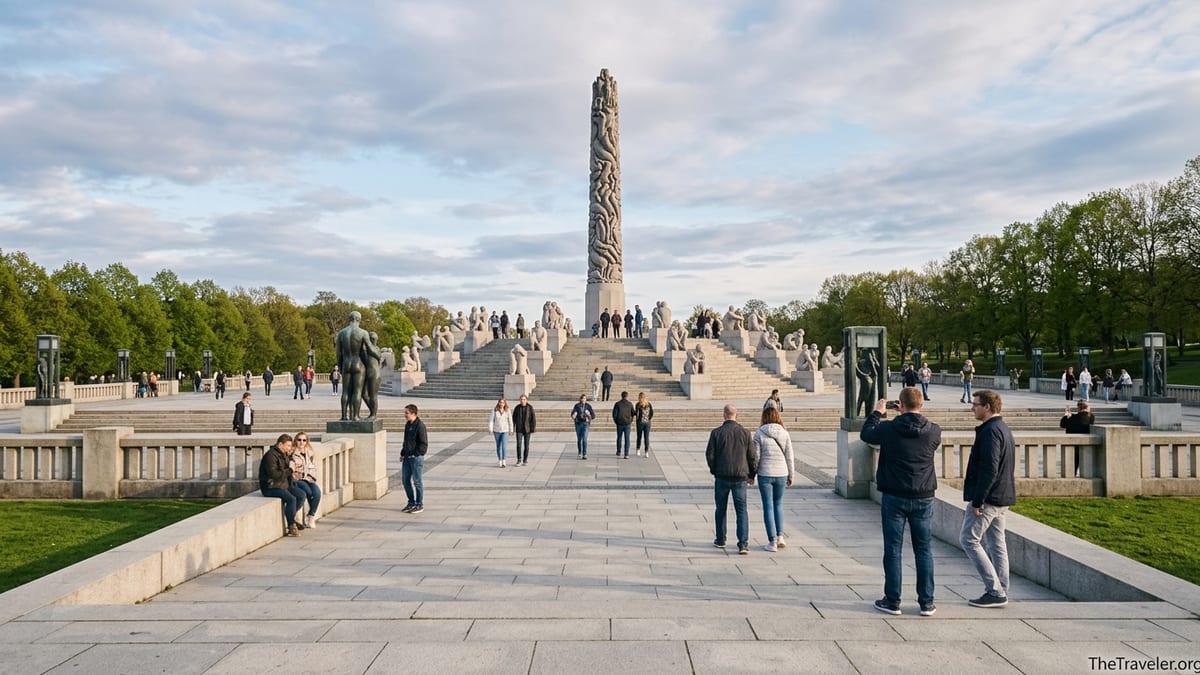
Understanding the Layout of Vigeland Sculpture Park
Vigeland Sculpture Park occupies the central portion of Frogner Park, about 3 kilometres northwest of central Oslo. The sculpture installation runs along an 850-metre axis from the wrought-iron Main Gate on Kirkeveien up to a circular feature called the Wheel of Life. Along this axis are the key zones you will move through: the Main Gate, the Bridge, the Fountain, the Monolith Plateau and, finally, the Wheel of Life at the far end. Most of the park’s 200-plus sculptures are concentrated in these five areas, which makes it relatively straightforward to structure your visit, even without a guide.
Gustav Vigeland not only sculpted the figures but also designed the park’s architectural layout. The result is that the whole space reads like a single artwork, with the human life cycle as a loose theme that runs from the playful children on the Bridge to the swirling figures of the Wheel of Life. Distances are walkable for most visitors, and the path is mostly flat until the gentle climb to the Monolith Plateau. Benches, lawns and café kiosks in Frogner Park make it easy to pause between sections, so you can approach each major group of sculptures with fresh eyes instead of rushing from one to the next.
For navigation, it helps to think of the park as a straight line with a hill at the far end. If you enter through the Main Gate on Kirkeveien you will first cross the Bridge over the Frogner ponds, then reach the Fountain on a raised terrace, then climb a broad set of steps flanked by granite figures to the Monolith Plateau. From there, a gently curving path through a small garden leads to the Wheel of Life. Most visitors follow this linear sequence, but you can also approach the park from side entrances in Frogner Park if you are coming from nearby neighbourhoods such as Majorstuen or Frogner.
Getting There, Hours and Practical Basics
From central Oslo, Vigeland Sculpture Park is easy to reach on public transport. Tram line 12 stops at Vigelandsparken or Frogner Plass, both a short walk from the Main Gate. Bus route 20 also serves Frogner Plass, which is convenient if you are coming from neighbourhoods like Grünerløkka. If you take the metro, any westbound line to Majorstuen leaves you around a 10-minute walk from the sculptures, along wide residential streets lined with cafes and grocery stores. Many visitors staying near the Oslo Central Station area simply tap their Ruter transport card or app and take tram 12 from Jernbanetorget, which normally takes around 15 to 20 minutes depending on traffic.
Taxi rides from central hotels around the National Theatre or Aker Brygge typically take less than 10 minutes in light traffic, although they cost noticeably more than using the integrated tram and bus system. Some travellers choose to visit the park as part of a guided bicycle tour of Oslo that includes the harbourfront, the Opera House and the Royal Palace gardens; this can be a relaxed way to cover ground if you are short on time and prefer to have context supplied as you ride. In summer, the city’s bike-share system often has docking stations near Frogner Stadium, which is just across from part of Frogner Park.
The sculpture park itself is open all day, every day, as part of the public Frogner Park. There is no admission fee to see the sculptures, and you can wander in at any hour, from early morning runners passing the bronze figures on the Bridge to late-evening picnickers on the lawns in June and July, when it barely gets dark. The adjacent Vigeland Museum, housed in the artist’s former studio building just outside the park, has separate hours and charges a modest entry fee, usually comparable to other Oslo museums. Checking its opening times before you go is worthwhile if you want to see Vigeland’s plaster originals and models after walking the outdoor installation.
Wear comfortable shoes, as you will easily cover several kilometres including the approach from the tram stop and the stroll to the far end at the Wheel of Life. In spring and autumn, temperatures can drop quickly once the sun dips behind the trees, so a light windproof jacket is useful even on bright days. There are public restrooms in Frogner Park and seasonal kiosks selling coffee, soft drinks and simple snacks. Many visitors pick up picnic supplies from a supermarket near Majorstuen or Frogner Plass and then settle on the lawns after touring the sculptures.
Starting at the Main Gate and Bridge: Where to Find The Angry Boy
The classic way to enter the installation is through the Main Gate, a sequence of imposing granite pillars and wrought-iron gates that give a first hint of the park’s design language. Once through the gate, you are on a straight, tree-lined avenue leading to the Bridge, which spans the Frogner ponds. The Bridge itself is around 100 metres long and is lined on both sides with dozens of bronze sculptures depicting men, women and children in everyday and often playful poses. This is where you will find one of the park’s most famous figures: The Angry Boy, known in Norwegian as Sinnataggen.
The Angry Boy is a small bronze statue of a toddler in a furious tantrum, fists clenched and one foot lifted mid-stomp. It has become a symbol of the park and of Oslo itself, appearing on postcards and souvenirs in shops across the city. To locate it on the Bridge, walk toward the middle section and look for a slightly larger crowd and visitors taking close-up photos at the railing. The Angry Boy stands on a corner of the central section, facing roughly south over the water. Because of its popularity, the sculpture’s extended hand and foot have been polished to a shine by thousands of touches from visitors.
As you explore the Bridge, allow time to look beyond this one celebrity figure. Many of the other bronzes are equally memorable, from a father tossing a child in the air to groups of children climbing over their parents. One dramatic, often-photographed piece shows a man twisting to fend off a cluster of babies that seem to fly toward him from all directions. None of the sculptures are labelled with explanatory plaques, so part of the experience is to interpret the scenes for yourself, perhaps comparing impressions with your travel companions as you move from one group to the next.
Practical photography tips can make this first section even more rewarding. On bright summer mornings, the light tends to fall softly from the east, illuminating the figures on one side of the Bridge and giving good contrast to the other. Late afternoon brings warmer light and reflections in the ponds below. If you prefer fewer people in your shots of The Angry Boy, consider arriving soon after breakfast or closer to sunset, when large tour groups are less common and locals are more spread out on the lawns of Frogner Park.
The Fountain and Surrounding Reliefs
From the Bridge, you continue straight ahead to a raised terrace that holds the massive bronze Fountain. Originally intended for a different site in Oslo, the Fountain became one of the anchors of Vigeland’s park plan. At its centre, a ring of towering bronze figures supports a large basin from which water cascades down. Around the base, a broad circular wall is decorated with intricately worked relief panels that many visitors overlook in their rush toward the Monolith further up the hill.
To appreciate this section, walk slowly around the Fountain and study the panels one by one. They depict stylised trees intertwined with human figures at different life stages: as children playing among the branches, as lovers resting in the shade, as parents embracing their children and, in some panels, as elderly figures close to death. The overall impression is of people literally woven into the cycles of nature. Details can be easier to see on overcast days, when softer light reduces glare on the dark bronze surface.
The Fountain terrace is also one of the best spots to pause and take in the park’s geometry. Looking back, you have a long view down the axis over the Bridge to the Main Gate and, beyond that, to the city streets. Turning around, you face the broad flight of steps leading up to the Monolith Plateau, with its ring of granite figures. The contrast between the darker bronze of the Fountain and the pale granite above makes for striking photographs, especially when clouds are moving quickly across the sky or when the surrounding trees have bright autumn colours in September and October.
If you are visiting with children, the low walls and open space around the Fountain give them room to move while adults linger over the details. In summer, you will often see Oslo residents reading on the grass nearby or eating ice cream from a kiosk, using the Fountain’s steady rumble as a backdrop. This mix of everyday life and monumental art is part of what makes the park feel so integrated into the city rather than a separate, formal attraction.
Climbing to the Monolith Plateau
From the Fountain, a processional staircase draws you toward the Monolith Plateau, the highest point of the installation and home to some of its most intense works. The steps are flanked by groups of granite sculptures that echo themes from the Bridge and Fountain but with a more contemplative, sometimes heavier mood. Families recline together, adults carry children or support one another, and older figures sit or lie in positions that suggest both rest and resignation. Because these sculptures are carved from pale granite, they take on different characters in changing weather, from crisp-edged silhouettes in low winter sun to soft, almost flesh-like tones in summer light.
At the centre of the plateau rises the Monolith itself, an almost 18-metre-tall column carved from a single block of granite. It is covered from base to summit with intertwined human figures, stacked and wrapped around one another in an upward spiral. Standing at its base, you can trace individual faces and gestures, but from a distance the column reads as one abstract form reaching toward the sky. Local guides and art historians offer various interpretations, from a symbol of human aspiration to a representation of the cycle of life and death, but Vigeland himself left few explicit explanations, inviting viewers to form their own.
Surrounding the Monolith are more than 30 separate granite groups arranged around the edge of the plateau. Many of these are among visitors’ favourites, including playful scenes of children clambering over adults and more solemn compositions of couples in quiet embrace. Because the plateau is slightly elevated and open on all sides, it can be windy, especially outside the summer months, so a scarf or extra layer is wise if you plan to linger. Early morning and late evening visits often reward you with softer light and fewer crowds, allowing you to walk the full circle around the Monolith and study each group in turn.
From a practical point of view, the climb to the Monolith Plateau involves several sets of steps, which some visitors may find demanding. There are ramps that allow wheelchair users to reach the plateau from the surrounding paths, although gradients can be steep in places. If mobility is a concern, it can be useful to arrive at the park with extra time so that you can ascend at your own pace, resting at the landings between levels and taking in different vantage points over the city as you go.
Reaching the Wheel of Life and Exploring Side Paths
After you have circled the Monolith Plateau, continue along the main axis toward the park’s final feature, the Wheel of Life. A gently sloping path leads through a smaller garden area planted with rose bushes and other seasonal flowers. At the far end, a raised circular platform holds a granite sculpture of intertwined human figures forming a ring, or wheel, floating above its base. This Wheel of Life echoes the spiralling forms of the Monolith but in a more compact, concentrated gesture. Many visitors see it as a closing symbol of the human life cycle that has been suggested throughout the park.
The area around the Wheel of Life tends to be quieter than the Bridge and Monolith, simply because some tour groups turn back earlier. This makes it a good place for reflection or for taking wide-angle photographs back along the park’s full length. On clear days, you can see beyond the trees to the hills around Oslo, including, in some directions, the ridge of Holmenkollen where the city’s ski jump stands. The setting reinforces the sense that Vigeland wanted his figures to be part of a broader natural landscape rather than confined within a city square.
While the main axis provides the clearest route between the park’s headline sculptures, side paths invite detours into quieter corners of Frogner Park. After visiting the Wheel of Life, you can loop back on a lower path alongside lawns and additional, less crowded sculptures, or continue into parts of Frogner Park where locals walk their dogs and children play on open fields. Near Frogner Manor, an 18th-century main house, you will find the Oslo City Museum, which adds historical context about the surrounding neighbourhood if you have time for an indoor stop.
If you want to expand your Vigeland-focused day, consider finishing with a visit to the Vigeland Museum, a short walk from one of the park’s side exits. The museum displays plaster models, early versions of some of the outdoor sculptures and personal artefacts that shed light on the artist’s working process. Seeing the rougher studio pieces after the polished stone and bronze outdoors can deepen your appreciation for the scale of his undertaking and the craftsmanship required to translate his designs into durable public art.
When to Visit and How to Experience the Atmosphere
The mood of Vigeland Sculpture Park changes dramatically with the seasons, so timing your visit can shape your experience as much as your route. In summer, particularly from late June to early August, long daylight hours and relatively mild temperatures turn Frogner Park into a social hub. Locals spread blankets near the ponds and children splash in the grass after swimming lessons at nearby Frognerbadet, the open-air pool complex. During these months, visiting in the early morning or later in the evening often provides the best balance between lively atmosphere and manageable crowds around the most famous sculptures.
Spring and autumn bring softer light and fewer visitors, which many photographers and art-focused travellers prefer. In April and May, trees bud and flowers around the paths begin to bloom, providing a fresh backdrop to the stone figures. By late September and October, the park’s trees shift to deep yellows and oranges, giving the granite and bronze a warmer tone and making the Monolith Plateau particularly photogenic. Winter visits are quieter and can be magical after snowfall, when the sculptures wear a temporary layer of white. Paths are generally cleared, but you should wear warm, waterproof footwear with good grip and be prepared for shorter days.
To immerse yourself fully, allow at least two to three hours for the park alone, including time to sit, sketch, photograph or simply watch how others interact with the sculptures. Many visitors find it rewarding to walk the main axis once without reading about the symbolism, then take a break on the lawns, and finally walk back with a guidebook or audio commentary that offers interpretations. This layered approach can help you notice small details you overlooked, such as the subtle changes in facial expressions from one side of a group to the other.
Respectful behaviour is appreciated, especially at the Monolith Plateau and Wheel of Life, where the mood is often more contemplative. While it is common to see children climbing on some of the lower sculptures or posing for playful photographs, consider the wear on the surfaces and follow any on-site guidance. If you bring food, use the many bins around Frogner Park and avoid leaving picnic remnants near the sculptures themselves. Dogs are a regular sight in the park but should be kept under control near crowded areas.
The Takeaway
Exploring Vigeland Sculpture Park is less about ticking off individual works than about walking through a carefully orchestrated sequence of spaces that together form one of Oslo’s defining landmarks. By understanding the park’s simple linear layout, starting at the Main Gate and Bridge, pausing at the Fountain, climbing to the Monolith Plateau and continuing to the Wheel of Life, you can make sure you see the most famous sculptures, including The Angry Boy, without feeling rushed.
With free entry, easy tram access from central Oslo and an atmosphere that blends everyday local life with monumental art, the park rewards both quick visits and long, reflective wanderings. Whether you come in high summer with a picnic blanket or on a crisp autumn afternoon with a camera, a little planning will help you find the key works and make sense of their place in the larger whole. Give yourself enough time to follow the axis, take side paths, and let the sculptures gradually reveal the human stories that tie the park together.
FAQ
Q1. Where exactly is Vigeland Sculpture Park located in Oslo?
Vigeland Sculpture Park occupies the central section of Frogner Park, about 3 kilometres northwest of Oslo’s city centre, with the main entrance on Kirkeveien.
Q2. How much time should I plan to see the main sculptures?
Most visitors need around two to three hours to walk the main axis from the Main Gate to the Wheel of Life, stopping at the Bridge, Fountain and Monolith Plateau.
Q3. Is there an entrance fee for Vigeland Sculpture Park?
No, the sculpture park is part of Frogner Park and is free to enter at all hours. Only the nearby Vigeland Museum charges an admission fee.
Q4. What is the easiest way to get there by public transport?
From central Oslo, tram line 12 to Vigelandsparken or Frogner Plass and bus 20 to Frogner Plass are convenient options. The metro to Majorstuen plus a short walk also works well.
Q5. How do I find The Angry Boy sculpture in the park?
The Angry Boy is on the Bridge section of the park. Walk to the central part of the Bridge and look for a small bronze toddler in a tantrum near the railing where people often gather for photos.
Q6. Are there facilities such as restrooms and food nearby?
Yes, there are public restrooms and seasonal kiosks in Frogner Park. Many visitors also bring picnic supplies from supermarkets near Majorstuen or Frogner Plass.
Q7. Is the park accessible for wheelchair users and strollers?
Most main paths are paved and suitable for wheelchairs and strollers, and there are ramps reaching the Monolith Plateau, though some slopes can be relatively steep.
Q8. Can I visit Vigeland Sculpture Park at night?
Yes, the park is open around the clock. In summer, late-evening visits are popular because it stays light for many hours, while in winter the park is more atmospheric but darker and quieter.
Q9. Are guided tours available, or should I explore on my own?
Both options work. You can join walking or bicycle tours that include the park, or explore independently using a map or simple route that follows the Main Gate, Bridge, Fountain, Monolith and Wheel of Life.
Q10. Is photography allowed, and are tripods permitted?
Photography for personal use is generally allowed throughout the park, and small tripods are usually fine as long as you do not block paths or disturb other visitors.