


Most first-time visitors to Naples pour every hour into the alleys of the historic center and along the waterfront, convinced this is where the “real” city lives. Yet above the chaos, on the hill of Vomero, another Naples unfolds: pedestrian shopping streets, quiet parks, astonishing views over the bay, and an easy window onto everyday life. Skipping Vomero is a common time-saving decision, but it often means leaving with an incomplete picture of the city.
Get the latest updates straight to your inbox!
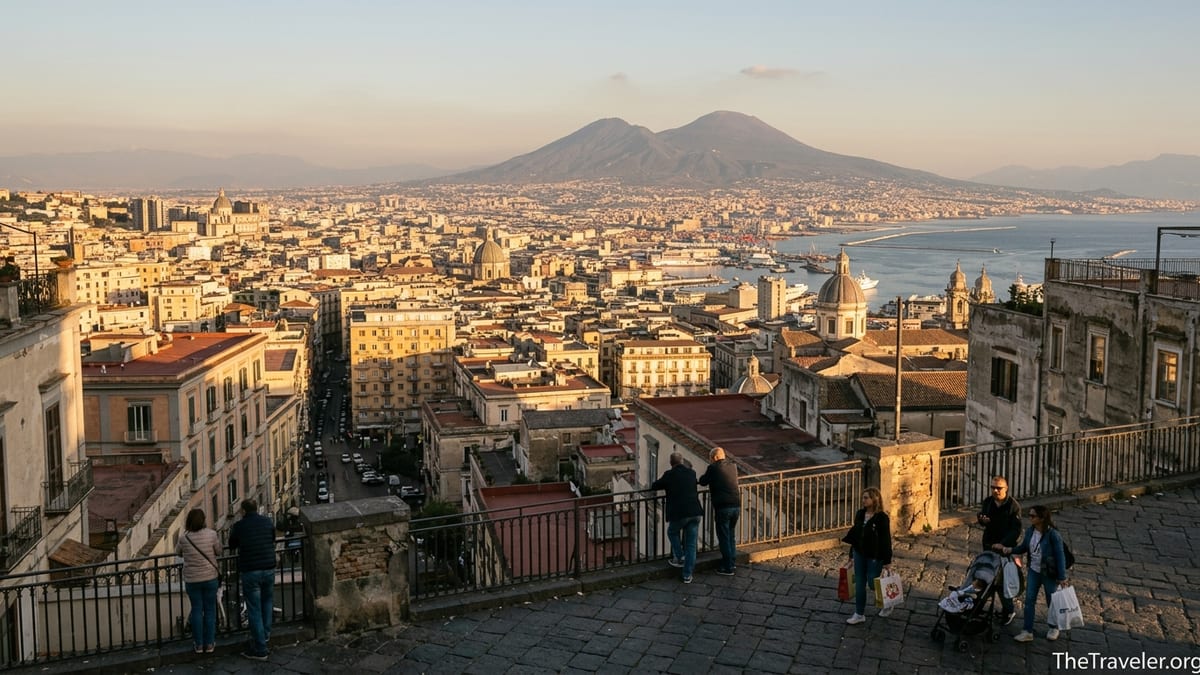
Beyond Spaccanapoli: Why Vomero Changes How You See Naples
Naples’ historic center and Spanish Quarter are intense, beautiful and, at times, overwhelming. Between Spaccanapoli, Via dei Tribunali, San Gregorio Armeno and the waterfront, it is tempting to stay below and assume the hilltop districts are optional. Vomero, though, is where many Neapolitans actually live, shop and go for a stroll after work. Spending even half a day here balances the picture of Naples from purely historic spectacle to a functioning modern city.
Physically, Vomero is Naples’ terrace. From the walks around Castel Sant’Elmo and the terraces of the Certosa di San Martino, you look out over the entire bay, from the Sorrento Peninsula to the outline of Procida and Ischia on a clear day. The volcano that feels distant from the alleys below suddenly rises at eye level, with layers of neighborhoods stepping down toward the port. This simple change of perspective helps visitors understand the city’s geography in a way that no map quite can.
Culturally, the area feels different from the centro storico. Instead of scooters edging past laundry lines, you find families with strollers on wide pavements, students lingering outside gelaterie and locals ducking into bakeries after work. On a weekday evening along Via Luca Giordano or Via Alessandro Scarlatti, you are more likely to hear teenagers debating football and university exams than the constant language-mix of tour groups. It is still absolutely Naples, but one that belongs to today as much as to history.
Crucially, all of this sits less than ten minutes above the historic center by funicular or Metro Line 1. If you board the Centrale funicular near the Galleria Umberto I or the Montesanto funicular close to Piazza Dante, you are whisked straight into the heart of Vomero without the effort of climbing. A single integrated public transport ticket, which typically covers 90 minutes of travel on metro, buses and funiculars within the city, is usually enough for an ascent and further connections, making a visit logistically easy and budget friendly.
Getting Up the Hill: Funiculars, Metro and Practical Details
Part of Vomero’s charm is how enjoyable it is to reach. Naples operates three historic funicular lines connecting the center to the hill: the Centrale line from the Augusteo station near Via Toledo and the Galleria Umberto I, the Montesanto line from the lively market area near Piazza Montesanto, and the Chiaia line from the elegant district near Via dei Mille and Piazza Amedeo. All three converge in or near Vomero, taking five to ten minutes to climb the hill and offering brief but atmospheric glimpses into courtyards and backstreets along the way.
For many visitors, the easiest option is Metro Line 1, the yellow line that cuts under the city and includes some of Naples’ celebrated “art stations.” From the central area you can board at Toledo or Dante and ride up to Vanvitelli, the main metro stop for Vomero. Emerging from Vanvitelli places you directly beside Piazza Vanvitelli, a broad square that functions as the neighborhood’s unofficial living room, ringed with cafes and shops. From here, you can walk almost everywhere in Vomero suitable for a first visit.
Tickets for the metro and funicular are integrated within the city’s main transport network. As of late 2025, a standard single-journey urban ticket costs only a few euros and usually includes 90 minutes of validity across buses, metro and funiculars, which is generally enough to ride up to Vomero, connect to another line if needed, and then ride back down later. If you plan a full day hopping between the historic center, Vomero and other districts, a daily ticket can provide good value and spare you repeated queueing at ticket machines.
In practice this means that adding Vomero to your itinerary does not require a special excursion budget. For example, a couple staying near Piazza Bellini can walk to Dante station, take Metro Line 1 up to Vanvitelli, spend the morning in Vomero, ride the funicular down to Chiaia for an evening stroll by the sea, and still remain within the cost of regular urban tickets. Compared to longer day trips to Pompeii or the islands, this is one of the easiest and most cost-effective ways to dramatically broaden your sense of Naples.
Piazza Vanvitelli and the Pedestrian Heart of Vomero
When you step out at Vanvitelli station, you arrive in Piazza Vanvitelli, the geographic and social center of Vomero. The square is framed by late 19th and early 20th century buildings with neorenaissance facades, small garden areas and ample pedestrian space. Traffic here is present but tamed by a series of limited-traffic and pedestrian zones that radiate out into the surrounding streets, making it feel immediately more relaxed than the frenetic avenues by the port.
From the southwest corner of Piazza Vanvitelli, Via Alessandro Scarlatti leads into one of Naples’ most successful pedestrian shopping drags. Together with Via Luca Giordano, which runs roughly parallel, it forms an L-shaped pedestrian island filled with mid-range clothing chains, independent boutiques, perfumeries and bookshops. On a Saturday afternoon, Neapolitan families stroll these streets in a slow loop, stopping for espresso, browsing window displays and greeting friends; it is a natural setting for people-watching and for observing Naples at play rather than at work.
Along these streets, cafe culture takes on a slightly different form from the dense, old-bar atmosphere of the centro storico. Longstanding names such as Caffè Vomero on Via Scarlatti or the Leopoldo Cafebar along Via Luca Giordano combine pastry counters with outdoor tables where locals linger over espresso, spritz or a glass of Falanghina. Prices are generally a touch higher than in the narrow lanes below but still moderate by Western European standards: a cappuccino might cost around 2 euros, a sfogliatella around 2 to 3 euros, and an aperitivo with a plate of snacks between 8 and 12 euros depending on the setting.
For visitors, these pedestrian streets can serve as a gentle reset after hours in the crowded alleys of the center. You can sit in the shade with a gelato, let children run ahead across the traffic-free paving, and slowly adapt back to a calmer rhythm without leaving the city. It is also a practical area to shop for everyday items, from pharmacies to electronics and fashion, which can be useful if you are in Naples at the end of a longer trip and need to restock basics or pick up last-minute gifts.
Castel Sant’Elmo, Certosa di San Martino and Naples From Above
Few experiences in Naples rival the first sight of the bay from Castel Sant’Elmo. This star-shaped medieval fortress, perched on the highest part of the hill, commands a 360-degree view over the city, Mount Vesuvius and the islands of the gulf. The walls and ramparts are open to visitors, and a slow loop around the perimeter reveals not just postcard vistas but the complex layering of Naples’ neighborhoods, from the grid of the Spanish Quarter to the domes of the historic center and the port beyond.
Next door, the Certosa di San Martino offers a more contemplative side to the same panorama. Once a Carthusian monastery and now a museum complex, it is one of the finest examples of Neapolitan Baroque architecture, with cloisters lined in white marble, frescoed ceilings and a church rich in inlaid marble and sculpture. Its terraces overlook the city in a series of framed views that combine manicured gardens, tiled roofs and the shimmering sea. Many visitors who make it up here report that this is where they finally grasp the scale and topography of Naples, and where the city feels less overwhelming and more coherent.
Reaching the castle and charterhouse on foot from Piazza Vanvitelli involves a short uphill walk. You can follow Via Morghen to the upper funicular station, then use the escalators and streets that lead toward Castel Sant’Elmo, or climb via the Petraio, an ancient stepped pedestrian route connecting Vomero to the city below. The climb is steep in stretches but rewards you with quiet corners, stone stairways and glimpses into gardens, offering a way to experience the historic hillside away from traffic.
Entrance fees to these sites are modest compared with major European monuments, and visiting both together makes a natural half-day itinerary. Many travelers combine a morning at Castel Sant’Elmo and the Certosa di San Martino with lunch back down in the pedestrian area, followed by shopping or a late-afternoon aperitivo. For photographers and sunset chasers, arriving in the late afternoon can be especially rewarding, as the light softens over the bay and the city’s chaos below transforms into a pattern of twinkling lights.
Parks, Belvederes and Green Space in the Hilltop City
One reason many visitors leave Naples feeling tired is the relative scarcity of quiet green space in the dense historic center. Vomero partly solves this. Villa Floridiana, set slightly away from the bustle of Piazza Vanvitelli, is a broad, tree-shaded park that falls away toward the sea. Gravel paths weave through pines and oaks, leading to belvederes where locals pause to look out at the bay. Inside the park stands the neoclassical Villa Floridiana itself, home to a ceramics museum, but many Neapolitans come simply for the greenery and the chance to sit on a bench with a book.
Other viewpoints are scattered across the hillside. Belvedere di San Martino, close to the castle complex, opens like a balcony toward the city, popular with both local couples and visiting photographers. The views here emphasize the rooftops and domes of the historic center as they slope down to the port. On clear days, the fortress and charterhouse can be framed together with Vesuvius behind them, making it easy to understand why these structures remain some of the city’s most prominent landmarks even from afar.
These green and open spaces also reveal how Neapolitans use their city outside the main tourist circuits. On a sunny Sunday, you will see grandparents pushing prams, teenagers taking photos, dog walkers greeting each other and groups of friends sharing takeaway pizza on park benches. For families traveling with children, this part of Naples can provide badly needed downtime, where kids can move freely without parents worrying about fast scooters or narrow pavements.
Because Vomero sits higher and often catches a breeze from the sea, temperatures here can feel slightly cooler than in the narrow lanes below, particularly in late spring and early autumn. During the height of summer, when the historic center can feel airless by mid-afternoon, retreating to Villa Floridiana’s trees or the shaded stone corridors around the Certosa di San Martino is a practical strategy to escape the heat without abandoning sightseeing altogether.
Everyday Food and Nightlife: Eating and Drinking in Vomero
While the centro storico is famous for its historic pizzerias and street food, Vomero offers a chance to taste how middle-class Naples eats on an ordinary day. Here you will find pizzerias that focus on local clientele, simple trattorias serving daily specials, and contemporary bars where aperitivo and cocktails sit comfortably alongside traditional espresso culture. Prices are often comparable to the center, but the atmosphere tends to be less hectic and slightly more residential.
Along Via Luca Giordano, for instance, it is easy to stop for an evening aperitivo at one of the many bars with outdoor seating. You might order a spritz or a local craft beer and receive a plate of crisps, olives and small bites as part of the ritual. A typical bill for two drinks and aperitivo snacks might come to 15 to 20 euros for a couple, depending on the bar and whether you add extra food. On nearby side streets, you can slip into a small osteria for a bowl of pasta with clams or a plate of parmigiana di melanzane, surrounded mostly by locals catching up on their day.
Pizza in Vomero is a serious business but less of a pilgrimage than in the historic center, which can work in visitors’ favor. Neighborhood pizzerias near Piazza Fuga or along Via Cilea often serve classic margherita and marinara pies at prices similar to the old town, with shorter waits, especially on weeknights. Many offer takeaway slices or folded pizzas to eat on the go, making it easy to pick up dinner before walking to one of the hilltop viewpoints for blue-hour cityscapes.
Nightlife here has a distinctly local tilt. Rather than bars crammed with backpackers, you will find wine bars, cocktail spots and cafes that gradually transform into evening hangouts. On mild nights, Piazza Vanvitelli remains busy until late, with groups gathered by the fountain or leaning against balustrades, and the pedestrian streets buzz with conversation. For travelers who enjoy observing everyday social life more than loud clubs, this rhythm can feel both safe and engaging.
Vomero as a Base: Staying Above the City
Most visitors instinctively book accommodation in or near the historic center, citing proximity to sights and transport. Yet Vomero can function as a surprisingly practical base, particularly for repeat visitors or anyone who values sleep and space over being in the absolute middle of the action. The area offers a spread of mid-range hotels, guesthouses and apartment rentals, often with better sound insulation and more modern facilities than many budget options in the older quarters.
Staying near Piazza Vanvitelli or along Via Luca Giordano means waking up to quieter streets and grabbing morning coffee alongside office workers and families rather than tourists. From here, you can still reach the center quickly: Metro Line 1 runs down to Toledo and Garibaldi, and the funiculars drop you into the Spanish Quarter, Montesanto market or Chiaia in minutes. For day trips to Pompeii or the Amalfi Coast, you simply ride the metro down to the main station before boarding regional trains or buses.
There are trade-offs. Evening trips home require keeping an eye on the last funicular or metro departures if you have spent the night on the waterfront or in the centro storico, and taxis back up the hill will cost more than stays in the flat part of town. However, many travelers find that the combination of quieter nights, easier access to green space and a strong selection of local restaurants outweighs the slight inconvenience.
For families and longer stays, Vomero also offers more of the everyday services that make a base feel livable: supermarkets tucked into side streets, bakeries selling fresh bread and taralli in the mornings, laundries, toy shops and pharmacies. Choosing an apartment here, even for a week, provides a sense of slipping into Neapolitan daily life that is harder to achieve in more transient, tourist-focused areas.
The Takeaway
Vomero rarely tops must-see lists in international guidebooks, overshadowed by the magnetic chaos of Naples’ historic center and the obvious draw of nearby sites like Pompeii and Capri. Yet for travelers curious about how the city lives today, and for anyone seeking both wider perspectives and moments of calm, skipping this hilltop neighborhood is a real loss. From the ramparts of Castel Sant’Elmo and the terraces of the Certosa di San Martino, you see Naples as a whole, not just as a tangle of lanes.
On the streets below, in Piazza Vanvitelli and along Via Scarlatti and Via Luca Giordano, you walk among Neapolitans doing ordinary things: buying shoes, sharing gelato, pushing prams and filling cafe terraces at aperitivo hour. Parks like Villa Floridiana, green belvederes and residential pizzerias complete a portrait of a city that works and relaxes, not only one that displays its most dramatic angles to visitors.
With simple, affordable transport connections, a few euros and a spare morning or evening, you can step into this “second” Naples without strain. When you finally ride the funicular back down into the tangle of the old streets, chances are high that the city will feel richer, more understandable and perhaps a little more lovable because you took the time to look at it from above.
FAQ
Q1. Is Vomero worth visiting if I only have one full day in Naples?
Yes, even a short visit can be worthwhile. If you have one day, consider spending the morning in the historic center, then taking Metro Line 1 or a funicular up to Vomero in the late afternoon for views from Castel Sant’Elmo and a walk along the pedestrian streets before dinner.
Q2. How long should I plan to spend in Vomero?
A focused visit can fit comfortably into half a day. Allow two to three hours for Castel Sant’Elmo and the Certosa di San Martino, plus another couple of hours to stroll around Piazza Vanvitelli, Via Scarlatti and Via Luca Giordano, and to stop for coffee, gelato or aperitivo.
Q3. What is the easiest way to reach Vomero from the historic center?
The most straightforward route for many visitors is Metro Line 1 to Vanvitelli station from Toledo or Dante. Alternatively, you can take one of the three funiculars, especially the Centrale line from near the Galleria Umberto I, which brings you directly up the hill in a few minutes.
Q4. Are the funiculars and metro in Naples safe to use?
Yes, the funiculars and metro are widely used by locals and are generally considered safe during normal operating hours. As in any busy city, keep an eye on your belongings, avoid displaying valuables and try to travel earlier in the evening rather than on the last departures.
Q5. Can I visit Vomero with children or someone who has limited mobility?
Vomero can work well for families and travelers with limited mobility because the main areas around Piazza Vanvitelli, Via Scarlatti and Via Luca Giordano are relatively flat and largely pedestrian. Reaching these areas by metro or funicular avoids steep climbs, though the walk up to Castel Sant’Elmo and the Certosa di San Martino is more demanding and may require taxis or careful planning.
Q6. Are there good places to eat in Vomero, or should I return to the historic center?
Vomero has an excellent range of options, from neighborhood pizzerias and casual trattorias to pastry shops and contemporary bars. Many visitors enjoy having dinner here to experience a more local dining scene, then returning to the center later or the next day for historic pizzerias and traditional street food.
Q7. What time of day is best for visiting Castel Sant’Elmo and the Certosa di San Martino?
Late afternoon is particularly rewarding, as the light over the bay softens and you can watch the city transition from day to evening. Morning visits are quieter and often cooler in summer, but sunset offers the most dramatic views and photo opportunities.
Q8. Is Vomero a good neighborhood to stay in for a multi-day trip?
Yes, especially if you value quieter nights and easier access to green spaces. From Vomero you can still reach the historic center and main train station via Metro Line 1 or the funiculars, while enjoying a more residential atmosphere, a wide choice of shops and services, and less late-night street noise.
Q9. Do I need to book tickets in advance for attractions in Vomero?
For most of the main sights in Vomero, including Castel Sant’Elmo and the Certosa di San Martino, advance booking is usually not essential outside peak holidays or special events. It is still wise to check opening hours shortly before your visit and to allow some flexibility in case of schedule changes.
Q10. What should I wear or bring when visiting Vomero?
Comfortable walking shoes are important, as pavements can be uneven and you may face slopes or stairs on the way to viewpoints. In warmer months, bring water, sunscreen and a hat, since the castle ramparts and terraces are exposed to the sun. A light layer for cooler evenings is useful, as the hilltop can feel breezier than the streets below.