


Sponza Palace is one of Dubrovnik’s most atmospheric buildings, a rare survivor of earthquakes and war that still anchors daily life in the Old Town. For first time visitors, it offers a compact but powerful glimpse into the city’s mercantile past and its more recent experience of conflict. This guide walks you through the essential history, what to see inside, practical details, and how to time your visit so Sponza becomes a highlight of your Dubrovnik stay rather than a quick photo stop on Stradun.
Get the latest updates straight to your inbox!
Why Sponza Palace Matters in Dubrovnik
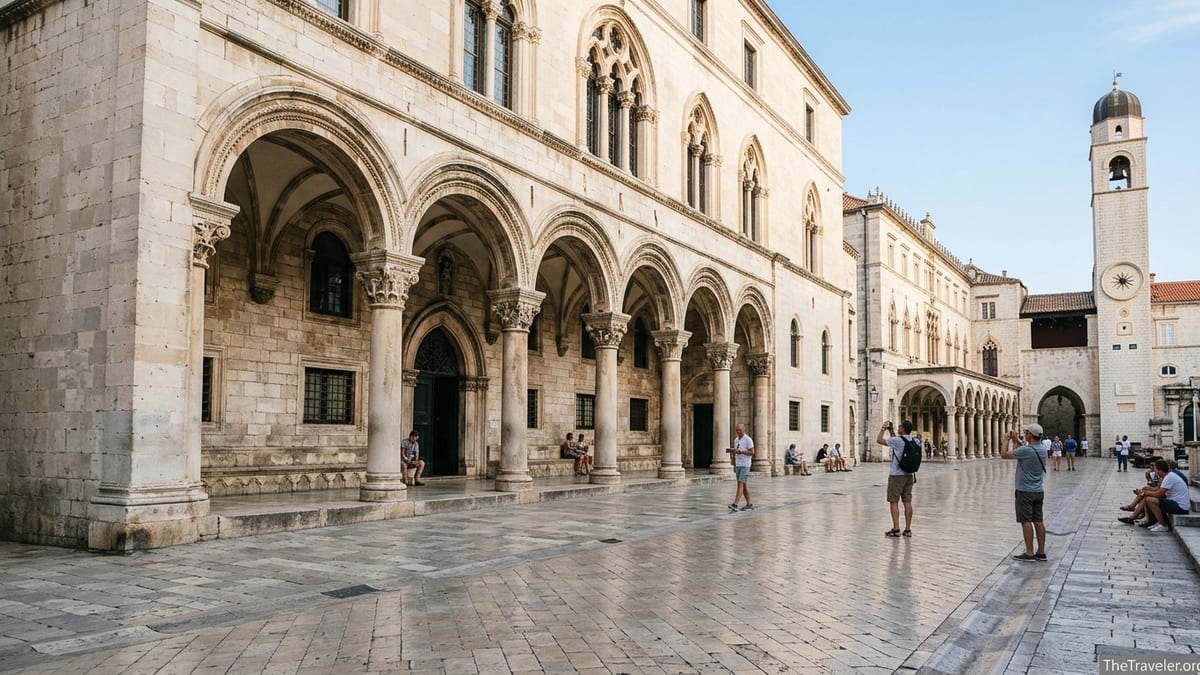
Sponza Palace stands at the eastern end of Stradun, beside Luža Square and the City Bell Tower, and is considered one of the finest secular buildings in Dubrovnik’s Old Town. Built between 1516 and 1522 as a customs house and trading hub for the Republic of Ragusa, it later served as a mint, treasury, armoury, and even a school. Today it houses the State Archives of Dubrovnik and functions as a cultural venue, while still welcoming visitors to its ground floor spaces.
Architecturally, Sponza is important because it largely survived the catastrophic 1667 earthquake that destroyed much of Renaissance Dubrovnik. When you step into its courtyard you are seeing a rare, largely original example of a 16th century Gothic Renaissance palace in the city. Locals often describe Sponza as a kind of time capsule; details like carved stone capitals, arcades and Latin inscriptions give a sense of how many of Dubrovnik’s palaces would have looked before the disaster reshaped the townscape.
Sponza also plays a living role in modern Dubrovnik. Its atrium serves as a venue for performances during the Dubrovnik Summer Festival, and the square outside is used for opening ceremonies and public events throughout the year. On a typical summer evening you might pass a classical chamber concert tuning up under the arches or see technicians setting up lighting rigs for a festival performance, a concrete reminder that the palace is not just a monument but part of the city’s cultural heartbeat.
For first time visitors planning an Old Town day, Sponza is usually experienced in two ways: a short but meaningful stop to absorb its architecture and memorial room, and as a backdrop for some of your best photos of Stradun and Luža Square. This guide assumes you will do both, and helps you decide how much time to allocate depending on your interests and schedule.
A Short History of Sponza Palace
Sponza Palace was constructed during Dubrovnik’s golden age as a maritime republic. Work began in 1516 under the chief architect Paskoje Miličević and was completed around 1522. Its original function was practical rather than ceremonial: it was built as a customs house, bonded warehouse and office complex where goods arriving by sea were registered, taxed and stored before moving onward into the city and hinterland.
The palace’s alternative historical name, Divona, reflects this role and is derived from the Italian word for customs. Merchants arriving from Venice, the Ottoman Empire or ports along the Adriatic would have dealt with officials based in Sponza, paid duties here and used its courtyard as a sheltered meeting place. In an era when trade in salt, wool and spices underpinned the city’s prosperity, the palace stood at the administrative core of that system.
Over time Sponza housed a variety of key institutions. Sources describe its use as the city’s mint, where coins of the Republic of Ragusa were struck, and as an armoury, treasury and bank. It also hosted a school, underlining how multi functional public buildings were in the compact Old Town. This layered civic history explains why the building is both large and architecturally refined, with careful attention paid to its arcades and interior courtyard despite its bureaucratic role.
In the modern era Sponza avoided the worst structural damage in the 1667 earthquake and in later conflicts, although Dubrovnik itself was shelled during the 1990s war. Today it is home to the State Archives of Dubrovnik, one of the richest archival collections in the region, preserving documents that trace the city’s trade, diplomacy and everyday life over centuries. While most of the archives are closed to casual visitors, knowing they are there adds weight to a walk through the ground floor: you are literally passing under centuries of recorded history.
Architecture and Atmosphere: What to Look For
Architecturally, Sponza combines late Gothic and early Renaissance elements in a way that feels both ornate and restrained. From the outside you will notice the open loggia facing Luža Square, with a series of arches supported by finely carved columns. Look up at the capitals to see vegetal motifs and small figures, which hint at the skill of the 16th century stonecutters who worked here. The façade’s rhythm of arches and windows frames some of the most photographed views of the Old Town, especially when captured in soft morning light.
Inside, the central courtyard is the highlight for many first time visitors. Surrounded by arcades on multiple levels, with pale stone walls that seem to glow in sunlight, it offers a calm, almost cloistered feel even when Stradun is busy just outside. You can often hear footsteps and low conversation echoing under the arches, which adds to the sense of stepping out of the modern tourist flow and into a quieter, more contemplative space.
As you walk around the courtyard, look for details that speak to the building’s original use. Doors and passageways that once led to storerooms and offices still open off the ground floor, and on the upper levels you may glimpse shuttered windows and porticoes that historically connected administrative spaces. Stone inscriptions in Latin on the walls remind visitors that this was a place where honesty in trade was a civic virtue; one famous inscription essentially warns that measures and weights are kept true here and that fraud will not be tolerated.
The building’s atmosphere changes noticeably by time of day. In the early morning, when cruise ship groups are only just arriving, the courtyard may be almost empty and filled with soft, angled light. By midday it provides welcome shade for visitors escaping the heat of Stradun, while in the evening, particularly during the Dubrovnik Summer Festival, it can feel almost theatrical, with subtle lighting on the arches and the sound of musicians rehearsing for a concert.
What You Will See Inside Today
For regular visitors, access to Sponza Palace is focused on the ground floor, especially the portico and central atrium. This is not a traditional museum with a long linear exhibition, and most of the upper floors are reserved for archival work and research. In practice, your visit will centre on walking into the building from Luža Square, exploring the courtyard, and then stepping into the Memorial Room of the Defenders of Dubrovnik.
The Memorial Room is a compact but powerful space just inside the entrance, before you reach the main cloister. Here you will see black and white portraits of those who died defending Dubrovnik during the Croatian War of Independence in the early 1990s. Many visitors describe this as one of the most moving experiences of their time in the city, both because of the youth of many faces and because the photographs are displayed without elaborate commentary. Plan to spend at least ten to fifteen quiet minutes here, and consider preparing children in advance if you are visiting as a family.
Beyond the memorial, the atrium itself is the main attraction. Depending on the day, you may find it relatively empty, with visitors taking photographs of the arches and looking up towards the upper galleries, or partially set for an event, with rows of chairs and basic stage lighting. During the Dubrovnik Summer Festival, tickets for concerts in the Sponza atrium are typically sold through official festival channels, and the space takes on a very different, more formal character in the evenings.
Because Sponza functions as a working archive, you may notice staff and researchers coming and going, particularly on weekday mornings. Access routes and some side doors are usually roped off or clearly signed to protect the working areas. This can surprise visitors expecting a conventional open museum layout, but it is part of what makes a stop here feel authentic: you are visiting an active civic building as much as a historical monument.
Tickets, Opening Hours and How Long to Spend
As of mid 2026, entry policies for Sponza Palace are relatively straightforward but can vary slightly by season and event schedule. In recent years the ground floor atrium has typically been open during standard Old Town visiting hours, with a modest entrance fee or donation requested for the Memorial Room, sometimes collected via a staffed desk or unobtrusive donation box. Because these details can change, especially during festivals or public holidays, it is sensible to confirm current conditions at the Dubrovnik tourist information office near Pile Gate or via your hotel reception on the day you plan to visit.
Typical opening hours broadly follow daytime business patterns in the Old Town, often from around mid morning to late afternoon, with occasional closures when the space is being prepared for official events, exhibitions or concerts. For example, on a day when a Dubrovnik Summer Festival chamber concert is scheduled in the atrium, access for sightseers may be curtailed from late afternoon onward so that technicians can set up sound equipment and seating. If Sponza is a priority for you, try to schedule your visit in the first half of the day to reduce the chances of disruption.
In terms of time, most first time visitors spend between twenty and forty minutes inside Sponza Palace. If you move fairly quickly, you can see the Memorial Room, appreciate the courtyard, and take photographs in about twenty minutes. If you are particularly interested in architectural details, or if the atmosphere encourages a longer, reflective pause in the courtyard, it is easy to extend this to forty five minutes or more without feeling rushed.
Sponza is not currently one of the core paid attractions tied directly to the main Dubrovnik city pass offers, which tend to focus on the city walls, major museums and Rector’s Palace. However, that balance of inclusions can evolve, and passes are sometimes updated to include or partner with additional sites. When you purchase a Dubrovnik city pass online or from an official booth, ask the staff which smaller Old Town sites are included that season and whether any combined tickets or guided tours incorporate a brief stop at Sponza.
Best Time to Visit and How to Fit Sponza into Your Day
Because Sponza Palace is compact, the main variable that shapes your experience is not the size of the building but the state of the streets outside. Luža Square is one of the busiest nodes in Dubrovnik’s Old Town, especially when multiple cruise ships are in port. For a calmer visit, aim for either early morning, roughly between 8:30 and 10:00, or later in the afternoon when the harshest sun has passed and some day trippers have left.
One popular approach for first timers is to begin the day with a walk on the city walls from Pile Gate, exit at Ploče Gate, then stroll back across Stradun towards Sponza. By the time you reach the eastern end of the main street, you can step inside the palace to cool off in the shade and reflect on the views you have just enjoyed from above. Afterwards, you are perfectly placed to continue to the nearby Church of St Blaise or the Rector’s Palace, each just a short walk across Luža Square.
If you plan to attend an evening performance during the Dubrovnik Summer Festival, consider timing a daytime visit to Sponza on the same day. This allows you to see the atrium in its daytime, relatively informal state and then return later when it has been transformed into a concert space. For example, many visitors book a string quartet recital or vocal concert in the Sponza atrium, enjoy an early dinner at a nearby konoba off Stradun, then arrive at the palace shortly before the performance start time to soak up the atmosphere in the square.
Weather also plays a role. On very hot summer days, Sponza’s stone courtyard offers genuine relief from the sun and may become one of your favourite shady refuges in the Old Town. Conversely, on rare rainy days, its covered arcades provide shelter yet still feel open to the outside world. In shoulder seasons like April and October, when the Old Town is less crowded overall, you might find the palace nearly empty for parts of the day, which can lend your visit a surprisingly intimate feel.
Events, Weddings and the Dubrovnik Summer Festival
Sponza Palace is closely associated with Dubrovnik’s cultural calendar, particularly the long running Dubrovnik Summer Festival. The square in front of the palace and the atrium itself are regular venues for performances and ceremonies during the festival season, typically running from early July to late August. Festival programmes often highlight Sponza as a setting for smaller scale classical music events, vocal recitals or intimate theatre pieces, which benefit from its acoustics and courtyard layout.
During the festival, you may see technicians setting up temporary seating, lighting rigs and sound equipment in the atrium, and performers using the arches as a natural backdrop. Local and national media frequently publish images of opening ceremonies held in the Luža Square area, with Sponza’s façade visible behind artists, dignitaries and the gathered crowd. If your visit coincides with the festival and you enjoy live performance, keeping an eye on the official schedule and choosing at least one event in or around Sponza is an excellent way to connect more deeply with the space.
Beyond the Summer Festival, Sponza is also occasionally used for other cultural events, art exhibitions and civic ceremonies. On certain evenings you might stumble upon a contemporary art projection on its walls, a local choir concert, or a city celebration connected to Dubrovnik’s patron saint or major anniversaries. Because programming can change from year to year, it is wise to check current listings at the tourist office or ask your accommodation host about notable events during your stay.
The palace has also become a sought after wedding venue, especially for couples drawn to Dubrovnik for its romantic Old Town architecture. Wedding planners in the city sometimes describe Sponza as one of the most atmospheric civil ceremony backdrops, thanks to its arcades and soft natural light. If you happen to visit on a wedding day, part of the atrium may be reserved for a time, and you might see photographers positioning newlyweds under the arches while friends and family look on. For most casual visitors this is a minor inconvenience at worst and, for many, a charming glimpse into how the building remains woven into personal milestones.
Practical Tips for First Time Visitors
Because Sponza Palace is integrated into the fabric of the Old Town, visiting it does not require special transport planning. Most visitors arrive on foot as part of a broader exploration of the walled city. From Pile Gate, the western entrance, it is roughly a ten minute stroll straight along Stradun to the eastern end, where Sponza stands just before the small rise that leads towards the Dominican Monastery and Ploče Gate. If you are navigating by landmarks, look for the City Bell Tower and the Orlando Column in Luža Square; Sponza occupies the prominent building beside them.
Dress expectations are relaxed, although out of respect for the Memorial Room and the building’s civic role, modest attire is appropriate. Lightweight, breathable clothing and comfortable walking shoes are recommended, especially in summer when stone surfaces reflect heat and Old Town pavements can become slippery from wear. The interior courtyard is largely level, but some thresholds and uneven flagstones make it advisable for those with mobility concerns to move cautiously and, if needed, ask a companion to check the path ahead.
Photography is generally allowed in the atrium, and many travellers consider Sponza one of the best backdrops in Dubrovnik for portraits and architectural shots. However, be considerate in the Memorial Room, where flash and loud conversation feel out of place, and follow any posted guidance on photography restrictions. If you visit during a concert setup or rehearsal, staff may ask you to avoid specific areas, cables or equipment; cooperating with these small requests helps the team keep the venue safe for evening events.
Finally, be prepared for the space to feel different from the more curated museums you may visit elsewhere in Dubrovnik. Sponza’s charm lies in its mixture of living function and historic fabric. There are fewer explanatory panels and interactive displays than in, for example, the Maritime Museum or the Cultural History Museum in Rector’s Palace. Coming here with basic historical context from this guide, and perhaps a few questions in mind about trade, justice and memory in the city, will help you make the most of what is, by design, a relatively understated but deeply atmospheric stop.
The Takeaway
For first time visitors to Dubrovnik, Sponza Palace is not a half day destination, but it is an essential chapter in understanding the city. In a compact space you encounter the legacy of a wealthy trading republic, the weight of more recent conflict and a living cultural venue that still hosts music, ceremonies and local milestones. Its courtyard can be one of the calmest corners of the Old Town, even in high season, and the Memorial Room offers a sobering counterpoint to the postcard perfect views outside.
If you plan your visit thoughtfully, Sponza fits easily into a morning or afternoon circuit that also includes Stradun, Luža Square, Rector’s Palace and the churches around the main square. Allow yourself time to pause under its arches, read the inscriptions, and look up at the play of light on stone. Whether you choose to return in the evening for a festival performance or simply remember it as a brief but powerful stop on your Old Town walk, Sponza Palace will likely stay with you long after you leave Dubrovnik’s walls.
FAQ
Q1. Where exactly is Sponza Palace in Dubrovnik’s Old Town?
Sponza Palace stands at the eastern end of Stradun, beside Luža Square, close to the City Bell Tower and the Orlando Column, a short walk from both Pile and Ploče gates.
Q2. How much time should I plan for a visit to Sponza Palace?
Most first time visitors spend about twenty to forty minutes inside, enough to see the Memorial Room, explore the courtyard and take photographs without rushing.
Q3. Is Sponza Palace included in the Dubrovnik city pass?
Core city passes focus mainly on the city walls and major museums, and Sponza is not always included, so it is best to confirm current inclusions when you buy your pass.
Q4. Do I need to book tickets for Sponza Palace in advance?
For daytime visits you usually do not need advance booking; you can walk in during opening hours, though evening festival concerts in the atrium require tickets bought through official channels.
Q5. What are the opening hours of Sponza Palace?
Opening hours generally follow daytime business patterns, often from mid morning to late afternoon, but can vary for events, so check locally on the day you plan to visit.
Q6. Is Sponza Palace suitable for children?
Children are welcome, but the Memorial Room contains sensitive war related images, so parents may want to prepare younger visitors in advance and decide together how long to stay inside.
Q7. Can I take photos inside Sponza Palace?
Photography is usually allowed in the courtyard and portico, but visitors are encouraged to be discreet in the Memorial Room and to follow any posted instructions regarding flash or equipment.
Q8. Are there guided tours that include Sponza Palace?
Some Old Town walking tours pause outside Sponza to explain its history, and a few may include a brief visit inside, but many visitors explore the interior independently.
Q9. Is Sponza Palace accessible for people with limited mobility?
The ground floor entrance and courtyard are relatively level, though historic stone thresholds and uneven paving may require caution, and most upper floor archive areas are not open to casual visitors.
Q10. What is special about visiting Sponza Palace during the Dubrovnik Summer Festival?
During the festival the atrium often hosts intimate concerts and events, and the square outside is used for ceremonies, so you can experience the palace as a living cultural stage rather than only as a daytime monument.