


More news on this day
Thick layers of wildfire smoke drifting across large parts of the United States have disrupted the national aviation network, contributing to more than four thousand flight delays and around one hundred cancellations as airlines and air traffic managers slow operations amid reduced visibility and changing weather patterns.
Get the latest news straight to your inbox!
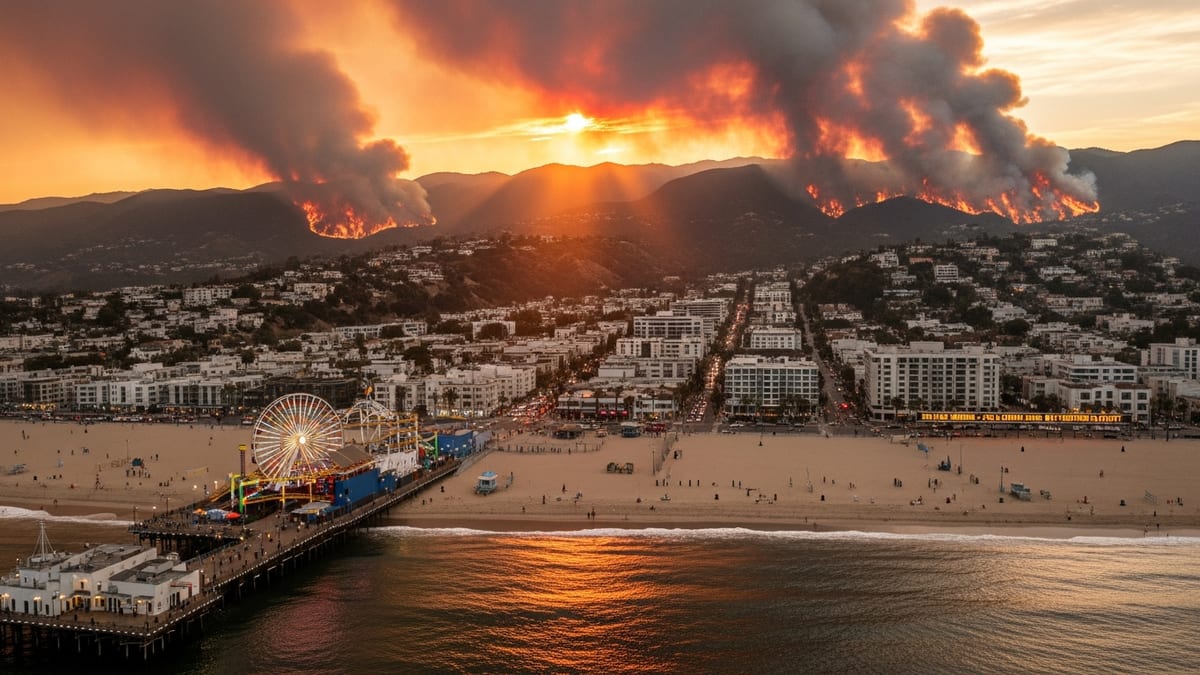
Smoke From Distant Fires Chokes Key Flight Corridors
The latest wave of disruption comes as smoke from extensive wildfires, including fires in Canada and the western United States, spreads over major population centers and busy air corridors. Satellite analysis released in mid July indicates plumes have traveled hundreds of miles, lowering visibility and degrading air quality across much of the Midwest and Northeast at various points this week.
Forecast discussions from the National Weather Service for several regions have highlighted wildfire smoke as a primary factor in reduced surface visibility, especially during the early morning and late evening hours when inversion layers tend to trap particulates closer to the ground. Publicly available information points to repeated episodes of hazy skies and localized visibility restrictions that can complicate approach and departure procedures at congested airports.
Environmental agencies have also noted deteriorating air quality values across affected regions, with some cities reporting air that is unhealthy for sensitive groups as fine particulate levels rise. While these readings primarily concern public health on the ground, the combination of low visibility and fluctuating ceiling heights has important implications for how flights are routed and spaced in the air.
Visual Flight Operations Constrained as Visibility Drops
The United States air traffic system relies on a combination of instrument flight rules and visual flight rules to move commercial, cargo, and general aviation traffic efficiently. When smoke significantly reduces visibility, aircraft that might ordinarily operate under visual procedures, particularly at smaller airports and in less congested airspace, must shift to instrument-based operations, increasing workload and reducing capacity.
Reports indicate that in some sectors, controllers have had to increase the spacing between aircraft and adjust arrival and departure rates as visibility deteriorates and pilots report haze or smoke along their routes. These adjustments can ripple quickly through the system, feeding into broader ground delay programs and flow restrictions that ultimately show up to travelers as late departures and missed connections.
For pilots flying under visual rules, especially in general aviation, wildfire smoke can limit the ability to maintain adequate visual reference with the terrain and other aircraft. Training materials and safety advisories emphasize that smoke can create deceptive conditions where horizontal visibility appears better than it is, or where distinct cloud and horizon lines become difficult to discern, heightening the need for caution and more conservative decision making.
Ground Delays, Flow Programs and Widespread Disruption
Real time status pages for the National Airspace System have shown a patchwork of ground delay programs, airborne holding, and departure slowdowns at various hubs in recent days, driven by a mix of convective storms and smoke related visibility concerns. Although not every delay is directly coded to wildfire smoke, the combination of weather and reduced visual conditions effectively constrains how many aircraft can safely depart and arrive in a given window.
On a typical summer day, the United States network handles tens of thousands of flights. When visibility falls and airports or en route sectors must temporarily reduce arrival or departure rates, even modest cuts can translate into thousands of delayed flights nationwide. Public flight tracking data for the current smoke episode suggest that more than four thousand services have operated behind schedule, with roughly one hundred cancellations concentrated at a handful of already busy hubs.
These cancellations often occur when cascading delays make it impossible for aircraft and crews to complete their planned rotations within duty limits, or when schedules leave little slack to absorb long ground stops. Low cost carriers and regional operators, which typically run tighter aircraft utilization, can be particularly exposed when strong smoke plumes coincide with afternoon thunderstorms or other disruptive weather.
Travelers Face Longer Journeys and Operational Uncertainty
For passengers, the operational consequences of wildfire smoke are most visible in longer journey times and unexpectedly tight or missed connections. Publicly accessible aviation dashboards and social media posts over the past 24 hours point to crowded gate areas, rolling departure estimates, and extended time spent on the ground while crews wait for updated flow times from air traffic facilities.
Travel advisers generally recommend that travelers build in additional time when severe weather or large scale air quality events are forecast, with a preference for morning departures that are less vulnerable to knock on effects from earlier disruptions. The current smoke related delays illustrate how quickly conditions can change, as visibility improves in one region while deteriorating in another, forcing airlines to rework aircraft routings on short notice.
Consumer resources hosted by transportation agencies emphasize that weather related delays, including those driven by smoke and reduced visibility, are usually categorized as outside an airline’s direct control. In practice this often limits the scope of compensation available to affected passengers, though carriers may still offer rebooking flexibility or travel waivers when large numbers of flights are impacted across multiple days.
Airports and Airlines Adapt to a Smokier Future
The latest disruptions come against a backdrop of increasingly frequent smoke intrusions into major North American cities in recent summers. Scientific research and recent government assessments link these episodes to longer and more intense wildfire seasons, with larger burn areas and greater production of fine particulates capable of traveling long distances at high altitude before settling into lower layers of the atmosphere.
Airports and airlines are gradually adapting operating procedures and contingency planning to account for more regular smoke related events. This includes refining visibility thresholds for using certain approach and departure procedures, expanding the use of instrument approaches where feasible, and improving coordination between meteorologists, dispatchers, and air traffic planners when model guidance suggests large smoke plumes will intersect busy routes.
Technology developers are also exploring advanced tools for early smoke detection and forecasting, using satellite imagery, improved atmospheric modeling, and machine learning techniques to better anticipate visibility impacts along flight paths. As those tools mature, analysts expect that more precise forecasts could help airlines make earlier schedule adjustments, potentially reducing the number of last minute disruptions when smoke again blankets key aviation corridors.