


Annecy in winter is quieter, colder and far more introspective than the bright, sunlit postcards suggest. The lake often appears steel-blue rather than turquoise, winds can bite along the quays, and in town you are as likely to meet cold rain as snow. Yet when the clouds lift, the surrounding Alps appear freshly dusted in white, and the medieval streets feel almost stage-lit in the short winter afternoons. For travelers who do not plan to ski, Annecy can still justify a weekend or short break, provided expectations are realistic and plans account for shorter days, limited boat schedules and reduced mountain access.
Get the latest updates straight to your inbox!
Understanding Annecy’s Winter Atmosphere
From roughly December to early March, daytime temperatures in Annecy are often in the low single digits Celsius, with nights dropping below freezing. Meteorological records from the local station show that snow does fall, but it does not always linger at lake level. Higher slopes around the basin, and nearby massifs like Semnoz and the Bauges, hold snow more reliably while the Old Town may see slush or bare cobbles. Many winter visitors are surprised that in town the dominant sensation is damp cold rather than deep snow, and that lake views are sometimes cloaked in low cloud.
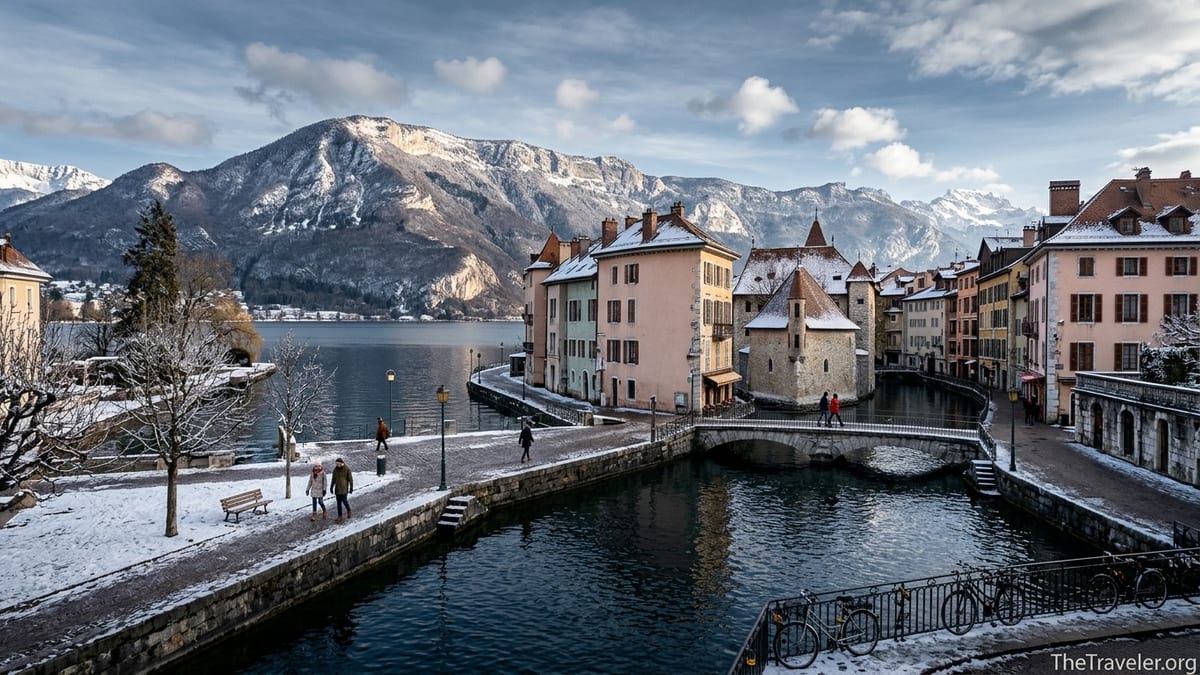
When conditions clear, the reward is sharp, theatrical light. The ramparts of the Château d’Annecy stand above terracotta roofs, and peaks such as La Tournette and the Dents de Lanfon often appear freshly powdered. The water itself turns dark, almost inky, which makes the pastel facades along the Thiou and the white arches of the Pont des Amours stand out in photographs. Sunsets come early, around 5 p.m. in January, so it is wise to structure outdoor walking in late morning and early afternoon, keeping evenings for museums and restaurants.
Winter also means far fewer visitors than July and August, when local authorities and residents alike complain of heavy crowding. Tourism data and local commentary emphasise that the Old Town feels calmer from November through March, aside from a brief spike during Christmas markets and the February school holidays. You can typically wander the canals without jostling, find seats in lakeside cafés, and enjoy morning walks on the promenade without the summer crush of cyclists and swimmers.
The trade-off for this quiet is that some seasonal attractions close or scale back. Beach facilities and outdoor watersports centres shut, paragliding shuttles run only in high season, and certain boat excursions move to a reduced timetable. However, core cultural sites, the main lake cruise company, and the city’s bus network all continue to operate year-round, making a non-ski winter stay feasible with a bit of planning.
Getting to Annecy in Winter: Rail and Airport Links
Annecy’s compact railway station, just across the street from the town bus hub, is the most practical entry point for winter visitors. National railway information confirms that several direct TGV inOui services link Paris Gare de Lyon and Annecy each day, typically taking around 3 hours 45 minutes. Regional and Intercités trains add indirect options via Chambéry or Lyon. Advance purchase fares on winter weekends often begin in the 40 to 60 euro range per person one-way in second class, though prices rise around Christmas, New Year and school holiday periods.
From Lyon, TER regional trains connect Lyon Part-Dieu with Annecy in roughly 2 hours, with multiple direct services daily even outside peak season. Fares on this route are usually lower than Paris, often around 25 to 35 euros one-way if booked ahead. For travelers flying long-haul, an itinerary routing through Paris with a same-day TGV to Annecy is workable, but winter rail works can affect weekend timetables. It is worth checking closer to departure to confirm exact departure times and platforms.
Geneva offers a useful alternative gateway for those mixing Switzerland and France. TGV Lyria timetables show frequent high-speed trains from Paris to Geneva, often around 3 hours, where you can connect to Annecy. Since the opening of the Léman Express network, there are direct regional services between Genève-Cornavin and Annecy operated in cooperation with French TER. These typically run at least every couple of hours and take about 1 hour 30 minutes, with more frequent segments between Geneva and Annemasse. Standard one-way fares from Geneva to Annecy usually fall in the 15 to 30 euro bracket depending on time of day and flexibility.
For those arriving by air, Geneva Airport is the most convenient hub. You can ride the frequent airport shuttle train to Genève-Cornavin in under 10 minutes, then connect to a direct regional train to Annecy. In winter 2025–2026, the Léman Express documentation describes a daily operating window roughly between 5 a.m. and half past midnight; this broad span helps late-arriving flights, though exact Geneva–Annecy frequencies vary by line and weekday. Dedicated coach transfers also exist but tend to be less frequent in low season and are often aimed at skiers heading to larger Alpine resorts. The train usually offers the most reliable and weather-resilient approach.
A Winter Walking Circuit Through Annecy’s Old Town and Lakefront
With limited daylight, a compact but immersive walking circuit makes sense for your first full winter day. Allow around three to four hours of gentle walking and visiting, not including café stops. Begin near the station and stroll ten minutes down Avenue de la Gare toward the Old Town. Within a few blocks you reach the Thiou, one of Europe’s shortest rivers, whose stone quays frame a classic first view of Annecy’s canals and pastel houses.
From here, head into the Vieille Ville’s narrow streets, taking Passage de l’Île toward the Palais de l’Île. This small, ship-shaped stone building, once a prison and courthouse, occupies a tiny island in the canal and effectively serves as the town’s emblem. Recent municipal information confirms that it opens all year except Tuesdays, with winter hours from 10:00 to 12:30 and 14:00 to 17:30 between October and May. Standard entry is currently indicated around 4 euros, with combined tickets covering both the Palais and the Château d’Annecy available at about 8 euros, valid for 48 hours.
After visiting the Palais, continue uphill through the Old Town toward the Château d’Annecy, a 10 to 15 minute cobbled climb from canal level. The former residence of the Counts of Geneva and later the Dukes of Savoy now houses the city’s main museum, displaying local art, lake ecology exhibits and a small alpine ethnography section. Tourist office data states that the Musée-Château keeps winter hours similar to the Palais, generally closing by early evening, with a full-price ticket around 6.50 euros from September to June. The viewpoints from the castle courtyard across the rooftops to the lake and mountains are among the best in town, especially on clear winter days with snow on the peaks.
Descending toward the water, aim for the Jardins de l’Europe, a lakeside park with mature trees and wide lawns. Even in winter, its paths are cleared and well-lit, though parts can be slick after rain or frost, so shoes with decent grip are essential. The walk from the Château through the gardens to the lakeshore takes roughly 20 minutes. Here you will find the photogenic Pont des Amours linking the gardens to the Pâquier, a wide open lawn that serves as Annecy’s communal living room in all seasons. In winter it becomes a vantage point for lake and mountain photographs rather than a picnic spot.
To finish the loop, follow the promenade south along the western lakeshore. Even on cold days you will see a few locals cycling on the adjacent path or jogging. Walk 20 to 30 minutes to the Marquisats area for a more open-angle view back toward the town, then either retrace your steps through the park or cut inland to return to the Old Town. At a relaxed pace, including visits to the two main museums and a lunch stop in the Vieille Ville, this loop fills most of a short winter day without requiring early starts or late-night walking in the cold.
Winter Museums, Boat Cruises and Lakeside Excursions
Annecy’s principal museums and the main cruise operator remain active through winter, but with adjusted hours and fewer departures. The city’s museum programme for the first half of 2026 confirms that the Château d’Annecy and Palais de l’Île follow winter opening schedules up to at least June, with free entry on the first Sunday of the month from October to May for all visitors. Standard admission outside these free days is set around 6.50 euros for the castle, 4 euros for the Palais, and 8 euros for a combined ticket, with small variations for reduced categories. Because closing days and public holiday schedules can change, it is wise to check the week’s timetable on arrival at the tourist office in the Old Town.
On the water, the Compagnie des Bateaux d’Annecy, based on Place aux Bois, states that it operates all year, including in winter and on public holidays. That does not mean summer-style frequencies. In practice, off-season schedules usually consist of a handful of short sightseeing cruises, often around one hour, and occasional lunch or dinner sailings concentrated on weekends and Christmas or New Year periods. In January or early February you might find only one or two daytime departures on weekdays. Typical adult prices for a one-hour winter cruise are in the region of 16 to 20 euros per person. Buying tickets a day or two before, once you see the weather forecast, is sensible, since strong wind or particularly poor visibility can lead to cancellations or reduced sailings.
For low-level lakeside excursions without skiing, local and regional buses make short trips to villages around the lake straightforward, though patience is required with winter timetables. The Grand Annecy mobility portal and the SIBRA network information explain that urban and interurban bus lines run year-round to both the west (Rive Ouest) and east (Rive Est) shores. Lines such as the 15A serve Sevrier, Saint-Jorioz and Duingt on the western side, while line 20 connects Annecy to Veyrier-du-Lac, Menthon-Saint-Bernard and Talloires-Montmin on the eastern side. In winter these lines run fewer services in the evenings compared with summer, so day trippers should take note of the last departures back to Annecy, often in the early-to-mid evening on weekends.
A practical itinerary for non-skiers is a half-day outing to Sevrier. From Annecy’s bus hub facing the station, the ride to Sevrier Mairie takes around 15 to 20 minutes. From there a short walk leads to the lakefront and the greenway cycle path that traces the old railway line. Even in winter, this path is popular with local walkers, and sections offer wide views back toward Annecy framed by snowy peaks. On the eastern side, a half-day in Veyrier-du-Lac or Talloires offers sunlit winter lakescapes; these villages sit on the sunnier shore, which residents note stays brighter on short days. Buses from Annecy Gare Routière to Talloires via Veyrier and Menthon usually take around 30 to 40 minutes. For all such excursions it is safest to plan a mid-afternoon return in case the final evening bus is cancelled due to weather or operational issues.
Mobil’Hiver: Reaching Semnoz and the Glières Without Skiing
For a change of scene and genuine snow underfoot, Grand Annecy’s Mobil’Hiver programme is the key. The latest official announcements confirm that for the 2025–2026 winter season, Mobil’Hiver runs from Saturday 20 December 2025 to Sunday 29 March 2026. Within this window, special winter mountain bus lines connect the city with nearby plateaus such as Semnoz and the Plateau des Glières. These services operate every day during the French school holidays of all three zones and on weekends outside school holidays, providing a predictable framework for planning a winter weekend visit.
Lines S1 and S2 link Annecy with Semnoz, the closest local mountain area. Route maps and timetable leaflets describe S1 as running from Vignières through central Annecy, including the Gare Routière, then climbing via Les Puisots to Semnoz Nordique. S2 offers a more direct route from the Annecy bus station to the Semnoz alpine area via Seynod and Quintal. Both are classed as SIBRA tariff lines, meaning that standard city bus tickets and passes apply, with winter mountain journeys included for subscribers who validate as on any urban bus. This makes a day’s mountain outing surprisingly affordable, often around a few euros per person for return travel.
For non-skiers, Semnoz offers snowshoeing circuits, short marked winter walking loops and wide viewpoints toward the Mont Blanc massif on clear days. The Semnoz access page specifies that winter buses drop passengers directly at the summit area, next to the Nordic zone, from which several signed snowshoe routes begin. Equipment rental is available from local shops around the summit car parks. These marked loops are intended for casual walkers and families and avoid avalanche terrain, but in bad weather they can still feel exposed, with strong wind and blowing snow. Travelers without winter hiking experience should remain on the waymarked routes and avoid venturing toward steeper, unpatrolled slopes or off-piste forest shortcuts.
The Plateau des Glières, reached by Mobil’Hiver lines G1 from Annecy and G2 from Évires, is higher and more remote. Grand Annecy documentation presents the Glières as a Nordic skiing and snowshoeing area rather than a downhill ski resort, with prepared cross-country tracks and snowshoe itineraries across a broad, treeless plateau. For non-skiing visitors, the attraction is a mix of open-snow landscapes, Second World War memorial sites and traditional farm-inns serving hearty Savoyard lunches. Again, you can rent snowshoes on-site and follow clearly signposted itineraries of one to two hours that avoid cornices or avalanche-prone slopes.
In both Semnoz and the Glières, it is crucial to distinguish between the gentle, signposted “raquettes” (snowshoe) circuits and the surrounding winter mountaineering terrain. Tourist and transport authorities emphasise that Mobil’Hiver makes the mountains accessible to the general public, but it does not transform all areas into safe promenades. Travel insurance, appropriate clothing, waterproof boots with good grip, and a conservative approach to changing conditions remain important. On days of strong wind, white-out or heavy new snow, a museum day in Annecy may be wiser than forcing a mountain excursion.
Where to Stay in Winter: Old Town, Station District or Lakefront
Annecy’s compact scale means that the choice of neighbourhood is less about distance and more about atmosphere, budget and noise tolerance. The Vieille Ville and immediate surroundings form the most atmospheric base, especially in winter when the canals and stone alleys feel like a film set after dark. Here you will find small independent hotels and guesthouses, often in historic buildings with exposed beams and limited car access. Rates in January and February are typically lower than peak summer, with mid-range doubles often hovering around 110 to 160 euros per night, though Christmas market periods can push prices higher for a few weekends.
Staying near the railway station suits travelers arriving late by train or needing an early departure. Several modern chain and mid-range hotels line the streets immediately opposite the station and the SIBRA bus hub. This area lacks the Old Town’s charm but compensates with convenience: you can roll your suitcase across one set of traffic lights to your hotel, and almost all local and regional buses depart from the same node. In winter, when early darkness, cold rain or ice can make even short walks feel longer, being within five minutes of both trains and buses has real advantages.
The lakefront zone between the Pâquier, Jardins de l’Europe and Albigny offers another personality: quieter residential streets, some higher-end hotels with direct lake views, and easy access to the promenade. Prices along the water often carry a premium relative to the station area, but off-season deals sometimes narrow the gap. For non-skiers planning to spend much of their time walking by the lake, taking boat rides and making short bus excursions to lakeside villages, this district can be ideal. Note, however, that in winter evenings the lakefront can feel somewhat deserted compared with the restaurant-rich lanes of the Old Town, so you may end up walking ten to fifteen minutes back toward the centre for dinner.
In all three areas, restaurant access is generally good in winter, but smaller establishments occasionally take seasonal breaks in January or February. The Old Town concentrates traditional Savoyard fare like fondue, raclette and tartiflette, while the streets between the station and the lake host more everyday bistros, pizzerias and Asian restaurants that serve locals year-round. Booking is rarely essential outside Saturday nights and holiday weeks, yet for popular spots on cold evenings it is still prudent to reserve earlier in the day.
Practicalities: Budget, Footwear and Accessibility
For a couple visiting in winter 2025–2026, a realistic mid-range weekend budget can be sketched using current published prices. Accommodation for two nights in a central three-star hotel outside major holidays might average around 260 to 320 euros in total. Return TGV tickets from Paris could cost in the region of 80 to 140 euros per person if booked several weeks ahead, so budgeting 250 to 300 euros for both travelers is cautious. Regional trains from Lyon or Geneva reduce this transport line significantly; for a Geneva–Annecy weekend by rail, two people might spend around 60 to 100 euros return in total.
Within Annecy, local transport is relatively inexpensive. SIBRA’s standard single tickets, valid across the urban network, are usually just a few euros, and Mobil’Hiver mountain buses to Semnoz or the Glières use the same tariff. Assuming four to six urban journeys plus one day-trip into the mountains over a three-day stay, a couple might allow 30 to 40 euros in total for local transport. Museum admissions, using a combined Château and Palais ticket and perhaps an additional exhibition, could add another 20 to 30 euros for two. A one-hour winter lake cruise for two would likely sit around 35 to 40 euros at current rates.
Food and drink costs vary widely, but a reasonable estimate for a couple choosing café breakfasts, simple lunches and one or two restaurant dinners is about 60 to 90 euros per day. That translates to roughly 180 to 270 euros over a two-night weekend. Summing these elements, a non-skiing winter trip for two from Paris might total around 750 to 950 euros for two nights and two and a half days, including rail, lodging, local transport, museum visits, a boat cruise and meals. From Lyon or Geneva, where long-distance rail is cheaper, the same stay could drop into the 550 to 750 euro range, assuming similar accommodation and dining choices.
Footwear and clothing deserve serious attention in winter. Streets in the Vieille Ville are cobbled and can be slick after rain, while lakeside paths and mountain plateaus can hide patches of ice. Waterproof ankle boots with firm soles and good tread make a bigger difference to comfort than almost any other purchase. Layering is key: a base layer, warm jumper or fleece, and a waterproof shell work better than one heavy coat, especially as you move between heated interiors and chilly streets. Many locals wear light down jackets under a rainproof shell to handle both wet and dry cold.
Accessibility is a mixed picture. The lakeside promenade from the Pâquier toward Albigny is generally flat and step-free, with benches at regular intervals, making it suitable for travelers with limited mobility provided surfaces are dry. The Jardins de l’Europe paths can be muddy or partially frozen but are still mostly level. The Old Town, by contrast, involves slopes, short staircases and irregular paving; the climb to the Château d’Annecy in particular is steep and cobbled. Wheelchair users or those with balance issues might prefer to admire the castle from lower viewpoints and focus on the canal-side streets, parks and boat trips.
Sample Winter Itineraries Without Skis
A two-day weekend works well for experiencing Annecy itself and a taste of the lake. On Day 1, aim for a mid-morning arrival by train, drop bags at your hotel and take the Old Town walking circuit described earlier, visiting the Palais de l’Île and the Château d’Annecy and lingering over lunch in a canal-side restaurant. Spend the late afternoon wandering through the Jardins de l’Europe and along the promenade as the light fades, then warm up with a Savoyard dinner in the Vieille Ville. If you visit during the Christmas period, allow time to explore any seasonal markets concentrated around the town hall and the lakeside.
Day 2 can focus on the broader lake. After breakfast, visit the Compagnie des Bateaux ticket office by the quai to check which winter cruises are running that day; in January there may be a single late-morning or early-afternoon departure. Take a one-hour sightseeing cruise if conditions are good, then use the afternoon for a short bus excursion to Sevrier, Veyrier or Talloires depending on bus timetables and your interest. Return to Annecy by late afternoon, allowing a final stroll through the Old Town before catching an evening train or spending a second night in town.
For a three-day stay that includes a weather-dependent mountain excursion, keep Day 1 as above. On Day 2, assume good conditions and ride a Mobil’Hiver S1 or S2 bus up to Semnoz. Stop by a summit rental shop to hire snowshoes, then follow one of the short marked loops, often between one and two hours, before enjoying a hot lunch in a mountain restaurant. Spend some time at the panoramic viewpoints, then catch a mid-afternoon bus back to Annecy rather than waiting for the final services, which may be crowded with skiers and subject to delays.
Day 3 can then revert to lake and village exploration, or, if weather forced you to postpone Semnoz on Day 2, become your mountain window instead. This flexibility is crucial in winter: heavy fog, wind or rain on the plateau can make the experience unpleasant or even unsafe, whereas Annecy’s museums and cafés provide easy ways to salvage a day. When planning, avoid prepaying non-refundable mountain activities; instead, treat Mobil’Hiver buses, rental shops and casual lunches as modular pieces you can slot into the clearest day of your stay.
Is Annecy Worth a Winter Visit Without Skiing?
For travelers willing to embrace short days, uncertain weather and a slower rhythm, Annecy can be very rewarding in winter even without skis. The combination of medieval streets, mountain silhouettes, a working year-round lake and accessible plateaus like Semnoz and the Glières offers more variety than many similarly sized towns. Non-skiers can fill two or three days with walking, museum visits, boat rides, short lakeside excursions and modest snowshoeing without ever buying a lift pass.
The best balance of conditions for non-ski travelers usually falls between late January and early March. In December the city is atmospherically decorated and Christmas markets provide extra interest, but crowds spike on certain weekends and snow cover in the mountains is not always assured. January can feel very quiet, with some restaurants and smaller hotels taking their annual break, yet mountain snow is more likely and accommodation prices are often at their lowest. February brings French school holidays, which increase demand on trains, hotels and mountain buses, but also improve the odds of snow-covered plateaus and extended winter opening hours.
If you expect sun-drenched lakeside picnics and turquoise water, winter Annecy will disappoint. If you come prepared for cold winds off the lake, grey days punctuated by sudden, crystalline clear spells and the possibility of rain at town level while the peaks sit snow-capped above, the city’s winter personality can feel quietly compelling. Thoughtful packing, flexible plans and attention to current rail, bus and Mobil’Hiver information are the keys to making a non-skiing winter weekend here both practical and memorable.