


Wise, still known to many travelers by its former name TransferWise, has become a default tool for moving money across borders. But the more its pricing evolves, the more confusion there is about what you actually pay to send, spend, and withdraw cash on the road. For frequent travelers, remote workers, and digital nomads, understanding Wise’s fees in 2026 is essential to decide when it is a money saver and when another option may be cheaper or more convenient.
Get the latest updates straight to your inbox!
How Wise’s fee model works in 2026
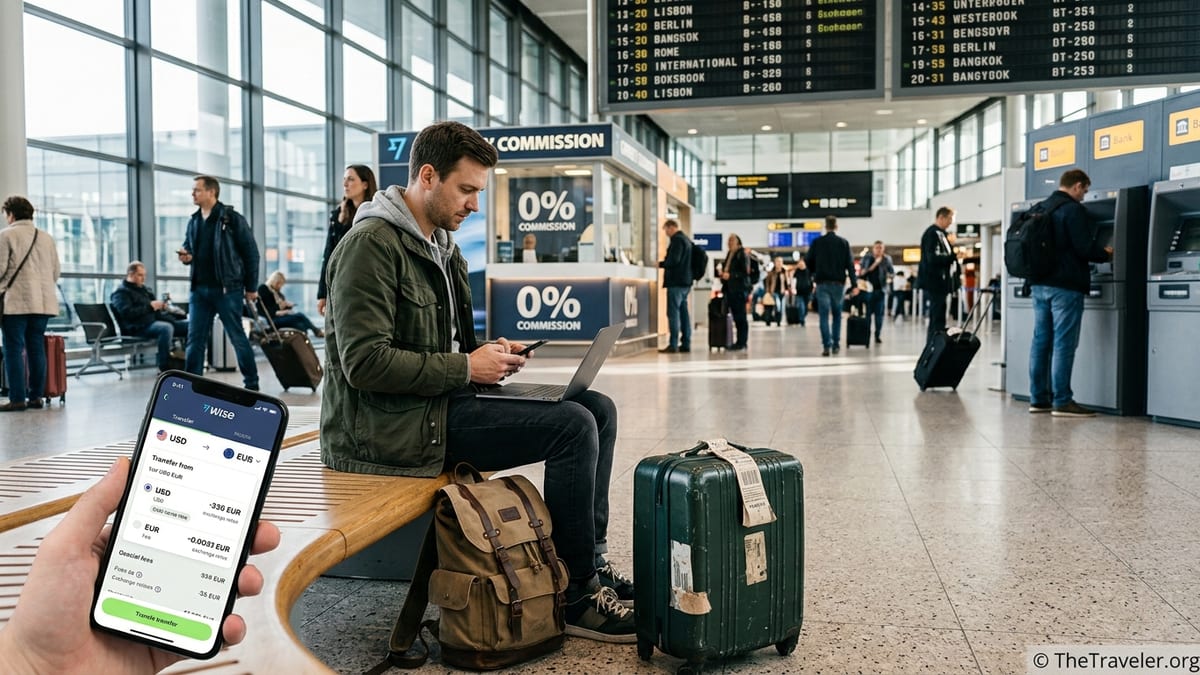
Wise builds its pricing around one idea: use the mid-market exchange rate and charge a separate, visible fee instead of hiding profit inside the rate. The mid-market rate is essentially the midpoint between the price banks are willing to buy and sell a currency for on international markets. Wise’s own materials emphasize that this is the “real” rate you might see on Google or financial data sites, with no markup added by Wise itself. In practical terms, that means when you send money from US dollars to euros, the exchange rate you see in the app should be extremely close to the real interbank rate at that moment, and Wise’s revenue comes from a transparent service fee.
On top of this rate, Wise usually charges a percentage-based conversion fee, plus a small fixed fee. Independent fee calculators that track Wise quotes in real time in 2026 typically show common currency routes like USD to EUR or USD to GBP falling somewhere in the rough range of about 0.45 to 0.65 percent of the amount converted, with some variation depending on how you fund the transfer. On a 1,000 dollar transfer from the United States to a bank account in Germany, a traveler might see something like a 5 to 7 dollar Wise fee plus a small fixed component, with the rest of the 1,000 converted at the real mid-market rate.
Funding method also matters. Paying Wise by cheap domestic transfer methods such as ACH in the United States tends to keep overall costs down. Paying by credit card is usually more expensive because Wise passes on card network costs as a higher fixed or percentage fee. Wise’s own fee update documents show complex tables by currency and pay-in method, which is why the company and independent comparison sites alike encourage users to always look at the live quote before confirming a transfer. For travelers, the key takeaway is that there is no single “Wise fee” but rather a transparent formula that depends on which currencies you are converting, how you pay in, and how the recipient gets the money.
Another important aspect is that Wise does not usually charge a separate monthly fee for personal multi-currency accounts. Opening an account and holding balances in various currencies is free in most cases, and Wise earns its money when you actually use the account: sending money abroad, converting one currency into another, or withdrawing cash with the Wise debit card.
What you pay to send money abroad
For many travelers, the first encounter with Wise is a simple international bank transfer. A common scenario in 2026 is a US remote worker paying rent for a Lisbon apartment in euros, or a parent sending tuition money to a child studying in the Netherlands. In a typical example, sending 1,000 US dollars from a US-based Wise account to a euro bank account in Portugal using ACH as the funding method often yields a total Wise fee in the area of a few dollars, with 995 dollars or more converted to euros at the mid-market rate. The exact figure shifts daily with exchange rates and fee tables, but it is usually far below the costs of a traditional bank wire that might charge a 30 to 45 dollar international wire fee plus a 2 to 3 percent exchange rate markup.
For less common currency routes or where Swift network fees come into play, costs can be higher. Wise’s own help center examples for US dollar transfers to some countries outside the United States show situations where a traveler might pay a Wise service fee plus an additional Swift payout fee. In some corridors with correspondent banks involved, Wise may estimate that intermediary charges will apply and build these into an all-in price, which can push the cost of sending 1,000 dollars closer to double digits. Even then, because Wise sticks to mid-market rates, the total can still compare favorably with many banks that add several percent to the exchange rate on top of wire fees.
There are also use cases where Wise is nearly free. Transfers between Wise users in the same currency are often free or close to it. For example, if two long-term travelers both hold US dollar balances inside Wise, sending 100 dollars from one to the other typically involves no conversion and no meaningful fee, making it a simple way to split a rental car bill or reimburse a friend. Similarly, when you receive local payments in the same currency to your Wise bank details, such as a euro SEPA payment into your Wise euro account or a US domestic ACH payment into your Wise US routing and account number, Wise does not usually charge a receiving fee.
The decision point for travelers is not whether Wise is cheaper than nothing, but whether it is cheaper than alternatives on a given route. For major travel corridors such as US to eurozone, US to the United Kingdom, or euro to Thai baht, comparison tools that track Wise, banks, and competitors like PayPal consistently show Wise at the lower end of the cost spectrum, especially for medium-sized transfers like a 1,500 dollar rent payment or a 3,000 dollar tuition transfer. For very large sums, such as moving 50,000 dollars to purchase property abroad, specialist brokers that negotiate custom spreads can sometimes come close, but they usually require more paperwork and less app-based convenience.
Card spending and ATM withdrawals: where fees add up
Wise’s debit card is one of its most popular travel tools because it lets you spend directly from your multi-currency balances at the mid-market rate when conversion is needed. In everyday card use, such as tapping to pay for coffee in Berlin, paying a restaurant bill in Mexico City, or buying train tickets in Italy, Wise typically does not add an extra foreign transaction fee. As long as you hold enough of the local currency in your Wise account, or allow the card to auto-convert from your primary currency at Wise’s normal conversion fee, there is usually no additional card-specific markup on the rate. This makes it attractive compared with many US bank debit cards that layer a 2 to 3 percent foreign transaction fee on every purchase abroad.
The headline cost for the card itself is modest. In 2026, US-based travelers generally pay around 9 dollars as a one-time fee to order the physical Wise card. There is no ongoing monthly card subscription for personal customers in most markets. For someone planning a multi-week trip to Europe, that 9 dollar one-off can be recovered quickly if it replaces a traditional bank debit card that would otherwise add a few percent on each foreign purchase. For example, a traveler spending 2,000 dollars equivalent on hotels, restaurants, and train tickets might save 40 to 60 dollars in avoided foreign transaction fees compared with a card that charges 2 to 3 percent.
ATM withdrawals are more complicated and are where recent changes have drawn criticism from heavy Wise users. Wise’s own pricing page for US-issued cards in 2026 still advertises a small amount of fee-free withdrawals each month, for example up to a dollar equivalent of a couple of hundred US dollars before Wise’s own withdrawal fee kicks in. After that threshold, Wise charges a fixed fee per withdrawal plus a percentage of the amount, such as around 1.95 dollars plus roughly 2 percent for US-issued cards, with the exact figures varying slightly by country of issuance and recent updates. Help center documents for some markets, such as cards issued in Australia or New Zealand, describe new structures where withdrawals up to the equivalent of 400 local dollars are free from Wise’s side and amounts above that are charged a percentage fee in the region of 2.69 percent.
Real-world traveler reports in early 2026 highlight the impact of these changes. A New Zealand user withdrawing just over the fee-free threshold on a trip to Southeast Asia might find that taking the equivalent of 600 New Zealand dollars in local currency from an ATM now triggers a fee in the ballpark of 2.69 percent on the amount above 400, plus any fixed fee the ATM operator itself imposes. In practice, that could mean paying more than 5 dollars to 10 dollars in Wise fees on top of a local ATM charge of a few dollars per withdrawal. For cash-heavy destinations like parts of Indonesia or the Philippines, where travelers may need to withdraw more and ATMs often add their own surcharges, the combined costs can now rival or exceed those of some traditional bank cards or local cash exchange offices.
For this reason, seasoned travelers are increasingly using Wise’s card primarily for card payments and limiting ATM use. Many choose to withdraw larger amounts less often to keep the ratio of fixed fees to cash withdrawn manageable, or use Wise to transfer money into a local bank account and then withdraw cash with that bank’s card. Others pair Wise with a separate debit or credit card that offers genuinely fee-free foreign ATM withdrawals up to a higher limit, using Wise mainly to receive and hold foreign currencies and settle card purchases at fair rates.
Hidden costs and gotchas travelers should watch
Although Wise is very transparent about its own fees, travelers can still encounter extra costs that are not immediately obvious inside the app. The most common example is third-party ATM charges. Wise might tell you that the first 250 dollars of withdrawals in a month from your US-issued card are free from Wise’s side, but the ATM operator in Spain or Thailand can still add its own fee of, say, 3 to 6 dollars per withdrawal. Wise cannot control this, and it usually shows up on the receipt or screen at the ATM, often in a foreign language. For a traveler withdrawing small amounts repeatedly, those local fees can add up to more than Wise’s own charges.
Another subtle cost comes from how some countries treat foreign-issued debit cards in their domestic payment networks. In New Zealand, for example, some merchants treat international debit cards as if they were credit cards and pass on a 2 to 3 percent surcharge. A traveler using a New Zealand-issued Wise card to pay at these merchants might find that, despite Wise itself not charging a foreign transaction fee, the merchant surcharge still appears on the receipt. This is not a Wise fee but it affects the total cost of the transaction, and in some destinations similar surcharges apply to any international card, regardless of the provider.
There are also occasional Swift and correspondent bank fees that are outside Wise’s direct control. On some corridors, especially when sending US dollars to certain banks outside the United States where local bank account networks are less integrated, Wise’s help pages indicate that correspondent banks in the Swift chain may deduct their own fee from the transferred amount. Wise increasingly tries to predict and bundle these into the up-front price, but in some cases the recipient may still receive slightly less than expected if an intermediary bank charges an unexpected fee. Travelers sending rent or tuition abroad should check whether their landlord or university prefers a specific local payout method, such as a domestic SEPA transfer in euros, to avoid these extra Swift charges.
Finally, because Wise relies on the real-time foreign exchange market, exchange rates themselves can move between the moment a traveler locks in a quote and the time the transfer is funded. Wise often gives a guaranteed rate window, for example a set number of hours in which you must complete your ACH payment to keep the quoted rate. If you miss that window, the transfer will be recalculated at the current market rate, which could be better or worse. This is not a fee in the strict sense, but for large amounts converted on volatile days, the difference can feel like a cost and should be considered when timing large transfers.
Comparing Wise to banks, PayPal, and travel cards
To understand whether Wise’s fees are worth it, it helps to compare them to the real alternatives travelers use. Traditional banks in the United States frequently charge 30 to 50 dollars for an international wire transfer, plus an exchange rate markup that can silently add another 2 to 4 percent to the cost. On a 1,000 dollar transfer to Europe, this can mean paying 50 dollars in visible fees plus losing 20 to 30 dollars in the rate. By contrast, a typical Wise transfer on the same route might cost under 10 dollars total and use the mid-market rate, meaning most of the 1,000 dollars actually arrives.
PayPal is another everyday alternative that many travelers instinctively use for cross-border payments. Independent comparisons in 2026 generally show PayPal charging a combination of a percentage fee and an exchange rate markup that often totals 3 to 5 percent or more for international person to person transfers and cross-currency purchases. For example, a freelance graphic designer in Mexico getting paid 500 US dollars from a US client via PayPal might see around 20 to 25 dollars disappear to fees and rate spreads. The same client paying 500 dollars through Wise to the designer’s Mexican bank or Wise balance would often result in closer to 5 to 7 dollars of fees and a fair rate, leaving significantly more pesos in the designer’s account.
When it comes to card spending, Wise competes mainly with two categories: traditional bank debit cards and specialist no foreign transaction fee credit or debit cards. Many US bank debit cards still add 2 to 3 percent on every foreign transaction and sometimes charge a separate fee for foreign ATM withdrawals. A traveler spending 3,000 dollars over two weeks in Japan on such a card could easily pay 60 to 90 dollars in fees. Using Wise’s card instead, with no foreign transaction fee on purchases and a small conversion fee around half a percent built into the currency exchange, might reduce that to around 15 dollars, assuming most spending is on the card and ATM use is limited.
Dedicated travel credit cards, especially those with no annual fee and no foreign transaction fee, complicate the picture. A widely available US travel credit card might charge no fee on foreign purchases and give card network exchange rates that are already quite close to mid-market, sometimes within 0.5 percent. For purchases, such a card can be as cheap as or cheaper than Wise, and it may add rewards like airline miles or cashback. However, these cards tend to be poor choices for cash withdrawals, as cash advances often trigger heavy interest and fees from day one. A common strategy among seasoned travelers is to use a no foreign transaction fee credit card for nearly all purchases and carry Wise as a backup for small cash withdrawals and for receiving or sending money in foreign currencies.
In the business and freelancer world, Wise’s advantage is more pronounced. Receiving foreign payments into a traditional bank often incurs incoming wire fees and less favorable rates, while Wise’s local receiving details in currencies like USD, EUR, and GBP usually allow overseas clients to pay as if they were making a domestic transfer. A European client can send a euro SEPA payment to a US-based freelancer’s Wise euro account at local cost, and the freelancer can then convert at Wise’s mid-market based fee structure, which is often materially cheaper than having the client send an international wire directly to a US bank.
When Wise is worth it, and when it is not
For frequent travelers and digital nomads, Wise tends to shine in a few clear scenarios. The first is regular cross-border payments such as rent, tuition, or family support, where the amounts are substantial enough that a few percentage points in savings per month add up quickly. Someone paying 1,500 euros in rent from a US income every month might save hundreds of dollars over a year by avoiding bank markups, even if Wise’s fees have crept up slightly in some corridors. The second is multi-currency living, where you receive income in one currency and spend in several others. Holding balances in Wise and converting only when needed at transparent rates is often simpler and cheaper than juggling multiple national bank accounts.
Wise is also particularly useful for those who need local account details in markets where they do not have residency. A US citizen working remotely across Europe can use a Wise euro IBAN and UK sort code to receive salaries or client payments as if they had local accounts in those regions, without paying monthly bank maintenance fees or facing extensive paperwork. This kind of flexibility is hard to replicate with traditional banks and can justify Wise’s modest account and card fees on its own.
On the other hand, there are scenarios where Wise is less compelling. Travelers who rarely need to send money internationally, and who mainly spend on a good no foreign transaction fee credit card, may find that Wise adds complexity without much extra saving. If your only foreign use each year is a one week vacation where you charge almost everything to a strong travel credit card and withdraw just a small amount of cash from ATMs, the benefit of setting up Wise, ordering the card, and learning its interface may be limited. Similarly, for large cash withdrawals in countries where ATM operators add steep fixed fees, Wise’s own withdrawal charges plus those third party surcharges can make it a relatively expensive way to get cash.
There are also travelers who have access to premium bank accounts that already waive foreign ATM fees and foreign transaction markups. Some high end US checking accounts or brokerage-linked debit cards reimburse all ATM fees worldwide and use near mid-market exchange rates. For these users, Wise’s main advantage narrows to receiving and sending foreign transfers rather than card spending. In such cases, Wise may be worth keeping as a specialized tool for international transfers, while the premium bank card handles day to day spending and cash.
Ultimately, deciding whether Wise is worth it comes down to your travel and money pattern. If you frequently cross borders, get paid in one currency and live in another, or support family abroad, the transparency and flexibility of Wise usually deliver more value than the modest fees you pay. If your travel is occasional, your bank card is already traveler friendly, and you mostly pay by card, Wise might be an optional extra rather than an essential tool.
The Takeaway
In 2026, Wise remains one of the most transparent players in cross-border money management, but it is no longer the ultra cheap outlier it once was in every category. Its core promise still holds: you get the real mid-market exchange rate and see your fees clearly before you hit send. For standard international transfers and everyday card spending, this often works out substantially cheaper than traditional banks or PayPal, especially along major travel corridors.
The tension lies in areas where Wise has raised prices, particularly ATM withdrawals. New fee structures that cap fee free cash withdrawals and add percentage charges above relatively low thresholds make heavy ATM use a lot more expensive than it used to be. Travelers who rely heavily on cash or who visit countries with high local ATM surcharges need to budget for this or consider pairing Wise with another card for cash.
For many modern travelers, remote workers, and globally mobile families, Wise is still worth it as a central piece of the toolkit: a place to receive and hold multiple currencies, a fair way to convert between them, and a convenient card for everyday purchases abroad. It rarely makes sense as the only financial tool in your wallet, but as part of a small lineup that includes at least one good no foreign transaction fee credit card and possibly a local bank account in your home base, Wise can significantly cut the hidden costs of living a cross-border life.
FAQ
Q1. Does Wise charge a monthly fee for personal accounts?
Wise does not generally charge a monthly maintenance fee for personal multi-currency accounts in 2026. Opening an account and holding money in multiple currencies is usually free. You pay only when you use paid services such as sending money abroad, converting currencies, ordering a physical debit card, or exceeding free ATM withdrawal limits.
Q2. How much does it cost to send 1,000 US dollars to Europe with Wise?
The exact fee changes with currency pairs and funding methods, but for a common route like USD to EUR funded by ACH, many travelers see Wise fees of only a few dollars, often in the rough range of around half a percent of the amount converted plus a small fixed fee. This is typically much cheaper than a traditional bank wire that may charge both a hefty transfer fee and an exchange rate markup.
Q3. Is spending with the Wise card abroad cheaper than using my regular bank card?
For many travelers, yes. Wise uses the mid-market exchange rate with a small, transparent conversion fee instead of adding a hidden markup. Many traditional bank debit cards add a 2 to 3 percent foreign transaction fee on every purchase. If your home bank still charges these, using the Wise card for everyday foreign purchases can usually save money, especially on longer trips or higher spending.
Q4. Are ATM withdrawals with Wise still a good deal in 2026?
ATM withdrawals with Wise can still be reasonable for small amounts, but they are less generous than in earlier years. Wise typically offers a limited fee-free allowance each month and then charges a combination of a fixed fee and a percentage of the amount withdrawn. In some markets, amounts above a threshold such as 400 local dollars attract a fee around 2 to 3 percent. When you add possible local ATM operator surcharges, heavy cash users may find Wise withdrawals noticeably more expensive than before.
Q5. Does Wise ever hide fees in the exchange rate?
Wise markets itself on not hiding fees in the rate, and its materials state that it uses the real mid-market exchange rate without markup. Independent checks in 2026 still broadly support this approach. Instead of altering the rate, Wise shows a separate service fee before you confirm a transfer or conversion. That said, other players in the payment chain, such as correspondent banks or ATM operators, can still add their own charges outside Wise’s control.
Q6. When is Wise not the best option for travelers?
Wise may not be the best option if you rarely travel, mostly pay with a strong no foreign transaction fee credit card, and seldom need to send money internationally. In that case, the savings from Wise may be modest compared with the simplicity of sticking to one good card. Wise can also be less attractive for large cash withdrawals in places where ATMs add high fixed fees, or if you already have a premium bank account that fully reimburses foreign ATM charges and uses near mid-market exchange rates.
Q7. Can I receive my salary or freelance income into Wise without extra fees?
In many cases, yes. Wise provides local account details in several currencies, such as US routing and account numbers, a European IBAN, and UK bank details. Employers or clients in those regions can usually pay you via domestic bank transfer, which often costs them little or nothing. Wise generally does not charge for receiving these local transfers into your account, and you only pay a fee when you later convert the money or send it onward in another currency.
Q8. How does Wise compare with PayPal for international payments?
PayPal typically charges higher overall costs for cross-border payments, combining explicit fees with an exchange rate markup that can be several percent. Wise, by contrast, uses the mid-market rate and charges a separate, plainly visible fee. For a freelancer receiving 500 US dollars from a foreign client, Wise often leaves noticeably more in their local currency account after conversion than PayPal would, especially on regular or larger payments.
Q9. Is it worth ordering the Wise debit card if I already have a travel credit card?
For many travelers, the answer is still yes, because the Wise card fills gaps that credit cards do not. Even if you have a no foreign transaction fee credit card for most purchases, the Wise debit card can be useful for modest cash withdrawals, for places that do not accept credit cards, or for managing separate travel budgets in specific currencies. The one-time card issuance fee is relatively low, so regular travelers often recover that cost quickly through lower foreign transaction expenses and more flexible money management.
Q10. How can I minimize Wise fees when traveling?
You can reduce Wise costs by funding transfers with cheaper methods like ACH instead of credit cards where possible, using Wise’s card mainly for purchases rather than frequent small ATM withdrawals, and withdrawing cash in slightly larger but less frequent amounts to dilute fixed ATM fees. It also helps to receive payments locally in the same currency when you can, and only convert when necessary, so that you take advantage of Wise’s transparent mid-market rates without paying for unnecessary conversions.